ClubMom Outcomes from a non-traditional model of health education - - PDF document

clubmom
SMART_READER_LITE
LIVE PREVIEW

ClubMom Outcomes from a non-traditional model of health education - - PDF document

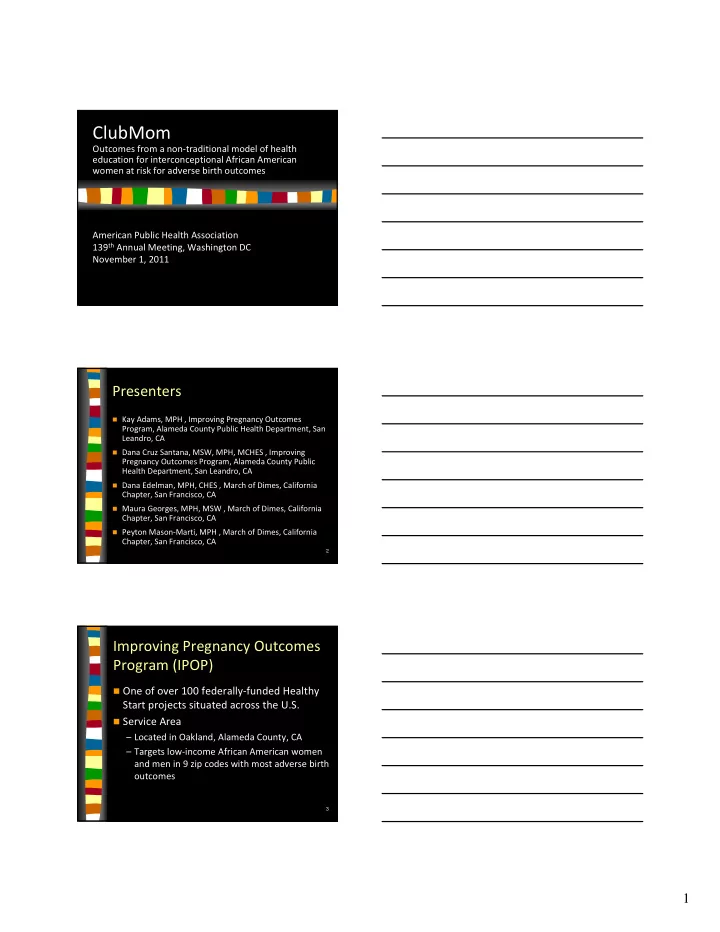
ClubMom Outcomes from a non-traditional model of health education for interconceptional African American women at risk for adverse birth outcomes American Public Health Association 139 th Annual Meeting, Washington DC November 1, 2011


slide-1
SLIDE 1

1

ClubMom

Outcomes from a non-traditional model of health education for interconceptional African American women at risk for adverse birth outcomes American Public Health Association 139th Annual Meeting, Washington DC November 1, 2011

2

Presenters

Kay Adams, MPH , Improving Pregnancy Outcomes

Program, Alameda County Public Health Department, San Leandro, CA

Dana Cruz Santana, MSW, MPH, MCHES , Improving

Pregnancy Outcomes Program, Alameda County Public Health Department, San Leandro, CA

Dana Edelman, MPH, CHES , March of Dimes, California

Chapter, San Francisco, CA

Maura Georges, MPH, MSW , March of Dimes, California

Chapter, San Francisco, CA

Peyton Mason-Marti, MPH , March of Dimes, California

Chapter, San Francisco, CA

3

Improving Pregnancy Outcomes Program (IPOP)

One of over 100 federally-funded Healthy

Start projects situated across the U.S.

Service Area

– Located in Oakland, Alameda County, CA – Targets low-income African American women and men in 9 zip codes with most adverse birth

  • utcomes
slide-2
SLIDE 2

2

4

IPOP Goals

Reduce infant mortality Improve birth outcomes including low birth

weight and preterm births

Empower participants to adopt healthy

lifestyles and to address underlying psychosocial factors impacting perinatal health

5

IPOP Intervention Strategies

Case management Group health education Fatherhood/male involvement services Outreach, information & referral Health awareness campaign Peer health leadership Provider training Local health systems change

6

Common Issues Faced by Residents

Poverty/ income instability Stress & depression Tobacco, alcohol & substance use Lack of employment & job training Under-resourced schools Food insecurity and ‘food deserts’ Housing instability Fragile family structure Exposure to violence

slide-3
SLIDE 3

3

7

Participant Assets

Resiliency—“handle setbacks, persevere and

adapt even when things go awry”

‘Make-something-out-of-nothing’ attitude Forgiving spirit Teachable, open-minded, hungry for information Value their children’s education Hopeful—want more for the next generation ‘Bite the bullet’—tolerate human service systems

  • n behalf of their children/families

8

IPOP Challenges

Needed more robust interconceptional (IC)

programming to mitigate trend of women fading away after birth of their infants (most likely due to program’s overemphasis

  • n pregnancy)

Targeting IC period (in addition to prenatal)

is the direction of MCH for improving birth

  • utcomes

9

IPOP Challenges

How can we be sure that we are meeting

their real health information needs?

How should we market and publicize

services? engage and retain participants?

How can we partner with the existing

natural helping system?

slide-4
SLIDE 4

4

10

Needs Assessment Findings

Priority health concerns

– Self: “Having enough energy to get through the day” – Children: “Will they do as I say, or do as I do” due to concern over their

  • wn health behaviors

11

Other concerns – Unstable housing & income – Live in a “food desert” (ex. 45 blocks between grocery stores in East Oakland); low-control

  • ver food choices

– Fear for safety (at the interpersonal level with partner & at the community level)

– unsafe home + unsafe neighborhood = where can mom and baby rest, thrive and feel safe?

Needs Assessment Findings

12

Needs Assessment Findings

Desired health information

– Do not limit health education to

  • nly the physiological aspects of

incubating a fetus – Prepare women for motherhood psychosocially & economically in addition to medically

slide-5
SLIDE 5

5

13

Want a group experience Want to attend fun events that are

educational—a respite for moms

– i.e., Should not feel like school

Want free food and childcare at all events Want events to be held often and in their

neighborhoods

Needs Assessment Findings

14

  • Do not want events to be held in

churches

  • Want ongoing relationships with

staff—“a health education home”

  • Want incentives in the form of gift

cards, housewares, and items for mothers & babies

Needs Assessment Findings

15

Needs Assessment Findings

Consumers want programming

implemented in a way that is non- stigmatizing – No “stress reduction” workshop – No “depression” support group – No “birth control” class – No “at-risk for poor outcome” label

slide-6
SLIDE 6

6

16

Want to share their individual pregnancy

and parenting experiences with younger, less experienced women

Printed materials must be

– Brief, yet interesting – Colorful and attractive – Provide resource and referral information so one can take action

Needs Assessment Findings

17

Building a Health Education Home

March of Dimes, CA Chapter Community Grant

funding in 2009-2010 allowed IPOP to expand from 1 to 3 venues

Capitalize on existing relationships Case

manager as ClubMom facilitator, peer volunteers

Neutral neighborhood location near public transit

hubs

Food and bus tickets were provided along with

highly desired participant incentives (grocery gift cards, raffle prizes, etc).

18

MPH-level perinatal health educator develops

monthly session plans in consultation with ClubMom facilitators through team meetings

Three monthly rotating themes

– Mental health – Healthy eating/active living – Relationships

All ClubMom venues have same monthly topic;

makes coordination and publicizing ClubMom more efficient

Building a Health Education Home

slide-7
SLIDE 7

7

19 20

Peer Health Leaders

Peer educators are needed to propagate staff

  • utreach efforts

Extend services to neighborhood niches with

more trained eyes, ears, hands, and feet

Mutual enhancement of formal and informal

helping systems

Serve as volunteer staff during ClubMom sessions

– $50 grocery gift card per Peer Health Leader

21

ClubMom Components

Three monthly venues

– 1 facilitator – 2―3 peer health leaders – Licensed MFT – Guest speakers (ex. Life coach, esthetician ) – Childcare and/or play area

slide-8
SLIDE 8

8

22

ClubMom Agenda

Moments of informal, familial socializing woven

throughout session

Facilitator shares key perinatal health messages &

guides discussion

Guest speaker and/or interactive group activity Licensed MFT triages difficult/painful moments &

provides closure on topic

Related resource highlight

23 24

slide-9
SLIDE 9

9

25

Family Health Holiday Celebration

26

ClubMom Objective

Positively change the CONTEXT in which

young African American mothers make decisions around their health and related behaviors so that it includes:

– Social SUPPORT – Health INFORMATION – Knowledge of RESOURCES – Health-seeking MOTIVATION

Evaluation foci

27

ClubMom Evaluation

Evaluation focused on measuring the

change in this context

– Shift from traditional health education which targets individual behavior change

Pre-test at enrollment, followed by post-

test at ten-months

143 women participated in ClubMom

sessions over 10 months

slide-10
SLIDE 10

10

28

Evaluation Results

Twice as many women felt they had more

health information about stress and depression (35% 61%)

Almost three times as many women felt

they had more information about eating healthier and exercising (26% 65%)

Number of women who reported an

increase in social support for relationship issues increased (70% to 91%)

29

Participants indicated that they were more

likely to seek help for:

– stress & depression (65% 78%) – healthier heating/exercise (58% 65%) – relationship issues (57% 91%)

Twice as many women could name a

provider where they could get help and services about healthier eating & exercise (39% 78%)

Evaluation Results

30

ClubMom Challenges

‘Victim of our success’ Need a larger

family-friendly facility, more resources & staffing

Stretching staff strengths to their limit Facilitator dynamics Why me? Being

chosen to do the work; worthiness

Difficult to implement within a county

government bureaucracy

slide-11
SLIDE 11

11

31

Lessons Learned

Takes one year just to establish a stable

cohort of participants for a ClubMom venue

– Programmatically – Get visibility in the word of mouth network

Interventions must be mediated through

trusting and ongoing relationships with staff “a health education home”

32

Lessons Learned

Must blend health promotion with life skills

development, for example:

– Repairing your credit is a health issue for ClubMom participants because it is related to stress and depression – Knowing how to go back to school while receiving public assistance is a health issue because it is related to future opportunities and stability for mom and baby – Understanding ones relationships are health issues because it allows women to be aware of their intentions for having sex, which impacts intended and unintended pregnancy

33

Future Directions

Current plans to expand ClubMom and launch

ChefMom

ClubMom texting campaign & social media

– Culturally-specific positive affirmations, health promotion messages, event invitations/reminders & resource announcements

Add a fourth venue ClubMom Mental Health

Support Group facilitated by licensed therapist

slide-12
SLIDE 12

12

34

“If you build it [together], they will come.”

―Teddy Roosevelt

The End

Questions?

36

Program Contact Information

Improving Pregnancy Outcomes Program Alameda County Public Health Department 1000 San Leandro Blvd., Suite 100 San Leandro, CA 94577 (510) 618-2080 www.acphd.org/ipop