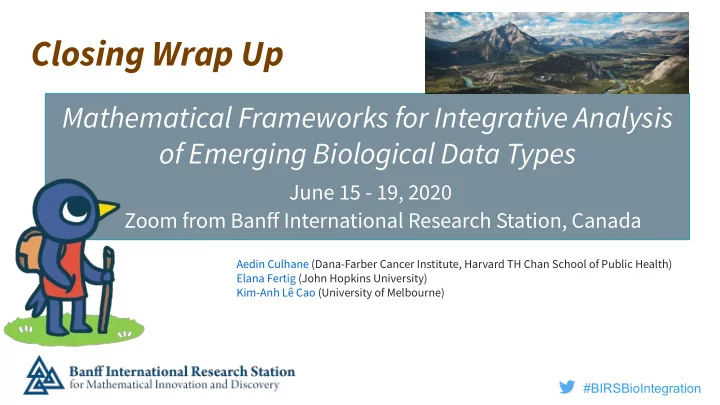
Closing Wrap Up Mathematical Frameworks for Integrative Analysis of - - PowerPoint PPT Presentation

closing wrap up
SMART_READER_LITE
LIVE PREVIEW

Closing Wrap Up Mathematical Frameworks for Integrative Analysis of - - PowerPoint PPT Presentation

Closing Wrap Up Mathematical Frameworks for Integrative Analysis of Emerging Biological Data Types June 15 - 19, 2020 Zoom from Banff International Research Station, Canada Aedin Culhane (Dana-Farber Cancer Institute, Harvard TH Chan School of


slide-1
SLIDE 1

Mathematical Frameworks for Integrative Analysis

  • f Emerging Biological Data Types

June 15 - 19, 2020

Zoom from Banff International Research Station, Canada

Closing Wrap Up

#BIRSBioIntegration

Aedin Culhane (Dana-Farber Cancer Institute, Harvard TH Chan School of Public Health) Elana Fertig (John Hopkins University) Kim-Anh Lê Cao (University of Melbourne)

slide-2
SLIDE 2

Goals of this workshop

Multi-omics integration of single cell data

○ is an active and emerging field ○ May provide insight that cannot be obtained from single datasets ○ lacks established performance benchmarks, ○ gold standard datasets, assessment standards.

Bring together interdisciplinary computational scientists

○ to examine cutting edge techniques for integrative analysis of diverse multi-omics. ○ Provide & assess open source resources for multi-platform analysis ○ Formulate goals and future directions to advance multi-omics analysis

Products: Guidelines, build collaboration, code & datasets, a white paper

#BIRSBioIntegration

Transparency Collaboration Open science Fairness Inclusion

slide-3
SLIDE 3

#BIRSBiointegration Community

#BIRSBioIntegration

3 challenging data challenges 16 contributed talks focusing on analysis 5 keynotes 9 Brainstorming sessions Data and GitHub code shared 339 Commits to manubot 156 Members, 16 Active Channels on Slack

slide-4
SLIDE 4

https://twitter.com/hashtag/BIRSBiointegration

#BIRSBioIntegration

Outreach Beyond Banff

Live Stream http://www.birs.ca/live

slide-5
SLIDE 5

Emerging Research: Five keynote speakers

  • Prof. GC Yuan

Dana-Farber Cancer Institute, Harvard TH Chan School of Public Health

  • Prof. Bernd

Bodenmiller

University of Zurich

  • Prof. Oliver Stegle

German Cancer Research Center & EMBL

  • Prof. Susan

Holmes

Stanford University

  • Prof. Vincent Carey

Harvard Medical School, Brigham & Women’s Hospital

Mon Tues Wed Thurs Fri

#BIRSBioIntegration

slide-6
SLIDE 6

Contributed talks from hackathon participants

sc seq-FISH Alexis Coullomb Hang Xu Dario Righelli Amrit Singh Joshua Sodicoff sc Targ Proteomics Yingxin Lin Chen Meng Pratheepa Jeganathan Kris Sankaran Lauren Hsu Duncan Forster scNMT-seq Al J Abadi Joshua Welch Arshi Arora Wouter Meuleman

Slides from Brainstorming sessions available, see on Slack #information

slide-7
SLIDE 7

3 Hackathon Challenges

… with 20 overlapping proteins

Adult mouse visual cortex seqFISH,

scRNAseq

  • seqFISH - 1,597 single cells x 125 genes

mapped (Zhu et al 2018)

  • scRNA-seq. ~1,600 cells (Tasic et al

2016 )

Gastrulation (scNMT)

826 cells matching across all data sets (transcriptome, DNA accessibility and DNA methylation) after quality control and filtering.

Breast Cancer sc Proteomics

Non-overlapping patients MIBI 40 TN, Mass Tag 7 TN

slide-8
SLIDE 8

Hackathon Challenge Brainstorms

#BIRSBioIntegration

Spatial Fish Targeted Proteomics RNA - DNA Summary Expt design, Platform Specific bias, Inclusion of spatial information Normalisation, Partial feature overlap Non-overlapping cells Integrating by phenotype Inherent spatial nature of biologial data, Binary data Transfer learning or imputation using other atlases, Non-linear integration Summary of common challenges: Non-overlapping features and/or cells, from data-driven towards mechanistic driven, Objective Assessment, Scale/metrics from single cell to cell communities DNA features summary, Generic towards context specific methods Annotation Atlases and maps for benchmarking Annotation of histone db Incorporate prior knowledge

slide-9
SLIDE 9

9 Brainstorming sessions

Guo-Cheng Yuan & Ruben Dries

Dana-Farber Cancer Institute, Harvard TH Chan School of Public Health & Boston University

Aedin Culhane & Olga Vitek

Dana-Farber Cancer Institute, Harvard TH Chan School of Public Health & Northeastern University

Ricard Arguelaget & Oliver Stegle

German Cancer Research Center & EMBL

Susan Holmes

Stanford University

Vincent Carey

Harvard Medical School and Brigham & Women’s Hospital

Mike Love & Matt Ritchie

University of North Carolina-Chapel Hill & Walter and Eliza Hall Institute

Kim-Anh Lê Cao & Casey Green

University of Melbourne & Uni Pennsylvania

seqfish_theme sc_targ_proteomics_theme scNMT-seq_theme summary_analyses_theme benchmark_theme interpretation_theme software_theme

Elana Fertig

Johns Hopkins University

future_theme

slide-10
SLIDE 10

Benchmarking Interpretation Software Future

Establish performance

benchmarks and

assessment standards

Issue of benchmarking datasets immunology gated descrete Representation mutli-view data Spatial Modality Colocation eQTL High cell/large tissue (HCA, Allen, HTAN)

Assessment metrics Datasets benchmarks Deliver open source resources for multi-platform analysis (data wrangling)

Awesome- multi-omics

Vocabulary for inside data science versus towards biologists Glossary for paper (appendix) Figures and visualization for communication versus discovery.

Annotation 4D, blueprint -Cell State- Cell State. Dropouts Scalability - containers Connecting to consoritums Color blind standard (import for UMAP) Need pertubations/ dynamic datsets Data sharing Molecular coverage Deeper sampling Which data for which question Training on model

slide-11
SLIDE 11

Community Coordination & Communication

  • Representations
  • Scale
  • Metrics
  • Unified language
  • Annotation, ontology resources
  • Leverages skills in other disciplines

(spatial)

  • Training - across disciplines
  • Benchmarking dataset - ground truth
  • What would be most interesting?
slide-12
SLIDE 12

DNA “accessible” for gene expression?

  • DNA ->Regulation -> RNA -> Protein-> Regulation
  • heterochromatin v euchromatin (silent v active) DNA

defines the genome accessible for transcription

  • Genome organization variability in cell types, states,

(differentiation, development, stress, disease) unknown

  • If regions are expected background off and other expected

“accessible” (within a expt negative control?) Using the Genome in experimental design Which chromatin features under selection (active) and which features are evolutionary silent (historical)? How precisely can chromatin define normal cell types

“Stable functional states and cell populations can be generated by two mechanisms: time- or population averaging of gene activity (Fig. 4A) or the formation of functionally equivalent but morphologically diverse cellular structures (Fig. 4B).”

Finn & Misteli Suggests timing Is there a timing delay between methylation and gene expression How to capture dynamics with the right technology? How do we distinguish cause vs effect of interactions? Multi-omics integration is a fancy word but are we learning anything new here (biology-wise)? Multi-omics done well might help us understand how the different levels of regulation are influencing each other. Methylation and gene expression don’t match up (or do they if you consider timing delays?). We haven’t accurately captured the direction of the regulation. How to capture dynamics with the right technology? How do we distinguish cause vs effect of interactions? How should multi-omic experiments be designed to be useful? What we learn will be constrained by how the experiment is designed. Filtering using a different omic lens might make it easier to identify functionally important events that are not particularly differentially events but that are implicated by other features. Use one omics as a ‘surrogate’ for omics data integration ○ How much can we even hack data from one technology to understand another (e.g., copy number estimates from single cell RNA) to capture regulation or distinct processes occurring at different scales ○ Use omics as a surrogate for temporal measurements?

slide-13
SLIDE 13

The accessible genome “open” for gene expression

Predicting # functional mRNA molecules

Delineate heterochromatin and transcriptional silencing.

Histone marks, Methylation of promoter/enhancers Transcription bursts (3 state model) Nascent mRNA, half life (cap/tail) miRNA How do we distinguish cause vs effect of interactions?

*Activity dependent on functional network of gene Protein complexes Activation enzyme (precursor -> active form cleavage) Post -translational modification Co-localization

Bulk RNAseq normalization approaches assumed 50% genes silent in sample >50% RNAseq in single cells are silent? Impact on DE gene expression analysis of scRNAseq if the Heterchromatin ∋ G p(E) =0 Euchromatin ∋ G p(E) >0 (imputation, dropout.. ) Requires Multi-omics *activity can be measured with proteins or inferred by expression of downstream targets

slide-14
SLIDE 14

bulk - single cell

Cell State - dependent on local autocrine, paracrine, community signalling. More dynamic/variant. Cell Type - relatively stable except for chromatin reorganization (stress/CNV/ dev) => Would predict bulk RNAseq captures cell type >> cell state

BULK Qualitative assessments of cell identity sc Quantitative, high-resolution cell atlases

Cell lineage -> Cell Type ≠ Cell State

slide-15
SLIDE 15
slide-16
SLIDE 16

Single Cells -> Communities -> Phenotype

Human Phenotype defined by Systems, Organs that are composed of Cell Communities Composed of organized Cells types, polarity Connected by signnaling (paracrine, endocine Gap junctions, autocrine) ‘Omics DNA Chromatin RNA Protein Glycosylation- metabolites etc

slide-17
SLIDE 17

Emerging Needs

Infrastructure

  • Representation of each data multi-view , unified language, Cell /tissue type specific Ontologies,
  • Representation/Visualization of anatomy

Benchmarking

  • Methods for integration of different scales /merging later / mapping at pheno level
  • Datasets to enable identification of DNA chromatin structure-> histone marks ->

Education

  • As disciplines work together, Nomenclature dictionaries /common terms
  • Education/Conference across discipline, especially in spatial biology - biologists learn from other fields

and not reinvent GIS/weather/ecology

slide-18
SLIDE 18

Products from meeting for multi-platform analysis

Datasets Online- Bioc package Code Code for all contributed talks Glossary/Language - Google Sheet (Data/Methods/Education) -

Resource available as Awesome-sc list White Paper

Open source resources

slide-19
SLIDE 19

Optimistic Timeline for White Paper

https://birsbiointegration.github.io/whitePaper/ #BIRSBioIntegration

  • Week 1 (June 26):

○ theme leaders push outline to Manubot to manage theme overlaps ○ Glossary of terms signed off

  • Week 2 (July 3): full section written ( ~ 1 page + 1 Figure)
  • Week 4 (July 17): first draft distributed to all for comments
  • Week 6 (July 31): comments back from all co-authors
  • Week 8 (August 14): finalise and submission
slide-20
SLIDE 20

Goal: White Paper

#manubot channel Pull requests managed by Casey Greene, organisers and theme leaders

slide-21
SLIDE 21

White Paper

1. Spatial Transcriptomics: #seqFish_theme 2. RNA - DNA: #scNMT-seq_theme 3. Targeted Proteomics: #scTarg_Proteomics_theme 4. Summary methods: #summary_Analyses_theme

slide-22
SLIDE 22

White Paper

1. Interpretation challenges: #interpretation_theme 2. Software infrastructure: #software_theme 3. Benchmarking: #benchmark_theme 4. Future Directions: #future_theme

slide-23
SLIDE 23

Communication will be key in the coming weeks!

Monitor these tools and make good use of them!

Live Zoom Communication Slack BIRSBioIntegration Datasets, code, paper

https://github.com/BIRSBioIntegration

Github

slide-24
SLIDE 24

Thank you for staying up late & waking up early

Go to #information channel lists all important links

Interest in;

  • Follow up meeting in Banff

(deadline for application is Sep/Oct)

  • Designing our own benchmarking expt and asking

$$ from CZI?

  • Other ideas. Please suggest.

A first poll will be distributed to state your authorship contribution.

slide-25
SLIDE 25

@AedinCulhane

On behalf of the (fully zoomed) organizers - Thank You

Aedín Culhane Dana-Farber Cancer Institute/ Harvard Chan

aedin@ds.dfci.harvard.edu

Elana Fertig Johns Hopkins University

ejfertig@jhmi.edu

Kim-Anh Lê Cao The University of Melbourne

kimanh.lecao@unimelb.edu.au

Scientific Program Coordinator: Chee Chow Program Assistant: Dominique Vaz Station Manager: Linda Jarigina-Sahoo Technology Manager: Brent Kearney

@FertigLab @mixOmics_team

@BIRS_Math