CLOSING IN ON THE DR MICHELLE CLUVER ARC FUTURE FELLOW HI-DDEN - - PowerPoint PPT Presentation

closing in on the
SMART_READER_LITE
LIVE PREVIEW

CLOSING IN ON THE DR MICHELLE CLUVER ARC FUTURE FELLOW HI-DDEN - - PowerPoint PPT Presentation

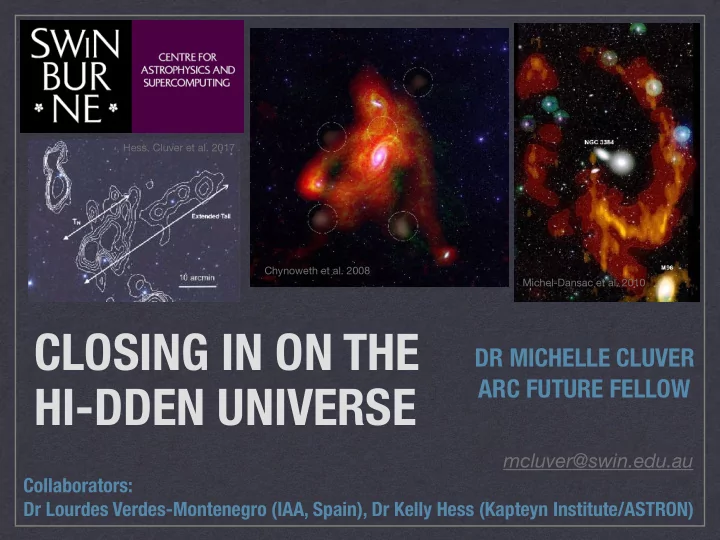
Hess, Cluver et al. 2017 Chynoweth et al. 2008 Michel-Dansac et al. 2010 CLOSING IN ON THE DR MICHELLE CLUVER ARC FUTURE FELLOW HI-DDEN UNIVERSE mcluver@swin.edu.au Collaborators: Dr Lourdes Verdes-Montenegro (IAA, Spain), Dr Kelly Hess


slide-1
SLIDE 1

CLOSING IN ON THE HI-DDEN UNIVERSE

DR MICHELLE CLUVER ARC FUTURE FELLOW

mcluver@swin.edu.au

Chynoweth et al. 2008 Michel-Dansac et al. 2010 Hess, Cluver et al. 2017

Collaborators: Dr Lourdes Verdes-Montenegro (IAA, Spain), Dr Kelly Hess (Kapteyn Institute/ASTRON)

slide-2
SLIDE 2

Discovery and exploration are such an important part of science

slide-3
SLIDE 3

it can be challenging…

Bowman et al. (2018) Ade et al. (2014)

slide-4
SLIDE 4

THE SEARCH FOR DARK MATTER: THE WAITING GAME

AHG Peter (2012) Hoh, Komaragiri, Abdullah (2016)

slide-5
SLIDE 5

THE SEARCH FOR DARK MATTER: THE WAITING GAME

AHG Peter (2012) Hoh, Komaragiri, Abdullah (2016)

How will this change the landscape of our science?

slide-6
SLIDE 6

Ofer Lahav

slide-7
SLIDE 7

“I FIND IT INTERESTING THAT NATURE IS MORE IMAGINATIVE THAN ASTRONOMERS”

Ofer Lahav

slide-8
SLIDE 8

“I FIND IT INTERESTING THAT NATURE IS MORE IMAGINATIVE THAN ASTRONOMERS”

Ofer Lahav

TBT: finding snowballs in hell

slide-9
SLIDE 9

A Spitzer study of the Shock in Stephan’s Quintet

Optical (CFHT/Coelum) + X-ray (NASA/CXC/CfA/E.O’Sullivan) Radio continuum (Allen, 1970) shows the

  • utline of the shock

(from Cluver et al. 2010)

slide-10
SLIDE 10

Cluver et al. (2010)

Intruder galaxy colliding at ~900 km/s Widespread excited H2 detected within the group

slide-11
SLIDE 11

Warm Molecular Hydrogen Emission

  • Mid-IR emission from pure rotational H2 is a direct
  • detection of H2 —> associated with starbursts, (U)LIRGs,

AGN Transitions: H2 0-0 S(0), S(1) – 28.22µm, 17.03µm (traces “coolest” warm H2) H2 0-0 S(2) – S(5) – 12.28µm, 9.67µm, 8.03µm, 6.91µm

  • rtho to para ratio ~ 3
slide-12
SLIDE 12

The projected co-existence of energetic X-rays (105<T<106 K) and warm H2 (102<T<103 K)

The warm H2 emission is more than three times more powerful than the X-ray emission

slide-13
SLIDE 13

Powerful Cooling Pathway

slide-14
SLIDE 14

HI from VLA (courtesy of L. Verdes-Montenegro) Tidal HI Debris has been transformed into molecular hydrogen

slide-15
SLIDE 15

Multiphase Media

slide-16
SLIDE 16

Multiphase Media

Image Credit: Robert Hurt and Michelle Cluver (SSC/Caltech)

slide-17
SLIDE 17

Multiphase Medium

  • High-speed collision with a multi-phase medium creates

multiple shocks (speeds)

  • Low density HI --> hot plasma (X-rays)
  • Denser clumps of HI --> fragment and form H2
  • Slow MHD shocks (5-20km/s) excite H2 (Guillard et al. 2009)
  • Clouds of H2 are heated by turbulence in the hot gas i.e.

kinetic energy of shock fuels H2 emission

  • Molecular gas is continuously excited by supersonic

turbulence

slide-18
SLIDE 18

HI from VLA (courtesy of L. Verdes-Montenegro) How extreme is this?

slide-19
SLIDE 19

COMPACT GROUPS OF GALAXIES

WHY ARE THEY KEY LABORATORIES?

slide-20
SLIDE 20

COMPACT GROUPS OF GALAXIES

  • HI deficiency of groups similar to

Virgo or Coma clusters — Single dish analysis of 72 Hickson Compact Groups (Verdes- Montenegro et al 2001)

WHY ARE THEY KEY LABORATORIES?

slide-21
SLIDE 21

COMPACT GROUPS OF GALAXIES

  • HI deficiency of groups similar to

Virgo or Coma clusters — Single dish analysis of 72 Hickson Compact Groups (Verdes- Montenegro et al 2001)

  • negligible ram-pressure stripping (insufficient hot, tenuous

medium / not in hydrostatic equilibrium) — Rasmussen et al. (2008), Desjardins et al. (2013), tidal interactions dominate

WHY ARE THEY KEY LABORATORIES?

slide-22
SLIDE 22

COMPACT GROUPS OF GALAXIES

  • HI deficiency of groups similar to

Virgo or Coma clusters — Single dish analysis of 72 Hickson Compact Groups (Verdes- Montenegro et al 2001)

  • negligible ram-pressure stripping (insufficient hot, tenuous

medium / not in hydrostatic equilibrium) — Rasmussen et al. (2008), Desjardins et al. (2013), tidal interactions dominate

  • accelerated evolution — bimodality in mid-infrared galaxy colours

(Johnson et al. 2007, Walker et al. 2010, 2012, Zucker et al. 2016)

WHY ARE THEY KEY LABORATORIES?

slide-23
SLIDE 23

COMPACT GROUPS OF GALAXIES

  • HI deficiency of groups similar to

Virgo or Coma clusters — Single dish analysis of 72 Hickson Compact Groups (Verdes- Montenegro et al 2001)

  • negligible ram-pressure stripping (insufficient hot, tenuous

medium / not in hydrostatic equilibrium) — Rasmussen et al. (2008), Desjardins et al. (2013), tidal interactions dominate

  • accelerated evolution — bimodality in mid-infrared galaxy colours

(Johnson et al. 2007, Walker et al. 2010, 2012, Zucker et al. 2016)

  • shock excitation (collisions) linked to accelerated evolution of

molecular hydrogen in 14/74 galaxies in 23 groups — Spitzer mid- infrared spectroscopy (Cluver et al. 2013)

WHY ARE THEY KEY LABORATORIES?
slide-24
SLIDE 24

COMPACT GROUPS OF GALAXIES

Phase 1: Most gas in galaxies Phase 2: Gas in tidal features Phase 3. No HI in the galaxies

VLA study of 16 Hickson Compact Groups (Verdes-Montenegro et al 2001)

Proposed evolutionary model: Amount of detected HI decreases further with evolution, by continuous tidal stripping —> supposed to turn up as X-rays

slide-25
SLIDE 25

COMPACT GROUPS OF GALAXIES

Green Bank Telescope: HI observations of 22 HCGs

  • HI deficiency reduced but not completely eliminated
  • A diffuse HI component missed by the VLA
  • Spread over > 1000 km/s
  • Increasing with evolutionary stage
  • HI filling factor bimodal: suggests rapid

transition from HSB to LSB

(Borthakur, Yun & Verdes-Montenegro et al 2010)

slide-26
SLIDE 26

COMPACT GROUPS OF GALAXIES

Green Bank Telescope: HI observations of 22 HCGs

  • HI deficiency reduced but not completely eliminated
  • A diffuse HI component missed by the VLA
  • Spread over > 1000 km/s
  • Increasing with evolutionary stage
  • HI filling factor bimodal: suggests rapid

transition from HSB to LSB

(Borthakur, Yun & Verdes-Montenegro et al 2010)

slide-27
SLIDE 27

COMPACT GROUPS OF GALAXIES

GBT

VLA

Green Bank Telescope: HI observations of 22 HCGs

  • HI deficiency reduced but not completely eliminated
  • A diffuse HI component missed by the VLA
  • Gas dynamically similar to the one mapped with the VLA
  • More consistent with tidal stripping than with ram-pressure

(Borthakur, Yun & Verdes-Montenegro et al 2010)

slide-28
SLIDE 28

COMPACT GROUPS OF GALAXIES

GBT

VLA

Green Bank Telescope: HI observations of 22 HCGs

  • HI deficiency reduced but not completely eliminated
  • A diffuse HI component missed by the VLA
  • Gas dynamically similar to the one mapped with the VLA
  • More consistent with tidal stripping than with ram-pressure

(Borthakur, Yun & Verdes-Montenegro et al 2010)

slide-29
SLIDE 29

KAT-7: A PATHFINDER PATHFINDER

slide-30
SLIDE 30

KAT-7

7 x 12m dishes Field of View: 1.08° Spatial Resolution: 3.5′ Pathfinder for MeerKAT

Image credit: SKA-SA

slide-31
SLIDE 31

Pilot on KAT-7: HCG 44 (P

.I. Cluver)

Serra et al. (2013) using WSRT Also: GBT observations (Borthakur et al. 2010, 2015)

slide-32
SLIDE 32

Hess, Cluver et al. (2017)

achieved sensitivity: NHI < 2×1018 cm-2

slide-33
SLIDE 33

extended tail: KAT-7 recovers as much emission as Arecibo (ALFALFA) ~450 kpc, 1.1× 10⁹ M⦿

KAT-7 ONLY: LOWEST CONTOUR IS ~ 2×10¹⁸ CM-2

slide-34
SLIDE 34

Why is this interesting?

slide-35
SLIDE 35

Why is this interesting?

According to photoionization and radiative transfer models HI should evaporate at column densities of <5 × 1019 cm−2 (Dove & Shull 1994) due to the lack of self-shielding against extragalactic ionizing photons

slide-36
SLIDE 36

Why is this interesting?

According to photoionization and radiative transfer models HI should evaporate at column densities of <5 × 1019 cm−2 (Dove & Shull 1994) due to the lack of self-shielding against extragalactic ionizing photons But, neutral HI detected below 2×1018 cm-2

slide-37
SLIDE 37

Why is this interesting?

According to photoionization and radiative transfer models HI should evaporate at column densities of <5 × 1019 cm−2 (Dove & Shull 1994) due to the lack of self-shielding against extragalactic ionizing photons But, neutral HI detected below 2×1018 cm-2 Proposed evolution of the group suggests neutral gas has survived at least 0.5-1 Gyr without being ionised (mass loss? lack of hot, dense IGM and associated ram pressure stripping?)

slide-38
SLIDE 38

ARECIBO DIGITAL SS

slide-39
SLIDE 39

ARECIBO DIGITAL SS

slide-40
SLIDE 40

ARECIBO DIGITAL SS

NGC 3162

slide-41
SLIDE 41
slide-42
SLIDE 42

SIMILAR BEHAVIOUR SEEN IN LOOSE GROUP IC 1459

slide-43
SLIDE 43

IC 1459

ASKAP-6 (Serra et al. 2015) KAT-7 (Osterloo et al. 2018)

slide-44
SLIDE 44

IC 1459

ASKAP-6 (Serra et al. 2015) KAT-7 (Osterloo et al. 2018)

slide-45
SLIDE 45

VLA D+CnB vs KAT-7

lowest contour: 5 x 1018 cm-2 lowest contour: 1.2 x 1019 cm-2

slide-46
SLIDE 46

Osterloo et al. (2018)

slide-47
SLIDE 47

Osterloo et al. (2018)

~500 kpc tail ≃ 3×10⁹ M⦿ — morphology reminiscent of the Magellanic stream

slide-48
SLIDE 48

Osterloo et al. (2018)

~500 kpc tail ≃ 3×10⁹ M⦿ — morphology reminiscent of the Magellanic stream age of the HI tail must be at least of order ≃ 2 Gyr

slide-49
SLIDE 49

Osterloo et al. (2018)

~500 kpc tail ≃ 3×10⁹ M⦿ — morphology reminiscent of the Magellanic stream age of the HI tail must be at least of order ≃ 2 Gyr

  • rder of magnitude larger than the estimated ages of

the HI tails seen in the Virgo cluster (Oosterloo & van Gorkom 2005)

slide-50
SLIDE 50

Osterloo et al. (2018)

~500 kpc tail ≃ 3×10⁹ M⦿ — morphology reminiscent of the Magellanic stream age of the HI tail must be at least of order ≃ 2 Gyr

  • rder of magnitude larger than the estimated ages of

the HI tails seen in the Virgo cluster (Oosterloo & van Gorkom 2005) reduced role for the intragroup medium in evaporating cold intragroup gas

slide-51
SLIDE 51
slide-52
SLIDE 52

ALSO NEARBY GALAXIES?

slide-53
SLIDE 53

The Olden Days

Corbelli et al. (1989)

Observations Photoionisation Models

Dove and Shull et al. (1994)

slide-54
SLIDE 54

For 17 nearby galaxies, radial column density profiles smoothly decline down to the sensitivity limit of the data (no break due to ionization by extragalactic photons) transition to a low column density gas? need sensitive observations

Ianjamasimanana et al. (arXiv:1803.10291)

Now

slide-55
SLIDE 55

What’s going on?

degree of steepness of the radial HI fall-off predicted by ionization models depends on :

  • vertical structure of the HI disk
  • the HI mass distribution
  • flux of the ionizing photons (not well constrained by
  • bservations — see also Dove & Shull 1994; Fumagalli

et al 2017)

slide-56
SLIDE 56

Popping (2010)

QSO obs + sims Sims Uncertainty in this regime only resolved by sensitive observations

  • No. of absorbers per unit HI vs HI

M31

slide-57
SLIDE 57

Popping (2010)

QSO obs + sims Sims Uncertainty in this regime only resolved by sensitive observations

  • No. of absorbers per unit HI vs HI

M31

slide-58
SLIDE 58

Credit: Koen van Gorp

The M81 Group

slide-59
SLIDE 59

Credit: Koen van Gorp

The M81 Group

slide-60
SLIDE 60

Credit: Koen van Gorp

The M81 Group

Image Credit: NASA/JPL-Caltech/WISE Team

slide-61
SLIDE 61

Credit: Koen van Gorp

The M81 Group

Image Credit: NASA/JPL-Caltech/WISE Team

Chynoweth et al. 2008

slide-62
SLIDE 62

Credit: Min Yun (University of Massachusetts)

slide-63
SLIDE 63

Credit: Min Yun (University of Massachusetts)

slide-64
SLIDE 64

STELLAR STREAMS!

slide-65
SLIDE 65

What is the fate of this intragroup gas?

slide-66
SLIDE 66

What is the fate of this intragroup gas?

How does it interact with the CGM —accretion, shock heating, (viscous, cold ram pressure) stripping, formation of H2?

slide-67
SLIDE 67

What is the fate of this intragroup gas?

How does it interact with the CGM —accretion, shock heating, (viscous, cold ram pressure) stripping, formation of H2? Formation of tidal dwarfs?

slide-68
SLIDE 68

What is the fate of this intragroup gas?

How does it interact with the CGM —accretion, shock heating, (viscous, cold ram pressure) stripping, formation of H2? Formation of tidal dwarfs? Hot intragroup medium? Dispersal and evaporation? Cool intragroup medium?

slide-69
SLIDE 69

What is the fate of this intragroup gas?

How does it interact with the CGM —accretion, shock heating, (viscous, cold ram pressure) stripping, formation of H2? Formation of tidal dwarfs? Hot intragroup medium? Dispersal and evaporation? Cool intragroup medium?

Important for galaxy evolution models and simulations?

slide-70
SLIDE 70

The SKA Pathfinder: MeerKAT

compact core containing 70% of the dishes extended array designed for high fidelity imaging performance over a range of resolutions

AR1.5 (March 2017)

Image credit: SKA-SA

slide-71
SLIDE 71

TNG of arrays

64 x 15m dishes Better receivers (Gifford-McMahon (GM) cryogenic cooling) Offset Gregorian dish configuration enhances sensitivity by providing high aperture efficiency, low spill-

  • ver temperature contribution, and

a clean optical path Excellent Column Density sensitivity in L-band (comparable to eVLA-D) Field of View — 1 degree Better UV coverage at short baselines (compared to VLA) to recover diffuse emission Longest baseline — 8 km, shortest — 29m eVLA B, C, D array simultaneously M64 — May/June 2018?

slide-72
SLIDE 72

One big telescope

https://briankoberlein.com/2015/10/14/how-does-interferometry-work/

Image credit: SKA-SA

slide-73
SLIDE 73

One big telescope

https://briankoberlein.com/2015/10/14/how-does-interferometry-work/

Image credit: SKA-SA

slide-74
SLIDE 74
slide-75
SLIDE 75

MeerKAT is ideally suited to detect low-column density HI

Column density sensitivity (a 12 hour integration on the 64 dish array will achieve a column density sensitivity of ~5×1018 cm−2 in 30″ beam Locating faint HI is crucial to understanding HI “cycle” and lifetime of tidally stripped material Better UV coverage at short baselines (compared to VLA) to recover diffuse emission Larger Field of View (compared to VLA: 1° vs 32′)

(Cluver et al. 2018, arXiv1802.03807)

slide-76
SLIDE 76

High(er) redshift analogues?

slide-77
SLIDE 77

High(er) redshift analogues?

slide-78
SLIDE 78

High(er) redshift analogues?

cool gas with multiple components and column densities (low ionisation absorbers) Also Whiting et al. (2006), Kacprzak et al. (2010)

slide-79
SLIDE 79

Observations ⬌ Models

slide-80
SLIDE 80

Observations ⬌ Models

Tidally-induced morphology difficult to model (e.g. M31-M33, Semczuk et al. 2018), neutral gas can help

slide-81
SLIDE 81

Observations ⬌ Models

Tidally-induced morphology difficult to model (e.g. M31-M33, Semczuk et al. 2018), neutral gas can help Modification of photoionisation models?

slide-82
SLIDE 82

Observations ⬌ Models

Tidally-induced morphology difficult to model (e.g. M31-M33, Semczuk et al. 2018), neutral gas can help Modification of photoionisation models? Better understanding of CGM/IGM interface —> sub-grid/prescriptive physics models

slide-83
SLIDE 83

WHAT ROLE DOES GROUP ENVIRONMENT PLAY IN HOW GALAXIES EVOLVE?

Schiminovich et al. (2007)

slide-84
SLIDE 84

WHAT ROLE DOES GROUP ENVIRONMENT PLAY IN HOW GALAXIES EVOLVE?

slide-85
SLIDE 85

WHAT ROLE DOES GROUP ENVIRONMENT PLAY IN HOW GALAXIES EVOLVE? State-of-the-art Group Catalogue — GAMA (Robotham et al. 2011)

slide-86
SLIDE 86

WHAT ROLE DOES GROUP ENVIRONMENT PLAY IN HOW GALAXIES EVOLVE? State-of-the-art Group Catalogue — GAMA (Robotham et al. 2011) Stellar Mass, Star Formation measures

slide-87
SLIDE 87

WHAT ROLE DOES GROUP ENVIRONMENT PLAY IN HOW GALAXIES EVOLVE? State-of-the-art Group Catalogue — GAMA (Robotham et al. 2011) Stellar Mass, Star Formation measures

(avoid optical in interacting systems (dust, dust geometry) — use mid-infrared WISE (Cluver et al. 2014, 2017)

slide-88
SLIDE 88

WHAT ROLE DOES GROUP ENVIRONMENT PLAY IN HOW GALAXIES EVOLVE? State-of-the-art Group Catalogue — GAMA (Robotham et al. 2011) Stellar Mass, Star Formation measures

(avoid optical in interacting systems (dust, dust geometry) — use mid-infrared WISE (Cluver et al. 2014, 2017)

Bulge vs Disk information

slide-89
SLIDE 89

WHAT ROLE DOES GROUP ENVIRONMENT PLAY IN HOW GALAXIES EVOLVE? State-of-the-art Group Catalogue — GAMA (Robotham et al. 2011) Stellar Mass, Star Formation measures

(avoid optical in interacting systems (dust, dust geometry) — use mid-infrared WISE (Cluver et al. 2014, 2017)

Bulge vs Disk information Gas as fuel/reservoir/tracer of SF

slide-90
SLIDE 90

WHAT ROLE DOES GROUP ENVIRONMENT PLAY IN HOW GALAXIES EVOLVE? Problem: complexity of physics and chemistry when limited to studying “snapshots” State-of-the-art Group Catalogue — GAMA (Robotham et al. 2011) Stellar Mass, Star Formation measures

(avoid optical in interacting systems (dust, dust geometry) — use mid-infrared WISE (Cluver et al. 2014, 2017)

Bulge vs Disk information Gas as fuel/reservoir/tracer of SF

slide-91
SLIDE 91

0.1<z<0.15

Most compact Most loose lack of high mass systems?

slide-92
SLIDE 92

0.15<z<0.2

Most compact Most loose increased SF?

slide-93
SLIDE 93

0.2<z<0.25

Most compact Most loose

slide-94
SLIDE 94

Parting thoughts

slide-95
SLIDE 95

Parting thoughts

The growth and enrichment of the IGM —

  • bservations vs simulations vs expectations
slide-96
SLIDE 96

Parting thoughts

The growth and enrichment of the IGM —

  • bservations vs simulations vs expectations

Intragroup neutral HI — we’re just scratching the surface (also QSO sightlines for ionised gas)

slide-97
SLIDE 97

Parting thoughts

The growth and enrichment of the IGM —

  • bservations vs simulations vs expectations

Intragroup neutral HI — we’re just scratching the surface (also QSO sightlines for ionised gas) We need MeerKAT, ASKAP (WALLABY + DINGO), Apertif, etc.

slide-98
SLIDE 98

Parting thoughts

The growth and enrichment of the IGM —

  • bservations vs simulations vs expectations

Intragroup neutral HI — we’re just scratching the surface (also QSO sightlines for ionised gas) We need MeerKAT, ASKAP (WALLABY + DINGO), Apertif, etc. Finding “known unknowns” vs “unknown unknowns” with the SKA and its Pathfinders

slide-99
SLIDE 99

Parting thoughts

The growth and enrichment of the IGM —

  • bservations vs simulations vs expectations

Intragroup neutral HI — we’re just scratching the surface (also QSO sightlines for ionised gas) We need MeerKAT, ASKAP (WALLABY + DINGO), Apertif, etc. Finding “known unknowns” vs “unknown unknowns” with the SKA and its Pathfinders More to come from GAMA group analysis