Clocks Some clocks use motion to mark their intervals Others clocks - - PDF document

clocks
SMART_READER_LITE
LIVE PREVIEW

Clocks Some clocks use motion to mark their intervals Others clocks - - PDF document

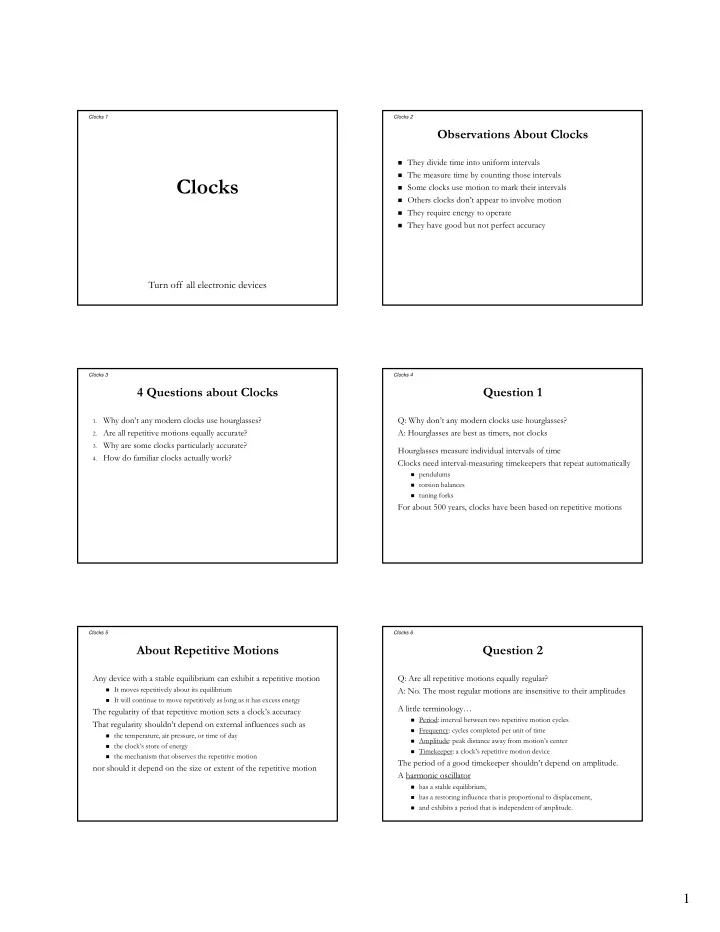
Clocks 1 Clocks 2 Observations About Clocks They divide time into uniform intervals The measure time by counting those intervals Clocks Some clocks use motion to mark their intervals Others clocks dont appear to involve motion


slide-1
SLIDE 1

1

Clocks 1

Clocks

Turn off all electronic devices

Clocks 2

Observations About Clocks

 They divide time into uniform intervals  The measure time by counting those intervals  Some clocks use motion to mark their intervals  Others clocks don’t appear to involve motion  They require energy to operate  They have good but not perfect accuracy

Clocks 3

4 Questions about Clocks

  • 1. Why don’t any modern clocks use hourglasses?
  • 2. Are all repetitive motions equally accurate?
  • 3. Why are some clocks particularly accurate?
  • 4. How do familiar clocks actually work?

Clocks 4

Question 1

Q: Why don’t any modern clocks use hourglasses? A: Hourglasses are best as timers, not clocks Hourglasses measure individual intervals of time Clocks need interval-measuring timekeepers that repeat automatically

 pendulums  torsion balances  tuning forks

For about 500 years, clocks have been based on repetitive motions

Clocks 5

About Repetitive Motions

Any device with a stable equilibrium can exhibit a repetitive motion

 It moves repetitively about its equilibrium  It will continue to move repetitively as long as it has excess energy

The regularity of that repetitive motion sets a clock’s accuracy That regularity shouldn’t depend on external influences such as

 the temperature, air pressure, or time of day  the clock’s store of energy  the mechanism that observes the repetitive motion

nor should it depend on the size or extent of the repetitive motion

Clocks 6

Question 2

Q: Are all repetitive motions equally regular? A: No. The most regular motions are insensitive to their amplitudes A little terminology…

 Period: interval between two repetitive motion cycles  Frequency: cycles completed per unit of time  Amplitude: peak distance away from motion’s center  Timekeeper: a clock’s repetitive motion device

The period of a good timekeeper shouldn’t depend on amplitude. A harmonic oscillator

 has a stable equilibrium,  has a restoring influence that is proportional to displacement,  and exhibits a period that is independent of amplitude.

slide-2
SLIDE 2

2

Clocks 7

Harmonic Oscillators

Any harmonic oscillator has

 an inertial aspect (e.g., a mass)  a spring-like restoring aspect (e.g., a spring).

A harmonic oscillator’s period decreases as

 its inertial aspect becomes smaller  its spring-like restoring aspect becomes stiffer

Common harmonic oscillators include

 a mass on a spring  a pendulum  a flagpole  a tuning fork Clocks 8

Question 3

Q: Why are some clocks particularly accurate? A: They have especially well-designed harmonic oscillators

 Harmonic oscillator clocks have practical limits to accuracy

 Sustaining the repetitive motion can influence its period  Measuring the period itself can influence the period  Temperature, pressure, wind… can influence the period

 Those clocks also have fundamental limits to accuracy

 Rate at which oscillation wastes energy limits preciseness of its period  Most accurate clocks waste as little energy as possible Clocks 9

Question 4

Q: How do familiar clocks actually work? A: Their harmonic oscillators are set in motion and observed carefully

 Common harmonic oscillators used in clocks are

 pendulums  balance rings  quartz crystals

 Each of these clocks

 has a harmonic oscillator as its timekeeper,  supplies that harmonic oscillator with energy to keep it going,  and counts cycles of that oscillator Clocks 10

Pendulum Clocks

 A pendulum is (almost) a harmonic oscillator  For small displacements

 Its restoring force is proportional to displacement  Its period is independent of amplitude  Its period is proportional to (length/gravity)1/2

 For accuracy, the pendulum’s

 length is temperature stabilized  length is adjusted for local gravity  friction & air resistance are small  motion is sustained and measured gently

 A pendulum clock mustn't be moved or tilted

Clocks 11

Pendulums as Harmonic Oscillators

Recall that any harmonic oscillator has

 an inertial aspect (e.g., a mass)  a spring-like restoring aspect (e.g., a spring).

In most harmonic oscillators, those two aspects are independent However, a pendulum’s spring-like restoring force

 is proportional to the pendulum’s weight  is therefore proportional to the pendulum’s mass

Therefore, increasing a pendulum’s mass

 increases its inertial aspect  increases the stiffness of its restoring force aspect  therefore has no effect on its period! Clocks 12

Balance Ring Clocks

Coil spring and balance ring form a harmonic oscillator Balance ring twists back and forth rhythmically

 Gravity exerts no torque about the ring’s pivot  Gravity has no influence on the period

For accuracy, balance ring’s

 friction & air resistance are small  motion is sustained gently  motion is measured gently

slide-3
SLIDE 3

3

Clocks 13

Quartz Clocks

A quartz crystal is a harmonic oscillator

 The crystal’s mass provides the inertial aspect  The crystal’s body provides the spring-like restoring aspect

As a harmonic oscillator, a quartz crystal’s

 oscillation decay is extremely gradual  sensitivity to gravity, temperature, and environment are minimal  fundamental accuracy is extremely high

Quartz is piezoelectric

 mechanical and electrical changes are coupled  Its motion can cause electric effects  Its electric situation can cause motion Clocks 14

Summary about Clocks

 Most clocks involve harmonic oscillators  Amplitude independence aids accuracy  Clock sustains and counts oscillations  Oscillators that lose little energy work best