Clinicopathological Presentation of Solitary Nodule in Our Setup - - PDF document

clinicopathological presentation of solitary nodule in
SMART_READER_LITE
LIVE PREVIEW

Clinicopathological Presentation of Solitary Nodule in Our Setup - - PDF document

ORIGINAL ARTICLE Clinicopathological Presentation of Solitary Nodule in Our Setup AMEER AFZAL, TOOBA MAHMOOD GHOHAR, NASIR NASIM, HAFIZ MUHAMMAD ASIF, ABISHEK CHAUDHRY, MUHAMMAD AZIM KHAWAJA ABSTRACT Introduction: Most patients present with an


slide-1
SLIDE 1

ORIGINAL ARTICLE

639 P J M H S Vol. 7, NO. 3, JUL – SEP 2013

Clinicopathological Presentation of Solitary Nodule in Our Setup

AMEER AFZAL, TOOBA MAHMOOD GHOHAR, NASIR NASIM, HAFIZ MUHAMMAD ASIF, ABISHEK CHAUDHRY, MUHAMMAD AZIM KHAWAJA

ABSTRACT

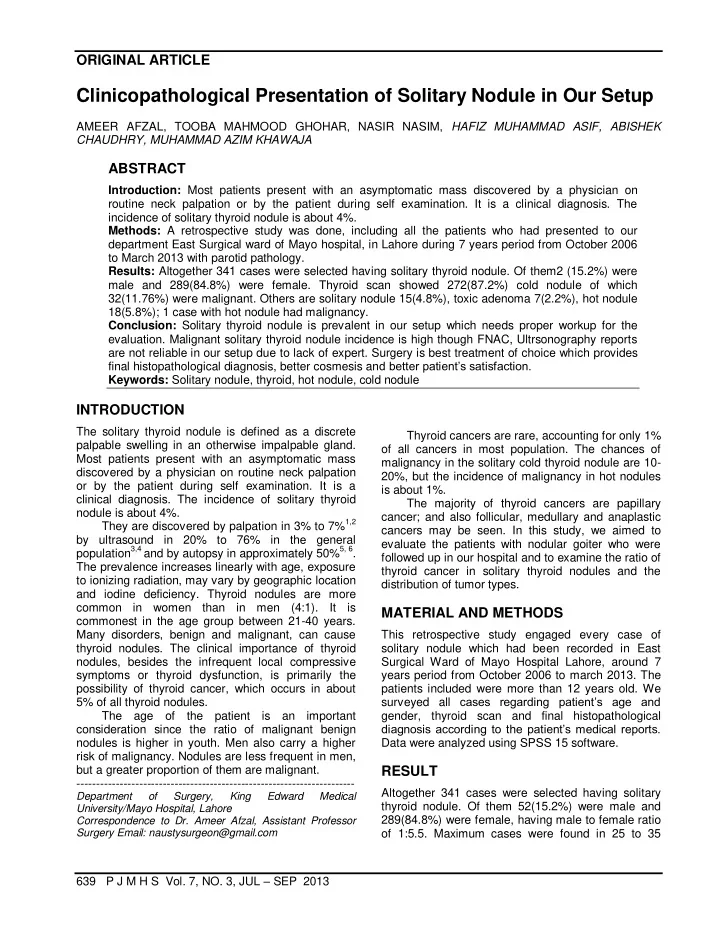
Introduction: Most patients present with an asymptomatic mass discovered by a physician on routine neck palpation or by the patient during self examination. It is a clinical diagnosis. The incidence of solitary thyroid nodule is about 4%. Methods: A retrospective study was done, including all the patients who had presented to our department East Surgical ward of Mayo hospital, in Lahore during 7 years period from October 2006 to March 2013 with parotid pathology. Results: Altogether 341 cases were selected having solitary thyroid nodule. Of them2 (15.2%) were male and 289(84.8%) were female. Thyroid scan showed 272(87.2%) cold nodule of which 32(11.76%) were malignant. Others are solitary nodule 15(4.8%), toxic adenoma 7(2.2%), hot nodule 18(5.8%); 1 case with hot nodule had malignancy. Conclusion: Solitary thyroid nodule is prevalent in our setup which needs proper workup for the

  • evaluation. Malignant solitary thyroid nodule incidence is high though FNAC, Ultrsonography reports

are not reliable in our setup due to lack of expert. Surgery is best treatment of choice which provides final histopathological diagnosis, better cosmesis and better patient’s satisfaction. Keywords: Solitary nodule, thyroid, hot nodule, cold nodule

INTRODUCTION

The solitary thyroid nodule is defined as a discrete palpable swelling in an otherwise impalpable gland. Most patients present with an asymptomatic mass discovered by a physician on routine neck palpation

  • r by the patient during self examination. It is a

clinical diagnosis. The incidence of solitary thyroid nodule is about 4%. They are discovered by palpation in 3% to 7%1,2 by ultrasound in 20% to 76% in the general population3,4 and by autopsy in approximately 50%5, 6. The prevalence increases linearly with age, exposure to ionizing radiation, may vary by geographic location and iodine deficiency. Thyroid nodules are more common in women than in men (4:1). It is commonest in the age group between 21-40 years. Many disorders, benign and malignant, can cause thyroid nodules. The clinical importance of thyroid nodules, besides the infrequent local compressive symptoms or thyroid dysfunction, is primarily the possibility of thyroid cancer, which occurs in about 5% of all thyroid nodules. The age of the patient is an important consideration since the ratio of malignant benign nodules is higher in youth. Men also carry a higher risk of malignancy. Nodules are less frequent in men, but a greater proportion of them are malignant.

  • Department
  • f

Surgery, King Edward Medical University/Mayo Hospital, Lahore Correspondence to Dr. Ameer Afzal, Assistant Professor Surgery Email: naustysurgeon@gmail.com

Thyroid cancers are rare, accounting for only 1%

  • f all cancers in most population. The chances of

malignancy in the solitary cold thyroid nodule are 10- 20%, but the incidence of malignancy in hot nodules is about 1%. The majority of thyroid cancers are papillary cancer; and also follicular, medullary and anaplastic cancers may be seen. In this study, we aimed to evaluate the patients with nodular goiter who were followed up in our hospital and to examine the ratio of thyroid cancer in solitary thyroid nodules and the distribution of tumor types.

MATERIAL AND METHODS

This retrospective study engaged every case of solitary nodule which had been recorded in East Surgical Ward of Mayo Hospital Lahore, around 7 years period from October 2006 to march 2013. The patients included were more than 12 years old. We surveyed all cases regarding patient’s age and gender, thyroid scan and final histopathological diagnosis according to the patient’s medical reports. Data were analyzed using SPSS 15 software.

RESULT

Altogether 341 cases were selected having solitary thyroid nodule. Of them 52(15.2%) were male and 289(84.8%) were female, having male to female ratio

  • f 1:5.5. Maximum cases were found in 25 to 35
slide-2
SLIDE 2

P J M H S Vol. 7, NO. 3, JUL – SEP 2013 640 years age group and solitary nodule was found in age group between 13-84 years old with mean age of 32 years old.

Table 1: Gender wise neoplasm Gender Benign Malignant Total Male 37 15 52 Female 242 47 289 Total 279 62 341

Chart 1: Solitary nodule with different carcinoma. Chart 2: Thyroid Scan and Neoplasm. Of 341 cases, 279(81.8%) cases were benign and 62(18.2%) were malignant. Maximum malignancy was found in age group between 35 -45 years old. Male were found to have more malignancy in comparison to female i.e. 15(28.84%) cases in 52 males; and female cases were 47(16.26%) in 289 cases. Thyroid scan showed 272(87.2%) cold nodule of which 32(11.76%) were malignant. Others are solitary nodule 15(4.8%), toxic adenoma 7(2.2%), hot nodule 18(5.8%); 1 case with hot nodule had

  • malignancy. Most common benign histopathological

diagnosis was colloid nodular goiter, followed by follicular adenoma. Most common malignant pathology was papillary carcinoma 33(53.22%) cases, followed by follicular carcinoma 7(11.29%) cases; 3(4.83%) cases were papillary carcinoma with follicular variant, 2(3.22%) cases had follicular and papillary carcinoma together, 1(1.61%) case had anaplastic carcinoma. There was no medullary carcinoma which signifies its rarity.

DISCUSSION

Clinical evaluation begins with a detailed patient history and careful thyroid palpation. Regardless of the way in which thyroid nodules are discovered, a detailed patient history is requisite. Information that needs to be ascertained includes; the presence of symptoms, a change in nodule size, previous head/neck radiation exposure and a family history of thyroid or endocrine diseases. A careful history and the physical examination provide the framework for assessing the risk of malignancy. Rapid

  • r

gradual progressive enlargement, compressive symptoms, a family history of medullary or papillary thyroid cancer, multiple endocrine neoplasia type 2, or familial tumor syndromes should raise the level of suspicion for

  • malignancy. Similarly, a firm or hard nodule fixed to

adjacent structures or regional lymphadenopathy is suggestive of malignancy. Colloid nodules, cysts and thyroiditis account for 80% of thyroid nodules, whereas benign follicular neoplasms are the cause in 10% to 15% and thyroid carcinoma account for about 5%7. Investigation of thyroid nodules should begin with assessment of the functional status of the thyroid. Tests include serum TSH, free thyroxin and free tri- iodothyronine. These tests are important as the thyroid nodule might be associated with hyperthyroidism which has low chance of malignancy and requires antithyroid drugs prior to surgery. All patients who present with a thyroid nodule should undergo ultrasound evaluation of the nodule, thyroid gland and cervical lymph nodes, if indicated. Ultrasound is an inexpensive, readily available and non invasive investigation. But still has limitations like lack of experts, accurate diagnostic feature. However ultrasound has really changed the outcome of FNAC through its guide accurate sampling regardless of its

  • size. CT is useful though it is not required in regular

basis in providing additional anatomical information, such as the presence of a retrosternal goiter, compressive symptoms and the relationship of a goiter to adjacent structures. Thyroid scintigarphy has a limited role in the evaluation of a solitary thyroid nodule. Depending on the pattern of uptake, nodules are classified as hyper functioning (hot), hypo functioning (cold) and normal functioning (warm). The role of scintigraphy in the

slide-3
SLIDE 3

641 P J M H S Vol. 7, NO. 3, JUL – SEP 2013 diagnostic work up of thyroid nodules is generally limited to a single nodule with suppressed TSH, MNG with substernal extension and searching for ectopic thyroid tissue, such as struma ovarii or sublingual

  • thyroid. Hot nodules are seen in about 5% of scans

and are malignant in 1% of cases8. Approximately 80-85% of nodules are cold and 10-15% of these are

  • malignant9. The incidence of malignancy in warm

nodule is reported to be 9%. This information on its

  • wn

is unlikely to change the subsequent management of the nodule and further decision making. FNAC is the most crucial step in the evaluation

  • f a thyroid nodule and is the procedure of choice in

the workup of thyroid nodules10, 11. It is able to provide specific information about the cellular composition of a nodule that directs subsequent management decisions. The diagnostic accuracy was nearly 98% with less than 2% false positive and false negative results. The four categories that are commonly used to describe FNAC results and there reported incidence are; benign 70%; indeterminate 10%; malignant 5% and non diagnostic 15%12. Management of thyroid nodules is based on the combination of history, examination, TFT, Isotop scan and ultimately cytology results. If malignant on FNAC total thyroidectomy is

  • done. If FNAC is inconclusive we go for lobectomy

and isthmusectomy and proceed according to final histopathological report. Toxic nodules are treated by resection after making the patient euthyroid. In cold nodule with no malignancy in FNAC we still go for lobectomy and isthmusectomy as we lack proper cytopathologist in our setup. Surgery is safe, removes the lesion, provides histological diagnosis, avoides leaving a hard nodule in the thyroid gland and avoids irradiation and possible hypothyroidisam. I131 therapy does have role in toxic nodule but is not used in our setup.

CONCLUSION

Solitary thyroid nodule is prevalent in our setup which needs proper workup for the evaluation. Malignant solitary thyroid nodule incidence is high though FNAC, Ultrsonography reports are not reliable in our setup due to lack of expert. Beside that all the patients readily wants the nodule to be excised in the first place. We lack proper follow up; therefore surgery is best treatment of choice which provides final histopathological diagnosis, better cosmesis and better patient’s satisfaction.

REFERENCE

1. Hegedus L. Clinical practice: the thyroid nodule. N Engl J Med 2004; 351(17):1764–71. 2. Vander JB, Gaston EA, Dawber TR. The significance

  • f nontoxic thyroid nodules: final report of a 15-year

study of the incidence of thyroid malignancy. Ann Intern Med 1968; 69(3): 537–40. 3. Tan GH, Gharib H. Thyroid incidentalomas: management approaches to nonpalpable nodules discovered incidentally on thyroid imaging. Ann Intern Med 1997; 126(3): 226–31. 4. Ezzat S, Sarti DA, Cain DR, et al. Thyroid incidentalomas: prevalence by palpation and

  • ultrasonography. Arch Intern Med 1994; 154(16):

1838–40. 5. Mortensen JD, Woolner LB, Bennett WA. Gross and microscopic findings in clinically normal thyroid glands. J Clin Endocrinol Metab 1955; 15(10):1270–80. 6. Ross DM. Diagnostic approach to and treatment of thyroid nodules. I. In: Rose BD, editor. Wellesley (MA): UpToDate; 2005. 7. Hegedus L. Clinical practice. The thyroid nodule. N Engl J Med 2004; 35:1764–71. 8. Oertel YC, Fine needle aspiration of thyroid: technique and terminology. Endocrinol Metab Clin North Am 2007; 36:737-751. 9. American Association of Clinical Endocrinologists and medical guidelines for clinical practice for the diagnosis and management of thyroid nodules Endocr Pract 2006, 12:63-102.

  • 10. Cooper DS,

Doherty GM, Haugen BR, et

  • al. Management guidelines for patients with thyroid

nodules and differentiated thyroid cancer. Thyroid 2006; 16:109-142.

  • 11. AACE/AME Task Force on Thyroid Nodules. American

Association

  • f

Clinical Endocrinologists and Associazione Medici Endocrinologi medical guidelines for clinical practice for the diagnosis and management

  • f thyroid nodules. Endocr Pract 2006; 12:63-102.
  • 12. Gharib H, Papini E. Thyroid nodules: Clinical

importance, assessment, and treatment. Endocrinol Metab Clin North Am 2007; 36:707-735. vi.