CLINICAL INFORMATICS: AN ESSENTIAL COMPETENCY FOR 21 ST CENTURY - - PDF document

clinical informatics an essential competency for 21 st
SMART_READER_LITE
LIVE PREVIEW

CLINICAL INFORMATICS: AN ESSENTIAL COMPETENCY FOR 21 ST CENTURY - - PDF document

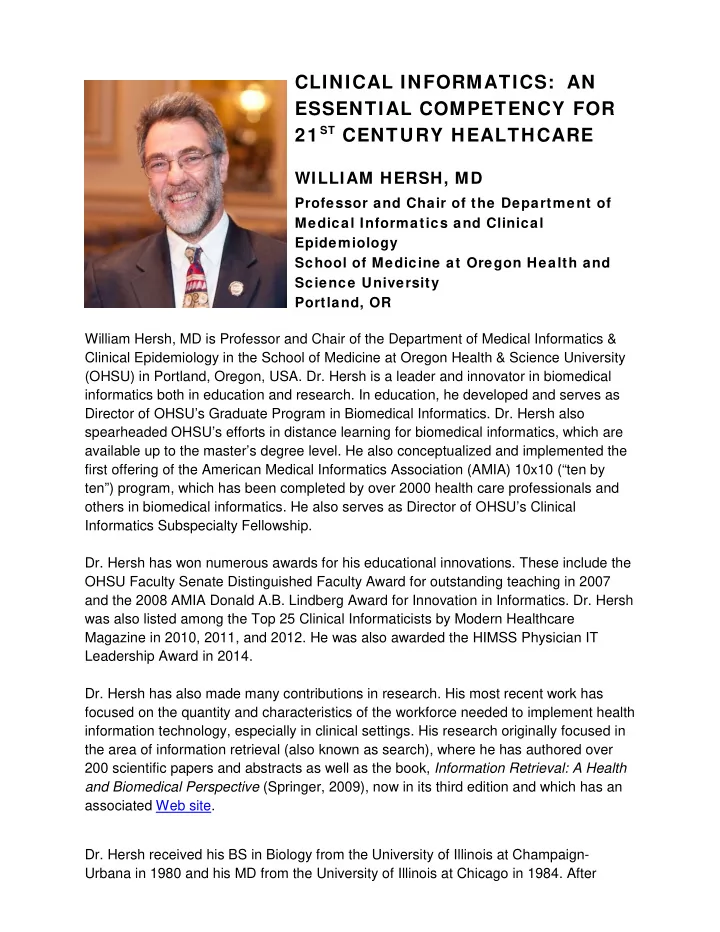
CLINICAL INFORMATICS: AN ESSENTIAL COMPETENCY FOR 21 ST CENTURY HEALTHCARE WILLIAM HERSH, MD Professor and Chair of the Department of Medical Informatics and Clinical Epidemiology School of Medicine at Oregon Health and Science University


slide-1
SLIDE 1

CLINICAL INFORMATICS: AN ESSENTIAL COMPETENCY FOR 21 ST CENTURY HEALTHCARE

WILLIAM HERSH, MD

Professor and Chair of the Department of Medical Informatics and Clinical Epidemiology School of Medicine at Oregon Health and Science University Portland, OR William Hersh, MD is Professor and Chair of the Department of Medical Informatics & Clinical Epidemiology in the School of Medicine at Oregon Health & Science University (OHSU) in Portland, Oregon, USA. Dr. Hersh is a leader and innovator in biomedical informatics both in education and research. In education, he developed and serves as Director of OHSU’s Graduate Program in Biomedical Informatics. Dr. Hersh also spearheaded OHSU’s efforts in distance learning for biomedical informatics, which are available up to the master’s degree level. He also conceptualized and implemented the first offering of the American Medical Informatics Association (AMIA) 10x10 (“ten by ten”) program, which has been completed by over 2000 health care professionals and

  • thers in biomedical informatics. He also serves as Director of OHSU’s Clinical

Informatics Subspecialty Fellowship.

  • Dr. Hersh has won numerous awards for his educational innovations. These include the

OHSU Faculty Senate Distinguished Faculty Award for outstanding teaching in 2007 and the 2008 AMIA Donald A.B. Lindberg Award for Innovation in Informatics. Dr. Hersh was also listed among the Top 25 Clinical Informaticists by Modern Healthcare Magazine in 2010, 2011, and 2012. He was also awarded the HIMSS Physician IT Leadership Award in 2014.

  • Dr. Hersh has also made many contributions in research. His most recent work has

focused on the quantity and characteristics of the workforce needed to implement health information technology, especially in clinical settings. His research originally focused in the area of information retrieval (also known as search), where he has authored over 200 scientific papers and abstracts as well as the book, Information Retrieval: A Health and Biomedical Perspective (Springer, 2009), now in its third edition and which has an associated Web site.

  • Dr. Hersh received his BS in Biology from the University of Illinois at Champaign-

Urbana in 1980 and his MD from the University of Illinois at Chicago in 1984. After

slide-2
SLIDE 2

completing a Residency in Internal Medicine at University of Illinois Hospital in 1987, he completed a Fellowship in Medical Informatics at Harvard University in 1990. Since that time, he has been a faculty member in the OHSU School of Medicine. More information about Dr. Hersh can be found on his Web site. He also maintains the Informatics Professor blog.

OBJECTIVES:

Participants should be better able to:

  • 1. Describe recent investments in health information technology, including the

electronic health record;

  • 2. Discuss the benefits and adverse consequences of this investment;
  • 3. Describe the role of the discipline of clinical informatics in aiming to improve the

value of health information technology;

  • 4. Discuss efforts to define and impart competency in clinical informatics among

clinicians and informatics professionals.

F R I D A Y , M A R C H 4 , 2 0 1 6

8 :4 5 A M

slide-3
SLIDE 3

1

Clinical Informatics: An Essential Competency for 21st Century Healthcare

William Hersh, MD, FACP, FACMI Diplomate, Clinical Informatics, ABPM Professor and Chair Department of Medical Informatics & Clinical Epidemiology Oregon Health & Science University Portland, OR, USA Email: hersh@ohsu.edu Web: www.billhersh.info Blog: http://informaticsprofessor.blogspot.com

1

  • Dr. Hersh has declared no

conflicts of interest related to the content of his presentation.

2

slide-4
SLIDE 4

2

Outline

  • Rationale for use of information technology

(IT) in healthcare, including the electronic health record (EHR)

  • Recent increase in adoption of EHRs due to

the Health Information Technology for Economic and Clinical Health (HITECH) Act

  • Results of HITECH – good and bad
  • Competence in clinical informatics for

informaticians and clinicians

3

Many problems in healthcare have information-related solutions

  • Quality – not as good as it could be (McGlynn,

2003; Schoen, 2009; NCQA, 2010)

  • Safety – errors cause morbidity and mortality;

many preventable (Kohn, 2000; Classen, 2011; van den Bos, 2011; Smith 2012)

  • Cost – cost growth has slowed, but US still spends

more and gets less (Angrisano, 2007; Brill, 2013; Martin, 2016)

  • Inaccessible information – missing information

common in primary care (Smith, 2005)

4

slide-5
SLIDE 5

3

Growing evidence that information interventions are part of solution

  • Systematic reviews (Chaudhry, 2006; Goldzweig, 2009;

Buntin, 2011; Jones, 2014) have identified benefits in a variety of areas, although

  • Quality of many studies could be better
  • Large number of early studies came from a small number
  • f “health IT leader” institutions

5

(Buntin, 2011)

What has been holding us back? (Hersh, 2004)

6

  • Cost
  • Technical challenges
  • Interoperability
  • Privacy and confidentiality
  • Workforce
slide-6
SLIDE 6

4

American Recovery and Reinvestment Act (ARRA) provided the opportunity

7

“To improve the quality of our health care while lowering its cost, we will make the immediate investments necessary to ensure that within five years, all of America’s medical records are computerized … It just won’t save billions of dollars and thousands of jobs – it will save lives by reducing the deadly but preventable medical errors that pervade our health care system.” January 5, 2009 HITECH Act (Blumenthal, 2011)

  • Incentives for EHR adoption by physicians and

hospitals (up to $27B)

  • Direct grants by federal agencies ($2B, including

$118M for workforce development)

What did HITECH entail?

  • Incentives for “meaningful use” (MU) of the

EHR, which required (Blumenthal, 2010)

– Eligible hospitals and professionals meeting criteria in three stages – Using certified EHR technology – Adhering to specified standards – Able to measure and send quality measures as well as enable health information exchange (HIE)

8

slide-7
SLIDE 7

5

Results of HITECH

9

Office-based physicians (DesRoches, 2015) Non-federal hospitals (Charles, 2015) Emergency departments (Jamoom, 2015) Outpatient departments (Jamoom, 2015)

Although adoption increased, other problems arose

  • Incomplete interoperability
  • Adverse impact on workflow
  • Conundrum of structured vs. unstructured

data

  • Problems with usability
  • Safety
  • Security

10

slide-8
SLIDE 8

6

Lack of interoperability

  • Despite large-scale adoption, systems do not

communicate well

  • Several causes

– Incomplete adoption of standards – Inadequate (?) incentives for health information exchange (HIE) under MU – Information blocking (ONC, 2015)?

11

Adverse impact on workflow

  • Famous JAMA cartoon

(Toll, 2012)

  • Too much focus on

computer than patient – “writing the wrong” (Patel, 2015)

  • Dr. Paul Chang and the

“demise of radiology rounds” (Jersild, 2012)

  • Facilitates workarounds,

such as copy-and-paste (or “sloppy and paste?”) (O’Reilly, 2013)

12

slide-9
SLIDE 9

7

Other adverse impacts

V97.33xD Sucked into jet engine, subsequent encounter

Usability

  • Substantial physician dissatisfaction (Lewis, AmericanEHR, 2014)
  • Partly due to conundrum of structured vs. unstructured data

– Structured data facilitates re-use – Narrative data tells the patient’s story

  • “Patients do not speak template” (Lewis, 2011)
  • Many physicians do not trust check boxes in EHRs (Personal Communications)
  • Vendors not adhering to usability requirements as part of ONC EHR

certification (Ratwani, 2015)

14

slide-10
SLIDE 10

8

15

The same EHRs we tout for safety may undermine it

  • Concerns led to Joint

Commission Sentinel Event alerts (42, 2008; 54, 2015)

  • IOM report called for more

effective monitoring and study (IOM, 2012), including a roadmap for avoiding e- iatrogenesis (Ash, 2012)

  • Well-known mishaps

– 38 times dose of antibiotic (Wachter, 2015) – Ebola patient in Dallas hospital (Cortese, 2015)

16

slide-11
SLIDE 11

9

Security

  • 2015 was the year of major

breaches

– Anthem – over 80M records (Rubenfire, 2015) – Premera Blue Cross – over 11M records (Vinton, 2015) – Excellus Blue Cross – over 10M records (Rubenfire, 2015)

  • Going forward from 2015-2019,

estimated 1 in 13 patients will suffer medical identify theft, at cost of $300B to system (Kalis, 2015)

  • Not limited to healthcare

– https://www.opm.gov/cybersecuri ty

17

(Two-fer, NewYorker)

Clinical informatics can lead to improved use of the EHR

  • There is still research evidence

that health IT improves care

  • Emerging models for more

effective use

  • Advocacy for improved usability,

interoperability

  • Robust opportunities, especially

related to data science/analytics

18

thinkgeek.com

slide-12
SLIDE 12

10

There is still a (mostly) positive evidence base (Jones, 2014)

19

Evidence in support of value of EHR continues

  • Enhancing patient-provider communication

(Berry, 2011)

  • Extracting phenotype from the EHR (Denny, 2013;

Wei, 2015)

  • Rapid learning in oncology (Yu, 2015)
  • Detection and early action on, e.g.,

– Delays in cancer diagnosis (Murphy, 2014; Murphy, 2015) – Risk of readmission (Amarasingham, 2013; Hebert, 2014) – Postoperative complications (Menendez, 2015)

20

slide-13
SLIDE 13

11

Emerging models for more effective exam room use

  • POISED model (Frankel,

2015)

– Prepare – Orient – Information gathering – Share – Educate – Debrief

21

(Duke, 2013)

Growing advocacy for making systems better

  • AMA usability principles (AMA, 2014)
  • AMIA white paper (Payne, 2015)
  • ACP documentation (Kuhn, 2015)
  • ONC Shared Nationwide Interoperability

Roadmap (ONC, 2015)

22

slide-14
SLIDE 14

12

Opportunities still exist

  • Optimists note the “data dividend” of MU (Perlin,

in Walsh, 2015)

  • Predictive analytics has potential to augment

modern clinical practice (Sniderman, 2015)

  • Rationale for EHRs still exists

– Diagnostic (IOM, 2015) and therapeutic (James, 2013) errors still abound; informatics part of the solution – Precision medicine will require EHRs and mobile devices to build 1M patient cohort (NIH, 2015)

23

Biomedical and health informatics underlies the solutions

  • Biomedical and health informatics (BMHI) is the

science of using data and information, often aided by technology, to improve individual health, health care, public health, and biomedical research (Hersh, 2009)

– It is about information, not technology – http://www.billhersh.info/whatis

  • Practitioners are BMHI are usually called

informaticians (sometimes informaticists)

  • Overview textbooks: Shortliffe, 2014; Hoyt, 2014

24

slide-15
SLIDE 15

13

Informatics has many sub-areas

25

Informatics = People + Information + Technology

Biomedical and Health Informatics

Legal Informatics Chemoinformatics

Bioinformatics

(cellular and molecular)

Clinical (Medical) Informatics

(person)

{Clinical field} Informatics Public Health Informatics

(population)

Consumer Health Informatics Imaging Informatics Research Informatics

Definition of clinical informatics (ACGME)

  • Clinical informatics is the subspecialty of all

medical specialties that transforms health care by analyzing, designing, implementing, and evaluating information and communication systems to improve patient care, enhance access to care, advance individual and population health outcomes, and strengthen the clinician-patient relationship

26

slide-16
SLIDE 16

14

Informatics competence is also fundamental to clinician practice

  • 21st century physicians and other clinicians

must have competence in clinical informatics

  • Driven by competencies focused on uses for

informatics and not just technology itself

  • What are the competencies in clinical

informatics for clinicians?

– One listing focused on medical students (Hersh, 2014) – probably applicable to all health professional students

27 28

slide-17
SLIDE 17

15

Educational programs for achieving competence

  • Informaticians
  • Clinicians

29

Educational programs for informaticians

  • An ever-growing number of programs – list of US

informatics programs on AMIA Web site

– http://www.amia.org/education/programs-and-courses

  • Programs come in many flavors: medical, clinical,

biomedical, health, bio-, nursing, etc.

  • Funding available for research programs from National

Library of Medicine (NLM), which funds fellowships to train future researchers at doctoral and postdoctoral levels at 14 universities

– http://www.nlm.nih.gov/ep/GrantTrainInstitute.html

  • New fellowships forthcoming for clinical informatics

subspecialists under ACGME model

30

slide-18
SLIDE 18

16

OHSU Biomedical Informatics Graduate Program

  • Aims to train future

professionals, leaders, and researchers

  • Graduate level programs

– Graduate Certificate – Master’s – research, professional – PhD

  • Graduate Certificate and

Master’s available online

  • Innovations in online

learning, including AMIA 10x10 Program

31 Graduates CI BCB HIM Total GC 321 37 358 MBI 146 6 2 154 MS 68 9 77 PhD 10 6 16 Total 545 21 39 605

http://www.ohsu.edu/informatics

Clinical informatics subspecialty

  • Following usual path of five years of

“grandfathering” training requirements to take certification exam before formal fellowships required

  • Two paths to eligibility for exam in first five years

– Practice pathway – practicing 25% time for at least three years within last five years (education counts at half time of practice) – Non-traditional fellowships – qualifying educational

  • r training experience, e.g., NLM, VA, or other

fellowship or educational program (e.g., master’s degree)

32

slide-19
SLIDE 19

17

Clinical training model presents some challenges

  • Fragmentation and funding challenges (Detmer, 2014)
  • Subspecialty designation limits those without a

primary specialty

  • After 2018, only pathway to board certification will be

a two-year ACGME-accredited fellowship

– Many clinicians pursue informatics in mid-career

  • Informatics is not only for physicians – AMIA exploring

certification for others in informatics, the Advanced Interprofessional Informatics Certification (AIIC)

– http://www.amia.org/advanced-interprofessional- informatics-certification

33

What about informatics education for clinicians?

  • Our competencies a starting point (Hersh,

2014)

  • Working with other grantee institutions of

AMA Accelerating Change in Education (ACE) initiative to develop

– Milestones – Entrustable professional activities (EPAs) – Assessments – Addition to board exams, e.g., USMLE

34

slide-20
SLIDE 20

18

Implementing competencies and curricula for OHSU medical students

  • Interactive lectures and

series, e.g.,

– “Information is Different Now That You’re a Doctor” – “Informatics, EBM, and Critical Thinking”

  • Pearls – weekly 7-10 minute

asynchronous recording

  • Clinical skills – e.g.,

– Using EHR – Applying quality measures

  • Enrichment (optional) – in-

depth topics (EHR), clinical informatics careers, etc.

35

Conclusions

  • Some problems in healthcare have informatics

solutions

  • Competence in clinical informatics is essential

for 21st century healthcare professionals

  • Many opportunities for clinical informatics

professionals who will lead the way

36

slide-21
SLIDE 21

19

Question 1

Which of the following has occurred as a result

  • f the HITECH Act?
  • a. The adoption of electronic health record use

has increased substantially

  • b. The cost of healthcare has decreased
  • c. Physicians are able to complete their clinical

documentation more quickly

  • d. Physician satisfaction with clinical practice

has increased

37

QUESTION 1 Which of the following has occurred as a result of the HITECH Act?

  • a. The adoption of electronic health

record use has increased substantially

  • b. The cost of healthcare has decreased
  • c. Physicians are able to complete their

clinical documentation more quickly

  • d. Physician satisfaction with clinical

practice has increased

38

a. b. c. d.

94% 0% 4% 2%

slide-22
SLIDE 22

20

Question 2

At this time in the US, electronic health records are more likely to be used by

  • a. Emergency departments
  • b. Hospitals
  • c. Long-term care facilities
  • d. Office-based physicians

39

QUESTION 2 At this time in the US, electronic health records are more likely to be used by

  • a. Emergency departments
  • b. Hospitals
  • c. Long-term care facilities
  • d. Office-based physicians

40

a. b. c. d.

8% 8% 0% 84%

slide-23
SLIDE 23

21

Question 3

The field focused on the optimal use of information in healthcare settings is best described as

  • a. Bioinformatics
  • b. Clinical informatics
  • c. Computer science
  • d. Consumer health informatics

41

QUESTION 3 The field focused on the optimal use of information in healthcare settings is best described as

  • a. Bioinformatics
  • b. Clinical informatics
  • c. Computer science
  • d. Consumer health informatics

42

a. b. c. d.

9% 2% 0% 89%

slide-24
SLIDE 24

22

Question 4

Clinical informatics is now recognized as which

  • f the following by the American Board of

Medical Specialties (ABMS)?

  • a. A certificate of completion
  • b. A medical specialty
  • c. A medical subspecialty of all specialties
  • d. A medical subspecialty of internal medicine

43

QUESTION 4 Clinical informatics is now recognized as which of the following by the American Board of Medical Specialties (ABMS)?

  • a. A certificate of completion
  • b. A medical specialty
  • c. A medical subspecialty of all

specialties

  • d. A medical subspecialty of

internal medicine

44

a. b. c. d.

6% 10% 73% 12%