Clinical Documentation: Turbulent Financial Waters for Revenue - - PDF document

clinical documentation
SMART_READER_LITE
LIVE PREVIEW

Clinical Documentation: Turbulent Financial Waters for Revenue - - PDF document

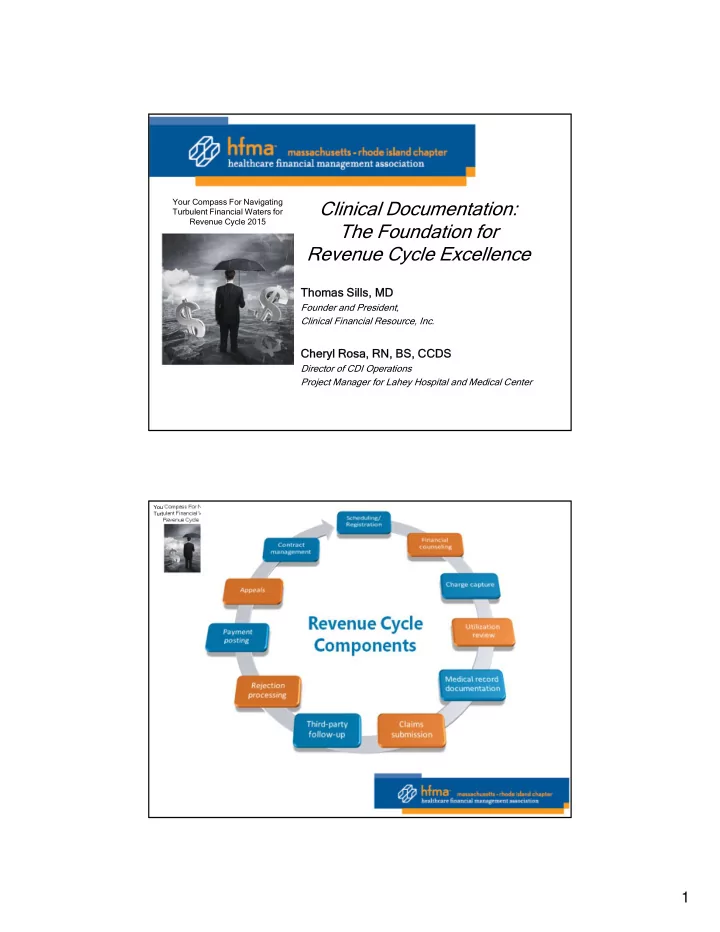
Your Compass For Navigating Clinical Documentation: Turbulent Financial Waters for Revenue Cycle 2015 The Foundation for Revenue Cycle Excellence Thomas Sills omas Sills, , MD Founder and President, Clinical Financial Resource, Inc . Che


slide-1
SLIDE 1

1

Your Compass For Navigating Turbulent Financial Waters for Revenue Cycle 2015

Clinical Documentation: The Foundation for Revenue Cycle Excellence

Thomas Sills

  • mas Sills,

, MD

Founder and President, Clinical Financial Resource, Inc.

Che Cheryl Ros Rosa, , RN, BS, CCDS RN, BS, CCDS

Director of CDI Operations Project Manager for Lahey Hospital and Medical Center

Your Compass For Navigating Turbulent Financial Waters for Revenue Cycle 2015

slide-2
SLIDE 2

2

Your Compass For Navigating Turbulent Financial Waters for Revenue Cycle 2015

Financial Drivers of Clinical Documentation Improvement (CDI)

  • DRGs
  • Professional Coding and Billing
  • OPPS
  • HCC

Your Compass For Navigating Turbulent Financial Waters for Revenue Cycle 2015

Financial Drivers of Clinical Documentation Improvement

  • Pay for Performance

– Value Based Purchasing – HACRP – HRRP – PSIs – IQIs – HACs

slide-3
SLIDE 3

3

Your Compass For Navigating Turbulent Financial Waters for Revenue Cycle 2015

Financial Impact of CDI on Inpatient Revenue

Increase CMI from 1.3 to 1.4 at mid-size hospital with blended rate of $6000 and 4000 discharges/year: 0.10 X $6000/discharge X 4000 discharges/yr = $2,400,000 per year

Your Compass For Navigating Turbulent Financial Waters for Revenue Cycle 2015

Financial Impact of Clinical Documentation on Medicare Advantage

  • Increase average RAF (risk adjustment factor)

per patient from 1.0 to 1.1 based on

  • documentation. The effect on Health Plan with

$600 pmpm payment and 10,000 covered lives: 0.10 X $600 pmpm X 10,000 members = $600,000/month increase

slide-4
SLIDE 4

4

Your Compass For Navigating Turbulent Financial Waters for Revenue Cycle 2015

Financial Impact of Documentation

  • n Professional Billing
  • Increase E&M levels from average of 3.5 to 4.1

in Emergency Department with 30,000 visits per year

  • Equivalent to an increase in 0.81 RVUs per

encounter. 0.81 rvu/pt X $35/rvu X 30,000 pts/yr = $850,000/yr

Your Compass For Navigating Turbulent Financial Waters for Revenue Cycle 2015

Financial Impact of Documentation

  • n Pay for Performance Measures
  • Inadequate documentation result in falsely elevated

numbers of Patient Safety Indicators (PSIs) and poor risk adjustment of severity of inpatient cases can result in loss of Medicare revenue:

– 1% in HACRP – 1.5% in VBP – 3.0% in HRPP For Hospital with $35,000,000 in annual Medicare Revenue, 5.5% of $35M = $1,925,000 is at risk

slide-5
SLIDE 5

5

Your Compass For Navigating Turbulent Financial Waters for Revenue Cycle 2015

Clinical Documentation Impact on Coding

  • Documentation determines coding
  • Coding determines:

– Payment – Quality metrics – Resource utilization metrics – Risk adjustment of cases – Pay for Performance – Medical necessity

Your Compass For Navigating Turbulent Financial Waters for Revenue Cycle 2015

Coding: Healthcare’s Clinical Accounting System

  • Every encounter/claim

– ICD-9 diagnosis code

  • Reason for service
  • Justification for Medical Necessity
  • Risk adjust encounter/pt
  • Determines payment

– ‘Service Code’

  • E&M code
  • CPT procedure code
  • ICD-9 procedure Code
  • Determines Payment
slide-6
SLIDE 6

6

Your Compass For Navigating Turbulent Financial Waters for Revenue Cycle 2015

Lahey CDI Program

  • History

– 2011 - 0.75 FTE – 2012 – 1.5 FTE – 2013 – 2.0 FTE – 2014 – 3 FTE – 2015 – 5 FTE

Your Compass For Navigating Turbulent Financial Waters for Revenue Cycle 2015

Targeting of Cases

  • Small vs. Large CDI staff
  • Medicine vs. Surgery
  • Information sources for targeting

– Coding/DRG validation – Physician Advisor – Quality – Case management

slide-7
SLIDE 7

7

Your Compass For Navigating Turbulent Financial Waters for Revenue Cycle 2015

Technology

  • CDI tracking

– Manual – CDIS 3M 360

Your Compass For Navigating Turbulent Financial Waters for Revenue Cycle 2015

Communication

  • Interaction between Departments

– CDI – Coding – Quality – Case Management – ACO

slide-8
SLIDE 8

8

Your Compass For Navigating Turbulent Financial Waters for Revenue Cycle 2015

Physician Engagement

  • Education and involvement by Physician

Advisor

  • Repetition
  • Building close relationships

Your Compass For Navigating Turbulent Financial Waters for Revenue Cycle 2015

Data Collected

  • Volume
  • Percentage of Queries
  • Physician response rate
  • SOI/ROM
  • UHC data
  • CMI
slide-9
SLIDE 9

9

Your Compass For Navigating Turbulent Financial Waters for Revenue Cycle 2015

17

$2,977,653 $3,050,974 $5,102,440 $4,699,702 $15,830,769 $4,465,738 $4,503,084 $7,930,563 $7,197,071 $24,096,456 $1,488,085 $1,452,110 $2,828,123 $2,497,369 $8,265,687

$0 $5,000,000 $10,000,000 $15,000,000 $20,000,000 $25,000,000 $30,000,000

Q1 Q2 Q3 Q4 YTD

CDIP/CDIS Query Financial Impact FY 14

Pre‐Query Reimbursement Post‐Query Reimbursement Difference

Your Compass For Navigating Turbulent Financial Waters for Revenue Cycle 2015

18

1348 1419 1991 2283 7041 471 491 737 700 2399 371 376 488 438 1673 100 115 249 262 726 79% 77% 66% 63% 70%

1000 2000 3000 4000 5000 6000 7000 Q1 Q2 Q3 Q4 YTD

CDIP/CDIS Query Response Rate FY 14

Total Charts Reviewed Total Queries MD Responded No Response % Rate Response

slide-10
SLIDE 10

10

Your Compass For Navigating Turbulent Financial Waters for Revenue Cycle 2015

19

No Response, MD Queries, September 2014

Attending Physician Service: Query Type: Pre-Query Financial I mpact Post-Query Financial I mpact

CARDI OLOGY 003 Clinical Findings $74,058.73 $109,851.39 $35,792.66 COLON RECTAL SURGERY GENERAL I NTERNAL MEDI CI NE HEPATOBI LI ARY SERVI CES HOSPI TALI STS NEUROSURGERY HOSPI TALI STS 041 Pneumonia Specificity $7,813.35 $7,813.35 $0.00

Your Compass For Navigating Turbulent Financial Waters for Revenue Cycle 2015

20

No Response, MD Queries, September 2014

Attending Physician Service: Query Type: Pre-Query Financial I mpact Post-Query Financial I mpact Difference

GENERAL I NTERNAL MEDI CI NE 210 Documentation Clarification $60,172.99 $77,055.21 $16,882.22 HOSPI TALI STS ORTHOPAEDI C SURGERY PERI PHERAL/ VASCULAR SURGERY VASCULAR MEDI CI NE HOSPI TALI STS 227 Rule Out Sepsis $8,071.65 $8,071.65 $0.00

slide-11
SLIDE 11

11

Your Compass For Navigating Turbulent Financial Waters for Revenue Cycle 2015

21

1348 1419 1991 2143 6901 206 217 319 340 1082 108 147 235 207 697 222 263 450 554 1489 1000 2000 3000 4000 5000 6000 7000 8000 Q1 Q2 Q3 Q4 YTD

CDIP/CDIS SOI and ROM Increases FY 14

Total Charts Total # Cases w/ SOI Increase Total # Cases w/ ROM Increase Total # Cases w/SOI/ROM Increase

Your Compass For Navigating Turbulent Financial Waters for Revenue Cycle 2015

22

slide-12
SLIDE 12

12

Your Compass For Navigating Turbulent Financial Waters for Revenue Cycle 2015

23

Your Compass For Navigating Turbulent Financial Waters for Revenue Cycle 2015

24

slide-13
SLIDE 13

13

Your Compass For Navigating Turbulent Financial Waters for Revenue Cycle 2015

25

Your Compass For Navigating Turbulent Financial Waters for Revenue Cycle 2015

26

slide-14
SLIDE 14

14

Your Compass For Navigating Turbulent Financial Waters for Revenue Cycle 2015

27

1.8401 1.8278 1.7681

1.6900 1.7100 1.7300 1.7500 1.7700 1.7900 1.8100 1.8300 1.8500 1.8700 1.8900

FY 14 FY 13 FY 12

CMI FY 14, 13, 12

Your Compass For Navigating Turbulent Financial Waters for Revenue Cycle 2015

28

1.2115 1.2152 1.1739

1.15 1.16 1.17 1.18 1.19 1.2 1.21 1.22

FY 14 FY 13 FY 12

Medical CMI FY 14, 13, 12

slide-15
SLIDE 15

15

Your Compass For Navigating Turbulent Financial Waters for Revenue Cycle 2015

29

2.8384 2.8112 2.6949

2.6 2.65 2.7 2.75 2.8 2.85

FY 14 FY 13 FY 12

Surgical CMI FY 14, 13, 12

Your Compass For Navigating Turbulent Financial Waters for Revenue Cycle 2015

30

Depar Department tment Depar Department tment

Department

Hospital Medicine first group Surgical Critical Care

Vascular Surgery and MIDLEVELS

Gastroenterology Neurology

Surgical Residents

Residents Radiology/IR

Neurosurgery Mid‐levels

GIM~BUR Cardiothoracic Surgery Neuro Mid‐levels Hematology/ Oncology Colorectal Transplant Hospital Medicine second group General Surgery Emergency Medicine Cardiology Gynecology Urology Infectious Disease Neurosurgery Case Management Nephrology Orthopedic Surgery Quality Pulmonary and Midlevel's Orthopedic Mid‐Levels Coding Plastic Surgery Admitting

CDI PRESENTATION SCHEDULE, FY14

slide-16
SLIDE 16

16

Your Compass For Navigating Turbulent Financial Waters for Revenue Cycle 2015

31

  • For all services increasing verbal queries, being more aggressive with the surgical

specialties, utilizing other services to improve information sharing to optimize inpatient cases, trying to maximize capture of POA electrolyte imbalances and PMH for SOI/ROM, trying to get diagnoses specified instead of symptoms (i.e. AMS, chest pain, fall etc.)

  • For all services trying to educate re: all HAC’s but a strong focus on appropriate

documentation of CAUTI’s and CLABSI’s not POA but when appropriate to document clinically unable to determine, if not proven source.

  • For all PSI’s, emphasis is on clarifying when conditions are intrinsic to procedure and

not of clinical significance, so complication codes are only assigned where appropriate.

  • For all HAC’s clear documentation when can find evidence was POA (pressure ulcers,

PNA’s, DVT’s, CAUTI’s and CLABSI’s).

CDIS FOCUS for FY15

Your Compass For Navigating Turbulent Financial Waters for Revenue Cycle 2015

32

Intensivists: really stepped up education with Physicians via several meetings and ongoing 1:1. Focus

  • n POPI when appropriate, early sepsis (v. post op), shock instead of ‘hemodynamic instability’ or
  • hypotension. Trying to coordinate efforts with Intensivist documentation/education with that of main

services that admit to SICU to minimize conflict. Cardiology: More recent focus with cardiology attendings to document hypertensive heart Disease w/ CKD to capture MCC when admission for CHF exacerbation only. Using ‘small’ NSTEMI over demand ischemia when appropriate. Generally they are doing very well specifying heart failure.

  • Ongoing focus on maximizing SOI/ROM by querying for CKD stage, DM complications, and complete

PMH’s.

  • PSI/HAC focus: Accidental puncture/Lac, Metabolic derangement, AKI

Neuro: Continue to maximize capture of high impact Neurology Diagnoses including Cerebral Edema and Compression of Brain, Obstructive Hydrocephalus and Hemiparesis, Accelerated HTN, TIA’s going for underlying cause.

  • Reinforcement in Education session promises greater attending by-in, spoke directly to need for attending
  • versight of mid-levels to assure highest rate of capture possible
  • PSI/HAC focus: Dural tear (separate coding from Accidental puncture/Lac), AKI (toxic nephropathy)

CDIS FOCUS for FY15

slide-17
SLIDE 17

17

Your Compass For Navigating Turbulent Financial Waters for Revenue Cycle 2015

33

Vascular: DM complications and underlying causes for ulcers, ischemia. CKD staging. Sepsis w/ post op wound infections PSI/HAC focus: POPI (w/ Intensivist), DVT’s (make sure clear documentation when POA) Heme – Onc: Malnutrition and pancytopenia, including r/t to chemo. Clarification re: active CA’s v. Hx. CKD/AKI. Cerebral edema/compression of brain w/ brain lesions/masses/CA PSI focus: CLABSI’s, CAUTI’s, pressure ulcers Ortho: Maximize POA Diagnoses, post op capturing expected ABLA when fractures present, acute drop in Hematocrit when expected post op no fracture, DVT’s POA *Cases with complication issues usually get transferred to hospitalists, so have worked with them re: specific documentation needed when intrinsic or expected. PSI focus: postoperative anemia (see above), DVT’s, complications of prosthetics, POPI with Intensivists Urology: CKD staging, DM complications, Cancer documentation (active Dx v. Hx) to maximize SOI/ROM, Sepsis/SIRS (Urosepsis) PSI focus: post op AKI (need to clarify guidelines during education session as we have w/ Cardiothoracic), postop anemia, Accid., Punct./Lac, POPI (w/ Intensivists) Hospitalists/GIM (All CDI’s): Diagnoses for symptoms. Maximizing PMH (CKD stage, DM complications, active conditions). Documentation of Acute Resp Fx, Encephalopathy, Malnutrition w/ severity, Sepsis/SIRS, CHF specificity,

  • AKI. Still need to improve documentation of likely complex PNA’s

PSI/HAC focus: general guidance/education to document when intrinsic to procedure v. a complication, when possibly POA (pressure ulcers, DVT’s, PNA’s, CAUTI’s).

CDIS FOCUS for FY15

Your Compass For Navigating Turbulent Financial Waters for Revenue Cycle 2015

34

Hepato-Biliary: Queries to clarify when hepatic encephalopathy active Dx v. PMH, AKI/CKD, complications of transplanted organs, post-op complications (typically infection/abscesses, retroperitoneal hemorrhage), Acute Liver Injury (when doesn’t meet criteria for shock liver) PSI/HAC focus: Accid. Punct./Lac., Anemia, POPI (with Intensivists) ColoRectal: Clarifying abscess to capture MCC when intra-abdominal, sepsis/SIRS queries, Malnutrition, early sepsis v. post op sepsis PSI/HAC focus: Accid. Punct./Lac., POPI (with Intensivists), post op sepsis, ileus

  • Gen. Surg.: Sepsis/SIRS, CKD staging/AKI, abscesses,

PSI/HAC focus: Accid. Punct./Lac, POPI (trauma, with Intensivists), post op ileus Cardiothoracic: New understanding/goals following meeting w/ MD Validator, emphasis on capturing SOI/ROM via PMH (CKD stage, DM comp., chronic CHF specificity. Seems to be some consensus agreement w/ documenting ‘acute drop in hematocrit’ as more accurate than ‘expected acute blood loss anemia’, will use this for queries going forward. Clarified CTS guidelines for querying for AKI (typically post op). Also broached topic of POPI. PSI/HAC focus: Pneumothorax excluded as PSI, Accid., Punct/Lac, AKI (only PSI if dialysis)

CDIS FOCUS for FY15
slide-18
SLIDE 18

18

Your Compass For Navigating Turbulent Financial Waters for Revenue Cycle 2015

35 FY 2015 Medical Staff EDUCATION Objectives for CDIS

  • 1. Verbal Engagement/physicians and midlevels
  • A. DRG and APR‐DRG assignment
  • B. SOI/ROM
  • C. Value Based Purchasing

i. PSIs/HACS

  • 2. ICD‐10 Specialty Specific Education
  • 3. Education of Medical Staff leadership regarding

documentation and coding impact on VBP

Your Compass For Navigating Turbulent Financial Waters for Revenue Cycle 2015

How does CDI translate documentation into RESULTS?

slide-19
SLIDE 19

19

Your Compass For Navigating Turbulent Financial Waters for Revenue Cycle 2015

CDI target: DRGs

78 y/o admitted thru ER with fever, confusion and UTI. T-102.2, BP86/60, WBC-15,000, lactate 4.8. Pt is admitted to ICU with UTI and hemodynamic

  • instability. Will tx with ABX, fluids and pressors as needed.

Princi Principal dx: dx: UT UTI DRG: 690 UT DRG: 690 UTI I w/o cc w/o cc Paymen Payment: t: $5200 $5200 ROM/SO ROM/SOI: I: 1 / 1 1 / 1 78 y/o admitted thru ER with fever, confusion and UTI. T-102.2, BP86/60, WBC-15,000, lactate 4.8 Pt is admitted to ICU with Sepsis due to UTI. Meets SIRS criteria. Suspect early septic shock evidenced by hemodynamic instability and acidosis. Likely metabolic encephalopathy. Tx with ABX, fluids and pressors . Princ Principal dx: dx: Sepsi Sepsis DR DRG: 871 Sepsi : 871 Sepsis w w mcc mcc sec dxes sec dxes: : sep septic shoc shock, UTI, UTI, Paym Paymen ent: t: $13,0 $13,000 acido acidosis, is, encep encepha halopathy ROM/SO ROM/SOI: 3 : 3 / / 3

Your Compass For Navigating Turbulent Financial Waters for Revenue Cycle 2015

CDI target: DRGs

78 y/o admitted thru ER with abd pain x 6 hours, Tender abdomen with rebound. T-99.2, WBC-15,000, Cr 1.8 CT with free air in abdomen. Pt taken to OR. Perforated diverticulitis dxed. Turbid peritoneal fluid present. Hemicolectomy with peritoneal irrigation. Princ Principal dx: dx: diverti iverticulitis is DRG: Major DRG: Major colon colon surge surgery w/o cc w/o cc Paymen Payment: t: $13,0 $13,000 ROM/SO ROM/SOI: I: 2 / 1 2 / 1 78 y/o admitted thru ER with abd pain x 6 hours, Tender abdomen with rebound. PMH-CKD T-99.2, WBC-15,000, CT with free air in abdomen. Pt taken to OR. Perforated diverticulitis dxed. Turbid peritoneal fluid present. Hemicolectomy, peritoneal irrigation. Peritonitis documented Princ Principal dx: dx: diverti iverticulitis is DRG: Major DRG: Major colon colon surge surgery w mcc w mcc sec dxes sec dxes: : periton itonitis, c itis, ckd Paym Paymen ent: t: $41,0 $41,000 ROM/SO ROM/SOI: I: 3 / 3 3 / 3

slide-20
SLIDE 20

20

Your Compass For Navigating Turbulent Financial Waters for Revenue Cycle 2015

Medicare Advantage

  • Medicare HMOs
  • 25% of all Medicare patients
  • Payment is per member per month to

HMO

  • HMO contracts with hospital and MDs
  • Risk adjusted by HCC

Your Compass For Navigating Turbulent Financial Waters for Revenue Cycle 2015

HCC Hierarchical Condition

Category

  • Risk Adjustment System
  • Based on demographic factors and on

ICD-9 diagnosis codes

  • Patient is assigned to one or more of

approximately 70 HCCs

  • HCCs are designed to predict utilization of

all Healthcare

slide-21
SLIDE 21

21

Your Compass For Navigating Turbulent Financial Waters for Revenue Cycle 2015

HCC Example

Risk Risk Fact Factors

  • rs

RAF RAF 76 y/o female 0.468 Medicaid Eligible 0.177 Total RAF 0.645 PMPM payment $485 Annual Payment $5805

Your Compass For Navigating Turbulent Financial Waters for Revenue Cycle 2015

Risk Risk Fact Factors

  • rs

RAF RAF 76 y/o female 0.468 Medicaid Eligible 0.177 Diabetes (HCC 19) 0.181

Vascular Dis. w/o chronic condition(HCC 105)

0.324 Total RAF 1.15 PMPM payment $863 Annual Payment $10,350

slide-22
SLIDE 22

22

Your Compass For Navigating Turbulent Financial Waters for Revenue Cycle 2015

Risk Risk Fact Factor

  • r

RAF RAF 76 y/o female 0.468 Medicaid Eligible 0.177

DM vasculopathy(HCC15)

0.608

Vascular Dis. w chronic condition(HCC 104)

0.645 CHF 80 0.395

Disease Interaction

0.204

Total RAF 2.497 PMPM payment $1873 Annual Payment $22,473

Your Compass For Navigating Turbulent Financial Waters for Revenue Cycle 2015

Pay for Performance (P4P)

  • CMS is transitioning from being a payer for services

rendered to a purchaser of care based on quality of services provided. Three key programs provide the framework for this transition:

– Hospital Acquired Condition Reduction Program HACRP – Hospital Value Based Purchasing HVBP – Hospital Readmission Reduction Progeram HRRP

  • Each program measures hospital performance using

defined risk adjusted outcomes and assigns rewards and penalties based on performance.

slide-23
SLIDE 23

23

Your Compass For Navigating Turbulent Financial Waters for Revenue Cycle 2015

P4P

  • P4P outcomes can impact up to 5.5% of hospital

Medicare payments.

  • These outcomes are derived from or modified by

ICD-9 codes on claims.

  • Clinical Documentation determines these code

assignments.

  • For 2015

– HACRP 1.0% – HVBP 1.5% – HRRP 3.0%

Your Compass For Navigating Turbulent Financial Waters for Revenue Cycle 2015

HACRP

(Hospital Acquired Condition Reduction Program)

  • 1% reduction in annual Medicare revenue if

hospital is in worse performing quartile

  • Determinates:

– PSI Composite 90 (Patient Safety Index) – Incidence of

  • Catheter Associated UTI (CAUTI)
  • Central Line Associated BloodStream Infection (CLABSI)
slide-24
SLIDE 24

24

Your Compass For Navigating Turbulent Financial Waters for Revenue Cycle 2015

PSI-90 composite

  • Defined by assigned codes on claims

– Accidental puncture/laceration during a procedure (998.2) – Peri Operative DVT or pulmonary embolus – Post Op Sepsis – Post Op Respiratory Failure – Post Op Hip Fracture – Central venous catheter infection – Iatrogenic pneumothorax – Pressure Ulcer – SCORES ARE GREATLY AFFECTED BY DOCUMENTATION AND CODING

Your Compass For Navigating Turbulent Financial Waters for Revenue Cycle 2015

HVBP

(Hospital Value Based Purchasing)

  • Payments for all hospital are reduced to fund an

“incentive pool” which is paid to hospitals who perform well on metrics which are based on:

– Outcome measures: PSIs, 30 day mortality rates, CLABSI, all of which are risk adjusted – Patient experience of care – Process of Care (core measures) – Efficiency

  • Includes proposal for how much episode of care cost as
  • pposed to hospital care cost
slide-25
SLIDE 25

25

Your Compass For Navigating Turbulent Financial Waters for Revenue Cycle 2015

HRRP

(Hospital Readmission Reduction Program)

  • Hospital with excess readmission for heart

failure, pneumonia, MI, COPD, Hip and Knee replacement are financially pnealized up to 3%

  • f Medicare reimbursement.

– Excludes planned readmission – Risk adjusted

Your Compass For Navigating Turbulent Financial Waters for Revenue Cycle 2015

Risk Adjustment

  • All P4P measures are risk adjusted
  • DRG and HCC payments are based on

risk adjustment concept

  • Risk adjustment is the rationale on which

changes in Healthcare purchasing are based

slide-26
SLIDE 26

26

Your Compass For Navigating Turbulent Financial Waters for Revenue Cycle 2015

Risk Adjustment

  • Adjusting the outcome measurement (readmission rates,

quality measures, resource utilization measures) based

  • n the difference in risk in specific patients that make up

the sample.

– Allows for comparison of physicians, hospitals, healthcare systems – Allows for increase payment for better care – Allows for direction of patients to preferred providers based on quality and utilization measures – Depends on accurate risk adjustment which in large part depends on accurate documentation and coding.

Your Compass For Navigating Turbulent Financial Waters for Revenue Cycle 2015

Risk Adjustment

  • Risk adjust cases by coding diagnoses that are

documented

  • Identify diagnoses that are not (adequately)

documented and obtain further documentation

  • Obtain institution wide definitions and education
  • n diagnoses that are often present but

frequently underdiagnosed.

slide-27
SLIDE 27

27

Your Compass For Navigating Turbulent Financial Waters for Revenue Cycle 2015

Public Reporting

  • Hospital Compare
  • Physician Compare
  • Insurance Plan reports
  • Health Grades

Your Compass For Navigating Turbulent Financial Waters for Revenue Cycle 2015

Health Grades

slide-28
SLIDE 28

28

Your Compass For Navigating Turbulent Financial Waters for Revenue Cycle 2015

Value Based Purchasing for Physicians

  • “value based payment modifier”
  • Will be used to adjust Medicare FFS

payments

  • Based on quality and cost measurements
  • To be phased in over 2015 to 2017
  • Based on performance beginning in 2013

Your Compass For Navigating Turbulent Financial Waters for Revenue Cycle 2015

Quality and Resource Use Reports

  • Provides report for individual physicians on

performance on 28 quality indicators

  • Resource use

– Per capita costs – Pt care directed by M.D. -35% or more care – Risk adjusted by HCC

slide-29
SLIDE 29

29

Your Compass For Navigating Turbulent Financial Waters for Revenue Cycle 2015

  • Medical Necessity
  • CMS

– 2 Midnight Rule

  • Insurance:

– InterQual – Milliman

  • Role of CDI in Medical Necessity

Your Compass For Navigating Turbulent Financial Waters for Revenue Cycle 2015

Conclusions:

  • Shifting of the payment system
  • Highly integrated program

– Staffing – Physician Advisor – Effective operational management

slide-30
SLIDE 30

30

Your Compass For Navigating Turbulent Financial Waters for Revenue Cycle 2015

Conclusion

  • Direct CDI program to multiple targets

– CMI – HCC – Professional services – P4P

Your Compass For Navigating Turbulent Financial Waters for Revenue Cycle 2015

Conclusion

  • CDI must engage physicians.
  • CDI must integrate with coding.
  • CDI must integrate with quality .
  • CDI must integrate with case

management.

  • CDI must have physician advisor
  • CDI must have effective ongoing
  • perational management