Climate Change: Action, Trends and Implications for Business The - - PowerPoint PPT Presentation

climate change
SMART_READER_LITE
LIVE PREVIEW

Climate Change: Action, Trends and Implications for Business The - - PowerPoint PPT Presentation

climate everyone s business Cambridge Judge Business School Cambridge Programme for Sustainability Leadership Climate Change: Action, Trends and Implications for Business The Intergovernmental Panel on Climate Change (IPCC) Fifth


slide-1
SLIDE 1

climate

everyone’s business

Cambridge Judge Business School Cambridge Programme for Sustainability Leadership
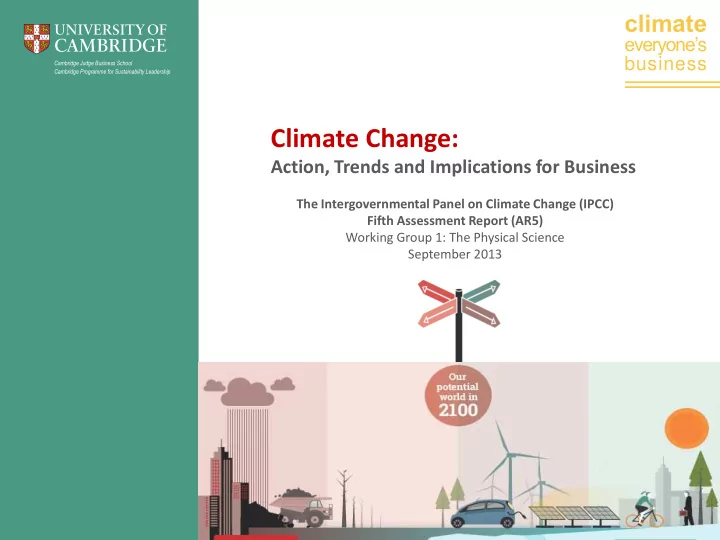
Climate Change:

Action, Trends and Implications for Business

The Intergovernmental Panel on Climate Change (IPCC) Fifth Assessment Report (AR5) Working Group 1: The Physical Science September 2013

slide-2
SLIDE 2

climate

everyone’s business

The IPCC’s Fifth Assessment Report (AR5)

  • The most up-to-date info on climate change
  • Comprehensive and relevant analysis

Working Group 1 (WGI)

  • Assesses the physical environment and
  • bserves factors likely driving climate change.
  • Models different aspects of climate change

and projects changes by the end of the century.

  • WGII (economy and population) and

WGIII (climate change mitigation) reports will be released Q2 2014.

Climate Change: Action, Trends and Implications for Business IPCC Fifth Assessment Report, Working Group 1 (WGI)

slide-3
SLIDE 3

climate

everyone’s business

WGI Key Findings: Physical science

It is at least 95% certain that human activities have caused more than half of the temperature increase since the 1950s, through the burning of fossil fuels and land-use changes such as deforestation.

  • The atmosphere and oceans are warming
  • Snow and ice are diminishing
  • Sea levels are rising
  • Weather patterns are changing
  • Oceans are acidifying

Human activities are causing a rise in global temperatures - particularly from emissions of CO2. At present, there is a net uptake of energy by the Earth system, increasing heat energy stored by the Earth. Over 90% of the excess heat is stored in the ocean.

slide-4
SLIDE 4

climate

everyone’s business

WGI Key Findings: Future climate change

Impacts by the end of the 21st century may include:

  • Global temperatures 2.6 - 4.8
  • C higher than present
  • Sea levels 0.45 - 0.82 m higher than present
  • Loss of Arctic sea ice from shrinking and thinning
  • Disruption to weather patterns:
  • More hot and fewer cold days globally
  • Longer and more frequent heatwaves
  • Dry areas will become drier and wet areas wetter
  • Carbon uptake will increase ocean acidification

‘Tipping point’ events (causing irreversible change) are possible, though there is little agreement on how likely they are or what the human consequences would be.

Due to historic emissions in the atmosphere, many changes will continue for hundreds

  • r thousands of years even if emissions are cut to zero today.

Climate changes are already occurring in all geographical regions.

slide-5
SLIDE 5

climate

everyone’s business

WGI Key Findings: Limiting warming

Total cumulative human CO2 emissions since the industrial era need to be limited.

Limiting climate change will require substantial and sustained reductions of greenhouse gas and CO2 emissions relative to pre-industrial levels.

2

  • C target

Parties to the 2010 UN Framework Convention on Climate Change (UNFCCC) agreed to commit to a maximum temperature rise of 2

  • C

above pre-industrial levels to prevent the most severe impacts of climate change, and to consider lowering that maximum to 1.5

  • C in the near future.

About half already emitted by 2011 Past Present

slide-6
SLIDE 6

climate

everyone’s business

WGI Representative Concentration Pathways (RCPs)

Four scenarios project how the climate is likely to change over the 21st century. The RCP number indicates the strength of climate change by 2100.*

* These scenarios depend on future levels of greenhouse gas emissions. The trajectory of emissions mainly depends on policy choices made by governments.

slide-7
SLIDE 7

climate

everyone’s business

What climate change means for business

  • Rising temperatures, rising sea levels, changes in rainfall patterns, disappearing glaciers and

acidifying seawater will have direct impacts on some business sectors.

  • Government policy changes will bring different sets of impacts for business.
  • Limiting climate change will require substantial and sustained reductions of emissions.
slide-8
SLIDE 8

For more information Tim Nuthall, Project Director Joanna Benn, Managing Editor Email: AR5@europeanclimate.org www.cpsl.cam.ac.uk/ipcc www.europeanclimate.org

Cambridge Judge Business School Cambridge Programme for Sustainability Leadership