Climate Change Preparing the Historic Environment to Meet the - - PowerPoint PPT Presentation

climate change
SMART_READER_LITE
LIVE PREVIEW

Climate Change Preparing the Historic Environment to Meet the - - PowerPoint PPT Presentation

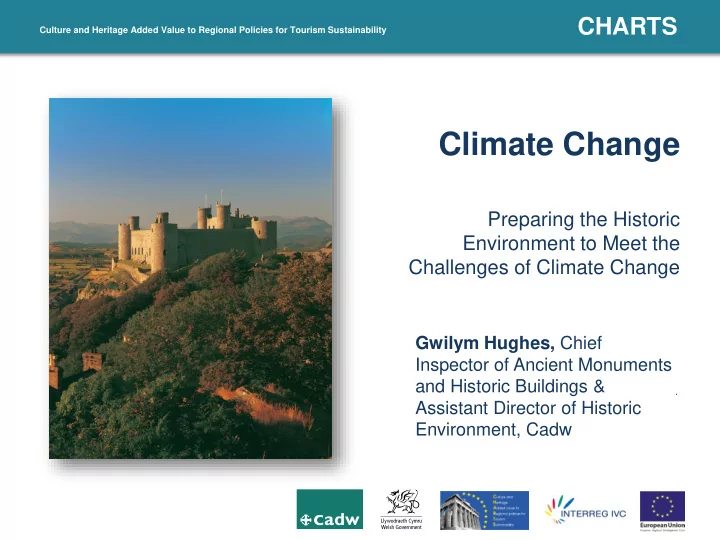
CHARTS Culture and Heritage Added Value to Regional Policies for Tourism Sustainability Climate Change Preparing the Historic Environment to Meet the Challenges of Climate Change Gwilym Hughes, Chief Inspector of Ancient Monuments and


slide-1
SLIDE 1

Culture and Heritage Added Value to Regional Policies for Tourism Sustainability

Climate Change

Preparing the Historic Environment to Meet the Challenges of Climate Change

.
CHARTS

Gwilym Hughes, Chief Inspector of Ancient Monuments and Historic Buildings & Assistant Director of Historic Environment, Cadw

slide-2
SLIDE 2

Introduction

The Wales Approach 1. Key classes of historic asset 2. Key predicted changes in the climate 3. How might these challenges impact on each of the classes of historic asset identified. 4. Developing an implementation framework action plan

1

Culture and Heritage Added Value to Regional Policies for Tourism Sustainability

CHARTS

slide-3
SLIDE 3

Climate Change in Wales

Latest predictions:

  • Warmer mean temperatures
  • Hotter drier summers
  • Warmer wetter winters
  • More frequent extreme weather

events

2

Culture and Heritage Added Value to Regional Policies for Tourism Sustainability

CHARTS

article story

slide-4
SLIDE 4

Climate Change in Wales

Responses to climate change

  • The impact of mitigation to reduce

the threat of climate change

  • The impact of some adaptive

responses to climate change

3

Culture and Heritage Added Value to Regional Policies for Tourism Sustainability

CHARTS

slide-5
SLIDE 5

The Direct Impact of Climate Change

First steps

  • Considering the consequences or

challenges of climate change

  • Considering the broad classes of

historic asset that might be affected

4

Culture and Heritage Added Value to Regional Policies for Tourism Sustainability

CHARTS

slide-6
SLIDE 6

Direct Impact of Climate Change

Challenges

  • Rise in sea levels
  • Frequent high winds/storms
  • More frequent flooding events
  • Drying out of wetlands
  • Drying and shrinking of clay soils
  • Longer growing season
  • Stress on some trees and plants
  • Migration of pests and diseases into Britain

5

Culture and Heritage Added Value to Regional Policies for Tourism Sustainability

CHARTS

slide-7
SLIDE 7

Classes of Historic Asset Affected

  • Historic landscapes
  • Historic parks and gardens
  • Historic forestry and

woodland

  • Historic buildings

6

Culture and Heritage Added Value to Regional Policies for Tourism Sustainability

CHARTS

slide-8
SLIDE 8

Classes of Historic Asset Affected

  • Historic assets below the 1.0m

contour

  • Historic assets on floodplains

and valley bottoms

  • Historic assets located in

coastal and marine environments

7

Culture and Heritage Added Value to Regional Policies for Tourism Sustainability

CHARTS

slide-9
SLIDE 9

Classes of Historic Asset Affected

8

Culture and Heritage Added Value to Regional Policies for Tourism Sustainability

CHARTS

  • Archaeological sites on peat, peaty

soils and blanket bog

  • Archaeological sites in upland areas
  • Archaeological sites on farmland
slide-10
SLIDE 10

The Risk Assessment

9

Culture and Heritage Added Value to Regional Policies for Tourism Sustainability

CHARTS

By assessing :

  • The extent of the impact
  • The severity of the impact
  • The sensitivity of the asset

Significance of impact = extent x severity x significance

slide-11
SLIDE 11

10

Culture and Heritage Added Value to Regional Policies for Tourism Sustainability

CHARTS Overall Risk Matrix

slide-12
SLIDE 12

Summary of Risks

11

Culture and Heritage Added Value to Regional Policies for Tourism Sustainability

CHARTS

  • Rising sea levels –

endangering historic landscapes, buildings and archaeology in the coastal zone

  • Coastal Erosion –

affecting historic sites on the coast Sites below 1m: 312

slide-13
SLIDE 13

Summary of Risks

12

Culture and Heritage Added Value to Regional Policies for Tourism Sustainability

CHARTS

  • Extreme weather – damage to historic

landscapes and buildings

  • More frequent intense rainfall – erosion of

archaeological sites and damaging flooding historic settlements Sites at risk of flooding: 12,745

slide-14
SLIDE 14

Summary of Risks

13

Culture and Heritage Added Value to Regional Policies for Tourism Sustainability

CHARTS

  • Changes in vegetation patterns – affecting

landscapes and parks and gardens

  • Pests - affecting historic buildings
slide-15
SLIDE 15

Summary of Risks

14

Culture and Heritage Added Value to Regional Policies for Tourism Sustainability

CHARTS

  • Drying out of soils – such as

upland peat and wetlands Sites over peat-type soils: 18,295

slide-16
SLIDE 16

Implementation Framework

Recording and surveying sites at risk

15

Culture and Heritage Added Value to Regional Policies for Tourism Sustainability

CHARTS

slide-17
SLIDE 17

Implementation Framework

Rescue excavation

16

Culture and Heritage Added Value to Regional Policies for Tourism Sustainability

CHARTS

slide-18
SLIDE 18

Implementation Framework

Arfordir: coastal survey

17

Culture and Heritage Added Value to Regional Policies for Tourism Sustainability

CHARTS

slide-19
SLIDE 19

18

Culture and Heritage Added Value to Regional Policies for Tourism Sustainability

CHARTS

  • 1. Define the assets
  • 2. Group these assets into categories
  • 3. Define the challenge that climate change will bring
  • 4. Undertake the risk assessment
  • 5. Develop implementation framework

Transferring the Approach

slide-20
SLIDE 20

19

Culture and Heritage Added Value to Regional Policies for Tourism Sustainability

CHARTS

Impact of Climate Change on historic environments in Västra Götaland

Transferring the Approach

slide-21
SLIDE 21

20

Culture and Heritage Added Value to Regional Policies for Tourism Sustainability

CHARTS The Workshop Exercise

For your region:

  • identify three or four heritage sites or groups of heritage assets that might be

impacted by climate change

  • consider three or four challenges that climate change poses
  • Map these challenges against your defined heritage assets, consider the

extent and severity of the impact and the sensitivity of the assets/s concerned

  • Consider actions that might form part of the implementation framework