Climate Change: Advocates for TDM Provides professional growth - - PDF document

climate change
SMART_READER_LITE
LIVE PREVIEW

Climate Change: Advocates for TDM Provides professional growth - - PDF document

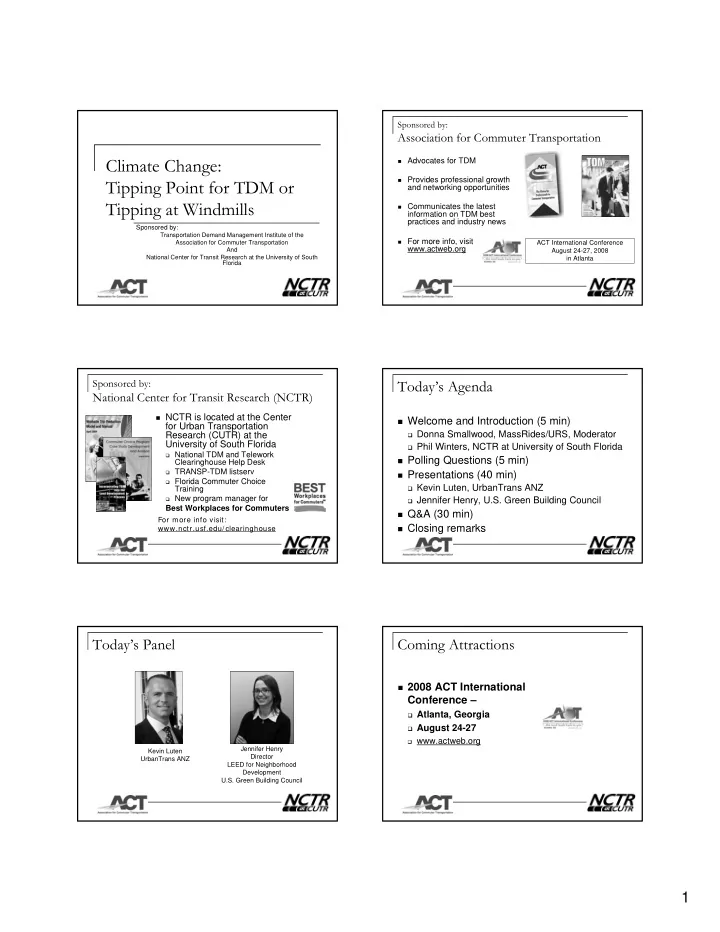
Sponsored by: Association for Commuter Transportation Climate Change: Advocates for TDM Provides professional growth Tipping Point for TDM or and networking opportunities Tipping at Windmills Communicates the latest information on


slide-1
SLIDE 1

1

Climate Change: Tipping Point for TDM or Tipping at Windmills

Sponsored by: Transportation Demand Management Institute of the Association for Commuter Transportation And National Center for Transit Research at the University of South Florida

Sponsored by:

Association for Commuter Transportation

Advocates for TDM Provides professional growth

and networking opportunities

Communicates the latest

information on TDM best practices and industry news

For more info, visit

www.actweb.org

ACT International Conference August 24-27, 2008 in Atlanta

Sponsored by:

National Center for Transit Research (NCTR)

NCTR is located at the Center

for Urban Transportation Research (CUTR) at the University of South Florida

National TDM and Telework

Clearinghouse Help Desk

TRANSP-TDM listserv Florida Commuter Choice

Training

New program manager for

Best Workplaces for Commuters

For more info visit: www.nctr.usf.edu/ clearinghouse

Today’s Agenda

Welcome and Introduction (5 min)

Donna Smallwood, MassRides/URS, Moderator Phil Winters, NCTR at University of South Florida

Polling Questions (5 min) Presentations (40 min)

Kevin Luten, UrbanTrans ANZ Jennifer Henry, U.S. Green Building Council

Q&A (30 min) Closing remarks

Today’s Panel

Jennifer Henry Director LEED for Neighborhood Development U.S. Green Building Council Kevin Luten UrbanTrans ANZ

Coming Attractions

2008 ACT International

Conference –

Atlanta, Georgia August 24-27

www.actweb.org

slide-2
SLIDE 2

TDM & Climate Change TDM & Climate Change

Kevin Luten Kevin Luten

slide-3
SLIDE 3

Transport is fastest growing sector of GHG

emissions in OECD (↑25%) and non-OECD (↑36%) countries (1990-2002)

Similar growth forecast through 2030 Fastest growth in non-OECD countries, yet

OECD transport emissions still very significant

Climate Change & Transportation Climate Change & Transportation

slide-4
SLIDE 4

Socolow and Pacala, Princeton University Transportation Wedge Options:

  • Increase fuel economy of two billion cars from 30 to 60 mpg
  • Drive two billion cars on ethanol or hydrogen*
  • Drive two billion cars not 10,000 but 5,000 miles/year (at 30 mpg)
slide-5
SLIDE 5

Climate Change & Transportation Climate Change & Transportation

  • Transport solutions:
  • 1. Fuel-efficiency (vehicle & engine design)
  • 2. Decrease carbon intensity of fuels
  • 3. Reduce vehicle miles traveled
  • Total success with #1 and #2 does not address:
  • Traffic congestion
  • Public health

TDM & Climate Change TDM & Climate Change

Are there opportunities for TDM related to climate change? Who are we selling TDM to?

  • Individuals
  • Businesses
  • Political leaders
slide-6
SLIDE 6

TDM & Climate Change TDM & Climate Change

Distinctions in TDM sales angles…

  • Congestion
  • Air quality
  • Public health (stress, obesity, etc.)
  • Business bottom-line benefits
  • Environmental benefits
  • Energy efficiency, energy independence
  • More…

Climate Change & Individuals Climate Change & Individuals

Individuals…

  • Washington Post / ABC News Poll:
  • Doubling within a year of Americans (33%)

that think climate change is biggest environmental problem facing the world

  • Single digits in mid-1990s
  • Katrina, temperatures, other weather events
  • Inconvenient Truth
  • IPCC Report, Stern Report
  • Nobel Prize
slide-7
SLIDE 7

Climate Change & Individuals Climate Change & Individuals

Washington Post / ABC News Poll:

  • How willing are you personally to change some
  • f the things you do in order to help improve

the environment - very willing, somewhat willing, not so willing or not willing at all?

  • 94% - willing, somewhat willing
  • What if it means some personal inconvenience
  • would you be as willing to change some of the

things you do, or less so?

  • 85% - still willing

Climate Change & Individuals Climate Change & Individuals

slide-8
SLIDE 8

Climate Change & Individuals Climate Change & Individuals

A standard environmental issue? Poll:

  • 70% feel climate change will pose a serious

threat to future generations

  • 63% believe we must start addressing it today
  • 50% believe steps must be taken today, even if

there is a high economic cost to the US

  • 40%, if politically conservatives
  • 1,000 born-again or evangelical Protestants

Climate Change & Individuals Climate Change & Individuals

Evangelical Climate Initiative:

  • Climate Change: An Evangelical Call to Action
  • Signed by 39 evangelical colleges, the

Salvation Army, Rick Warren, and others

  • Positions climate change as a moral issue and

a social justice issue

  • Calls for Federal action requiring

reductions in CO2 emissions

slide-9
SLIDE 9

Climate Change & Business Climate Change & Business

Roles for business?

  • Risk management
  • Direct opportunities
  • Competitive advantage

Reducing emissions “will save money for our customers, make us a more efficient business, and help position us to compete effectively in a carbon-constrained world.”

  • Lee Scott, Wal-mart

Climate Change & Business Climate Change & Business

Business risks

  • Physical
  • Regulatory
  • Competitive
  • Reputational
slide-10
SLIDE 10

Climate Change & Business Climate Change & Business

Carbon Disclosure Project (CDP):

  • 304 investors, US$41 trillion (32%)
  • Backed by HSBC, JP Morgan Chase, Bank
  • f America, Merrill Lynch, Goldman Sachs
  • Seeks information and data on emissions

and business risks and opportunities from climate change

  • 940 of the world’s largest companies

reported in CDP4 in 2006 (72% if FT500)

Climate Change & Business Climate Change & Business

Competitive Advantage on a Warming Planet:

  • Quantify your carbon “footprint” (GHG inventory)
  • Assess your carbon-related risks and opportunities
  • Adapt your business
  • Do it better than rivals
slide-11
SLIDE 11

GHG Inventories GHG Inventories

WRI / WBCSD Greenhouse Gas Protocol:

1.

Organisational boundaries

2.

Operational boundaries “direct” and “indirect” emissions WRI / WBCSD

slide-12
SLIDE 12

GHG Inventories GHG Inventories

Guidance for Scope 3 emissions:

  • “Relevance and significance” of these

emissions to org. operations or goals

  • As defined by any / all of 4 factors:
  • 1. Relative size
  • 2. Risk
  • 3. Stakeholder concern
  • 4. Company influence

Climate Change & Business Climate Change & Business

Wal-Mart / CDP Supply Chain Partnership

  • Measuring energy used for products sold
  • Includes procurement, manufacturing, distribution
  • Supplier pilot to focus on energy efficiency

“This is an important first step toward reaching our goal of removing non-renewable energy from the products Wal-Mart sells. This is an

  • pportunity to spur innovation and efficiency throughout our supply

chain that will not only help protect the environment but save people money at the same time.”

  • John Fleming, VP, Wal-Mart
slide-13
SLIDE 13

Climate Change & Business Climate Change & Business

Overlapping corporate initiatives:

1.

GHG emissions analysis / mitigation (CDP)

2.

Sustainability reporting (GRI)

3.

Corporate social responsibility programmes

4.

Employee health & wellness programmes

5.

Workplace TDM programs

Climate Change & Business Climate Change & Business

Critical issues moving forward:

  • Establish norms for inclusion of employee

commutes in GHG inventories for knowledge and service organization (gov’t leadership)

  • Stress process linkages
  • Carpe diem
slide-14
SLIDE 14

Climate Change & Politics Climate Change & Politics

PlaNYC: A Greener, Greater New York

  • Congestion charging, revenue for transit
  • BRT lanes
  • Increase bike paths, promote bicycling
  • Eliminate tax on hybrids

Climate Change & Politics Climate Change & Politics

US Mayors Climate Protection Agreement – 600 mayors signed on

slide-15
SLIDE 15

Climate Change & Politics Climate Change & Politics

IPCC - 2007

TDM & Climate Change TDM & Climate Change

Potential threats:

  • Individual attitudes and motivation to act

unsatisfied, or satisfied through other means

  • Cap-trade induced demand overwhelms TDM
  • Business rapidly assemble climate change

strategies without TDM

  • TDM not seen as too minor a solution
  • Political push leads to funding and

mainstreaming of sustainable transport strategies separate from TDM groups

slide-16
SLIDE 16

www.urbantrans www.urbantrans-

  • anz.com

anz.com

Kevin Luten Kevin Luten +61 (03) 9018 5435 +61 (03) 9018 5435 lutenk@urbantrans lutenk@urbantrans-

  • anz.com

anz.com

slide-17
SLIDE 17

News from the New Frontier of LEED

Piloting LEED for Neighborhood Development

Preview

Overview of USGBC & LEED Overview of LEED for Neighborhood Development TDM & LEED: Specific Credits and Future Development Q & A

slide-18
SLIDE 18

USGBC

STEWARD this market transformation OFFER expertise EDUCATE the industry and the public FORUM for industry dialog PROVIDE tools

10,000

slide-19
SLIDE 19

What is the LEED System?

LEADERSHIP in ENERGY and ENVIRONMENTAL DESIGN A leading-edge system for certifying DESIGN, CONSTRUCTION, & OPERATIONS

  • f the greenest

buildings in the world

Scores are tallied for different aspects of efficiency and design in appropriate categories. For instance, LEED assesses in detail:

  • 1. Site Planning
  • 2. Water Management
  • 3. Energy Management
  • 4. Material Use
  • 5. Indoor

Environmental Air Quality

  • 6. Innovation &

Design Process

slide-20
SLIDE 20
slide-21
SLIDE 21

LEED for Neighborhood Development is a partnership of:

LEED for Neighborhood Development is a rating system that combines elements of smart growth smart growth, new urbanism new urbanism, and green building green building into the first national standard for neighborhood design.

What is LEED for Neighborhood Development?

slide-22
SLIDE 22

There are three categories three categories of prerequisites and credits in the rating system.

Smart Location & Linkage Neighborhood Pattern & Design Green Construction & Technology

slide-23
SLIDE 23

Pilot Projects by Land Area

Mean: 298 acres Median: 30 acres

slide-24
SLIDE 24

Comparison of U.S. Pilot Locations to All Zip Codes & Urban Areas

(176 projects using the 2000 census)

Source: Criterion Planners, Census Bureau, and USGBC

27 42 Median structure age (years)

  • 8.6%

17.9% MF 20+ units

  • 8.7%

12.9% MF 5-19 units

  • 9.1%

13.5% MF 2-4 units 65.8% 52.6% SF units 2.59 2.65 Person/household Housing 25.5 25.3 Mean travel time to work (min.) (c) 3.3% 3.7% Work at home

  • 3.4%

7.5% Cycle/walk

  • 4.7%

11.7% Public transportation 12.2% 12.1% Carpool

  • 75.7%

64.3% Drive alone Work Commute $41,994 $44,484 Median household income

  • 1,221

5,890 Persons/sq.mi. 22.4% 9.1% Rural location 77.6% 90.9% Urban area location (b) Population Potential Climate Change Benefits (a) All Zip Codes Pilot Zip Codes Census Item

slide-25
SLIDE 25

Notable Location & Travel Differences

Source: Criterion Planners and USGBC

Development Timeline for Rating System

2007: Pilot Program launches

2008: Revisions to rating system Public comment periods held

2009: Full post‐pilot rating system ballot and launch

slide-26
SLIDE 26

LEED and TDM Credits in other LEED Rating Systems

SS Credit 2: Development Density & Community Connectivity SS Credit 4.1: Alternative Transportation: Public Transportation Access SS Credit 4.2: Alternative Transportation: Bicycle Storage & Changing Rooms SS Credit 4.3: Alternative Transportation: Low Emitting & Fuel Efficient Vehicles SS Credit 4.4: Alternative Transportation: Parking Capacity

slide-27
SLIDE 27

Credits in LEED for Neighborhood Development

NPD Credit 10: Transportation Demand Management 2 Points Intent Reduce energy consumption and pollution from motor vehicles by encouraging use of public transit. Requirements OPTION 1 TDM program for the project aimed at reducing trips by at least 20%; and fund for a minimum of two years following buildout of the project; OPTION 2 Provide transit passes valid for at least one year, subsidized to be half of regular price or cheaper, to each resident and employee for the first three years; OR OPTION 3 Provide transit service (with vans, shuttles, buses) to rail, ferry, or other major transit facilities and/or another major destination such as a retail or employment center, for at least two years.

Credits in LEED for Neighborhood Development

SLL Credit 4 Reduced Automobile Dependence SLL Credit 5 Bicycle Network NPD Credit 6 Reduced Parking Footprint NPD Credit 7 Walkable Streets NPD Credit 9 Transit Facilities

slide-28
SLIDE 28

Evolution of LEED

  • Convergence of rating systems
  • Streamlining
  • Project-appropriate requirements
  • Performance-based whenever practical
  • Overall weighting

Stay connected to LEED for Neighborhood Development…

Visit www.usgbc.org/leed/nd Download the complete LEED for Neighborhood Development Pilot Rating System. View a complete list of pilot projects. Sign up for our corresponding committee listserv to receive announcements.

slide-29
SLIDE 29

Q & A