Climate Change in the Pacific Hon. Ralph Regenvanu, Minister of - - PowerPoint PPT Presentation

climate change in the pacific
SMART_READER_LITE
LIVE PREVIEW

Climate Change in the Pacific Hon. Ralph Regenvanu, Minister of - - PowerPoint PPT Presentation

Strategies for Preserving Cultural Heritage in Climate Change in the Pacific Hon. Ralph Regenvanu, Minister of Lands and Natural Resources, Government of Vanuatu Building Small Island Resilience to Global Climate Change | September 20-23, 2016 |


slide-1
SLIDE 1

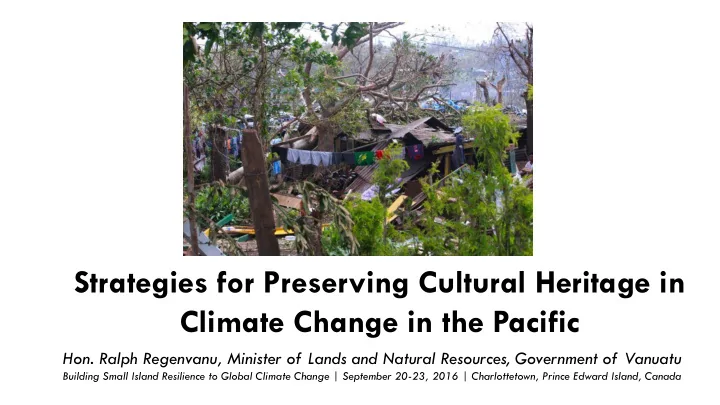
Strategies for Preserving Cultural Heritage in Climate Change in the Pacific

  • Hon. Ralph Regenvanu, Minister of Lands and Natural Resources, Government of Vanuatu

Building Small Island Resilience to Global Climate Change | September 20-23, 2016 | Charlottetown, Prince Edward Island, Canada

slide-2
SLIDE 2
slide-3
SLIDE 3

MELANESIA

slide-4
SLIDE 4

REPUBLIC OF VANUATU

slide-5
SLIDE 5
slide-6
SLIDE 6

DEFN: INTANGIBLE CULTURAL HERITAGE

For the purposes of this Convention, 1.The “intangible cultural heritage” means the practices, representations, expressions, knowledge, skills – as well as the instruments, objects, artefacts and cultural spaces associated therewith – that communities, groups and, in some cases, individuals recognize as part of their cultural heritage. This intangible cultural heritage, transmitted from generation to generation, is constantly recreated by communities and groups in response to their environment, their interaction with nature and their history, and provides them with a sense of identity and continuity, thus promoting respect for cultural diversity and human

  • creativity. For the purposes of this Convention, consideration will be given solely

to such intangible cultural heritage as is compatible with existing international human rights instruments, as well as with the requirements of mutual respect among communities, groups and individuals, and of sustainable development.

Article 2(1), Convention for the Safeguarding of the Intangible Cultural Heritage
slide-7
SLIDE 7

DEFN: INTANGIBLE CULTURAL HERITAGE (CONT.)

For the purposes of this Convention,

  • 2. The “intangible cultural heritage”, as defined in paragraph 1 above, is

manifested inter alia in the following domains: (a) oral traditions and expressions, including language as a vehicle of the intangible cultural heritage; (b) performing arts; (c) social practices, rituals and festive events;
 (d) knowledge and practices concerning nature and the universe; (e) traditional craftsmanship.

  • 3. “Safeguarding” means measures aimed at ensuring the viability of the intangible

cultural heritage, including the identification, documentation, research, preservation, protection, promotion, enhancement, transmission, particularly through formal and non-formal education, as well as the revitalization of the various aspects of such heritage.

Article 2(2 & 3), Convention for the Safeguarding of the Intangible Cultural Heritage

slide-8
SLIDE 8
slide-9
SLIDE 9
slide-10
SLIDE 10
slide-11
SLIDE 11
slide-12
SLIDE 12
slide-13
SLIDE 13
slide-14
SLIDE 14
slide-15
SLIDE 15

SUBJECTIVE WELL-BEING

2016 HPI: #4 Global Ranking #1 Regional Ranking

slide-16
SLIDE 16

MELANESIAN WELL-BEING INDICATORS:

MEASURING WHAT MATTERS TO THE SOUTH PACIFIC

slide-17
SLIDE 17

ALTERNATIVE DOMAINS OF WELL-BEING FOR MELANESIA

  • Natural Resource Access
  • Traditional Knowledge & Practice
  • Community Vitality

Natural Resource Access

Customary Lands Forest Resources Marine Resources

slide-18
SLIDE 18

ALTERNATIVE DOMAINS OF WELL-BEING FOR MELANESIA

  • Natural Resource Access
  • Traditional Knowledge & Practice
  • Community Vitality

Traditional Knowledge & Practice

Knowledge: Language, History, Environment, Song, Dance, Art Practice: Production Skills, Traditional Wealth Access, Ceremonial Participation

slide-19
SLIDE 19

ALTERNATIVE DOMAINS OF WELL-BEING FOR MELANESIA

  • Natural Resource Access
  • Traditional Knowledge & Practice
  • Community Vitality

Community Vitality

Traditional Governance Safety, Equality, Support Values

Two-thirds of ni-Vanuatu gave a fully positive assessment of their traditional leaders in 2012 in terms of communication, respect for culture, ability to maintain peace, and management of community

  • resources. 83% of ni-Vanuatu provided assistance

to others in their community towards child care, construction, farming, tending livestock and more in the last 12 months. 38% perceive a level of equality with others in their community. Respect for family and leaders, hard work, giving back to

  • thers and helping those in need are all important

values to over 80% of ni-Vanuatu.

slide-20
SLIDE 20