
SLIDE 1
CLIC timeline
1
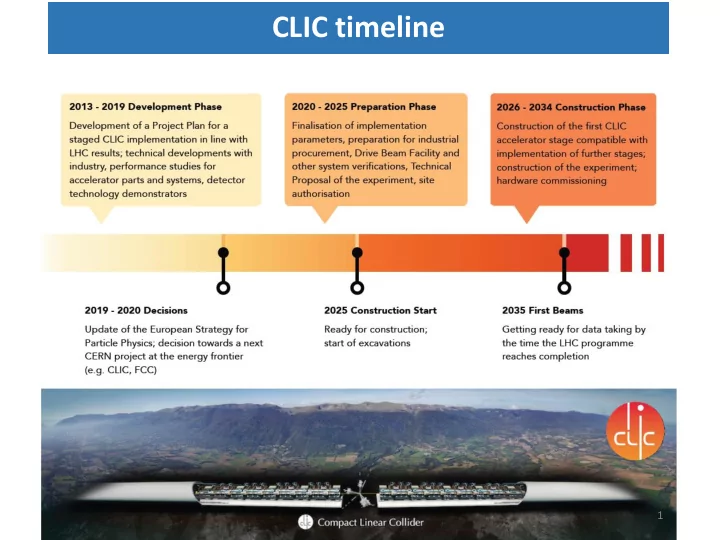
CLIC timeline 1 Project Plan (main results by end 2018) Timeline - - PowerPoint PPT Presentation
CLIC timeline 1 Project Plan (main results by end 2018) Timeline for the European Strategy updaet ~2019-20, goal: Cost and power optimised 380 GeV machine (~11 km) (drivebeam and klystrons) upgradeable to 3 TeV Goal for next strategy
1
2
Timeline for the European Strategy updaet ~2019-20, goal:
(drivebeam and klystrons) upgradeable to 3 TeV
DRIVE BEAM LOOPS DRIVE BEAM INJECTOR BYPASS TUNNELe- INJECTION DESCENT TUNNEL
DAMPING RINGS MAIN BEAM INJECTOR INTERACTION REGION DRIVE BEAM DUMPS COMBINER RINGS TURN AROUNDe+
INJECTION DESCENT TUNNEL FRANCE SWITZERLANDCLIC SCHEMATIC
(not to scale) e+ SIDE e- SIDE LHC INJECTION TUNNEL Sands and gravels Molasse Moraines Limestones 1km 100mGoal for next strategy update: Present a CLIC project that is a “credible” option for CERN beyond LHC, a Project Implementation Plan. Guidelines used internally:
at 13-14 TeV as results become available (be flexible)
380 GeV to 3 TeV (staging)
LHC+50%) (staging)
(max 3-4 years) operational breaks, and with upgrade costs also in reasonable agreement with current budget level.
(modules, klystrons, beams, etc)
(using CLEAR+ (MB like) and/or CLIC zero(DB))
EU proj,
construction and operation
TeV
Other: Resources available, Governance, Industry basis, related X-band projects, Outreach, Availability/risks/critical parameters, Document layouts and teams
4 Parameters and Design
Integrated Baseline Design and Parameters
Performance Studies
Background, Polarization
Operational Scenarios
sources, Damping Rings, Ring- To-Main-Linac, Main Linac - two-Beam Acceleration, Beam Delivery System
(MDI) activities
Experimental verification
Upgrades
forward and feedbacks
with beam
including modulator development and injector
magnet converters
Tests (ATF and FACET, others)
X-band Technologies
Production
(high efficiency)
High power Testing Facilities
Technical Developments
Superconducting Wiggler
Control
development
Detector and Physics
benchmarking
http://clic-study.web.cern.ch/content/clic-accelerator-activities
Project wide studies:
Over the last year the LC study organisation has changed in preparation of the European Strategy Update report. We put more emphasis on implementation studies related to the entire CLIC machine. We still have the project organised in four main activities, each with a group of individual WPs and WP leaders: 1. Beamdynamic and design - D.Schulte 2. X-band included high off klystron studies - W.Wuensch 3. Linac systems: Main Linac module and Drive Beam front end - S.Doebert 4. Technical systems and studies - N.Catalan General work-packages and budgets – S.Stapnes: The studies at ATF2 and in light sources are WPs under General activities. ILC/LCC support activities likewise. CTF3 closedown and CLEAR preparation are also under this general heading with WPs lead by R.Corsini. Oher types of implementation studies are supported under this heading (last paragraph previous slide)
Five new implementation working groups preparing for the ESU have been started (https://indico.cern.ch/category/4337/ ) – some of which also existed ahead of the CDR in 2012: 1. Civil Engineering & Infrastructure and Siting WG (CEIS) (lead J.Osborne) (mandate) 2. Cost, Power and Schedule (lead S.Stapnes) (Detailed costing of a 380 GeV machine - DB and klystrons - plus additional stages beyond) 3. Main Linac Hardware Baselining (lead C.Rossi) (Optimised module technical design and surrounding infrastructure in the tunnel, considering the entire lifetime of a module including commissioning, installation, conditioning,
4. Baseline parameters and design (lead D.Schulte) (Designs and parameters for 380 (DB and klystrons) GeV, 1.5 TeV and 3 TeV) 5. Novel Accelerator methods for future stages of CLIC (lead E.Adli) (mandate) The WGs have ~10-15 core members as needed to cover the subject, and meet every 4-6 weeks in open meetings (to all coll. members). Costing meetings are closed. See implementation meetings every Friday 9-11 at indico link above.
2017 2018 2019
Description Budget Foreseen Foreseen
TOTAL CLIC GENERAL 4'420 4'000 3'850 12'270TOTAL CLIC GENERAL TOTAL CLIC PD 549 428 109 1'086TOTAL CLIC PD TOTAL CLIC LS 2'040 1'700 400 4'140TOTAL CLIC LS
CLIC TD 1'020 620 100 1'740TOTAL CLIC TD
CLIC XBT 4'160 1'966 300 6'426TOTAL CLIC XBT
12'189 8'714 4'759 25'662REQUEST
GRAND TOTAL (2017-2019) Total Activity 2017-2019
MTP 2017 represents no significant change compared to last year Key investments foreseen 2017-19 in good agreement with budget Personnel/team will be the most critical part:
CLIC, FCC become one tentative budget line from 2020 (future projects)