CLIC detector requirements and technologies first comparison with - - PowerPoint PPT Presentation

clic detector requirements and technologies first
SMART_READER_LITE
LIVE PREVIEW

CLIC detector requirements and technologies first comparison with - - PowerPoint PPT Presentation

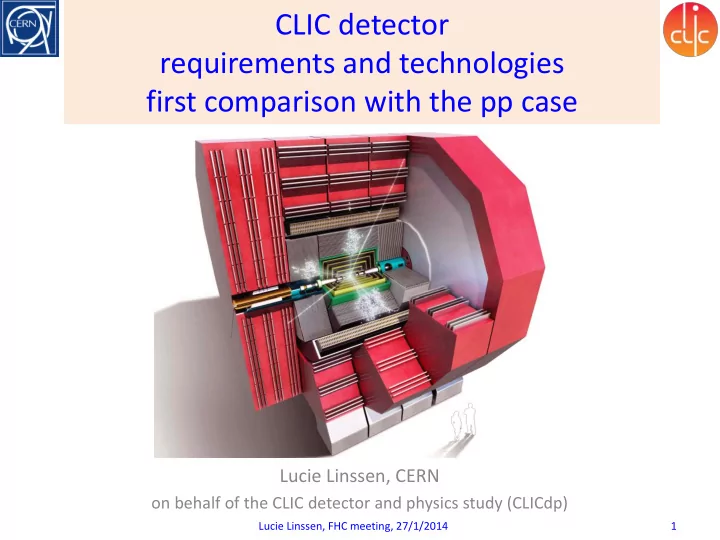
CLIC detector requirements and technologies first comparison with the pp case Lucie Linssen, CERN on behalf of the CLIC detector and physics study (CLICdp) Lucie Linssen, FHC meeting, 27/1/2014 1 contents Contents: CLIC detector


slide-1
SLIDE 1

CLIC detector requirements and technologies first comparison with the pp case

Lucie Linssen, CERN

  • n behalf of the CLIC detector and physics study (CLICdp)

Lucie Linssen, FHC meeting, 27/1/2014 1

slide-2
SLIDE 2

contents

Lucie Linssen, FHC meeting, 27/1/2014 2

Contents:

  • CLIC detector requirement
  • Beam conditions at CLIC
  • CLIC detector concept(s) and some comparison with pp case
  • W/Z mass separation in W/Z => jj

Results shown are from full Geant4-based detector simulation/reconstruction with overlay of beam-induced backgrounds

Note on ATLAS, CMS and CLIC experiment comparisons: Performance comparisons between ATLAS, CMS and CLIC experiment were compiled by Erik van der Kraaij, CERN detector seminar October 2012: https://indico.cern.ch/conferenceDisplay.py?confId=210720 …with references therein. (You’ll find some of them in the backup slides)

slide-3
SLIDE 3

References

and note on ongoing detector optimisation

Lucie Linssen, FHC meeting, 27/1/2014 3

  • CLIC CDR (#2), Physics and Detectors at CLIC,

CERN-2012-003, arXiv:1202.5940

  • CLIC CDR (#3), The CLIC Programme: towards a staged e+e- Linear Collider

exploring the Terascale, CERN-2012-005, http://arxiv.org/abs/1209.2543

  • Physics at the CLIC e+e- Linear Collider, Input to the Snowmass process

2013, http://arxiv.org/abs/1307.5288

CLIC has been using 2 detector concepts, derived from the ILC concepts. These are used in the references above and in most of the talk. We are currently doing new detector optimisation studies. With the aim of having one optimised concept by end 2014

slide-4
SLIDE 4

physics aims => detector needs

Lucie Linssen, FHC meeting, 27/1/2014 4

 impact parameter resolution:

e.g. c/b-tagging, Higgs BR

 jet energy resolution:

e.g. W/Z/h di-jet mass separation

 angular coverage, very forward electron tagging  momentum resolution:

e.g. Smuon endpoint

Higgs recoil mass, Higgs coupling to muons W-Z jet reco smuon end point

(for high- E jets)

+ requirements from CLIC beam structure and beam-induced background

slide-5
SLIDE 5

CLIC machine environment

Lucie Linssen, FHC meeting, 27/1/2014 5

CLIC machine environment (1)

Drives timing requirements for CLIC detector

CLIC at 3 TeV L (cm-2s-1) 5.9×1034 BX separation 0.5 ns #BX / train 312 Train duration (ns) 156

  • Rep. rate

50 Hz σx / σy (nm) ≈ 45 / 1 σz (μm) 44

Beam related background:

  • Small beam profile at IP leads very high E-field

 Beamstrahlung

 Pair-background  γγ to hadrons

very small beam size

slide-6
SLIDE 6

Beamstrahlung  important energy losses right at the interaction point E.g. full luminosity at 3 TeV: 5.9 × 1034 cm-2s-1 Of which in the 1% most energetic part: 2.0 × 1034 cm-2s-1 Most physics processes are studied well above production threshold => profit from full luminosity 3 TeV

√s

energy spectrum

CLIC machine environment (2)

Lucie Linssen, FHC meeting, 27/1/2014 6

Coherent e+e- pairs  7 x 10⁸ per BX, very forward Incoherent e+e- pairs  3 x 10⁵ per BX, rather forward

gg→ hadrons

 3.2 events per BX  main background in calorimeters ~19 TeV in HCAL per bunch train Simplified view: Pair background

  • Design issue (high occupancies)

gg → hadrons

  • Impacts on the physics
  • Needs suppression in data

slide-7
SLIDE 7

γγ => hadrons background

Lucie Linssen, FHC meeting, 27/1/2014 7

Average pT of background particles is ~2 GeV Total ~19 TeV deposited in the calorimeters, within detector acceptance. Ratio 10/1 for Endcaps/Barrel

slide-8
SLIDE 8

CLIC detector concepts

ultra low-mass vertex detector with 25 μm pixels main trackers: TPC+silicon (CLIC_ILD) all-silicon (CLIC_SiD) fine grained (PFA) calorimetry, 1 + 7.5 Λi, strong solenoids 4 T and 5 T return yoke with Instrumentation for muon ID complex forward region with final beam focusing 6.5 m

Lucie Linssen, FHC meeting, 27/1/2014 8

… in a few words …

slide-9
SLIDE 9

CLIC_ILD and CLIC_SiD

CLIC_ILD CLIC_SiD

7 m

Lucie Linssen, FHC meeting, 27/1/2014 9

Two general-purpose CLIC detector concepts

Based on initial ILC concepts (ILD and SiD) Optimised and adapted to CLIC conditions

slide-10
SLIDE 10

CLIC time structure

10

Lucie Linssen, FHC meeting, 27/1/2014

  • not to scale -

CLIC

Bunch separation = 0.5 ns 1 train = 312 bunches Repetition rate = 50 Hz

CLIC time structure of the beam

CLIC has a very low duty cycle:  No need for a trigger, read out all data after 156 ns bunch train  The beam structure is used to apply power pulsing to all detectors  Key ingredient to achieve low mass in the vertex/tracker  Key ingredient to achieve highly compact calorimetry 156 ns 20 ms

slide-11
SLIDE 11

comparison CLIC  LHC detector

In a nutshell:

CLIC detector:

  • High precision:
  • Jet energy resolution
  • => fine-grained calorimetry
  • Momentum resolution
  • Impact parameter resolution
  • Overlapping beam-induced background:
  • High background rates, medium energies
  • High occupancies
  • Cannot use vertex separation
  • Need very precise timing (1ns, 10ns)
  • “No” issue of radiation damage (10-4 LHC)
  • Except small forward calorimeters
  • Beam crossings “sporadic”
  • No trigger, read-out of full 156 ns train

LHC detector:

  • Medium-high precision:
  • Very precise ECAL (CMS)
  • Very precise muon tracking (ATLAS)
  • Overlapping minimum-bias events:
  • High background rates, high energies
  • High occupancies
  • Can use vertex separation in z
  • Need precise time-stamping (25 ns)
  • Severe challenge of radiation damage
  • Continuous beam crossings
  • Trigger has to achieve huge data reduction

Lucie Linssen, FHC meeting, 27/1/2014 11

slide-12
SLIDE 12

Challenges in LC detector R&D

Lucie Linssen, FHC meeting, 27/1/2014 12

These requirements lead to the following challenges: Vertex and tracker

Very high granularity Dense integration of functionalities Including ~10 ns time-stamping Super-light materials Low-power design + power pulsing Air cooling

Calorimetry

Fine segmentation in R, phi, Z Time resolution ~1 ns Ultra – compact active layers Pushing integration to limits Power pulsing

ultra – light ultra – heavy and compact

slide-13
SLIDE 13

CLIC vertex detector

Lucie Linssen, FHC meeting, 27/1/2014 13

Vertex + forward tracking CLIC_ILD

  • ~25×25 μm pixel size => ~2 Giga-pixels
  • 0.2% X0 material par layer <= very thin !
  • Very thin materials/sensors
  • Low-power design, power pulsing, air cooling
  • Aim: 50 mW/cm2
  • Time stamping 10 ns
  • Radiation level <1011 neqcm-2year-1 <= 104 lower than LHC

Very challenging and very active R&D project !

slide-14
SLIDE 14

CLIC vertex detector R&D

Lucie Linssen, FHC meeting, 27/1/2014 14

CLICpix 64×64 pixel demonstrator Fully functional

  • 65 nm technology
  • 25×25 μm2 pixels
  • 4-bit TOA and TOT information
  • 10 nsec time-slicing
  • Power 2 W/cm2 (continuous)
  • With power pulsing
  • 50 mW/cm2

Hybrid approach pursued: (<= other options possible)

  • Thin (~50 μm) silicon sensors
  • Thinned High density ASIC in very-deep-sub-micron:
  • R&D within Medipix/Timepix effort
  • Low-mass interconnect
  • Micro-bump-bonding (Cu-pillar option, Advacam)
  • Through-Silicon-Vias (R&D with CEA-Leti)
  • Power pulsing
  • Air cooling

1.6 mm 64×64 pixels CLICdp participates in RD53 (pixel ASIC R&D in 65 nm) together with ATLAS and CMS

slide-15
SLIDE 15

CLIC_SiD main silicon tracker

Lucie Linssen, FHC meeting, 27/1/2014 15

1.3 m

all-silicon tracker in 5 Tesla field

chip on sensor

Aim: ~1%X0 per layer in the outer tracker R&D still at an early stage

slide-16
SLIDE 16

calorimetry and PFA

Lucie Linssen, FHC meeting, 27/1/2014 16

Jet energy resolution and background rejection drive the overall detector design => => fine-grained calorimetry + Particle Flow Analysis (PFA) Typical jet composition: 60% charged particles 30% photons 10% neutrons Always use the best info you have: 60% => tracker 30% => ECAL 10% => HCAL

What is PFA? Hardware + software !

slide-17
SLIDE 17

calorimetry and PFA

Lucie Linssen, FHC meeting, 27/1/2014 17

Simulated image (gives good feeling of the granularity) FPA-based simulation (to determine depth of tungsten HCAL)

slide-18
SLIDE 18

PFA calorimetry at CLIC

Lucie Linssen, FHC meeting, 27/1/2014 18

technology

ECAL Si or Scint. (active) + Tungsten (absorber) cell sizes 13 mm2 or 25 mm2 30 layers in depth HCAL Several technology options: scint. + gas Tungsten (barrel), steel (endcap) cell sizes 9 cm2 (analog) or 1 cm2 (digital) 60-75 layers in depth Total depth 7.5 Λi

jet energy resolution

High precision on jets  ECAL +HCAL have to fit inside coil  CLIC needs Tungsten absorber in HCAL  Requires beam tests to validate Geant4

(no jet clustering, without background overlay)

slide-19
SLIDE 19

Linear Collider calorimetry R&D

Lucie Linssen, FHC meeting, 27/1/2014 19

With major technological prototypes in beam tests in recent years

slide-20
SLIDE 20

Analog HCAL: scintillator/tungsten

Lucie Linssen, FHC meeting, 27/1/2014 20

HCAL tests with 10 mm thick Tungsten absorber plates, Tests in 2010+2011 with scintillator active layers, 3×3 cm2 cells => analog readout

CERN SPS 2011

visible Energy protons longitudinal shower profile, pions good agreement with Geant4

slide-21
SLIDE 21

digital DHCAL glass RPC’s (CALICE)

Lucie Linssen, FHC meeting, 27/1/2014 21

CERN test setup includes fast readout RPC after (T3B) W-DHCAL π- at 210 GeV (SPS) Steel DHCAL Tungsten DHCAL 500’000 readout channels 54 glass RPC chambers, 1m2 each PAD size 1×1 cm2 Digital readout (1 threshold) 100 ns time-slicing Fully integrated electronics Main DHCAL stack (39) + tail catcher (15) Total 500’000 readout channels Successfully tested: 2010+2011 Fermilab Steel absorber 2012 CERN PS + SPS Tungsten absorber

slide-22
SLIDE 22

time development in hadronic showers

Lucie Linssen, FHC meeting, 27/1/2014 22

(depends on active material)

slide-23
SLIDE 23

background suppression at CLIC

  • Full event reconstruction + PFA analysis with background overlaid
  • => physics objects with precise pT and cluster time information
  • Time corrected for shower development and TOF
  • Then apply cluster-based timing cuts
  • Cuts depend on particle-type, pT and detector region
  • Allows to protect high-pT physics objects
  • Use well-adapted jet clustering algorithms
  • Making use of LHC experience (FastJet)

+

Lucie Linssen, FHC meeting, 27/1/2014 23

tCluster Triggerless readout of full train  t0 physics event (offline)

slide-24
SLIDE 24

combined pT and timing cuts

Lucie Linssen, FHC meeting, 27/1/2014 24

1.2 TeV 100 GeV

1.2 TeV background in reconstruction time window 100 GeV background after tight cuts

slide-25
SLIDE 25

time window / time resolution

Lucie Linssen, FHC meeting, 27/1/2014 25

Translates in precise timing requirements of the sub-detectors The event reconstruction software uses:

 t0 physics event (offline)

slide-26
SLIDE 26

PFO-based timing cuts

Lucie Linssen, FHC meeting, 27/1/2014 26

slide-27
SLIDE 27

W/Z separation in jj reconstruction (1)

Lucie Linssen, FHC meeting, 27/1/2014 27 with beam- induced background

Simulated WW => ννqq and ZZ => νlqq events Background suppressed through jet clustering and timing cuts of PFA particles

See: arXiv:1209.4039

slide-28
SLIDE 28

W/Z separation in jj reconstruction (3)

Lucie Linssen, FHC meeting, 27/1/2014 28

Simulated events:

Z0Z0

See: LCD-Note-2012-028

slide-29
SLIDE 29

Outlook (1)

Lucie Linssen, FHC meeting, 27/1/2014 29

Many more details/subtleties can be shown and discussed……. I see several areas of common e+e- / pp interests (non exhaustive):

  • Vertex detector technology
  • Advanced R&D in hybrid detector (including developments with HVCMOS)
  • Advanced radiation-hard microelectronics
  • Detector powering
  • Low-mass engineering (incl. microcooling options ?)
  • Tracker
  • Low-mass silicon-based trackers
  • Small strips / large pixels (for reduced occupancies)
  • Fine-grained calorimetry
  • To optimise jet energy resolution through PFA
  • As a tool for background suppression
  • As a tool for high precision timing of reconstructed particles
  • Can we reach and exploit << 1ns timing ?
  • Overall detector engineering aspects and large+strong detector magnets
slide-30
SLIDE 30

Outlook (2)

Lucie Linssen, FHC meeting, 27/1/2014 30

Several areas of common e+e- / pp interests (non exhaustive):

  • Simulation tools and methods
  • Flexible detector geometry descriptions for full simulation
  • PFA-like event reconstruction tools
  • Jet clustering
  • Physics studies
  • Would be good to keep physics studies (New Physics) well-connected
  • Possibly work towards common aims (e.g. reports like hep-ex/0112004)

Thank you

slide-31
SLIDE 31

Lucie Linssen, FHC meeting, 27/1/2014 31

SPARE SLIDES

slide-32
SLIDE 32

CLIC vertex R&D: power pulsing

Lucie Linssen, FHC meeting, 27/1/2014 32

slide-33
SLIDE 33

EM calorimeter (barrel, at 90°)

Lucie Linssen, FHC meeting, 27/1/2014 33

slide-34
SLIDE 34

EM calorimeter (barrel, at 90°)

Lucie Linssen, FHC meeting, 27/1/2014 34

slide-35
SLIDE 35

Hadron calorimeter (barrel, at 90°)

Lucie Linssen, FHC meeting, 27/1/2014 35

slide-36
SLIDE 36

Hadron calorimeter (barrel, at 90°)

Lucie Linssen, FHC meeting, 27/1/2014 36

slide-37
SLIDE 37

Software compensation

Lucie Linssen, FHC meeting, 27/1/2014 37

High granularity of the calorimeter can be used to distinguish between electromagnetic (dense) and hadronic (less dense) shower components CALICE Steel-AHCAL data  Improved resolution (20% better) and linearity

slide-38
SLIDE 38

details of forward detector region

Lucie Linssen, FHC meeting, 27/1/2014 38

IP at ~2 m forward calorimeters “FCAL”

slide-39
SLIDE 39

2 forward calorimeters: Lumical + beamcal Tungsten thickness 1 X0, 40 layers BeamCal sensors GaAs, 500 mm thick LumiCal sensors silicon, 320 mm thick FE ASICs positioned at the outer radius BeamCal angular coverage 10 - 40 mrad LumiCal coverage 38 – 110 mrad doses up to 1 Mgy neutron fluxes of up to 1014 per year

Forward calorimetry

Lucie Linssen, FHC meeting, 27/1/2014 39

Very compact: Active layer gap is 0.8 mm Moliere radius 11 mm