
SLIDE 1
Class of 2020/21 Social & Public Communication
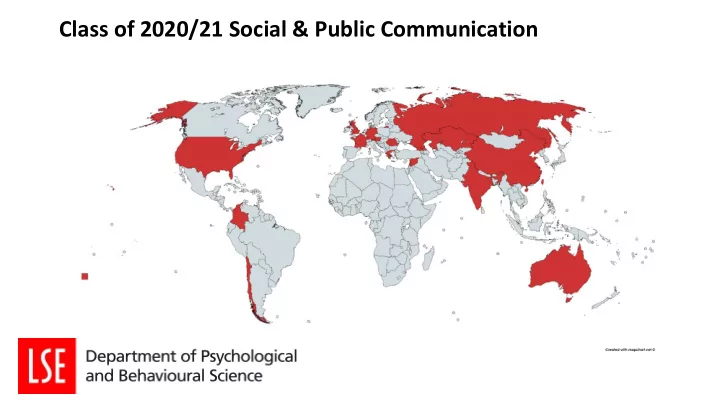
Class of 2020/21 Social & Public Communication Dr Bankole - - PowerPoint PPT Presentation
Class of 2020/21 Social & Public Communication Dr Bankole Falade, Dunhuang with Prof Bradley Franks Class 2007/08 2017 Class of 2019/20 Class of 2006/07 Parts of Class 2016/17 Louise Millar Martin W Bauer SPC Core Team Will Stubbs
Class of 2020/21 Social & Public Communication
Class of 2019/20 Class of 2006/07 Parts of Class 2016/17 Dunhuang with Prof Bradley Franks 2017 Dr Bankole Falade, Class 2007/08
Louise Millar Will Stubbs Jennifer Sheehy-Skeffington Martin W Bauer
SPC Core Team
Also involved: Sandra Jovchelovitch Bradley Franks Alex Gillespie Helen Green (LSE@life) Adrian Bangerter (Neuchatel) Glenn O’Neil (Geneva)
The LSE - London School of Economics and Political Science
Founded in 1895 [e.g George Bernard SHAW Library, 6th floor of Old Building, Concent Hall] by a group of Fabian Socialists ‘to make the world a better place on the basis of empirical research’ Its ‘socialist flavour’ is long evaporated; now politically diverse, but committed to impact in the world. Social science faculty only, unique in the world; we are not a Business School Social science departments / research centres + School of Public Policy + Institutes (e.g. Inequalities) 1995
Department of Social Psychology (1964)
The 1st Social Psychology Dept in Europe Professor Hilde Himmelweit A Pioneer of Political Psychology 1970 HH & faculty HH with Eileen Barker
2016: Psychological and Behavioural Science
A new BSc Psychological and Behavioural Science Expanding the Department from 10+ to 25+ staff: 6 MSc programmes A dynamic and innovative environment Royal Society of London: ‘Attitudes to Science and its Measurement’ Workshop on novel approaches to ‘text analysis’ Award-winning LSE Student Centre
MSc Social & Public Communication
Our Ethos C is foundational to social life and to social sciences C is ubiquitous and basic like ‘breathing’, but we need to relearn to improve it C is complicated: to really understand C, you need to grasp several concepts [the five language games] The Course consists of Four Papers [each at 25% of final mark]
suite 1: – strongly recommended health communication [helping], corporate communication [reputation]; dialogue and negotiation [mediation] suite 2: – recommended political psychology, social representations, social identity and group dynamics, others from PBS
Our witness for this: Ludwig Wittgenstein (1889-1951)
7/14/2020
2011 2017
We have a Textbook
2014
https://www.visualrhetoric.co.uk/
2021 Data Hackathon Wellcome Global Monitor 2018
144 countries database on Vaccination hesitancy & trust in science Sign-up for it, if you like ……
Teaching Director MSc Social & Public Communication PB404 Social Psychology of Communication PB422 Health Communication Director of PhD Programme Research:
Martin W BAUER Professor of Social Psychology and Research Methodology
2007 2000 2012 2015 2019 2013
Jenn nnifer S SHEEHY-SKE SKEFFING NGTON Assistant Professor of Social Psychology
Teaching
Research:
conditions
COVID-19 Plans for the 2020/21 Academic Session
new students for Welcome (21st September 2020)
problems obtaining your visa, support will be available for you from your academic departments and from central support services until you are able to join us later in Michaelmas Term.
academic year online, which will be followed with an on-campus enrolment event when you arrive in London.
groups, as well as Harvard style teaching sessions, will run on campus where possible, all in socially distanced environments. These activities, as well as
students unable to access campus if there is a delay to you joining us in London.
Term 2020. All lectures will be recorded and made available for you to access off-campus.
ability to work together, both online and on campus, and contribute safely to your learning
classes will give you the opportunity to connect with
students and engage with LSE’s rich education and research culture.
areas and in communal spaces in residences will be
hygiene practices, recalibrating space, floor markings to ensure social distancing, controlled access to campus buildings.
Advice and LSE LIFE will continue to be available to guide you through the next academic year and beyond through excellent online and in-person services where possible.
here: http://www.lse.ac.uk/study-at-lse/Graduate/News
7/14/2020 16
How to resist the virus? OR How to design a ‘viral message’ nobody can resist? [but that would be the end of us all]
7/14/2020 17