Claim Evidence Mathematical Model with Reasoning about the - - PowerPoint PPT Presentation

claim evidence mathematical model
SMART_READER_LITE
LIVE PREVIEW

Claim Evidence Mathematical Model with Reasoning about the - - PowerPoint PPT Presentation

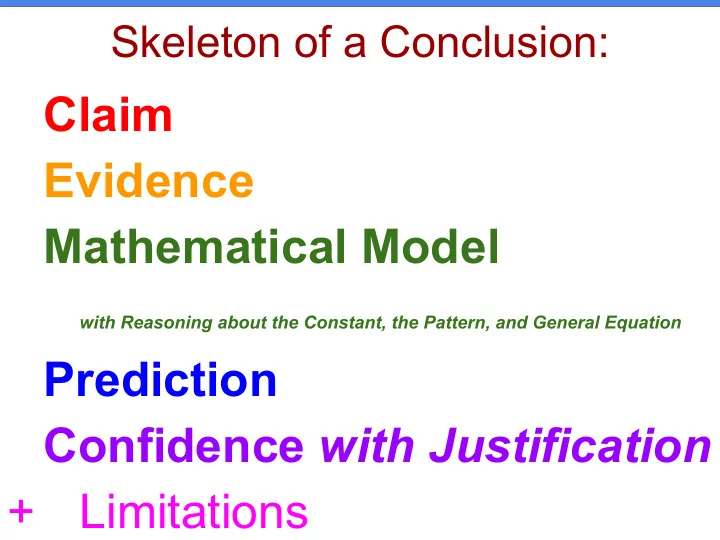
Skeleton of a Conclusion: Claim Evidence Mathematical Model with Reasoning about the Constant, the Pattern, and General Equation Prediction Confidence with Justification + Limitations 208 Patterns Physics Electricity, Magnetism, &

slide-1
SLIDE 1

208 Patterns Physics Electricity, Magnetism, & Power Production

Skeleton of a Conclusion:

Claim Evidence Mathematical Model

with Reasoning about the Constant, the Pattern, and General Equation

Prediction Confidence with Justification + Limitations

slide-2
SLIDE 2

Skeleton of a Conclusion:

  • I. Claim

Clearly state your conclusion.

  • I. Evidence

Explain how the data you cite supports your claim.

  • I. Mathematical Model with Reasoning

Communicate the mathematical model that behaves the same as the system you investigated. Along with the model you need to describe your reasoning about 1) what the A-value represents in the real world and 2) why the pattern makes sense. Be sure to also include 3) the generalized equation (in all words).

  • I. Prediction

Communicate how the system you behave for the scenario presented at the beginning of the experiment.

  • I. Justification

Explain your thinking for your confidence in using your data to predict the future behavior of the system.

  • I. Limitations

Evaluate the limitations of either your procedure to collect data or of the model your created of the system you investigated.

+ Research Extension Question:

slide-3
SLIDE 3

Exemplar Conclusion from Past Experiment: After investigating speeding up of a ball down a ramp in order to determine a mathematical model for constant acceleration, I conclude that there is a quadratic relationship between the distance the object moves and the time is has moved. My evidence for this claim is that all five of my data points over a 3 m range all fit on a single best-fit curve that is quadratic. This system of an accelerating object from rest can be mathematically modeled as: Distance Travelled = 0.3 m/s /s * time2 where the 0.3 m/s /s is how much the ball is speeding up each second. It makes sense that the pattern is quadratic because time affects both how long the ball has rolled and how much it has speed up. So in general for an object accelerating from the model will be Distance Travelled = ½ acceleration * time x time Using data from the 30 cm high ramp groups, I predict for a ball rolling for 4 seconds that it will travel a distance of 4.80 (+/- 0.05) m. My confidence for this prediction is only medium-high, since the best-fit line hits near the center of most of my data points but the prediction is outside their data range. One limitation of our procedure was that our ramp was not straight, now that I understand acceleration better I can reason that where the ramp was bowed down the ball would accelerate faster than where is was slightly bowed up, which would make for data points respectively above and below the best fit curve.

slide-4
SLIDE 4

211 Patterns Physics Electricity, Magnetism, & Power Production

Challenges with Solar Cells

slide-5
SLIDE 5

212 Patterns Physics Electricity, Magnetism, & Power Production

slide-6
SLIDE 6

213 Patterns Physics Electricity, Magnetism, & Power Production

Our Evolving Understanding of the Nature of Light

Activity: 6Extension - Wave / Particle Duality

HS-PS4-3. Evaluate the claims, evidence, and reasoning behind the idea that electromagnetic radiation can be described either by a wave model

  • r a particle model, and that for some situations
  • ne model is more useful than the other.
slide-7
SLIDE 7

214 Patterns Physics Electricity, Magnetism, & Power Production

Our Evolving Understanding of the Nature of Light

Activity: 6Extension - Wave / Particle Duality

We have to remember that what we observe is not nature in itself, but nature exposed to our method of questioning. — Werner Heisenberg

slide-8
SLIDE 8

215 Patterns Physics Electricity, Magnetism, & Power Production

Electricity, Magnetism, & Power Production - Day 12 Agenda: Understanding the Earth System to inform our Climate Rubric Using our Inner Scientist to look at Data Due Next Class Due This Class

Warm Up Question: Go to bit.ly/climatesim Write the following:

  • 3 things you notice
  • 2 things you wonder

I notice… I wonder...

slide-9
SLIDE 9

216 Patterns Physics Electricity, Magnetism, & Power Production

Teacher Note: Resources & Background

  • n climate science and climate change

The Framework for K-12 Science Education (which the NGSS was based upon) is an excellent, short resource for background information. See ESS2.D: WEATHER AND CLIMATE pages 186-191 and ESS3.D: GLOBAL CLIMATE CHANGE pages 196- 199

slide-10
SLIDE 10

217 Patterns Physics Electricity, Magnetism, & Power Production

slide-11
SLIDE 11

218 Patterns Physics Electricity, Magnetism, & Power Production

What is Climate vs Weather?

Weather, which varies from day to day and seasonally throughout the year, is the condition

  • f the atmosphere at a given place and time.

Climate is longer term and location sensitive; it is the range of a region’s weather over 1 year or many years.

  • - The Framework for K-12 Science

Education

Simply put: weather is how it is outside right now, climate is how it is supposed to be.

slide-12
SLIDE 12

219 Patterns Physics Electricity, Magnetism, & Power Production

Timescales for Climate vs. Weather

Weather and climate are shaped by complex interactions involving sunlight, the ocean, the atmosphere, ice, landforms, and living things. These interactions can drive changes that occur

  • ver multiple time scales—from days, weeks,

and months for weather to years, decades, centuries, and beyond—for climate.

  • - The Framework for K-12 Science

Education

slide-13
SLIDE 13

220 Patterns Physics Electricity, Magnetism, & Power Production

You can get surprisingly far with 3 simple factors affecting Atmospheric Circulation

  • 1. The differential intensity of sunlight over the earth

Think: different optimal angles for a solar cell

slide-14
SLIDE 14

221 Patterns Physics Electricity, Magnetism, & Power Production

You can get surprisingly far with 3 simple factors affecting Atmospheric Circulation

  • 1. The differential intensity of sunlight over the earth

Think: different optimal angles for a solar cell

  • 2. The earth’s surface varies

Think: water vs. land vs mountain ranges

  • 3. The fact the earth is really big and spinning

Think: it is not going to be simple

slide-15
SLIDE 15

222 Patterns Physics Electricity, Magnetism, & Power Production

A bit Oversimplified: Air at the equator warms, rises, and is pushed from the following air behind it to the poles, where it cools, sinks and flows back to the equator to repeat

Simple, single cell atmospheric convection in a non-rotating Earth. "Single cell" being either a single cell north or south of the equator. Figure 7.5 in The Atmosphere, 8th edition, Lutgens and Tarbuck, 8th edition, 2001.

slide-16
SLIDE 16

223 Patterns Physics Electricity, Magnetism, & Power Production

Remember the earth’s surface varies and it is really big and spinning

Idealized, three cell atmospheric convection in a rotating Earth. "Three cell" being either three cells north or south

  • f the equator. The deflections of the winds within each cell is caused by the Coriolis Force.

Figure 7.5 in The Atmosphere, 8th edition, Lutgens and Tarbuck, 8th edition, 2001.

slide-17
SLIDE 17

224 Patterns Physics Electricity, Magnetism, & Power Production

Source: serc.carleton.edu

slide-18
SLIDE 18

225 Patterns Physics Electricity, Magnetism, & Power Production

A Peak at an animated representation.

Source: http://montessorimuddle.org/

slide-19
SLIDE 19

226 Patterns Physics Electricity, Magnetism, & Power Production

A Peak at another representation. Why is Oregon so mild in winter vs Minnesota at the same latitude?

Figure 7.9 in The Atmosphere, 8th edition, Lutgens and Tarbuck, 8th edition, 2001.

slide-20
SLIDE 20

227 Patterns Physics Electricity, Magnetism, & Power Production

A Peak at another representation. Why is Oregon so mild in summer vs. Minnesota at the same latitude?

Figure 7.9 in The Atmosphere, 8th edition, Lutgens and Tarbuck, 8th edition, 2001.

slide-21
SLIDE 21

228 Patterns Physics Electricity, Magnetism, & Power Production

Earth System through Sankey Diagrams

Annotate your Sankey Diagram in your Packet

Often diagrams can better represent and express what is happening:

slide-22
SLIDE 22

229 Patterns Physics Electricity, Magnetism, & Power Production

Earth System through Sankey Diagrams

Light energy from the sun.

slide-23
SLIDE 23

230 Patterns Physics Electricity, Magnetism, & Power Production

Earth System through Sankey Diagrams

Light energy from the sun. Light energy reflected by clouds, ice, water, and land.

slide-24
SLIDE 24

231 Patterns Physics Electricity, Magnetism, & Power Production

Earth System through Sankey Diagrams

Light energy from the sun. Light energy reflected by clouds, ice, water, and land. Light energy is transferred into the ground as thermal energy.

slide-25
SLIDE 25

232 Patterns Physics Electricity, Magnetism, & Power Production

Earth System through Sankey Diagrams

Light energy from the sun. Light energy reflected by clouds, ice, water, and land. Light energy is transferred into the ground as thermal energy. Thermal energy is emitted by the surface of the Earth.

slide-26
SLIDE 26

233 Patterns Physics Electricity, Magnetism, & Power Production

Earth System through Sankey Diagrams

Light energy from the sun. Light energy reflected by clouds, ice, water, and land. Light energy is transferred into the ground as thermal energy. Thermal energy is emitted by the surface of the Earth. Greenhouse gases in the atmosphere absorb and re-emit back to Earth and into space.

slide-27
SLIDE 27

234 Patterns Physics Electricity, Magnetism, & Power Production

Understanding Energy in the Earth System

At its very simplest is it is about

Ein versus Eout Ein Eout unit time unit time EStored in Earth

System

Now at this point we really should add:

Ein versus Eout unit time unit time

One level more thoughtful is looking at the rate of Energy Transfer

slide-28
SLIDE 28

235 Patterns Physics Electricity, Magnetism, & Power Production

Energy in the Earth System: Warming Climate In a warming climate the Earth system gains energy because the energy in is greater than the energy out. Ein Eout EStored in Earth

System

EStored in Earth

System

Ein Eout

Energy into the Earth system increased Less energy left the Earth system

slide-29
SLIDE 29

236 Patterns Physics Electricity, Magnetism, & Power Production

Energy in the Earth System: Cooling Climate In a cooling climate the Earth system loses energy because the energy in is less than the energy out. Ein Eout EStored in Earth

System

Energy leaving the Earth system increased Less energy enters the Earth system

EStored in Earth

System

Ein Eout

slide-30
SLIDE 30

237 Patterns Physics Electricity, Magnetism, & Power Production

Earth System through Sankey Diagrams

Let’s investigate these 10 factors by their primary/initial effect and the timescale of the effect they have on the Earth system:

  • A. Atmospheric composition
  • B. Volcanic activity
  • C. Circulation of the Oceans
  • D. Deforestation
  • E. Earth’s orbit and the orientation of its axis
  • F. Circulation of the Atmosphere
  • G. Glaciation
  • H. Human activities
  • I. Increase in sun’s energy output
  • J. Decrease in sun’s energy output
slide-31
SLIDE 31

238 Patterns Physics Electricity, Magnetism, & Power Production

Earth System through Sankey Diagrams

See interactive arrows in 6Activity - Sankey Manipulative Diagram for Climate Change Graphic

slide-32
SLIDE 32

239 Patterns Physics Electricity, Magnetism, & Power Production

Factor: Atmospheric Composition

Earth at Equilibrium. What would change due to the factor?

slide-33
SLIDE 33

240 Patterns Physics Electricity, Magnetism, & Power Production

Increased Atmospheric Composition

With more greenhouse gases in the atmosphere more energy is absorbed and re-emit back to Earth. More energy is stored in the Earth.

slide-34
SLIDE 34

241 Patterns Physics Electricity, Magnetism, & Power Production

New Equilibrium with a Warmer Climate

slide-35
SLIDE 35

242 Patterns Physics Electricity, Magnetism, & Power Production

Factor: Circulation of the Oceans

When it comes to regulating global climate, the circulation of the Atlantic Ocean plays a key role. The constantly moving system of deep-water circulation, sometimes referred to as the Global Ocean Conveyor Belt, sends warm, salty Gulf Stream water to the North Atlantic where it releases heat to the atmosphere and warms Western Europe. The cooler water then sinks to great depths and travels all the way to Antarctica and eventually circulates back up to the Gulf Stream. Credit: Intergovernmental Panel on Climate Change Read more at: https://phys.org/news/2018-04-atlantic-ocean-circulation-weakest-years.html#jCp

slide-36
SLIDE 36

243 Patterns Physics Electricity, Magnetism, & Power Production

Decreased Atmospheric Composition

With less greenhouse gases in the atmosphere less energy is absorbed and re-emit back to Earth. Less energy is stored in the Earth.

slide-37
SLIDE 37

244 Patterns Physics Electricity, Magnetism, & Power Production

Factor: Volcanic Activity

Earth at Equilibrium. What would change due to the factor?

slide-38
SLIDE 38

245 Patterns Physics Electricity, Magnetism, & Power Production

Factor: Volcanic Activity Early

Early after volcanic activity more light is reflected by ash in the atmosphere. Less energy is stored in the Earth.

slide-39
SLIDE 39

246 Patterns Physics Electricity, Magnetism, & Power Production

Factor: Volcanic Activity Long Term

Later, with more greenhouse gases in the atmosphere more energy is absorbed and re-emit back to Earth. More energy is stored in the Earth.

slide-40
SLIDE 40

247 Patterns Physics Electricity, Magnetism, & Power Production

Factor: Circulation of the Oceans

Earth at Equilibrium. What would change due to the factor?

slide-41
SLIDE 41

248 Patterns Physics Electricity, Magnetism, & Power Production

Factor: Deforestation

Earth at Equilibrium. What would change due to the factor?

slide-42
SLIDE 42

249 Patterns Physics Electricity, Magnetism, & Power Production

Factor: Deforestation

With more buildings and roads, less light is reflected. Greenhouse gases increase with fewer trees to store the CO2. More energy is stored in the Earth.

slide-43
SLIDE 43

250 Patterns Physics Electricity, Magnetism, & Power Production

Factor: Earth’s Orbit and the Orientation of its Axis

Earth at Equilibrium. What would change due to the factor?

slide-44
SLIDE 44

251 Patterns Physics Electricity, Magnetism, & Power Production

Earth’s Orbit: Closer to the Sun

Light energy from the sun increases because we are closer to the Sun. More energy is stored in the Earth.

slide-45
SLIDE 45

252 Patterns Physics Electricity, Magnetism, & Power Production

Earth’s Orbit: Further from the Sun

Light energy from the sun decreases because we are farther away from to the Sun. Less energy is stored in the Earth.

slide-46
SLIDE 46

253 Patterns Physics Electricity, Magnetism, & Power Production

Factor: Circulation of the Atmosphere

Earth at Equilibrium. What would change due to the factor?

slide-47
SLIDE 47

254 Patterns Physics Electricity, Magnetism, & Power Production

Factor: Circulation of the Atmosphere

slide-48
SLIDE 48

255 Patterns Physics Electricity, Magnetism, & Power Production

Remember the earth’s surface varies and it is really big and spinning

Idealized, three cell atmospheric convection in a rotating Earth. "Three cell" being either three cells north or south

  • f the equator. The deflections of the winds within each cell is caused by the Coriolis Force.

Figure 7.5 in The Atmosphere, 8th edition, Lutgens and Tarbuck, 8th edition, 2001.

slide-49
SLIDE 49

256 Patterns Physics Electricity, Magnetism, & Power Production

Factor: Glaciation

Earth at Equilibrium. What would change due to the factor?

slide-50
SLIDE 50

257 Patterns Physics Electricity, Magnetism, & Power Production

Increased Glaciation

More light energy reflected by ice. Less energy is stored in the Earth.

slide-51
SLIDE 51

258 Patterns Physics Electricity, Magnetism, & Power Production

Decreased Glaciation

Less light energy reflected by ice. More energy is stored in the Earth.

slide-52
SLIDE 52

259 Patterns Physics Electricity, Magnetism, & Power Production

Factor: Human activities

Earth at Equilibrium. What would change due to the factor?

slide-53
SLIDE 53

260 Patterns Physics Electricity, Magnetism, & Power Production

Factor: Human activities

With more building and roads, less light is reflected. Greenhouse gases increase with fewer trees to store the CO2. More energy is stored in the Earth.

slide-54
SLIDE 54

261 Patterns Physics Electricity, Magnetism, & Power Production

Factor: Increase in Sun’s Energy Output

Earth at Equilibrium. What would change due to the factor?

slide-55
SLIDE 55

262 Patterns Physics Electricity, Magnetism, & Power Production

Factor: Increase in Sun’s Energy Output

Light energy from the sun increases because of more energy output. More energy is stored in the Earth.

slide-56
SLIDE 56

263 Patterns Physics Electricity, Magnetism, & Power Production

Factor: Decrease in Sun’s Energy Output

Light energy from the sun decreases because of less energy output. Less energy is stored in the Earth.

slide-57
SLIDE 57

264 Patterns Physics Electricity, Magnetism, & Power Production

Our Simple but Pretty Good Diagram

slide-58
SLIDE 58

265 Patterns Physics Electricity, Magnetism, & Power Production

A More Complex Diagram

What do you notice? wonder about?

slide-59
SLIDE 59

266 Patterns Physics Electricity, Magnetism, & Power Production

Let’s Be Playful with our Inner Scientist

We have been building our critical thinking and analysis toolbox all year. Climate data is so complex you will need to use all you got. Helpful discussion starters:

  • I notice…
  • I see a pattern with…
  • I wonder…
  • What is the system?
  • How does this connect to
  • ther things we know?
slide-60
SLIDE 60

267 Patterns Physics Electricity, Magnetism, & Power Production

slide-61
SLIDE 61

268 Patterns Physics Electricity, Magnetism, & Power Production

  • 1. What is the overall trend?
  • 2. What is happening on earth that could explain

why the data cyclical?

  • 3. Can you estimate a mathematical model?
  • 4. What is the value in

creating a model?

  • 1. What other models would

you think of creating?

  • 6. What other questions

do we have?

Let’s Be Playful with our Inner Scientist

Let us move around the Triangle

slide-62
SLIDE 62

269 Patterns Physics Electricity, Magnetism, & Power Production

Let get a bit more complex.

Let’s Be Playful with our Inner Scientist

Let us move around the Triangle

slide-63
SLIDE 63

270 Patterns Physics Electricity, Magnetism, & Power Production

  • 1. How is this graph different?
  • 2. How is this graph similar?
  • 3. Where is Barrow?
  • 4. Why is Barrow’s oscillations so big and

American Samoa small?

  • 5. Why does the South Pole

always stay below average?

Let’s Be Playful with our Inner Scientist

Let us move around the Triangle

slide-64
SLIDE 64

271 Patterns Physics Electricity, Magnetism, & Power Production

slide-65
SLIDE 65

272 Patterns Physics Electricity, Magnetism, & Power Production

Let’s get a a lot more complex.

Let’s Be Playful with our Inner Scientist

Let us move around the Triangle

slide-66
SLIDE 66

273 Patterns Physics Electricity, Magnetism, & Power Production

Animated Graph Next Slide

https://www.esrl.noaa.gov/gmd/ccgg/trends/history.html pause at 2 minute mark

slide-67
SLIDE 67

274 Patterns Physics Electricity, Magnetism, & Power Production

slide-68
SLIDE 68

275 Patterns Physics Electricity, Magnetism, & Power Production

At the 2 minute mark:

  • 1. How is this graph different?
  • 2. How is this graph similar?
  • 3. Why is this graph named the “pump handle”?
  • 4. Why is the northern

hemisphere different than the southern hemisphere?

  • 1. Why are measurements

usually taken away from cities?

Let’s Be Playful with our Inner Scientist

Let us move around the Triangle

slide-69
SLIDE 69

276 Patterns Physics Electricity, Magnetism, & Power Production

Helpful discussion starters:

  • I notice…
  • I see a pattern with…
  • I wonder…
  • Who is...
  • How does this connect to...
  • What other questions does

this raise?

Let’s Be Playful with our Inner Scientist

Last One

slide-70
SLIDE 70

277 Patterns Physics Electricity, Magnetism, & Power Production

National Oceanic and Atmospheric Administration

Animated CO2 Emission Graph (must use link) https://www.esrl.noaa.gov/gmd/ccgg/trends/ff.htm l

https://www.esrl.noaa.gov/gmd/ccgg/trends/ff .html

slide-71
SLIDE 71

278 Patterns Physics Electricity, Magnetism, & Power Production

Electricity, Magnetism, & Power Production - Day 13 Agenda: Finish Understanding Earth Systems Due Next Class 6Q3 - Quiz on the Basic Physics of Climate Science Due This Class

Warm Up Question:

slide-72
SLIDE 72

279 Patterns Physics Electricity, Magnetism, & Power Production

Finish where we left off with understanding Earth Systems

slide-73
SLIDE 73

280 Patterns Physics Electricity, Magnetism, & Power Production

Electricity, Magnetism, & Power Production - Day 14 Agenda: Quiz on Understanding Earth Systems Applying Our Understanding to Make Our Rubric Due Next Class Due This Class

Warm Up Question:

slide-74
SLIDE 74

281 Patterns Physics Electricity, Magnetism, & Power Production

Earth System through Sankey Diagrams

slide-75
SLIDE 75

282 Patterns Physics Electricity, Magnetism, & Power Production

6Q3 - Quiz on the Basic Physics of Climate Science

slide-76
SLIDE 76

283 Patterns Physics Electricity, Magnetism, & Power Production

Philosophical Chairs: The Questions of Nuclear?

slide-77
SLIDE 77

284 Patterns Physics Electricity, Magnetism, & Power Production

Philosophical Chairs for Climate Impact Rubric

For each energy source

  • 1. Stand next to the number 1-5 that you think

best represents the Climate/Environmental impact of that source.

  • 2. Each group present two important reasons.
  • 3. Now if persuaded move to the number.
  • 4. Explain why you moved.
  • 5. Any one now want to move?
  • 6. Count which number has highest or should we

average them?

slide-78
SLIDE 78

285 Patterns Physics Electricity, Magnetism, & Power Production

slide-79
SLIDE 79

286 Patterns Physics Electricity, Magnetism, & Power Production

Electricity, Magnetism, & Power Production - Day 15 Agenda: Starting your 50 Year Energy Plan Due Next Class Due This Class

Warm Up Question:

slide-80
SLIDE 80

287 Patterns Physics Electricity, Magnetism, & Power Production

slide-81
SLIDE 81

288 Patterns Physics Electricity, Magnetism, & Power Production

Starting Your 50 Year Energy Plan

slide-82
SLIDE 82

289 Patterns Physics Electricity, Magnetism, & Power Production

Reviewing and Redefining Our Problem

(Look at your 6CER - Section 1 - Exploring Our Engineering Challenge)

Problem Statement:

We as the Energy Plan Commission seek to create a 50 Year Energy Plan that must address the energy needs of Oregonians for the State of Oregon.

Constraints: What we must accomplish

  • 1. Meet the energy needs of the state for the next 50 years
  • 2. Stay within the projected growth each decade
  • 3. Provide reliable power
  • 4. Be off coal by 2035

Criteria: How we judge our plan

  • 1. Environmental Impact / Land Use
  • 2. Climate Impact / Air Quality
  • 3. Start Up Cost / Maintenance
slide-83
SLIDE 83

290 Patterns Physics Electricity, Magnetism, & Power Production

Overview of the Program

slide-84
SLIDE 84

291 Patterns Physics Electricity, Magnetism, & Power Production

Overview of the Program

Tells you how much energy you need to provide each decade and how much you can change.

slide-85
SLIDE 85

292 Patterns Physics Electricity, Magnetism, & Power Production

Overview of the Program

Create your plan here. Current % for each energy source is given. Edit the blue column with how much you want it to grow.

slide-86
SLIDE 86

293 Patterns Physics Electricity, Magnetism, & Power Production

Overview of the Program

All of the energy sources and their criteria scores and numbers that limit their growth.

slide-87
SLIDE 87

294 Patterns Physics Electricity, Magnetism, & Power Production

Overview of the Program

The constraints are checked here. You must have all of these be a by the end of your 50 Year Plan.

slide-88
SLIDE 88

295 Patterns Physics Electricity, Magnetism, & Power Production

Overview of the Program

The criteria are factored in here.

slide-89
SLIDE 89

296 Patterns Physics Electricity, Magnetism, & Power Production

Exploring the Program

Constraints: What we must accomplish

  • 1. Meet the energy needs of the

state for the next 50 years

  • 2. Stay within the projected growth

each decade

  • 3. Provide reliable power
  • 4. Be off coal by 2035

What do you have to do to in a decade to get three ?

Play with the Program for a little bit...

slide-90
SLIDE 90

297 Patterns Physics Electricity, Magnetism, & Power Production

Exploring the Program

Criteria: How we we judge our plan

  • 1. Environmental Impact / Land Use
  • 2. Climate Impact / Air Quality
  • 3. Start Up Cost / Maintenance

What in the program decides what emoji you get?

Play with the Program for a little bit...

slide-91
SLIDE 91

298 Patterns Physics Electricity, Magnetism, & Power Production

Some Strategy Tips Before you Start

  • Look back at the first paragraph in your essay.

Use that to help determine your strategy. ○ Prioritize the criterion that you value the most.

  • Just start with your first thoughts, then iterate to

improve the plan. (Your first plan should not be your best plan)

  • You do not necessarily need to spend all of the

% Growth every decade.

slide-92
SLIDE 92

299 Patterns Physics Electricity, Magnetism, & Power Production

50 Year Energy Plan

Go and complete your 50 Year Plan. You should complete at least three plans. This will help you improve your plan and strategy.

slide-93
SLIDE 93

300 Patterns Physics Electricity, Magnetism, & Power Production

Evaluating Competing 50 Year Energy Plans

Once you finalize your plan, be thoughtful in your description of it

slide-94
SLIDE 94

301 Patterns Physics Electricity, Magnetism, & Power Production

Evaluating Design Solutions

You will be tasked to communicate the problem and evaluate your design solution against

  • thers. In this there will be four (4) sections.
  • 1. Exploring Our Engineering Challenge (Claim)
  • 2. Evaluating Competing 50 Year Plans

(Evidence)

  • 3. Reasoning about the Best Design (Reasoning)
  • 4. Limitations of your Plan

Our focus next class

slide-95
SLIDE 95

302 Patterns Physics Electricity, Magnetism, & Power Production

Electricity, Magnetism, & Power Production - Day 16 Agenda: Refine your 50 Year Energy Plan Evaluating Competing Plans Reasoning about the Best Design Reflecting on Limitations Due Next Class ❖ Graphic Organizers for Competing Plans and Best Design / Reasoning about the Best Design

Warm Up Question:

In terms of our 50 year energy plan, how would you convince someone that one plan was better than the other?

slide-96
SLIDE 96

303 Patterns Physics Electricity, Magnetism, & Power Production

slide-97
SLIDE 97

304 Patterns Physics Electricity, Magnetism, & Power Production

Evaluating Design Solutions

You will be tasked to communicate the problem and evaluate your design solution against

  • thers. In this there will be four (4) sections.
  • 1. Exploring Our Engineering Challenge (Claim)
  • 2. Evaluating Competing 50 Year Plans

(Evidence)

  • 3. Reasoning about the Best Design (Reasoning)
  • 4. Limitations of your Plan

At the Start of Class: Our focus

slide-98
SLIDE 98

305 Patterns Physics Electricity, Magnetism, & Power Production

Evaluating Competing 50 Year Energy Plans

Time to consider

  • ther solutions.
slide-99
SLIDE 99

306 Patterns Physics Electricity, Magnetism, & Power Production

Evaluating Design Solutions

You will be tasked to communicate the problem and evaluate your design solution against

  • thers. In this there will be four (4) sections.
  • 1. Exploring Our Engineering Challenge (Claim)
  • 2. Evaluating Competing 50 Year Plans

(Evidence)

  • 3. Reasoning about the Best Design (Reasoning)
  • 4. Limitations of your Plan

Decisions need to be made, what is our best option?

slide-100
SLIDE 100

307 Patterns Physics Electricity, Magnetism, & Power Production

Reasoning about the Best Design

slide-101
SLIDE 101

308 Patterns Physics Electricity, Magnetism, & Power Production

Evaluating Design Solutions

You will be tasked to communicate the problem and evaluate your design solution against

  • thers. In this there will be four (4) sections.
  • 1. Exploring Our Engineering Challenge (Claim)
  • 2. Evaluating Competing 50 Year Plans

(Evidence)

  • 3. Reasoning about the Best Design (Reasoning)
  • 4. Limitations of your Plan

As always in science and engineering let’s reflect on the limitations

  • f our plan.
slide-102
SLIDE 102

309 Patterns Physics Electricity, Magnetism, & Power Production

Limitations of Your Plan

slide-103
SLIDE 103

310 Patterns Physics Electricity, Magnetism, & Power Production

Electricity, Magnetism, & Power Production - Day 17 Agenda: In class essay Due Next Class Due This Class Finishing your in class essay

Warm Up Question: