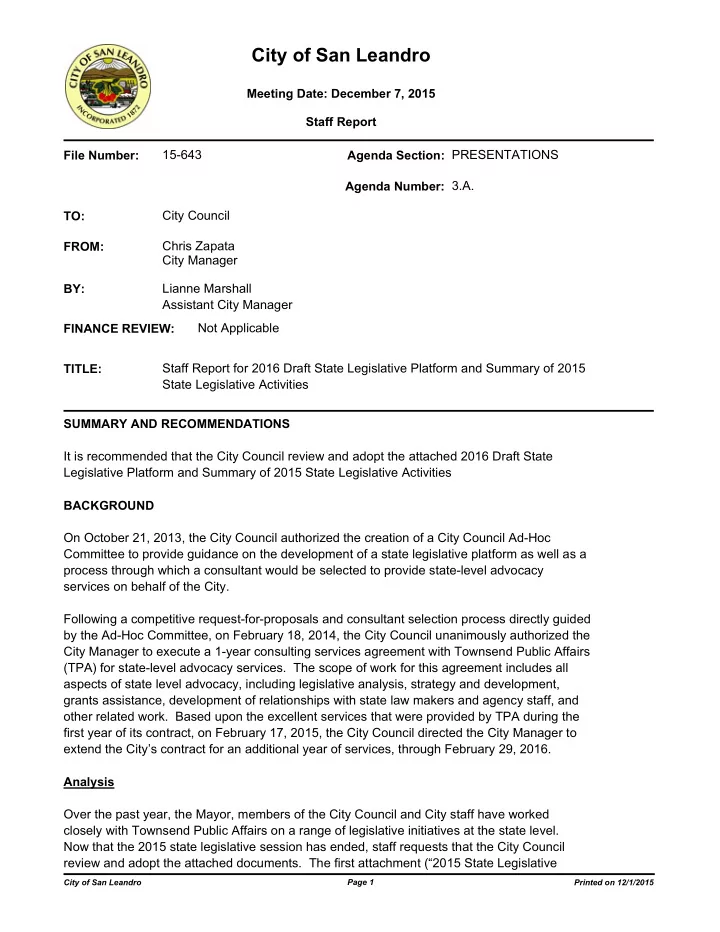
City of San Leandro Meeting Date: December 7, 2015 Staff Report - - PDF document

city of san leandro
SMART_READER_LITE
LIVE PREVIEW

City of San Leandro Meeting Date: December 7, 2015 Staff Report - - PDF document

City of San Leandro Meeting Date: December 7, 2015 Staff Report 15-643 PRESENTATIONS File Number: Agenda Section: Agenda Number: 3.A. TO: City Council FROM: Chris Zapata City Manager BY: Lianne Marshall Assistant City Manager Not


slide-1
SLIDE 1

City of San Leandro

Meeting Date: December 7, 2015 Staff Report Agenda Section: File Number: 15-643 PRESENTATIONS Agenda Number: 3.A. TO: City Council FROM: Chris Zapata City Manager BY: Lianne Marshall Assistant City Manager FINANCE REVIEW: Not Applicable TITLE: Staff Report for 2016 Draft State Legislative Platform and Summary of 2015 State Legislative Activities SUMMARY AND RECOMMENDATIONS It is recommended that the City Council review and adopt the attached 2016 Draft State Legislative Platform and Summary of 2015 State Legislative Activities BACKGROUND On October 21, 2013, the City Council authorized the creation of a City Council Ad-Hoc Committee to provide guidance on the development of a state legislative platform as well as a process through which a consultant would be selected to provide state-level advocacy services on behalf of the City. Following a competitive request-for-proposals and consultant selection process directly guided by the Ad-Hoc Committee, on February 18, 2014, the City Council unanimously authorized the City Manager to execute a 1-year consulting services agreement with Townsend Public Affairs (TPA) for state-level advocacy services. The scope of work for this agreement includes all aspects of state level advocacy, including legislative analysis, strategy and development, grants assistance, development of relationships with state law makers and agency staff, and

  • ther related work. Based upon the excellent services that were provided by TPA during the

first year of its contract, on February 17, 2015, the City Council directed the City Manager to extend the City’s contract for an additional year of services, through February 29, 2016. Analysis Over the past year, the Mayor, members of the City Council and City staff have worked closely with Townsend Public Affairs on a range of legislative initiatives at the state level. Now that the 2015 state legislative session has ended, staff requests that the City Council review and adopt the attached documents. The first attachment (“2015 State Legislative

Page 1 City of San Leandro Printed on 12/1/2015

slide-2
SLIDE 2

File Number: 15-643

Activities Summary”) provides a retrospective summary of various efforts and initiatives that took place on behalf of the City of San Leandro over the past legislative session. The second attachment (“2016 Draft State Legislative Platform”) provides a summary of the City’s proposed policy priorities for the 2016 legislative session. This document was informed by the City Council’s 2015 adopted legislative platform, and has been updated for 2016 to reflect new or emerging policy issues following input from City department heads and staff. The purpose of this latter document is twofold. First, it provides standing authority for the Mayor, City staff and the City’s advocates to take action on behalf of the City on pending legislative matters when time constraints or other logistical hurdles preclude bringing such matters before the City Council in advance. Second, it provides the City’s advocates a better understanding of the Mayor and City Council’s policy preferences regarding a variety of legislative and intergovernmental issues that may arise during the course of the year. Related efforts could include issuing letters on behalf of the City to the Governor or State Legislature in support or opposition to various bills, organizing meetings with the Governor’s Office or elected state representatives, and advancing the City’s interests on various matters that are dependent upon or impacted by the actions of the State. Because the State legislative environment is inherently dynamic, the City Council reserves the opportunity to further amend the 2016 platform over the course of the year ahead should unforeseen needs or issues arise. ATTACHMENTS

·

2015 State Legislative Activities Summary

·

2016 State Legislative Platform and Policy Guidelines PREPARED BY: Eric Engelbart, Assistant to the City Manager, City Manager’s Office

Page 2 City of San Leandro Printed on 12/1/2015

slide-3
SLIDE 3

Southern California Office ▪ 1401 Dove Street • Suite 330 • Newport Beach, CA 92660 • Phone (949) 399-9050 • Fax (949) 476-8215 Northern California Office ▪ 300 Frank Ogawa Pl.• Suite 204 • Oakland, CA 94612• Phone (510) 835-9050 • Fax (510) 835-9030 State Capitol Office ▪ 925 L Street • Suite 1404 • Sacramento, CA 95814 • Phone (916) 447-4086 • Fax (916) 444-2063 Federal Government Office ▪ 611 Pennsylvania Avenue SE • #331 • Washington, DC • Phone (202) 744-2926

M E M O R A N D U M To: Mayor Pauline Cutter and Members of the San Leandro City Council CC: Chris Zapata, City Manager Lianne Marshall, Assistant City Manager Eric Engelbart, Assistant to the City Manager From: Christopher Townsend, President, Townsend Public Affairs, Inc. Niccolo De Luca, Senior Director, Townsend Public Affairs, Inc. Alex Gibbs, Associate, Townsend Public Affairs, Inc. Date: December 7, 2015 Subject: Summary of 2015 State Legislative Activities Townsend Public Affairs, Inc. (TPA) has prepared this report for the City of San Leandro following the end of the 2015 State legislative session. This report lists our efforts to date including a summary of our legislative advocacy actions on behalf of the City. 2015 State Legislative Highlights TPA worked with the elected City leaders and the City Manager’s executive staff to develop, advocate for, and secure several major City initiatives. San Leandro-specific initiatives were accomplished by working directly with Assembly Member Bonta and his office, Senator Hancock and her office, the office of the Senate Pro Tem, the Office of the Assembly Speaker, and the Governor’s Administration. As background, the first year of the 2015-16 legislative session ended at midnight on September

  • 11th. The Governor had until October 11th to sign or veto the hundreds of bills before him, which

included over 645 pieces of legislation in total. The State Legislature is now on interim recess and is not scheduled to reconvene for the second year of the two-year session until January 4, 2016, although it is possible that they may return sooner in order to work on transportation matters in the special session. Below is a recap of the 2015 state legislative session highlights that were of importance to the City

  • f San Leandro and reflect the 2015 legislative priorities of the Mayor and City Council, as adopted
  • n November 3, 2014.

Affordable Housing With the dissolution of redevelopment agencies statewide, an ongoing source of funding for affordable housing has been lacking. One of TPA’s top priorities for the City was to identify, support and push forward legislative proposals supporting and encouraging affordable or work force housing. The Assembly submitted a package of bills to provide funding for the construction of affordable housing and on behalf of the City of San Leandro we were actively involved in helping move these bills forward, specifically:

slide-4
SLIDE 4

2015 State Legislative Summary Page 2 of 7

 Assembly Bill 35 (Chiu) Income Taxes: Credits: Low Income Housing. This bill, which was supported by Mayor Cutter, would have provided $100 million in low income housing funding in the form of tax credits over the next five years. This was one of the main bills in a larger affordable housing package that was pushed by Speaker Atkins, Asm. Chiu, and the Assembly leadership. TPA was an active supporter of this bill on the city’s behalf and is working as part of a large coalition to support this bill. Unfortunately Governor Brown vetoed this and all other tax credit legislation, stating that a carefully balanced budget could require him to cut these new programs if the state’s finances changed in the upcoming years.  Assembly Bill 90 (Chau) Affordable Housing Trust Fund. This bill, which was supported by Mayor Cutter, designates the Department of Housing and Community Development as the agency responsible for administering federal Housing Trust Funds and designates how the agency must allocate affordable housing monies. TPA lobbied on behalf of the City in conjunction with other stakeholders to support this bill. Governor Brown signed this bill into law.  Assembly Bill 744 (Chau). This bill would require a local government, upon the request of a developer who receives a density bonus, to reduce the minimum parking requirements for certain types of housing developments. Specifically, if a housing development is 100% affordable, the ratio shall not exceed 0.5 spaces per unit if the development is located within a half-mile of a major transit stop. AB 744 enjoyed support from numerous regional planning organizations and affordable housing advocates that see parking as a significant barrier to the construction of many types of housing developments, especially in the East

  • Bay. Governor Brown signed this bill into law.

 Assembly Bill 1335 (Atkins) Building Homes and Jobs Act was Speaker Atkin’s bill to push for affordable housing funding. It proposed a $75 fee on paper transactions for commercial real estate that would create $400 million annually. Due to this proposal being a new revenue source, it needed a two-thirds vote in both the Senate and Assembly. The bill is currently on hold and could be brought back next session. Medical Cannabis Statewide Regulations A comprehensive, thorough approach to statewide medicinal cannabis guidelines has been a priority for the San Leandro over the last few years. The medical marijuana regulatory framework includes three bills, Senate Bill 643 (McGuire), Assembly Bill 266 (Bonta) and Assembly Bill 243 (Wood). TPA served as an instrumental member of a statewide coalition that supported the views

  • f both local government and the industry and provided the City with prompt, ongoing updates,

helped explain the various proposals and its impact on the City, and kept the City abreast of the ever changing proposals. In addition, TPA actively drafted language and lobbied legislators and staff to ensure statewide regulations would be in the best interest of the City and its approved

  • perator. Prior versions of this legislation contained key dates related to provisional licensing that

could have negatively impacted the implementation of San Leandro’s dispensary ordinance, which were ultimately struck from the final version of the legislation that was signed into law by the Governor. The approved framework provides protections for cities and existing, approved operators, various local control protections, explicit taxation authority, mechanism for funding environmental clean-up, employer protections for workplace use of medical marijuana, and a strict licensure scheme involving a requirement for both a state and local license, with a local license being required first. The purpose of each of the three bills is summarized below: SB 643 (McGuire) Medical Marijuana

slide-5
SLIDE 5

2015 State Legislative Summary Page 3 of 7 

Directs the California Medical Board to prioritize investigation

  • f

excessive recommendations of medical cannabis by physicians.

Imposes fines ($5,000) against physicians for violating prohibition against having a financial interest in a medical marijuana business.

Recommendation for cannabis without a prior examination constitutes unprofessional conduct.

Imposes restrictions on advertising for physician recommendations.

Upholds local power to levy fees and taxes. AB 266 (Bonta, Cooley, Jones-Sawyer, Lackey, Wood) Medical Marijuana

Protects local control as it establishes a statewide regulatory scheme, headed by the Bureau of Medical Marijuana Regulation (BMMR) within the Department of Consumer Affairs (DCA).

Provides for dual licensing: state will issue licenses, and local governments will issue permits or licenses to operate marijuana businesses, according to local ordinances. State licenses will be issued beginning in January 2018.

Revocation of a local license or permit will unilaterally terminate the ability of the business to operate in that jurisdiction.

Expressly protects local licensing practices, zoning ordinances, and local constitutional police power.

Caps total cultivation for a single licensee at four acres statewide, subject to local

  • rdinances.

Requires local jurisdictions that wish to prevent delivery services from operating within their borders to enact an ordinance affirmatively banning this activity. No specific operative date for the ban is specified.

Includes a labor peace agreement under which unions agree not to engage in strikes, work stoppages, etc. and employers agree to provide unions reasonable access to employees for the purpose of organizing them. Specifies that such an agreement does not mandate a particular method of election. AB 243 (Wood) Medical Marijuana

Places the Department of Food and Agriculture (DFA) in charge of licensing and regulation

  • f indoor and outdoor cultivation sites. Creates a Medical Cannabis Cultivation Program

within the department.

Mandates the Department of Pesticide Regulation (DPR) to develop standards for pesticides in marijuana cultivation, and maximum tolerances for pesticides and other foreign object residue.

Mandates the Department of Public Health (DPH) to develop standards for production and labelling of all edible medical cannabis products.

Assigns joint responsibility to DFA, Department of Fish and Wildlife (DFW), and the State Water Resources Control Board (SWRCB) to prevent illegal water diversion associated with marijuana cultivation from adversely affecting California fish population.

Specifies that DPR, in consultation with SWRCB, is to develop regulations for application of pesticides in all cultivation.

Specifies various types of cultivation licenses.

Directs the multi-agency task force headed by DFW and SWRCB to expand its existing enforcement efforts to a statewide level to reduce adverse impacts of marijuana cultivation, including environmental impacts such as illegal discharge into waterways and poisoning of marine life and habitats. The Governor signed all three bills into law, and now there will be a period of drafting regulations and working with the impacted state agencies, most specifically the Business, Consumer Services and Housing Agency, to finalize guidelines.

slide-6
SLIDE 6

2015 State Legislative Summary Page 4 of 7

RDA Dissolution Another top priority for the City in the 2015 legislative session was to support legislation or regulations that provide relief from past RDA dissolution actions and oppose legislation or regulations that may cause setbacks to successor agencies. Whereas the dissolution of redevelopment agencies has been coming to a close, there was one major outstanding item that was introduced as part of the Governor’s budget proposal. AB 113 (Budget Committee) was the first iteration of an RDA clean-up bill introduced in 2015. From the moment AB 113 was introduced, TPA and San Leandro had numerous discussions on how this proposal would impact the City, what proposed changes needed to occur, and next steps going

  • forward. TPA worked closely with the City to craft and distribute several letters from Mayor Cutter
  • utlining the negative impacts of AB 113 and how it had the potential to wipe out $13.6 million in

loan commitments and funding obligations. Once the City’s position was official, TPA worked with

  • ur East Bay delegation, office of the Assembly Speaker, and a large State wide coalition to help

remove the harmful provisions of AB 113. AB113 stalled and did not move forward. SB 107 (Budget Committee) was amended to become the final package of a redevelopment agency dissolution proposal. Due to our extensive efforts dating back to January, none of the harmful provisions in AB 113 were included in SB 107. SB 107 also includes provisions for cities to access bonds that redevelopment agencies sold during 2011. Those bonds that were issued for affordable housing purposes can be accessed at a 100% level, while those for non-housing purposes can be accessed on a sliding scale ranging from 20% to 45%, depending upon the date

  • f issuance.

Assembly Bill 57 (Quirk) Telecommunications: Wireless Facilities The bill, while written with noble intentions, places high burdens on local governments to meet deadlines that can be unfeasible and strips away the autonomy of local control when it comes to approving telecommunication/cell tower applications. San Leandro’s geography, which includes steep hillsides east of Interstate 580, does not always lend itself to easy resolution of telecommunication company requests. Following some minor amendments, this legislation was signed into law on October 9, 2015. Homelessness Whereas addressing the homeless and helping to provide support is a great need for cities, some legislation was put forward this year that included some potentially harmful provisions for local

  • governments. AB 718 (Chu) would have prohibited a city from penalizing, by impoundment or other

method, the act of sleeping in a lawfully parked vehicle. This measure was introduced as a means to help address homelessness by not criminalizing those who are forced to sleep in their vehicles. This bill received significant opposition from local governments, as well as law enforcement

  • rganizations, claiming that it would infringe upon local governing powers.

Additionally, there were significant concerns about what impact this bill might have on the health, safety, and broader public welfare in communities across the State. Ultimately, when AB 718 was considered on the Senate Floor, it did not garner enough support for passage and failed on an 18- 14 vote, and was then moved to the Inactive File. While this bill will be eligible to be reconsidered again in January, it is likely that the Legislature will look at broader legislation dealing with issues of homelessness. E Cigarettes The rise in popularity of e-cigarettes and lack of centralized regulations has forced local and state governments to begin enforcing their own e-cigarette ordinances. San Leandro’s Second Hand

slide-7
SLIDE 7

2015 State Legislative Summary Page 5 of 7

Smoke Ordinance was one of the first in the state to be expanded to prohibit the use of -e- cigarettes in public places. Senate Bill 140 (Leno) E-Cigarettes would have placed e-cigarettes in the same category at tobacco products in terms of statewide regulations. While SB 140 stalled in policy committee this year, Senator Leno has pledged to reintroduce the bill next year and continue working with us to move the bill forward. Law Enforcement Accountability A major legislative policy in the Capitol at the beginning of the year was legislation addressing

  • fficer-related homicides involving unarmed men and women of color. The Legislature began

exploring best practices for the use of police body-worn cameras in California and the City of San Leandro was often mentioned as an example of a City that has effectively used this technology while balancing the needs of residents. TPA provided ongoing updates to the City of these various bills including:  Assembly Bill 66 (Weber) Body Cameras. This bill proposed to establish mandatory requirements and recommended guidelines for the use of body-worn cameras by peace

  • fficers and the handling of the resulting video and audio data. The bill successfully made it
  • ut of the Assembly Public Safety Committee and the Privacy and Consumer Protection

committee, but is currently on hold in the Assembly Appropriations committee and is eligible to be considered next session.  Assembly Bill 69 (Rodriguez) Body Cameras. This bill requires law enforcement agencies to consider specified best practices when establishing policies and procedures for downloading and storing data from body-worn cameras. This bill was signed into law by the governor.  Assembly Bill 953 (Weber) Racial Profiling. This bill proposes to change the state's definition of "racial profiling" and requires local law enforcement agencies to collect demographic data on the people they stop. This bill was signed into law by the governor. San Leandro Hospital TPA was asked to assist the City and provide support to the ongoing efforts regarding San Leandro Hospital. TPA arranged a briefing meeting with the Mayor, City Manager and our East Bay legislative delegation. The focus of the briefing was to provide the current status of the San Leandro Hospital, discuss next steps, and brainstorm how the coalition can continue working together on this regional asset. The Mayor expressed her vision to come up with a game plan that the delegation can all get behind and implement successfully. TPA helped secure the following attendees to the meeting: Assembly Member Bonta, Assembly Member Quirk, Supervisor Chan, Senator Hancock’s District Director, and staff from Senator Wieckowski’s office. From that meeting, various strategies were implemented and are moving forward.  AB 72 (Bonta) Eden Township Healthcare District: special taxes: authorization. TPA alerted the City to a bill, Assembly Bill 72 (Bonta) that was introduced at the last week of session. This bill sought to allow the Eden Township Healthcare District (ETHD) to impose special

  • taxes. More specifically the bill would: allow the ETHD, until January 1, 2026, to impose

special taxes within the district pursuant to the procedures required by state law, require ETHD’s board of directors to determine the basis and nature of a special tax and its manner of collection, require that special taxes imposed by the ETHD must apply uniformly to all taxpayers or all real property within the district; and declare the

slide-8
SLIDE 8

2015 State Legislative Summary Page 6 of 7

Legislature’s intent that funds from a tax enacted pursuant to this section must be used to support the purposes of the ETHD, including support of nonprofit and public hospitals and

  • ther health care providers in the communities served by the district.

It was expressed that this bill allows ETHD to provide vitally-needed financial support to hospitals that serve district residents by seeking voter approval of a parcel tax measure. The bill was heard in the Senate Governance committee and made it out, yet was ultimately held on the Senate floor and will be revisited next legislative year. Transportation Funding The Legislature has postponed discussion of Cap and Trade expenditures until January of next year after not being able to reach an agreement on how to spend available funding, including how much should be dedicated to transit projects, rail, and affordable housing, among other

  • priorities. The administration estimates about $1.2 billion in cap-and-trade money is available, with

another $500 million in reserve. Governor Brown had offered to put up $500 million annually in cap-and-trade revenue as part of a transportation deal, but that deal was unable to come to fruition before the end of session. A special session solely on transportation has been called by the Governor and will likely convene in the coming weeks. It is speculated that the governor’s office has a proposal totaling $3.5 billion. TPA has been working with various stakeholders, trade groups and others to identify then lobby the needed votes to move this forward. Climate Action SB 350 (de León) passed in the final hours of the Legislative Session and is expected to be signed by the Governor. The measure will enact the Clean Energy and Pollution Reduction Act of 2015, which establishes targets to increase retail sales of renewable electricity to 50% by 2030 and double the energy efficiency savings in electricity and natural gas uses by 2030. The bill was amended in the final week of session to remove the provision that would have established a statewide goal to codify the Governor’s Executive Order to reduce greenhouse gas emissions by reducing the state’s petroleum use from cars by 50 percent. The petroleum provisions were the source of significant opposition from outside interests, as well as from members of the Assembly. Even though the petroleum provisions have been removed, the Governor indicated that he will work with the Air Resources Control Board to take administrative actions that can lower California’s usage of petroleum. This bill was signed into law by the Governor. New funding opportunities TPA worked on two upcoming funding opportunities to help support seismic safety, which is one of the City’s priorities. First, working with a handful of Bay Area cities, $3 million was secured in the State budget for cities to utilize as part of their local seismic safety program to better prepare structures for the next earthquake. Additionally, we have been supporting legislation that would provide tax credits to residents in cities with seismic retrofit mandates. AB 428 reached the Governor's desk and Mayor Cutter joined other Mayors from throughout the state in seeking the Governor’s signature. Unfortunately the Governor vetoed this bill though we are working with the author’s office on next steps. Another funding bonus was in the 2015-16 Budget, which included full repayment of the pre-2004 mandate debt owed to cities and the first payment in lieu of taxes (PILT) funds made in twenty

  • years. A total of $765 million in pre-2004 mandate debt was repaid statewide to local agencies. In

addition, $9.6 million in Public Records Act mandate reimbursement was included in the budget for local agencies statewide. Weekly Updates

slide-9
SLIDE 9

2015 State Legislative Summary Page 7 of 7

In addition to the work mentioned above, TPA provided the City with ongoing, weekly legislative updates on bills, relevant statewide policy topics, and other matters of interest to ensure the City has up to date information and is directly involved in the decision making process. These updates included specific bills we were working on for the City along with bills we suggested the City monitor, support or oppose. The legislative categories included: Public Safety, Planning, Housing and Land Use, Infrastructure, Environment, Energy and Sustainability, Economic Development, Youth, Constitutional changes, and Miscellaneous.

slide-10
SLIDE 10

City of San Leandro DRAFT 2016 State Legislative Platform and Policy Guidelines December 7, 2015 The City of San Leandro’s legislative agenda for 2016 is designed to reflect the adopted priorities and policy direction of the Mayor and City Council with direct input from the City Administration. This strategic agenda includes advocating for legislation, regulations, and funding that is consistent with the City’s adopted priorities. It is informed by the City Council’s 2015 adopted legislative platform, and has been updated for 2016 to reflect new or emerging policy issues following input from City department heads and staff. This agenda is designed to (a) provide standing authority for the Mayor, City staff or the City’s legislative advocates to take action on pending legislative matters on behalf of the City of San Leandro when time constraints or administrative burdens preclude bringing such matters before the City Council in advance, and (b) provide the City’s advocates a better understanding of the Mayor and Council’s policy preferences regarding a variety of legislative and intergovernmental issues that might arise during the course of the year. This report is compiled into two sections:

  • 1. City Specific State Legislative Priorities for Recommended Action, and
  • 2. Policy Priorities for Ongoing Monitoring or Advocacy;
  • 1. City Specific State Legislative Priorities for Recommended Action

Below is a list of specific legislative priorities for the City. Direct advocacy with the Governor, the Legislature, State agencies and other organizations will be focused on these areas: Transportation & Public Works  Electric Vehicle Infrastructure. Support legislative efforts and funding programs that provide cities greater flexibility and opportunities to enhance and build out electric vehicle infrastructure.  Illegal Dumping & Graffiti Abatement. Support legislative efforts that provide for greater penalties or incentives to reduce the amount of illegal dumping and graffiti.  Reclaimed/Recycled Water Projects. Support legislation that advances the use of recycled water while meeting the needs of local agencies, especially during times of

  • drought. These efforts could include support for permitting, construction, or maintenance of

recycled water pipelines. Oppose legislation or regulations that harm these efforts.  Recycling Programs. Support legislation to extend incentives for both household and commercial recycling efforts. Oppose legislation that hampers recycling efforts or reduces incentives to recycle.  Transfer of state urban highways. Support efforts to create a streamlined process for the transfer of state urban highways to local agencies. East 14th Street and Davis Street are presently designated state highways; however, the current mechanism that would facilitate the transfer of these highways to the City does not provide sufficient financial commitments from the state prior to any transfer. Support efforts that would allow the state to reconstruct both roadways in advance of any transfer of rights-of-way to the City of San Leandro.  Traffic Signal Synchronization. Support legislation or regulatory efforts to address greenhouse gases (GHG) by providing funding for traffic signal synchronization and related actions that reduce traffic and pollution. This past legislative session marked a new focus of

slide-11
SLIDE 11

City of City of San Leandro 2016 State Legislative Platform and Policy Guidelines Page 2 of 5

changing state law to allow for greater flexibility of certain funds, especially to help address GHG reductions.  Undergrounding of Utilities/Rule 20A. The Public Utilities Commission oversees the funding used to support the undergrounding of utilities. This work is done under provisions

  • f Rule 20A, an electric tariff filed with the California Public Utilities Commission. Projects

performed under Rule 20A are nominated by a city, county or municipal agency and discussed with utility companies. Support efforts to fund and approve these projects, including exploring regional approaches.  Use of State Highways. Support efforts that would facilitate the use of overweight trucks to transport goods from local San Leandro businesses to and from the Port of Oakland on routes that utilize state highways.  Vehicle Miles Traveled Legislation. Monitor new legislation or regulatory efforts with a greater focus on Road Usage Charges (RUC). The Senate Transportation Committee is working on a guide for the development and implementation of a pilot program to study the potential for RUC as an alternative to the gas tax.  Water Quality Measures/Trash Capture Devices. Support legislation, regulations, and budget proposals that will provide support and resources to purchase and install trash capture devices to address storm water runoff. Housing & Land Use  Affordable Housing. With the dissolution of redevelopment agencies statewide, an

  • ngoing source of funding for affordable housing has been lacking. Support efforts to

identify funding, or streamline the process for developing more affordable or work force

  • housing. Support efforts to include a broader range of options that would be eligible to

receive state housing element credits, including the conversion of existing commercial and housing stock, senior housing, assisted living units and housing cooperatives.  Broadband Infrastructure. Support legislation or funding opportunities that would expand public and private access to broadband, including the development of related infrastructure  CEQA Reform. Support legislation that makes common sense reforms to the California Environmental Quality Act, including allowing for the reduction in time delays or excessive lawsuits, while ensuring environmental protections remain in place. Support efforts that would allow local agencies to set criteria for traffic impact levels-of-service based upon locally adopted General Plans and/or other local requirements.  Creek Walk, East Bay Greenway, and other Bike/Ped projects. Support legislation, regulations, and budget proposals that would provide funding opportunities or other support for the development of greenway projects, bicycle and pedestrian projects, and other modes of active transportation. 

  • Dredging. Support efforts to identify funding for the dredging of recreational marinas.

 Parks Funding. The Pro Tem elect authored a bill that would establish a 2016 park bond. Support this legislation or similar efforts to identify funding for parks and recreation.  Shoreline Development. Support legislative efforts or funding opportunities that would assist in the successful redevelopment of San Leandro’s shoreline area. Law Enforcement & Public Safety  Body Cameras. Support legislation addressing best practices for the use of police body- worn cameras, while balancing the needs of the public and law enforcement personnel.

slide-12
SLIDE 12

City of City of San Leandro 2016 State Legislative Platform and Policy Guidelines Page 3 of 5

 Disaster Prevention and Recovery. Seek additional funding, and expand the definition of programs eligible for grant funding, for disaster recovery and prevention. 

  • Drones. As the use, and need for drones expands, so does the discussion on local control

and privacy. Monitor any new legislation and support efforts to ensure local needs are adequately addressed.  Illegal gambling parlors. Support legislative efforts that would provide additional local authority to address the frequency of ‘pop up’ online casinos. Assembly Bill 1439 (Salas) was signed into law by the Governor, providing cities with additional authority to regulate these types of establishments. Additional legislation may be needed to continue to effectively regulate online gambling establishments.  Massage Parlors. Legislation was passed in 2014 to give cities tighter control of massage

  • establishments. Support the City’s efforts to interface with the California Massage Therapy

Council (CAMTC) on the certification of new businesses, while working to ensure that bad businesses are denied certification. Health & Human Services 

  • Homelessness. Work with regional stakeholders to develop regional solutions to

homelessness in the Bay Area. Support efforts to identify additional funding opportunities for local agencies and non-profit organizations for shelters and/or other programs and services designed to support homeless populations.  Medical Cannabis Regulations. Now that state legislation has been signed into law, there will be an effort to codify new regulations that will be administered by the State. Support efforts that would facilitate the successful implementation San Leandro’s medical cannabis dispensary ordinance. Oppose federal actions that interfere with state’s rights, as well as any actions or legislation that restrict local control.  San Leandro Hospital. Support efforts to ensure the successful operation and financial sustainability of San Leandro Hospital  Safety Net Services and Support for Seniors. Support legislative efforts that would expand safety net services for those most in need, including low-income residents and senior populations. Public Finance  Cap & Trade Funding. Support legislation, funding guidelines, and/or other regulations for the successful disbursement of funding from the State’s Cap-and-Trade program for City programs and efforts.  Utility User Taxes. Support legislation or regulations that would provide cities with the flexibility and authority to collect or increase Utility User Taxes (UUTs). Additionally, fight any proposals that seek to limit or restrict the City’s use of UUTs.

  • 2. Policy Priorities for Ongoing Monitoring or Advocacy

Monitor legislative activity and/or or advocate on behalf of the City of San Leandro's interests in the following broad policy areas:  Public Safety

slide-13
SLIDE 13

City of City of San Leandro 2016 State Legislative Platform and Policy Guidelines Page 4 of 5

  • This includes policy topics such as disaster preparedness, proposals to

provide local law enforcement with additional support, school resource

  • fficers or joint use efforts with school districts, prevention and

intervention funding for at-risk youth, 911 call centers, public safety answering points (PSAPs), POST mandates, AB 109 Realignment implementation, stolen vehicles, mental illness counseling services, juvenile justice programs, technology enhancements and support, crisis intervention and suicide prevention, and other related programs.  Transportation

  • This includes policy topics such as goods movement, safe routes to

school funding, local road repair, regional transportation funds, street signs, curb paintings, and other efforts to support regional transportation programs.  Economic Development

  • This includes policy topics such as redevelopment dissolution, measures

providing for new tax increment financing opportunities, infrastructure financing districts, efforts to encourage local job creation, and other such topics.  Infrastructure

  • This includes policy topics such as funding for roads, sewers, storm

drains, and other public works responsibilities.  Health & Human Services

  • This includes general policy topics related health and human services

matters effecting the residents of San Leandro and could include: safety net services, homelessness and hunger, childcare, and community health facilities, among others  Housing and Land Use

  • This includes policy topics such as creating new sources of affordable

housing funds, and legislation that may negatively impact local authority, and other similar topics.  Quality of Life

  • This includes policy topics such as the development of funding sources

for parks, urban waterways, climate change, clean energy efforts, waste reduction, multilingual outreach, kindergarten readiness programs, project literacy, veterans, homework/technology centers, library capital improvement needs, after school sports, park/playground equipment, and other quality of life programs.  Constitutional Modifications

  • This includes policy topics such as measures that would impact local

governments, such as lowering the voter threshold to 55% for various bond issuances and local taxes.  Protecting Local Control

  • The City of San Leandro values its ability and authority to exercise local

control, provide excellent public services and protect and enhance the quality of life for San Leandro residents, businesses, and visitors, and supports efforts to streamline regulations that simplify the job of running

slide-14
SLIDE 14

City of City of San Leandro 2016 State Legislative Platform and Policy Guidelines Page 5 of 5

the City’s operations and opposes efforts that erode the City’s authority to control its own affairs. This also includes policy topics such as measures or budget actions which could potentially impact the

  • perations of, or services provided by, the City of San Leandro.

 Technology

  • This includes policy topics such as efforts to expand access to fiber
  • ptic/broadband infrastructure for community residents, businesses, or

schools, energy efficiency projects like LED street lights and residential/commercial retrofits, as well as efforts to support technological innovation in San Leandro and the region. Process for Reporting In addition to regular progress reports sent to the City, annual reports on these and other efforts to support the City’s legislative agenda shall be provided to the City Council and City staff.

slide-15
SLIDE 15

City of San Leandro

Meeting Date: December 7, 2015 Minute Order - Council Agenda Section: File Number: 15-644 PRESENTATIONS Agenda Number: TO: City Council FROM: Chris Zapata City Manager BY: Lianne Marshall Assistant City Manager FINANCE REVIEW: Not Applicable TITLE: MOTION Adopting the 2016 State Legislative Platform and Summary of 2015 State Legislative Activities

Page 1 City of San Leandro Printed on 12/1/2015