
SLIDE 1
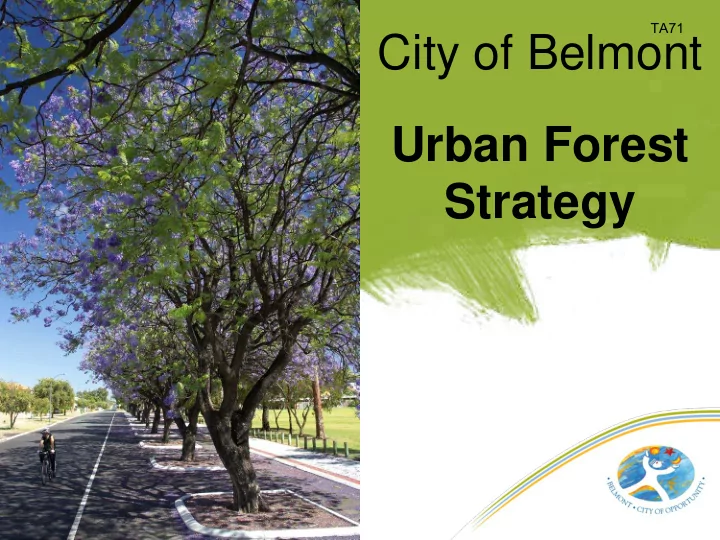
City of Belmont Urban Forest Strategy
TA71
City of Belmont Urban Forest Strategy PROGRESS TIMELINE TA72 - - PowerPoint PPT Presentation
TA71 City of Belmont Urban Forest Strategy PROGRESS TIMELINE TA72 Strategic Community Plan objective No.1 Protect and Street Tree Strategy Environment Plan Strategic Community Plan enhance the natural Workshop (Councillors, 2010-2015
TA71
Environment Plan 2010-2015 adopted by Council June 2010
Strategic Community Plan
enhance the natural environment”
Forest Strategy
Strategic Community Plan 2012-2032 and Corporate Business Plan 2013-2017 Street Tree Strategy Workshop (Councillors, Managers & Directors) - November 2010
CEO’s goals & targets
Street Tree Plan SMG
Draft Street Tree Plan presented to Standing Committee (Environmental) – November 2012
Street Tree Plan adopted by Council February 2013
Canopy Mapping Presentation presented to Standing Committee (Environmental) March 2013 - with approval sought to begin the development of an Urban Forest Strategy.
Draft Urban Forest Strategy presentation presented to the Standing Committee (Environmental) June 2013 Updated Draft Urban Forest Strategy presentation presented to SMG September 2013
Updated Draft Urban Forest Strategy presentation presented to Standing Committee (Environmental) September 2013 Internal Working group meetings held (January to March 2014)
Councillor workshop held April 2014 with agreement for the draft Urban Forest Strategy to be presented to Standing Committee (Environmental) June 2014
1st Draft Urban Forest Strategy presented to Standing Committee (Environmental) June 2014 Urban Forest Strategy presented to OCM for adoption – August 2014
TA72
meetings held (January to March 2014) Councillor workshop held April 2014 with agreement for the draft Urban Forest Strategy to be presented to Standing Committee (Environmental) June 2014 1st Draft Urban Forest Strategy presented to Standing Committee (Environmental) June 2014 Urban Forest Strategy presented to OCM for adoption – August 2014
TA73
The City’s Urban Forest Strategy will;
most liveable and desirable inner-city municipalities and
industry and therefore the livelihoods, lifestyles and health of the City’s diverse communities. The retention and enhancement of green infrastructure will not
the precursor for healthy communities for decades to come.
TA74
Heat related deaths 2011: 137 2050: 374 Reduces heat related illnesses
Improves sense
Improves mental wellbeing
Encourages physical activity
Improves physical wellbeing
Connects children with nature
Reduces crime Maintains cultural connections Improves social cohesion Improves air and water quality $270pa in ecological contributions Increases TravelSmart Reduces UV exposure Reduces Urban Heat Island Effect Store and sequester carbon Increases soil permeability and health
Provides habitat and greater biodiversity Reduces storm water flow by 40% Improves streetscapes
Enhances parks and open spaces
Reinforces City identity Improves amenity of hard infrastructure Reinforces Community identity
Increases property value
$9,500 increase
with canopy cover Increases longevity
pavements Enables energy savings $ Enables water savings $ Reduces overall financial burden from social health issues Attracts economic growth and development Increases rental yield
Built Belmont Business Belmont Social Belmont Natural Belmont TA75
Milestone 1 Undertake mapping of the City of Belmont’s Canopy Coverage and analyse for trends (completed 2013) Milestone 2 Develop an Urban Forest Strategy with strategic objectives and an initial canopy target (April 2014) Milestone 3 Develop and implement the Canopy Plan with actions to achieve the strategic objectives of the Strategy Milestone 4 Undertake implementation of the Canopy Plan, its subsidiary documents and progress towards a formalised Canopy Target Milestone 5 Review and evaluate Council’s progress towards the Canopy Target in regards to Strategic objectives and revise plan and target if required
TA76
Milestone 1 Undertake mapping of the City of Belmont’s Canopy Coverage and analyse for trends (completed 2013) Milestone 2 Develop an Urban Forest Strategy with strategic objectives and an initial canopy target (April 2014) Milestone 3 Develop and implement the Canopy Plan with actions to achieve the strategic objectives of the Strategy Milestone 4 Undertake implementation of the Canopy Plan, its subsidiary documents and progress towards a formalised Canopy Target Milestone 5 Review and evaluate Council’s progress towards the Canopy Target in regards to Strategic objectives and revise plan and target if required
TA77
Decided at Urban Forest Strategy Councillor Workshop, 1 April 2014
TA78
TA79
Leadership and Governance Asset Retention
Awareness, Participation and Capacity Building
Research, Best Practice and Adaptive Management
realised
TA80
TA81
TA82
TA83
TA84
Dining
Active transport
Public Transport
Commercial high-rise
Social cohesion
Pedestrian movement
Relaxation
Green space
Pavement
Outdoor Exercise Shaded Walkway TA85
TA86