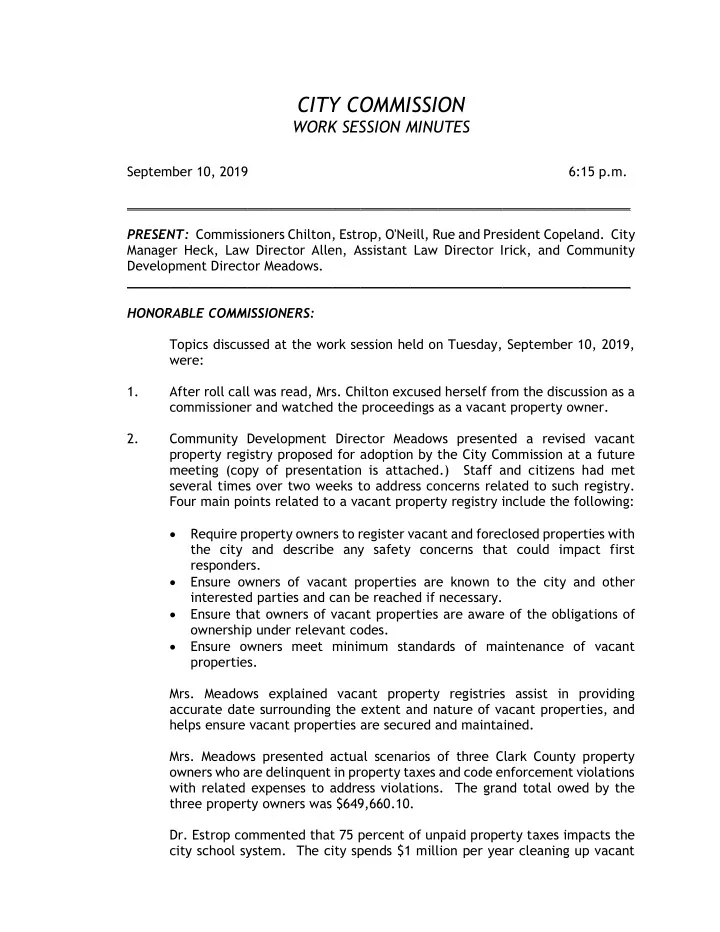
CITY COMMISSION WORK SESSION MINUTES September 10, 2019 6:15 p.m. - - PDF document

city commission
SMART_READER_LITE
LIVE PREVIEW

CITY COMMISSION WORK SESSION MINUTES September 10, 2019 6:15 p.m. - - PDF document

CITY COMMISSION WORK SESSION MINUTES September 10, 2019 6:15 p.m. _______________________________________________________________________ PRESENT: Commissioners Chilton, Estrop, O'Neill, Rue and President Copeland. City Manager Heck, Law


slide-1
SLIDE 1

CITY COMMISSION

WORK SESSION MINUTES

September 10, 2019 6:15 p.m. _______________________________________________________________________ PRESENT: Commissioners Chilton, Estrop, O'Neill, Rue and President Copeland. City Manager Heck, Law Director Allen, Assistant Law Director Irick, and Community Development Director Meadows. _______________________________________________________________________ HONORABLE COMMISSIONERS: Topics discussed at the work session held on Tuesday, September 10, 2019, were: 1. After roll call was read, Mrs. Chilton excused herself from the discussion as a commissioner and watched the proceedings as a vacant property owner. 2. Community Development Director Meadows presented a revised vacant property registry proposed for adoption by the City Commission at a future meeting (copy of presentation is attached.) Staff and citizens had met several times over two weeks to address concerns related to such registry. Four main points related to a vacant property registry include the following:  Require property owners to register vacant and foreclosed properties with the city and describe any safety concerns that could impact first responders.  Ensure owners of vacant properties are known to the city and other interested parties and can be reached if necessary.  Ensure that owners of vacant properties are aware of the obligations of

  • wnership under relevant codes.

 Ensure owners meet minimum standards of maintenance of vacant properties.

  • Mrs. Meadows explained vacant property registries assist in providing

accurate date surrounding the extent and nature of vacant properties, and helps ensure vacant properties are secured and maintained.

  • Mrs. Meadows presented actual scenarios of three Clark County property
  • wners who are delinquent in property taxes and code enforcement violations

with related expenses to address violations. The grand total owed by the three property owners was $649,660.10.

  • Dr. Estrop commented that 75 percent of unpaid property taxes impacts the

city school system. The city spends $1 million per year cleaning up vacant

slide-2
SLIDE 2

September 10, 2019 Page 2 properties and cutting grass and weeds. Additional expenses are also incurred by the Police and Fire Divisions.

  • Mr. O’Neill asked why nothing has been done, and Mrs. Meadows stated there

needs to be a new system in the Springfield and the region to address these issues as there are no single individuals or offices at fault. Mr. Copeland added many cities in Ohio are facing similar situations.

  • Mrs. Meadows stated there are 1,600 vacant property registries across the

country and 117 are in Ohio. Dr. Estrop added Beavercreek’s registry had been mentioned at a previous meeting, and staff obtained a copy.

  • Mrs. Meadows explained the proposed registry for Springfield would include

four types of residential properties:  Abandoned properties. A structure that is unoccupied as the result of the relinquishment of possession or control by an owner. The City of Springfield may register abandoned properties on the VPR  Vacant for sale or rent. A structure that is not occupied for 90 days or

  • less. A vacant structure that has not remained vacant for 90 days does

not have to be listed on the VPR by the owner or authorized agent.  Vacant for rehabilitation. A structure that is not occupied for more than 90 days. A vacant structure that is unoccupied for more than 90 days must be listed by the owner or the authorized agent. The registration must include a statement of intent for the property and life/safety disclosures. 

  • Foreclosed. Properties under complaints of foreclosure must be

registered on the VPR by the person (includes corporate entities) filing the foreclosure complaint. Law Director Allen reviewed the responsibilities and obligations of owners, agents, property managers, financial institutions, and mortgage companies. Each property must have a designated contact person, not just a property

  • wner who is listed on the tax records.
  • Mrs. Meadows reviewed the process of reporting vacant properties and

penalties associated with failure to report:  Residential properties are considered vacant when they have been unoccupied for 90 days.  Owners are responsible for registering properties within 30 days of it becoming vacant.  Owners who seasonally leave their home unoccupied with intent to return (snowbirds) are not required to register.

slide-3
SLIDE 3

September 10, 2019 Page 3  Owners must provide all information required on the VPR form, including a Statement of Intent for the property and a Conditions that affect life/safety Summary.  Owners failing to register properties will be subject to penalties  Owners aggrieved by a decision made by the Community Development Director may appeal the decision to the City Manager. Appeals of the City Manager’s decision may be made to the Board of Building Appeals.

  • Mrs. Meadows explained the various registration methods, the annual fee of

$100 per registration, the $25 per day administrative penalty not to exceed $750, and the possible fee waiver if property is placed on the voluntary demolition list.

  • Mrs. Meadows further explained the adoption of such a registry would begin

the outreach and education phase of the process. Staff recommends implementing the registration process but waiting 60 to 90 days after adoption for the requirements to become effective. Questions may be directed to the Community Development at 937-324-7380.

  • Dr. Estrop thanked staff for the work on the proposed registry as well as the

Housing Consortium, City Commissioners, and property owners who participated in the discussions to find a way to address the issue of vacant

  • properties. Dr. Estrop announced his intent to make a motion during the

legislative meeting to postpone the first reading of the vacant property registry until the next meeting.

  • Mr. O’Neill asked for clarification of 4,000 vacancies in the city at this time.
  • Mrs. Meadows stated there are 4,000 properties identified as abandoned,

unoccupied during rehabilitation, held as unoccupied, vacant for sale, or vacant for rent. Mr. O’Neill stated and Mrs. Meadows confirmed that not all

  • f the 4,000 properties would be required to register as a vacant property

based on their status per the registry requirements. 3.

  • Mrs. Chilton returned to the discussion for adjournment. On motion of Dr.

Estrop, seconded by Mr. Rue, the meeting adjourned. Yeas, Mrs. Chilton, Dr. Estrop, Mr. O’Neill, Mr. Rue and Mr. Copeland. Yeas 5, Nays 0.

  • Adj. 7:10 p.m.

Respectfully submitted, Jill R. Pierce Clerk of the City Commission

slide-4
SLIDE 4

9/17/2019 1

Proposed Vacant Property Registry

September 10, 2019 Shannon Meadows, Community Development Director Jill Allen & Jason Irick, City of Springfield Law Dept.

What is a Vacant Property Registry?

01

Require property owners to register vacant and foreclosed properties with the city and describe any safety concerns that could impact first responders.

02

Ensure owners of vacant properties are known to the city and other interested parties and can be reached if necessary.

03

Ensure that owners of vacant properties are aware of the obligations

  • f ownership under relevant codes.

04

Ensure owners meet minimum standards of maintenance of vacant properties.

slide-5
SLIDE 5

9/17/2019 2

Vacant Property Registries

  • Assist in providing accurate data surrounding the

extent and nature of vacant properties

  • Provides detailed and reliable contact information for
  • wners and/or authorized agents
  • Provides detailed information about safety hazards

within the structure

  • Helps ensure vacant properties are secured and

maintained

  • Reduce harms and costs vacant properties pose to
  • Neighborhoods
  • First Responders
  • Community at large

Three Fundamental Types of VPROs

Source: US Department of Housing and Urban Development

Require property owners to register properties after a certain length of vacancy.

Vacant and Abandoned Model Foreclosure Model Hybrid Model

Springfield’s proposed VPRO is set to be a Hybrid Model

Registration is triggered by a formal, state- required notice of default

  • r intent to foreclose that

is filed as a part of a judicial proceeding or advertised by the mortgagee or servicer as a part of a non judicial foreclosure process. Many communities have more recently adopted the Hybrid Model by enacting ordinances with characteristics of the Vacancy and Abandonment Model and the Foreclosure Model. The Hybrid Model can be triggered either by vacancy or by foreclosure-related actions. Allows government entities to identify abandoned properties Requires property

  • wners to register

properties after 90 days

  • f vacancy

Requires mortgage holders or servicers to register vacant foreclosed properties

slide-6
SLIDE 6

9/17/2019 3

The Growth of Vacancy

Vacancy in urban communities is not new The number of vacant units grew from 2000 to 2010 by 27% nationally

Predatory lending practices begin to take hold – particularly in minority communities.

2007 1990s

The Foreclosure Crisis takes hold nationwide, including Springfield OH

1970s

Various programs begin to fuel the “Flipping” Industry, but funds quickly dry up.

1950s

Industrial movement away from the Midwest and toward the Sunbelt results in population loss. Over 4,000 residential units in Springfield are vacant (14%) Springfield has suffered the effects of abandoned and vacant housing in legacy neighborhoods for decades.

The rise in foreclosures only exacerbated the negative effects.

Springfield has suffered the effects of abandoned and vacant housing in legacy neighborhoods for decades.

The rise in foreclosures only exacerbated the negative effects.

A Closer Look

slide-7
SLIDE 7

9/17/2019 4

slide-8
SLIDE 8

9/17/2019 5

slide-9
SLIDE 9

9/17/2019 6

slide-10
SLIDE 10

9/17/2019 7

slide-11
SLIDE 11

9/17/2019 8

slide-12
SLIDE 12

9/17/2019 9

slide-13
SLIDE 13

9/17/2019 10

slide-14
SLIDE 14

9/17/2019 11

Responding to the Effects of Vacancy

The federal Neighborhood Stabilization Program was helpful in focused areas of Springfield, but has not been sufficient in dealing with the problem of large numbers of foreclosed, vacant and abandoned properties in the last decade. Create Local Land Banks Improve the local tax foreclosure system Adopt Vacant Property Registration Ordinance Use Court Appointed Receivers when Necessary Enhance Code Enforcement Systems

Various tools are necessary to fully address the effects

  • f vacancy in weaker

market regions, and particularly in legacy

  • neighborhoods. One

entity cannot do it alone.

slide-15
SLIDE 15

9/17/2019 12

The current situation in Springfield The current situation in Springfield

Vacant property causes economic hardship throughout the community and drains city resources, including Code Enforcement. A Closer Look

slide-16
SLIDE 16

9/17/2019 13

Property Owner A

Property Tax Delinquency

$ 262,931.52

Outstanding CE Fines

$42,343.03

Property Summary

33 properties 15 subject to R & D

Estimated Demolition

$136,000.00

Total

$441,274.55

Three Owners

Property Tax Delinquency

$ 331,629.36

Outstanding CE Fines

$70,030.74

Property Summary

56 properties 29 subject to R & D

Estimated Demolition

$248,000.00

Total

$649,660.10

Property Owner C

Property Tax Delinquency

$ 48,885.58

Outstanding CE Fines

$8,973.50

Property Summary

9 properties 7 subject to R & D

Estimated Demolition

$56,000.00

Total

$113,859.08

Property Owner B

Property Tax Delinquency

$ 19,812.26

Outstanding CE Fines

$18,714.21

Property Summary

14 properties 7 subject to R & D

Estimated Demolition

$56,000.00

Total $94,526.47

Vacant Property Registration Local Government Adoptions

Before 2000 2000 - 2007 2008 - 2009 2010 - 2012 2013 - 2019

NATIONALLY

TODAY 1,639 VPROS EXIST There are currently 117 VPROs in the state of Ohio. Ohio municipalities began adopting VPROs in 2005 50 100 150

OHIO

TODAY 117 VPROS EXIST

The dominant type of VPRO before 2008 had been the vacancy and abandonment type. Hybrid types grew beginning in 2008.

slide-17
SLIDE 17

9/17/2019 14

Springfield’s Proposed VPRO

A structure that is unoccupied as the result of the relinquishment of possession or control by an owner. The City of Springfield may register abandoned properties on the VPR.

Abandoned Properties

Properties under complaints of foreclosure must be registered on the VPR by the person (includes corporate entities) filing the foreclosure complaint.

Foreclosed

A structure that is not occupied for 90 days or less. A vacant structure that has not remained vacant for 90 days does not have to be listed on the VPR by the owner or authorized agent.

Vacant for sale or rent

A structure that is not occupied for more than 90 days. A vacant structure that is unoccupied for more than 90 days must be listed by the

  • wner or the authorized agent. The

registration must include a statement

  • f intent for the property and

life/safety disclosures.

Vacant for rehabilitation

01 02 03 04

Responsibilities & Obligations

Owners, Agents, Property Managers, Financial Institutions, and Mortgage Companies.

  • Liability will extended beyond the traditional “owner” with the Vacant Property

Registration Program.

  • Liability and therein responsibility may apply to:
  • Executors/Trustees
  • Lessees
  • The Owner’s Authority Agent,
  • Property Managers,
  • Financial Institutions,
  • Mortgage Companies and,
  • Those with an interest who knowingly take action in a juridical, admin.

Proceeding for the purposes of delay.

Chapter 1386 Liability

slide-18
SLIDE 18

9/17/2019 15 Springfield VPRO Process

  • Residential properties are considered vacant

when they have been unoccupied for 90 days

  • Owners are responsible for registering

properties within 30 days of it becoming vacant

  • Owners who seasonally leave their

home unoccupied with intent to return (snowbirds) are not required to register

  • Owners must provide all information required
  • n the VPR form, including a Statement of

Intent for the property and a Conditions that affect life/safety Summary

  • Owners failing to register properties will be

subject to penalties

  • Owners aggrieved by a decision made by the

Community Development Director may appeal the decision to the City Manager. Appeals of the City Manager’s decision may be made to the Board of Building Appeals.

Straightforward Registration

Owners may register on paper forms provided by the City of Springfield Owners may register electronically on their smart phone or other electronic device Owners or authorized agents may provide registration updates and amendments electronically

$100 per registration required annually for each vacant property Registration Fee Fees may be waived if property is placed on the voluntary demolition list Voluntary Demolitions Subject to a $25 per day administrative penalty not to exceed $750 Failure to Register The data gathered via the VPR is public record Registration Data Owners must file registrations for each vacant structure owned Registrations filed

slide-19
SLIDE 19

9/17/2019 16

Moving Forward

Questions?

September 10, 2019 No legislative action Work session Presentation Staff recommends at least 60 to 90 days after an affirmative vote for the VPR to be effective as law. Vacant Property Registry Start Legislation must be scheduled for consideration by City Commission. The legislation would be voted on when the second reading is scheduled. First and Second Reading If the Legislation becomes

  • rdinance, staff will embark upon a

deliberate education and outreach program. Outreach and Education COS VPR