Circular Wire Resonator as an Efficient Huygens Element Sergei - - PowerPoint PPT Presentation

circular wire resonator as an efficient huygens element
SMART_READER_LITE
LIVE PREVIEW

Circular Wire Resonator as an Efficient Huygens Element Sergei - - PowerPoint PPT Presentation

Circular Wire Resonator as an Efficient Huygens Element Sergei Kosulnikov, 1, 2, a) Dmytro Vovchuk, 1, 3 Roman Noskov, 1 Amir Boag, 1 and Pavel Ginzburg 1, 4 1 Tel Aviv University, Israel 3 Yuriy Fedkovych Chernivtsi National University, Ukraine 2


slide-1
SLIDE 1

Sergei Kosulnikov,1, 2, a) Dmytro Vovchuk,1, 3 Roman Noskov,1 Amir Boag,1 and Pavel Ginzburg1, 4

Circular Wire Resonator as an Efficient Huygens Element

1Tel Aviv University, Israel 2ITMO University, Russia 3Yuriy Fedkovych Chernivtsi National University, Ukraine 4Moscow Institute of Physics and Technology, Russia

Introduction

Structure optimization

Simulation Setup Results Conclusion References [1] R.F. Harrington, Time-Harmonic Electromagnetic Fields, 2nd ed. (Wiley-IEEE Press, New York, 2001). [2] D. Filonov, et.al, Appl. Phys. Lett. 113, 123505 (2018) [3] M. Kerker, D.-S. Wang, and C.L. Giles, J. Opt. Soc. Am. 73, 765 (1983).

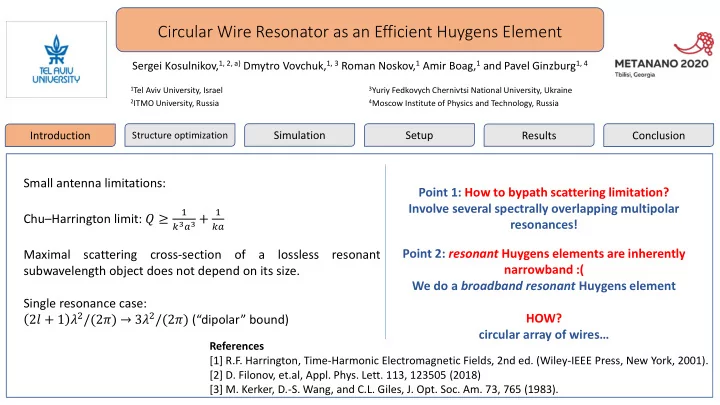
Small antenna limitations: Chu–Harrington limit: 𝑅 ≥

1 𝑙3𝑏3 + 1 𝑙𝑏

Maximal scattering cross-section

  • f

a lossless resonant subwavelength object does not depend on its size. Single resonance case: 2𝑚 + 1 𝜇2/(2𝜌) → 3𝜇2/(2𝜌) (“dipolar” bound) Point 1: How to bypath scattering limitation? Involve several spectrally overlapping multipolar resonances! Point 2: resonant Huygens elements are inherently narrowband :( We do a broadband resonant Huygens element HOW? circular array of wires…

slide-2
SLIDE 2

Sergei Kosulnikov, Dmytro Vovchuk, Roman Noskov, Amir Boag, and Pavel Ginzburg

Circular Wire Resonator as an Efficient Huygens Element

Introduction

Structure optimization

Simulation Setup Results Conclusion

Scattering efficiency Circular wire array plane wave illumination, vertical polarization We proceed with 11 wires…

slide-3
SLIDE 3

Sergei Kosulnikov, Dmytro Vovchuk, Roman Noskov, Amir Boag, and Pavel Ginzburg

Circular Wire Resonator as an Efficient Huygens Element

Introduction

Structure optimization

Simulation Setup Results Conclusion

Forward / backward directions with respect to the wave incidence Multipole decomposition of the scattering efficiency

slide-4
SLIDE 4

Sergei Kosulnikov, Dmytro Vovchuk, Roman Noskov, Amir Boag, and Pavel Ginzburg

Circular Wire Resonator as an Efficient Huygens Element

Introduction

Structure optimization

Simulation Setup Results Conclusion

Three types of the experimental setups a) Near-to-near b) Near-to-far c) Far-to-far

slide-5
SLIDE 5

Sergei Kosulnikov, Dmytro Vovchuk, Roman Noskov, Amir Boag, and Pavel Ginzburg

Circular Wire Resonator as an Efficient Huygens Element

Introduction

Structure optimization

Simulation Setup Results Conclusion

Forward and the backward scattering efficiency Characterization of the resonant modes Experimental data

  • Az. order

1 2 3 4 4 5 5 f, GHz

  • 2.055

2.181 2.23 2.239 2.253 2.258 Q-factor

  • 32.5

220 1316 1595 1211 2579 Numerical data M-poles ED MD+EQ MQ+EO MO M16-pole M16-pole M32-pole M32-pole f, GHz 1.773 1.887 2.094 2.217 2.273 2.295 Q-factor 1.1 3.8 20 120 873 5599 experiment simulations

slide-6
SLIDE 6

Circular Wire Resonator as an Efficient Huygens Element

Introduction

Structure optimization

Simulation Setup Results Conclusion

  • 1. Multipoles analysis shows predominant contribution of magnetic multipoles with respect to electric
  • nes for almost all eigenmodes except from the lowest one.
  • 2. Multipoles contribution to the Huygens element performance have been shown.
  • 3. Scattering efficiency of the demonstrated configuration is 15 times larger than its geometrical cross

section and, at the same time, the device demonstrates broadband forward scattering capabilities,

  • btained at a bandwidth ~ 10% of the carrier frequency in the GHz range.

https://arxiv.org/abs/2006.14006 sergeik@mail.tau.ac.il

Sergei Kosulnikov,1, 2, a) Dmytro Vovchuk,1, 3 Roman Noskov,1 Amir Boag,1 and Pavel Ginzburg1, 4

1Tel Aviv University, Israel 2ITMO University, Russia 3Yuriy Fedkovych Chernivtsi National University, Ukraine 4Moscow Institute of Physics and Technology, Russia