CIRCULAR ECONOMY BY DESIGN Dr Kemi Adeyeye Assoc. Prof in - - PowerPoint PPT Presentation

circular economy by design
SMART_READER_LITE
LIVE PREVIEW

CIRCULAR ECONOMY BY DESIGN Dr Kemi Adeyeye Assoc. Prof in - - PowerPoint PPT Presentation

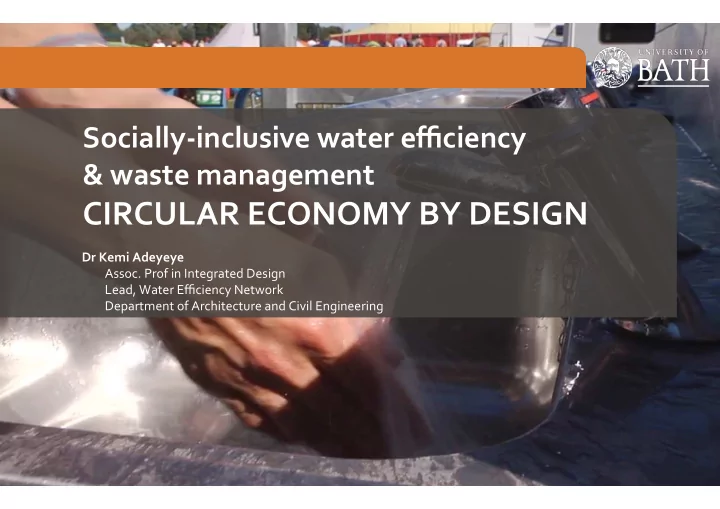
Socially-inclusive water efficiency & waste management CIRCULAR ECONOMY BY DESIGN Dr Kemi Adeyeye Assoc. Prof in Integrated Design Lead, Water Efficiency Network Department of Architecture and Civil Engineering Research focus: 5Ps:


slide-1
SLIDE 1

Socially-inclusive water efficiency & waste management

CIRCULAR ECONOMY BY DESIGN

Dr Kemi Adeyeye

  • Assoc. Prof in Integrated Design

Lead, Water Efficiency Network Department of Architecture and Civil Engineering

slide-2
SLIDE 2

Research focus:

  • 5Ps: people, process,

performance, policy, products

  • Socio-technical studies to

mitigate environmental impact and change

  • Integrated design and

solutions for resource efficiency and resilience (RE+R)

Source: whconference.unc.edu

slide-3
SLIDE 3

Global view

Source: United Nations Environment Programme (UNEP). Online at: http://www.unep.org/dewa/vitalwater/ article141.html

Water is a vital human and natural resource It is also a scarce resource and this poses challenges for the 21st century and beyond

  • Market for water supply, sanitation and water efficiency estimated at US$ 253bn and is

expected to grow to US$ 658bn by 2020

  • Estimated investment of US$ 15bn per annum
slide-4
SLIDE 4

Water Efficiency & Waste recovery

  • Social-technical, multi-stakeholder

studies

  • Process efficiency, optimisation
  • Project examples: service innovation in

supply networks, resource efficiency in domestic and commercial sectors: e.g. laundrettes, hotels

“Water efficiency is not just about conserving water Instead, an understanding of customer behaviour and need is realised such that water is used optimally and through behaviour, technology and infrastructure efficiency, waste is eliminated”.

1Balnave, J., & Adeyeye, K. (2013). A comparative study of attitudes and preferences for water efficiency in

  • homes. Journal of Water Supply: Research and Technology-Aqua, 62(8), 515-524.
slide-5
SLIDE 5

Decentralised/ alternative water supply

  • Alternative water supply systems and

solutions can help to save water, energy, and money

  • They are an essential component of a

circular economy for water and can help to address social challenges too

  • Examples of non-potable (not for

drinking) use include:

  • Agriculture and landscape irrigation
  • cooling water in building services and

industrial applications

  • construction activities e.g. concrete

mixing

  • Domestic uses e.g. toilet flushing

Common technologies:

  • rainwater recycling
  • greywater reuse
  • seawater desalination and;
  • integrated sustainable urban drainage

systems Source: Waterscan

slide-6
SLIDE 6

Micro Scale

Source: Window on America Centre in Dnipropetrovsk. Online at: http://woadnepr.blogspot.co.uk/2014/08/energy-evolution.html

slide-7
SLIDE 7

Macro-meso scale

Making demand-supply chain optimised and efficient reduces waste, without compromise to quality

Source: Thames Water

slide-8
SLIDE 8

Socially-inclusive waste minimisation and circular economy in Spain

slide-9
SLIDE 9

Current work and circular economy

  • Integrated social-environmental

studies on:

  • Integrated solutions for water-

energy-(food?)

  • Service innovation – socially

inclusive, optimised processes, reduced waste

Demand & Supply

Waste reduction

Service innovation

People-centred Natural and built environment Resilience

Product innovation Efficiency processes

Manufacturing, supply chain

slide-10
SLIDE 10

Current work: Reducing Energy Dependency in Atlantic area Water Networks (REDAWN)

  • Distributing our Water Resources: Utilising Integrated, Smart and low-Carbon Energy (DWR UISCE) (Source: Ferras, D. Trinity College Dublin)

nvestigators: Action Renewables, Northern Ireland (Lead); Trinity College Dublin; Northern Ireland Water; Watef Network- University of Bath; Università degli Studi di Napoli FEDERICO II Italy; Empresa De Electricidade da Madeira S.A. Portugal; EDA RENOVÁVEIS S.A. Portugal; Instituto Superior Tecnico Portugal; Hidropower Ltd

  • rtugal; RENOVA S.A. Portugal; Parceria Portuguesa para a Água Portugal; Asociación FERAGUA de Comunidades de Regantes de Andalucía, Spain; Universidad de

órdoba, Spain; Fundacion Asturiana de la Energia, Spain.

slide-11
SLIDE 11

Current work: Healthy Housing for Displaced People

slide-12
SLIDE 12

Current projects: Smart systems, smart cities

  • Information and communication systems
  • Smart tools
  • Smart microgrids and micronets

Integrated

Localised

Optimised Sustainable Efficient

Resilient

slide-13
SLIDE 13

Resilience: Avoiding the boom and bust cycle

Source: Consultamcy.uk

Lack of planning can lead to wasteful response, and breakdown of good practise. Resilience should be part of a circular economy

slide-14
SLIDE 14

Main findings from previous research

  • Resources/materials/products are not just

commodities, they have social (livelihood, quality of life) and environmental impact

  • People should be at the core of circular economy policy

and practices

  • Everything is connected –so opportunities for:
  • Value creation – local, regional, global
  • Resource efficiency and reduced waste (materials,

processes etc.)

  • Information is key
  • Integration/Joined up thinking helps to identify
  • pportunities for value creation and waste minimisation
slide-15
SLIDE 15

Collaboration

  • Circular economy through water efficiency, reuse and recycling

(WASH)

  • Circular economy (for resilience) in (informal) urban settlements
  • Integrated water-energy cradle to grave solutions
  • Energy recovery and reuse measures especially from water processes
  • Combined value creation for waste minimisation and resilience
  • Participatory, co-created design and implementation of solutions

(collaborative value creation)

  • Improving adaptive capacity (e.g. through education and training) for

better use practices and waste reduction in processes

slide-16
SLIDE 16
slide-17
SLIDE 17
slide-18
SLIDE 18

THANK YOU

Email: k.Adeyeye@bath.ac.uk Website: http://www.bath.ac.uk/ace/people/adeyeye/ Publications: https://www.researchgate.net/profile/Kemi_Adeyeye/publications