
SLIDE 1
Choosing a Long Range Vision
OCTOBER 2019
Local Policy Maker Group
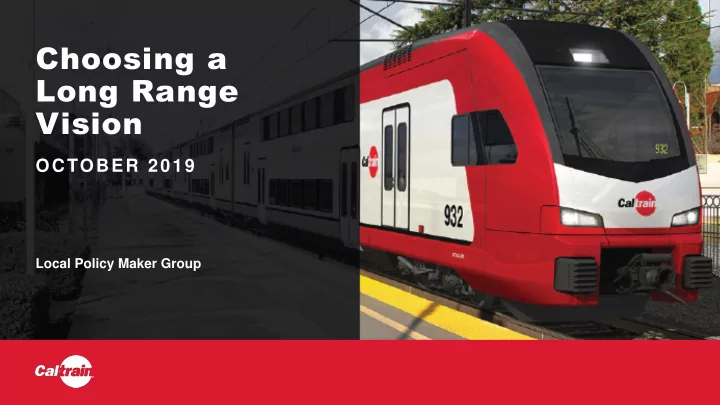
Choosing a Long Range Vision OCTOBER 2019 Local Policy Maker - - PowerPoint PPT Presentation
Choosing a Long Range Vision OCTOBER 2019 Local Policy Maker Group Overview & Process Agenda Outreach Update for Today Comments on the Draft Service Vision Revised Service Vision Completing the Business Plan 2 Ov Over erview
OCTOBER 2019
Local Policy Maker Group
2
Completing the Business Plan Comments on the Draft Service Vision Revised “Service Vision” Outreach Update Overview & Process
3
4
Development and Evaluation of Growth Scenarios Staff Recommendation for Long Range Service Vision Refinement and Proposed Adoption
Service Vision Completion of Business Plan July 2018 – July 2019 August 2019 October 2019 Early 2020 November 2019 Organizational Assessment Workshop
5
The 2040 Long Range Service Vision sets a target for the future that we and our partners can grow towards incrementally A successful Long Range Service Vision:
and commitments that Caltrain and its partners have made
the agency as it develops its own plans and engages with local, regional, and state partners
details, timing, and costs of individual projects change
6
Adopting a Long Range Service Vision is a critical Step in advancing Caltrain’s own work in the region An adopted Long Range Service Vision is needed to:
San Francisco and San Jose to advance
vision to the region and state and identify funding needs
Business Plan related to funding, access and connecting service and equity
needs and governance Adopting a Long Range Service Vision is not the “end” of the Business Plan process. It is a critical policy action that sets a specific goal for the railroad to plan and work towards. Board adoption of the Vision helps Caltrain narrow its focus so that key planning, organizational and implementation work can advance
7
Timing & Format Content and Purpose
ask Howard questions and discuss OA report
respond to OA report recommendations and
processes should be pursued going forward
At the August 1 JPB Meeting, the Board asked staff to identify a time for a special meeting to conduct a “deep dive” into the organizational Assessment Work and report developed during the Business Plan process This meeting will provide an opportunity to discuss how the Caltrain organization should evolve to support implementation of the Service Vision adopted by the Board
8
Adopting a Service Vision sets a long range policy goal for the railroad to work towards. It does not commit the JPB or its member agencies to funding the Vision. Finding the money to fund the Service Vision will be a challenge. In addition to the significant level
funding will be required to operate and maintain Caltrain service. This investment is needed on an
funding will be a major focus of analysis and discussion in the remainder of the Business Plan
All costs shown in 2018 dollars
$97M
Covered by Fares
$38M
Subsidy Needed
$266M
Covered by Fares
$104M
Subsidy Needed
$135 Million
Total Annual Operating Costs
$370 Million
Total Annual Operating Costs
2018 2040
Annual Operating Costs & Subsidy Need
9
10
July 22, 2019 - September 30, 2019
Factsheets Distributed
Surveys Completed
Public Meetings
Rider Engagement
Station Pop-Ups Train Ride Q&A Station Message Signs Social Media
Virtual Townhall Views
September 2019 (1,000+ Factsheets Distributed)
September 2019 (1,200+ Responses)
Service Benefits Very Excited Somewhat Excited Not Excited Faster Travel 73% 22% 4% Show up and Go Scheduling 73% 23% 3% More Flexibility 69% 25% 5% More Commute Service 66% 27% 5% More Frequent Service 66% 26% 6% Capacity for 3x Riders 60% 32% 5% More Options 54% 34% 8% 77 miles of all-day service 45% 34% 17% Regional Benefits Very Excited Somewhat Excited Not Excited Reducing greenhouse gas emissions 78% 17% 3% Reducing driving 78% 18% 3% Trains vs lanes 71% 22% 4% Carrying more people 63% 32% 4% Adding jobs 44% 41% 13% Increasing economic activity 42% 41% 14%
87% survey responses from people that ride Caltrain 916 comments (in open-ended sections)
550+ Downloads Platform
Tableau Data Visualization package
Winner: Jonathon Yu, SF Bay Area resident
Purpose
Built multiple tabs representing
patterns, station passengers at various times of day, a series of string charts, and more
Functionality
Each scenario is included in the dataset which allows for the user to easily switch variables and factors
14
15 Jul Aug Sept Oct Nov Dec Jan Feb Mar Apr May Jun Jul Aug Sept Oct Local Policy Maker Group
City/County Staff Coordinating Group
Project Partner Committee
Stakeholder Advisory Group
Partner General Manager
Targeted Online Engagement Website Launch, Data Visualization Challenge, Reddit/YouTube Live, Online Open House
Community Meetings SPUR, Friends of Caltrain, Station Outreach
Sister Agency Presentations SFCTA, SF Capital Planning, TJPA, SamTrans, SMCTA, CCAG, VTA, MTC, Diridon Station JPAB
2018 2019
July 2018 – September 2019
Stakeholders Engaged
Public Agencies
Jurisdictions
Stakeholder meetings
Organizations in the Stakeholder Advisory Group
Public Outreach
Virtual Townhall views
Public meetings and presentations
Website views
Survey results
16
July 2018 – September 2019
17
Broad Support for the Service Vision Wide degree of general support for Business Plan process and for staff recommendation Planning for Higher Growth Consistent comments asking that Caltrain take a more affirmative, proactive approach to planning for a possible “High Growth” type future Emphasizing Refinement and Optimization
by some jurisdictions about illustrative service levels shown at individual stations
service planning over time
Key Themes from Stakeholder Meetings and Outreach 07/22/2019-09/30/2019
Connectivity and Seamless Integration with other Systems Comments about the need for seamless integration with other transit systems (schedule coordination, fares, stations/hubs) Blending with High Speed Rail Comments and questions about relationship and timing of Caltrain service growth relative to High Speed Rail services Regional and Megaregional Rail Requests to include more explicit references to planned and contemplated service expansions of regional and megaregional rail services (ACE, CCJPA, Dumbarton Rail and service to Monterey County)
Key Themes from Stakeholder Meetings and Outreach 07/22/2019-09/30/2019
Making Caltrain Affordable and Equitable
to understand equity implications of Vision
making Caltrain accessible and affordable to all Station Area Connections and Development
and last-mile strategy
uses planned in station vicinity Key Themes from Stakeholder Meetings and Outreach 07/22/2019-09/30/2019 Integrating the Corridor and Communities
about grade separations (including meaning of ‘not- to-preclude’ 4 tracks)
need to mitigate impacts of increased rail service
Next Steps
service improvements can be phased and incremented
additional studies Evolving the Organization Comments that
foundational and necessary to deliver the Vision Funding the Vision
funding sources are a prerequisite to achieve the Vision
about funding and cost details
Key Themes from Stakeholder Meetings and Outreach 07/22/2019-09/30/2019
22
Business Plan Service Vision Next Steps and Follow-On Work The “Service Vision” is a high-level policy statement supported by technical analysis. Some comments and questions received have been addressed through direct modification of the proposed ‘Vision’ language, while others will be incorporated into the remaining analysis and work required to complete the Business Plan. For many comments and questions to be fully addressed, subsequent detailed planning and policy efforts will need to be undertaken. The Business Plan will identify this program of work.
(1) Caltrain’s Long Range Service Vision directs the railroad to plan for a substantially expanded rail service that, by 2040, will address the local and regional mobility needs of the corridor while supporting local economic development activities. When fully realized, this service will provide;
A. A mixture of express and local Caltrain services operated in an evenly spaced, bi-directional pattern. B. Minimum peak hour frequencies of; i. 8 trains per hour per direction on the JPB-owned corridor between Tamien Station in San Jose and San Francisco, extended to Salesforce Transit Center at such time as the Downtown Extension is completed ii. 4 trains per hour per direction between Blossom Hill and Tamien Stations, subject to the securing of necessary operating rights iii. 2 trains per hour per direction between and Gilroy and Blossom Hill Stations, subject to the securing of necessary operating rights 23
(1) continued
C. Off-peak and weekend frequencies of between 2 and 6 trains per hour per direction north of Blossom Hill and hourly between Gilroy and Blossom Hill, with future refinements to be based on realized demand D. Accommodation of California High Speed Rail trains, in accordance with the terms of existing and future blended system agreements between the JPB and the California High Speed Rail Authority Accommodation of California High Speed Rail, Capitol Corridor, Altamont Corridor Express and freight services in accordance with the terms of existing agreements E. Delivery of these services will occur through the incremental development of corridor projects and infrastructure to be further defined through individual planning process, feasibility studies, and community engagement. At this time, such infrastructure is conceptually understood to include; i. Investments in rail systems including a new, high performance signal system ii. Station modifications including platform lengthening, level boarding, and investments in station access facilities and amenities to support growing ridership and improve customer experience iii. New and modified maintenance and storage facilities in the vicinity
fleet. 24
25
(1) continued
E. Delivery of these services will occur through the incremental development of corridor projects and infrastructure to be further defined through individual planning process, feasibility studies, and community engagement. At this time, such infrastructure is conceptually understood to include; iv. A series of short, 4-track stations and overtakes at various points throughout the corridor v. Completion of key regional and state partner projects including 1. The Downtown Extension to the Salesforce Transit Center 2. The reconstruction of Diridon Station and surrounding rail infrastructure 3. The reconstruction and electrification of the rail corridor south of Control Point Lick to the Gilroy Station 4. Additional improvements to allow for the operation of High Speed Rail service between Gilroy and San Francisco 5. The substantial grade separation of the corridor as well as safety upgrades to any remaining at-grade crossings, undertaken in a coordinated strategic manner driven by the desires of individual local jurisdictions as well as legal requirements associated with any proposed 4-track segments.
(2) Caltrain’s Long Range Service Vision further directs the railroad to continue its planning for consideration of a potential “higher” growth level of service as well as potential new regional and mega- regional connections. in the context of major regional and state rail planning. Specifically, the Long Range Service Vision directs the railroad to;
A. Work with regional and state partners to collectively plan for and study and evaluate both the feasibility and desirability of higher levels of service in the context of major regional and state rail initiatives as well as expanded regional and megaregional rail
Dumbarton Rail Corridor, the 2nd a potential second Transbay Crossing, the potential for expanded Altamont Corridor Express and Capitol Corridor services, a potential extension of rail service to Monterey County, and ongoing planning for related to the California High Speed Rail system. 26
(2) continued
A. To B. To take certain specific actions to anticipate consider and, where feasible and financially practicable, not preclude facilitate such higher levels of service and connections as they specifically relate to; i. The planning of rail terminals and related facilities ii. The sale or permanent encumbrance of JPB land iii. The design of grade separations in areas where 4-track segments may be required iv. The sizing of future maintenance facilities and storage yards C. To return to the Bboard with a recommendation regarding any formal expansion of the Long Range Service Vision at such a time as clear regional and state policy and funding commitments are in place, and the financial, operational, and physical feasibility of such an option on the corridor has been confirmed, and community impacts have been assessed and affected communities have been consulted. 27
(3) Caltrain’s Long Range Service Vision directs the railroad to prepare for the implementation of the Vision by;
A. Completing the Caltrain Business Plan including additional analyses of issues related to funding, connectivity and access, and equity as well as the identification of a detailed implementation program of next steps and follow on work B. Evolving the organization in a manner that best prepares the railroad to deliver the service vision by deliberately and transparently addressing the issues of service delivery, internal
C. Seeking the new and dedicated sources of funding that will be needed to sustain the railroad’s operation and to incrementally implement the long range service vision 28
(3) (4) Finally, Caltrain’s Long Range Service Vision directs the railroad to periodically reaffirm the Vision to ensure that it continues to provide relevant and useful guidance to the railroad. Such reaffirmations should occur;
A. At a regular intervals of no less than 5 years B. In response to significant changes to JPB or partner projects that materially influence the substance of the Long Range Service Vision 29
30
31
Development and Evaluation of Growth Scenarios Staff Recommendation for Long Range Service Vision Refinement and Proposed Adoption
Service Vision Completion of Business Plan July 2018 – July 2019 August 2019 October 2019 Early 2020 November 2019 Organizational Assessment Workshop
Remaining Technical Analysis
32
Equity analysis & focus on making Caltrain accessible to all Analysis of connections to
With a 2040 Service Vision adopted, how can Caltrain “Round Out” its vision for the future? During the fall of 2019, additional technical and policy analysis will be undertaken to focus on areas that that were highlighted as important through stakeholder outreach and help complete the picture of the railroad Caltrain hopes to become
Review of funding options and revenue generation opportunities to support the Vision
Remaining Technical Analysis
33
With a 2040 Service Vision adopted, what will the next 10 years look like for Caltrain? What are the key actions and steps we need to focus on next? During the fall of 2019, additional technical and policy analysis will be undertaken to focus on what Caltrain can achieve over the next decade and they key near term steps and work that will be needed to make it happen
Accompanying financial projections and funding plan Building towards the Vision with service concepts for initial electrification and options for growth and investment through 2020s Identification of a program of key planning, policy and
F O R M O R E I N F O R M AT I O N W W W . C A LT R A I N 2 0 4 0 . O R G B U S I N E S S P L A N @ C A LT R A I N . C O M 6 5 0 - 5 0 8 - 6 4 9 9