Children: What Every Early Educator Needs to Know Sarah Erdman - - PDF document

children what every early educator needs to know
SMART_READER_LITE
LIVE PREVIEW

Children: What Every Early Educator Needs to Know Sarah Erdman - - PDF document

11/12/2020 Trauma and Young Children: What Every Early Educator Needs to Know Sarah Erdman (she/her) 1 Land Acknowledgement Im presenting today while on the unceded lands of the Manahoac. While I do not have the authority to give back


slide-1
SLIDE 1

11/12/2020 1

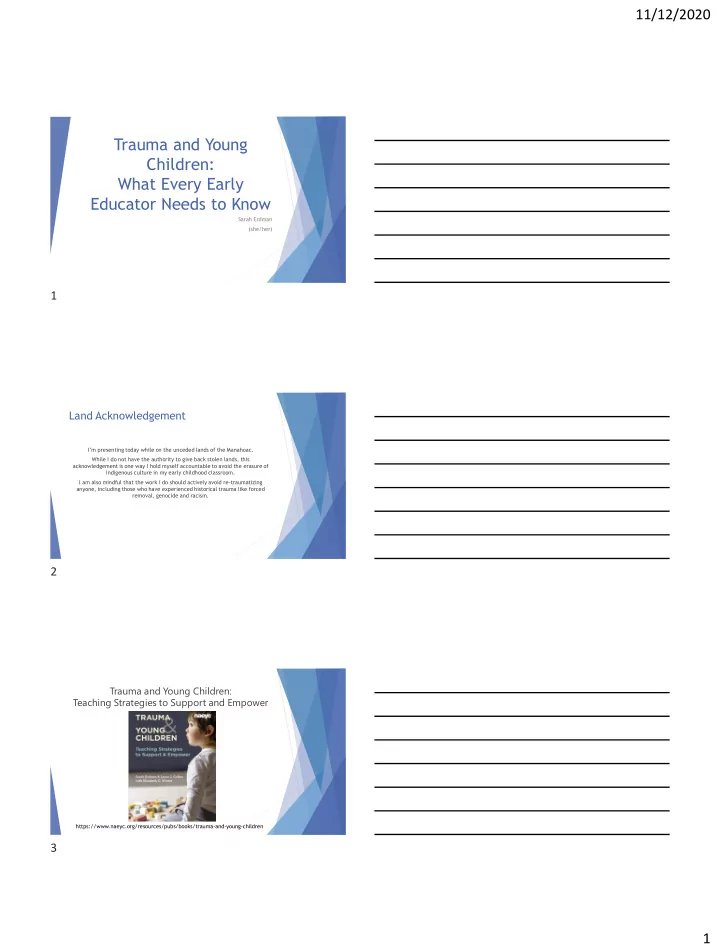
Trauma and Young Children: What Every Early Educator Needs to Know

Sarah Erdman (she/her)

Land Acknowledgement

I’m presenting today while on the unceded lands of the Manahoac. While I do not have the authority to give back stolen lands, this acknowledgement is one way I hold myself accountable to avoid the erasure of Indigenous culture in my early childhood classroom. I am also mindful that the work I do should actively avoid re-traumatizing anyone, including those who have experienced historical trauma like forced removal, genocide and racism.

Trauma and Young Children: Teaching Strategies to Support and Empower

https://www.naeyc.org/resources/pubs/books/trauma-and-young-children

1 2 3

slide-2
SLIDE 2

11/12/2020 2

Definitions

 Educator  Trauma Informed Care (TIC)  Trauma  Traumatic Effect  Post Traumatic Stress Disorder (PTSD)

Trauma occurs when a child witnesses or experiences an event that is a threat (real or perceived) to themselves or someone close to them. It can overwhelm a child’s ability to cope and cause a chain reaction of feelings and changes in behavior.

Trauma is…

 An individual experience based on that person’s perspective  Not just the event itself but the response to the situation  Subjective

4 5 6

slide-3
SLIDE 3

11/12/2020 3

Adverse Childhood Experiences (ACES)

Potentially traumatic events that occurred in childhood

Source: Centers for Disease Control and Prevention, Kaiser Permanente. The ACE Study Survey Data [Unpublished Data]. Atlanta, Georgia: U.S. Department of Health and Human Services, Centers for Disease Control and Prevention; 2016.

Racism and Trauma

0% 10% 20% 30% 40% 50% 60% 70% Black children White children

Experienced ACEs

If everyone woke up tomorrow and said they were “going to be kind” racism would still exist it is built into the systems all around us

7 8 9

slide-4
SLIDE 4

11/12/2020 4

Why Knowing About Trauma is Important

Center on the Developing Child: Harvard University Developingchild.Harvard.edu

Stress Response

10 11 12

slide-5
SLIDE 5

11/12/2020 5

Types of Stress

What Can You Do?

 Recognize all children will benefit from a trauma informed approach  Build relationships  Use play  Take care of yourself

RELATIONSHIPS ARE ONE OF THE BEST TOOLS WE HAVE TO HELP CHILDREN DEVELOP POSITIVE STRESS RESPONSE The relationships you build are CRITICAL

13 14 15

slide-6
SLIDE 6

11/12/2020 6

Families

Play is the work of the child

Maria Montessori

16 17 18

slide-7
SLIDE 7

11/12/2020 7

Burnout Compassion Fatigue Vicarious Trauma Don’t Go It Alone Make A Plan Respect Yourself

19 20 21

slide-8
SLIDE 8

11/12/2020 8

Respect Yourself

This Photo by Unknown Author is licensed under CC BY-NC-ND

Make a Plan

 Smart Goals  Specific: What exactly are you trying to accomplish? Why is this goal important? What resources or limits are involved?  Measurable: How much effort will it take? How many people are involved? How will you know it is accomplished?  Assignable: Who will do it?  Realistic: Is this worthwhile? What results can realistically be achieved given available resources?  Time: When, specifically, can it be achieved? What can you do today? SET 2-3 SMART GOALS AT A TIME

Don’t Go It Alone

This Photo by Unknown Author is licensed under CC BY-NC

22 23 24

slide-9
SLIDE 9

11/12/2020 9

Covid 19

This Photo by Unknown Author is licensed under CC BY-SA

We are all in the same storm We are not all in the same boat

25 26 27

slide-10
SLIDE 10

11/12/2020 10

Sarah Erdman

CabinetofCuriositiesVA@gmail.com @CabinetofCurios

28