Children and Divorce: What 25 We Know and What We Need 20 to Know - - PDF document

children and divorce what
SMART_READER_LITE
LIVE PREVIEW

Children and Divorce: What 25 We Know and What We Need 20 to Know - - PDF document

Refined Divorce Rates for Five Countries Children and Divorce: What 25 We Know and What We Need 20 to Know 15 10 5 Paul R. Amato 0 0 5 0 5 0 5 0 5 0 4 6 6 7 7 8 8 9 9 0 0 Department of Sociology 9 9 9 9 9 9 9


slide-1
SLIDE 1

1

Children and Divorce: What We Know and What We Need to Know

Paul R. Amato Department of Sociology Pennsylvania State University

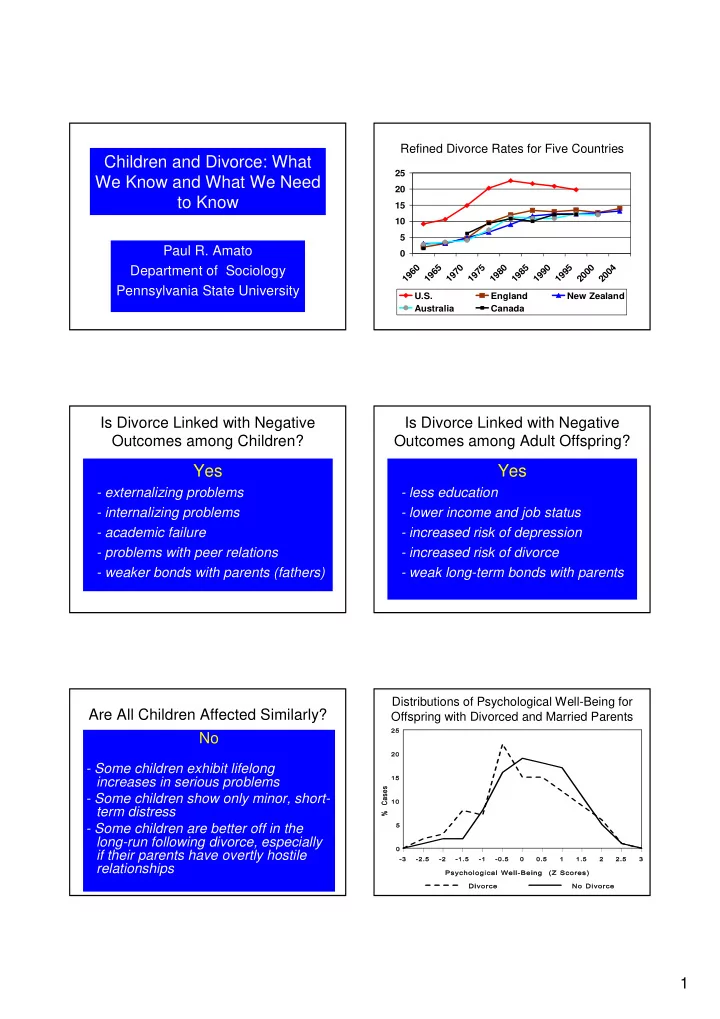
Refined Divorce Rates for Five Countries

5 10 15 20 25 1 9 6 1 9 6 5 1 9 7 1 9 7 5 1 9 8 1 9 8 5 1 9 9 1 9 9 5 2 2 4 U.S. England New Zealand Australia Canada

Is Divorce Linked with Negative Outcomes among Children?

Yes

  • externalizing problems
  • internalizing problems
  • academic failure
  • problems with peer relations
  • weaker bonds with parents (fathers)

Is Divorce Linked with Negative Outcomes among Adult Offspring?

Yes

  • less education
  • lower income and job status
  • increased risk of depression
  • increased risk of divorce
  • weak long-term bonds with parents

Are All Children Affected Similarly? No

  • Some children exhibit lifelong

increases in serious problems

  • Some children show only minor, short-

term distress

  • Some children are better off in the

long-run following divorce, especially if their parents have overtly hostile relationships

Distributions of Psychological Well-Being for Offspring with Divorced and Married Parents

slide-2
SLIDE 2

2

Do Gender Differences Exist in the Links Between Divorce and Child Well-Being?

  • Perhaps, but the pattern is not clear
  • Among children, boys are at greater

risk of problems with conduct and social relationships

  • Among young adults, women

experience greater educational disadvantage than men

Does Divorce Cause These Problems? Yes, but selection processes also play a role

  • Marital conflict
  • Parent psychopathology
  • Genetic effects

Marital Conflict Model

Marital conflict Divorce Child problems

Parent Personality Model

Parent psycho- pathology Divorce Child problems Inept parenting

Parent psychological problems, divorce, and child problems

(NSFH I & II, Unstandardized coefficients)

Divorce Child Problems Parenting quality Parent psychological problems

.06*** .16** .24**

  • .47***
  • .15***

Time 1 Time 2

slide-3
SLIDE 3

3 Passive Genetic Model

Parents' genes Parents' divorce Child's genes Children's behavior problems

Percentage of Children Exhibiting Behavior Problems by Divorce and Adoption Status

Do We Know How Divorce Lowers Children’s Well-Being?

Yes

  • Economic hardship
  • Mothers’ parenting quality
  • Loss of relationship with father
  • Feeling caught in the middle
  • Multiple transitions

Divorce Economic hardship Mother's parenting Loss of father Caught in the middle Multiple transitions Child

  • utcomes

Do We Know What Helps? Yes

  • Economic security
  • Competent (authoritative) parenting

from both parents

  • Cooperative co-parenting
  • Stability

Children Living with One Parent by Marital Status (US)

slide-4
SLIDE 4

4

Questions

  • Do children with never married

parents experience the same risks as do children with married parents who divorce?

  • Are the mediating processes the

same for these children?

More questions

  • Few studies have focused on minority
  • groups. In the U.S., are the estimated

effects of divorce comparable for Whites, Blacks, Latinos, and Asians?

  • Are there differences between

countries? And if yes, what accounts for these differences? Culture? Social policies?

How Effective are Interventions?

  • Court-based parenting education

courses for divorcing parents are common in the U.S. Do they work?

  • Would more joint physical custody

benefit children?

  • What can we do about high-conflict

couples following divorce?

Programs to Promote Healthy Marriage

  • How effective is marriage education

at improving marital quality and lowering divorce?

  • Is it useful to encourage unmarried

parents to marry?

  • Are community education programs

useful?

  • Do these programs benefit children?