Chehalis Basin Strategy: Reducing Flood Damage and Enhancing - - PowerPoint PPT Presentation

chehalis basin strategy reducing flood damage and
SMART_READER_LITE
LIVE PREVIEW

Chehalis Basin Strategy: Reducing Flood Damage and Enhancing - - PowerPoint PPT Presentation

Chehalis Basin Strategy: Reducing Flood Damage and Enhancing Aquatic Species Policy Workshop November 13, 2013 Agenda 8:30 Welcome and Introductions 8:45 Charge to the Governors Chehalis Basin Work Group and the process to develop
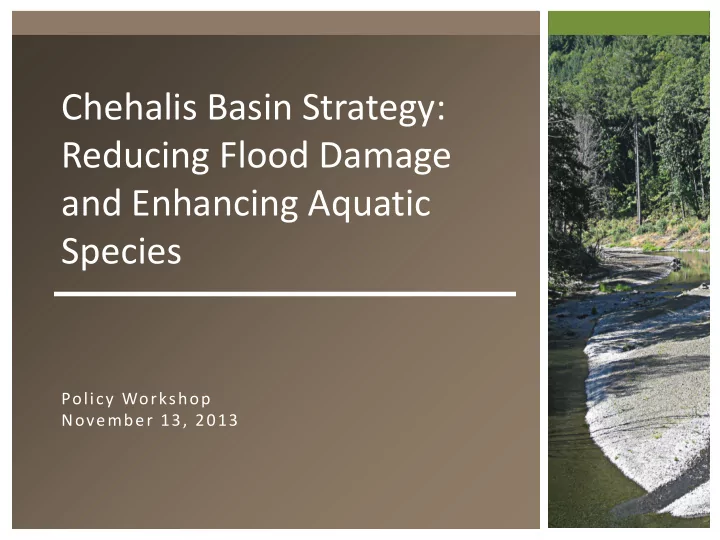

slide-1
SLIDE 1

Chehalis Basin Strategy: Reducing Flood Damage and Enhancing Aquatic Species

Policy Workshop November 13, 2013

slide-2
SLIDE 2

2

Agenda

8:30 Welcome and Introductions 8:45 Charge to the Governor’s Chehalis Basin Work Group and the process to develop recommendations to the Governor and Legislature by November 2014 9:15 The history of floods in the Basin and discussion of what floods should be analyzed as the focus for reducing damage. 10:00 Break 10:15 Aquatic species in the Basin, latest findings and strategy for creating an enhancement plan 11:15 Alternatives that will be considered for flood damage reduction 11:40 Public Comment 12:00 Lunch 1:00 Research on innovative dam designs and fish passage 2:00 Methods for comparing alternatives 3:00 Break 3:15 Public comment 3:45 Conclusions and next steps 4:30 Adjourn

11/12/2013

slide-3
SLIDE 3

3

Challenge: History of Flood Damage

March 1910 December 1933 January 1974 November 1990

Source: www.dipity.com/nickrobertgeorge/personal/#timeline

slide-4
SLIDE 4

4

2007 Storm: $938M Basin-wide Damage

Exit 77 (I-5) in Chehalis Steve Ringman/The Seattle Times City of Centralia Steve Ringman/The Seattle Times Photos Source: Lewis County, Division Of Emergency Management

slide-5
SLIDE 5

5 11/12/2013

I-5 at Hwy 507 Interchange looking south – December 4, 2007

slide-6
SLIDE 6

6 11/12/2013

Need caption

slide-7
SLIDE 7

7

Ranked High Flow Events (1932 to 2012)

  • I-5 closed 1990, 1996, 2007, 2009
  • Five largest events since 1986 − Frequent floods are getting

worse and damage is increasing . . .

  • Chart − Chehalis River Flow Rates near Grand Mound (cfs)

9 13 7 13 11 6 16 10

4 3

8

2

12 15

1 5

10000 20000 30000 40000 50000 60000 70000 80000 90000 1932 1934 1936 1938 1940 1942 1944 1946 1948 1950 1952 1954 1956 1958 1960 1962 1964 1966 1968 1970 1972 1974 1976 1978 1980 1982 1984 1986 1988 1990 1991 1993 1995 1996 1998 2000 2002 2004 2006 2008 2010 2012

slide-8
SLIDE 8

8

  • Salmon populations are 15-25% of historic levels
  • Other important aquatic species
  • Water quality is poor seasonally

Need for Aquatic Species Enhancement

Upper Chehalis (May 31, 2010) James E. Wilcox/Wild Game Fish Conservation International Source: www.chehalisbasinpartnership.org

slide-9
SLIDE 9

9

Governor’s Chehalis Basin Work Group

  • Appointed by Gov. Gregoire (2012); Re-confirmed by
  • Gov. Inslee (2013)
  • Members are:
  • David Burnett (Chairman Chehalis Tribe)
  • Karen Valenzuela (Thurston County Commissioner , Vice-Chair

Flood Authority)

  • Vickie Raines (Mayor Cosmopolis, Chair Flood Authority)
  • J Vander Stoep (Private Attorney, Pe Ell Alternate Flood Authority)
  • Jay Gordon (President Washington Dairy Federation and

Chehalis Farmer)

  • Sandi Triggs (Capital Budget Advisor to Governor)
  • Keith Phillips (Governor’s Energy and Environment Advisor)
slide-10
SLIDE 10

10

Chehalis River Basin Flood Authority

  • Grays Harbor County
  • Lewis County
  • Thurston County
  • City of Aberdeen
  • City of Napavine
  • City of Oakville
  • Town of Pe Ell
  • Town of Bucoda
  • Formed in 2008
  • Developed up to date information on the flooding

in the Basin

  • Created small project list
  • Continues to oversee implementation of

capital projects

  • City of Centralia
  • City of Chehalis
  • City of Cosmopolis
  • City of Montesano
slide-11
SLIDE 11

11

Local, tribal, state, and federal governments working together over the next year to create the long-term strategy and implementing solution.

Forging a Basin-wide Strategy

slide-12
SLIDE 12

12

Elements of a Basin-wide Strategy

  • Significant reduction in flood

damage and enhancement of aquatic resources

  • Solving one problem doesn’t

increase another.

  • Maintain focus in five areas:

1.Major capital projects 2.Localized projects 3.Land use management 4.Aquatic species and habitat enhancements 5.Flood warning, emergency response

slide-13
SLIDE 13

13

  • Evaluate dam designs throughout the world
  • Determine the design(s) that could accomplish the flood

control goals of this project and be technically feasible with site conditions

  • Investigate and determine the feasibility of the dam

structure from a geotechnical perspective (i.e., will the dam design be safe?)

  • Identify best options for fish passage which maintain flood

control integrity

  • Identify the likely species and habitats that would be impacted

by the flood control options being evaluated

Dam Feasibility 2013-2014

slide-14
SLIDE 14

14

  • Four alternatives under consideration

with/without dam, with/without I-5 widening:

  • I-5 Levees and Walls, Raise Airport Levee, New

Southwest Chehalis Levee

  • I-5 Raise and Widen Only
  • I-5 Express Lanes
  • I-5 Temporary Bypass

Protecting I-5

slide-15
SLIDE 15

15

  • Programs and Smaller Scale Actions
  • Additional flood proofing and home elevation
  • Additional home buy out programs in the floodplain
  • Additional livestock and farm evacuation areas
  • Refinements to forest practices
  • Improving riparian areas
  • Additional bank erosion control
  • Review of local land use policies: no additional risk

Smaller Scale Actions and Programs

slide-16
SLIDE 16

16

  • Assess the current use by aquatic species
  • Develop a strategy and set of projects/programs to

enhance the current populations

  • Determine the benefits to aquatic species from

restoration measures

Aquatic Species Enhancement Plan

slide-17
SLIDE 17

17

  • Evaluate the benefits of smaller flood reduction projects

in the Basin

  • Home elevations and buyouts
  • Small levee projects
  • Bank erosion control
  • Stormwater management
  • Removal of constrictions like road culverts

Scenario of Smaller Scale Flood Damage Reduction Projects

slide-18
SLIDE 18

18

  • First 6 months involve:
  • Determine alternatives for dam design and operation, I-5, and small

project scenario

  • Guidance on aquatic species plan and benefit/cost methodology
  • Second 6 months involve:
  • Finalize dam design/operation plan, and assessment of benefits and

impacts

  • Finalize species enhancement plan
  • Finalize all other technical analyses

Governor’s Work Group Process Overview

slide-19
SLIDE 19

19

Workshop Schedule

Technical October 30-31, 2013 Spring 2014 Mid September 2014 Policy November 13, 2013 Spring 2014 Late September 2014 Public Meetings Spring 2014 Late September 2014 Work Group Recommendations to Governor and Legislature Mid November 2014

Workshops

  • Prior to guidance from Work Group in November 2013,

February 2014, and final recommendations in November 2014

slide-20
SLIDE 20

20

  • Water Retention Permitting?
  • Protection of I-5?
  • Aquatic Species Enhancement?
  • Smaller Scale Projects and Program Changes?

Decision November-December 2014