CHE Alaska call Wednesday, February 4 th , 2015 9:00 am Alaska Time - - PowerPoint PPT Presentation

che alaska call wednesday february 4 th 2015
SMART_READER_LITE
LIVE PREVIEW

CHE Alaska call Wednesday, February 4 th , 2015 9:00 am Alaska Time - - PowerPoint PPT Presentation

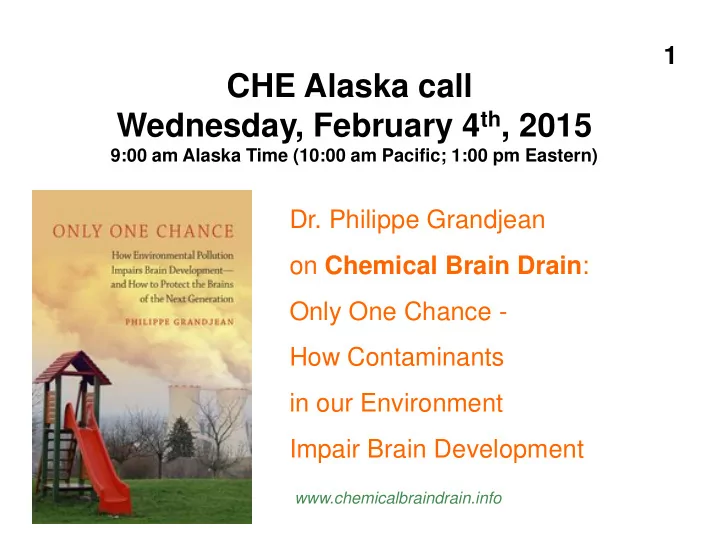
1 CHE Alaska call Wednesday, February 4 th , 2015 9:00 am Alaska Time (10:00 am Pacific; 1:00 pm Eastern) Dr. Philippe Grandjean on Chemical Brain Drain : on Chemical Brain Drain : Only One Chance - How Contaminants in our Environment Impair


slide-1
SLIDE 1

CHE Alaska call Wednesday, February 4th, 2015

9:00 am Alaska Time (10:00 am Pacific; 1:00 pm Eastern)

  • Dr. Philippe Grandjean
  • n Chemical Brain Drain:

1

  • n Chemical Brain Drain:

Only One Chance - How Contaminants in our Environment Impair Brain Development

www.chemicalbraindrain.info

slide-2
SLIDE 2

2

slide-3
SLIDE 3

Erroneous and dangerous assumptions:

  • The placenta protects the fetus
  • Children are just little adults

3

  • Children are just little adults
  • Poisonings are reversible
  • Proof is needed for regulation
  • Testing is too expensive
slide-4
SLIDE 4

Sensitive brain development

  • Cell division

In third trimester about 12,000 nerve cells are formed every minute

  • Differentiation

Different types of neurons and glia cells

  • Migration

4

  • Migration

Distances up to 1,000 times the size of the cell

  • Axon formation

Total length by age 20 years: 176,000 / 149,000 km (m/f)

  • Generation of synapses

Up to 1,000 new synapses per second early postnatally

  • Weeding of synapses
slide-5
SLIDE 5

Brain development gone astray

…in every case the mother was healthy, and it was not until more than three months after birth that the symptoms were recognized

5

were recognized

Shoji Kitamura (1959)

Photo: W. Eugene Smith

slide-6
SLIDE 6

Focal Widespread

6

Diffuse

slide-7
SLIDE 7

90 70 50 Percent correct responses on MCAS math test in 4th grade Averages for 351 Massachusetts municipalities: Children born in 1992 and 1999

Exposure limit (CDC) 7

10 30 50 70 50 30

Average blood-lead (µg/L) at preschool age

and 1999

(Jessica W. Reyes, 2012)

slide-8
SLIDE 8

Chemical group Known in 2006 Newly identified Metals/inorganic compounds Arsenic* Lead* Methylmercury* Fluoride* Manganese* Organic solvents (Ethanol) Tetrachloroethylene*

Chemical brain drainers

8

Organic solvents (Ethanol) Toluene* Tetrachloroethylene* Pesticides Chlorpyrifos* DDT/DDE* Other organic compounds Polychlorinated biphenyls (PCBs)* Brominated diphenyl ethers* Total 6 6

(Grandjean & Landrigan, Lancet Neurology, 2014) *Endocrine disruptor, according to TEDX

slide-9
SLIDE 9

Neurotoxicant dose (

subjects affected

Silent pandemic

Subclinical effects in child populations 9 Time of recognition

e (inverted scale)

Number of s Neurotoxicity In adults Poisoning incidents

(Grandjean and Landrigan, The Lancet, 2006)

slide-10
SLIDE 10

Neurotoxic Neurotoxic to humans N > 200 Known neurotoxic to humans during development, N > 10 10 Chemical universe N ~ 100,000 Neurotoxic in lab tests N > 1,000

(Updated from Grandjean and Landrigan, The Lancet, 2006)

slide-11
SLIDE 11
  • 11

(James J Heckman, 2008)

slide-12
SLIDE 12

The goal: Full integrity of the brain to allow optimal brain functions We need it: The brain

12

The brain determines behavior, IQ, endocrine functions... and who we are

slide-13
SLIDE 13

What can be done?

  • Mothers, consumers can make choices to

decrease exposures

  • An OECD test protocol is available to test

for developmental neurotoxicity in rodents

13

  • New cell-based tests are faster, cheaper
  • Updated regulation of toxic substances
  • Chemicals control needs to include focus
  • n brain development
  • International clearinghouse
slide-14
SLIDE 14

raindrain.info icalbraindrain rainDrain

14

www.chemicalbra Facebook: chemi Twitter: ChemBra