Characterization of Sterilization Characterization of Sterilization - - PowerPoint PPT Presentation

characterization of sterilization characterization of
SMART_READER_LITE
LIVE PREVIEW

Characterization of Sterilization Characterization of Sterilization - - PowerPoint PPT Presentation

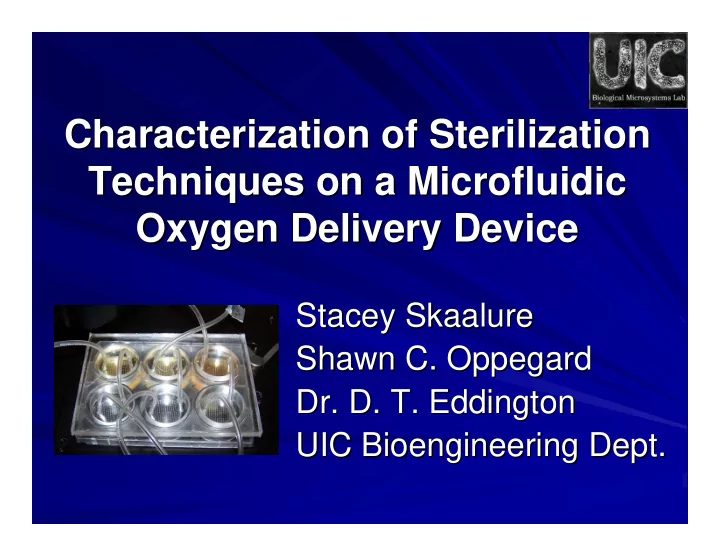
Characterization of Sterilization Characterization of Sterilization Techniques on a Microfluidic Microfluidic Techniques on a Oxygen Delivery Device Oxygen Delivery Device Stacey Skaalure Skaalure Stacey Shawn C. Oppegard Oppegard Shawn


slide-1
SLIDE 1

Characterization of Sterilization Characterization of Sterilization Techniques on a Techniques on a Microfluidic Microfluidic Oxygen Delivery Device Oxygen Delivery Device

Stacey Stacey Skaalure Skaalure Shawn C. Shawn C. Oppegard Oppegard

  • Dr. D. T.
  • Dr. D. T. Eddington

Eddington UIC Bioengineering Dept. UIC Bioengineering Dept.

slide-2
SLIDE 2

Objectives Objectives

General: Validate utility of General: Validate utility of microfluidic microfluidic device fabricated in lab device fabricated in lab

– – Designed to carefully and efficiently control Designed to carefully and efficiently control

  • xygen exposure to cell cultures
  • xygen exposure to cell cultures

Specific: Characterize effects of Specific: Characterize effects of sterilization sterilization methods on effectiveness of methods on effectiveness of the device the device

slide-3
SLIDE 3

Motivation: Why control Motivation: Why control

  • xygen content in cell culture?
  • xygen content in cell culture?

Simulate hypoxia and Simulate hypoxia and hyperoxia hyperoxia in vitro in vitro Some experimental Some experimental applications: applications:

– – Response of cardiac Response of cardiac cells to changing cells to changing

  • xygen levels (
  • xygen levels (eg

eg. . heart attack) heart attack) – – Regulation of stem cell Regulation of stem cell differentiation using differentiation using

  • xygen signals
  • xygen signals

www.aist.go.jp/aist_e/aist_today/2006_22/feature/feature_06.html

slide-4
SLIDE 4

Problem: Limitations of existing Problem: Limitations of existing exposure system exposure system

Modular hypoxic chamber Modular hypoxic chamber

– – Floods entire chamber with Floods entire chamber with gas gas – – All cells exposed to same All cells exposed to same

  • xygen concentration
  • xygen concentration

– – Takes >3 h to equilibrate Takes >3 h to equilibrate with media with media

slide-5
SLIDE 5

Advantages of Advantages of microfluidic microfluidic exposure system exposure system

Microfluidic Microfluidic oxygen

  • xygen

delivery device delivery device

– – Adapts to multi Adapts to multi-

  • well culture

well culture plates plates – – Can expose cells in Can expose cells in different wells or same different wells or same well to different O well to different O2

2

concentrations concentrations – – System equilibrates in System equilibrates in minutes minutes – – Made with PDMS: Made with PDMS:

www.sumibe.co.jp/sumilon/photo/plate1.jpg

biocompatible, gas-permeable

slide-6
SLIDE 6

Structure of the device Structure of the device

slide-7
SLIDE 7

Device sterilization analysis Device sterilization analysis

Devices must be Devices must be sterilized before use in sterilized before use in cell culture cell culture Need to investigate Need to investigate: :

– – Optimal sterilization Optimal sterilization technique that withstands technique that withstands repetitive use repetitive use

Experimental Plan: Experimental Plan:

– – Cut up device into 5 separate inserts, one per Cut up device into 5 separate inserts, one per sterilization technique sterilization technique – – Repeatedly sterilize and measure oxygen Repeatedly sterilize and measure oxygen permeability through membranes permeability through membranes

slide-8
SLIDE 8

Sterilization Techniques Sterilization Techniques

UV light

2 hours in culture hood

Autoclave

15 min at 121ºC 15 min soak at 52ºC Control - Nothing 15 min soak

70% Ethanol

slide-9
SLIDE 9

Measurement setup Measurement setup

Generate Generate calibration curve calibration curve using using 0, 10, 20% O 0, 10, 20% O2

2

flowing through flowing through a device without a device without membrane membrane Test Test experimental experimental devices using devices using 10% O 10% O2

2

Oxygen tank Flowmeter Plastic tubing Devices in 6- well plate Fluorescent microscope FOXY-SGS slide Device 6-well plate 5 images taken per slide

slide-10
SLIDE 10

Measuring oxygen concentration Measuring oxygen concentration with fluorescent microscopy with fluorescent microscopy

Imaging software can Imaging software can measure fluorescent measure fluorescent intensity intensity Intensity and [O Intensity and [O2

2] are

] are inversely related inversely related Calibration curve Calibration curve used to solve for [O used to solve for [O2

2]

] sensed in test sensed in test devices devices

Calibration Curve

y = 53167x2 - 21603x + 3499.3 500 1000 1500 2000 2500 3000 3500 4000 0% 5% 10% 15% 20% 25%

[O2] Intensity

slide-11
SLIDE 11

Effects of sterilization on diffusion Effects of sterilization on diffusion

  • f 10% oxygen
  • f 10% oxygen

*

2 4 6 8 10 12 5 10 15 20 25 30 35 Cycle [O2] (%) Autoclave Dri-Clean Ethanol UV Control

* n = 5

slide-12
SLIDE 12

Conclusions Conclusions

All of sterilized devices performed same as control All of sterilized devices performed same as control

– – (2 (2-

  • factor ANOVA, p > 0.5)

factor ANOVA, p > 0.5) – – No negative effects due to sterilization techniques No negative effects due to sterilization techniques – – User can choose preferred technique User can choose preferred technique

No significant changes seen due to repetitive No significant changes seen due to repetitive sterilization sterilization

– – (2 (2-

  • factor ANOVA, p > 0.4)

factor ANOVA, p > 0.4) – – Can be used/sterilized many more than 32 times before Can be used/sterilized many more than 32 times before replacement may be necessary replacement may be necessary

Overall: Overall: Device very resistant to changes in Device very resistant to changes in permeability properties permeability properties

slide-13
SLIDE 13

Ongoing/future goals Ongoing/future goals

Develop computer models using CFD Develop computer models using CFD-

  • ACE

ACE+

+

– – Simulate fluid dynamics and diffusion within Simulate fluid dynamics and diffusion within device device – – Serves as a form of validation Serves as a form of validation

Conduct Conduct mesenchymal mesenchymal stem cell studies stem cell studies

– – Control differentiation by exposing cells to Control differentiation by exposing cells to various oxygen concentrations various oxygen concentrations

Publish paper, recommend device to Publish paper, recommend device to potential users potential users

slide-14
SLIDE 14

Acknowledgements Acknowledgements

Shawn C. Shawn C. Oppegard Oppegard Ki Ki-

  • Hwan Nam

Hwan Nam

  • Dr. David
  • Dr. David Eddington

Eddington Dr.

  • Dr. Takoudis

Takoudis Dr.

  • Dr. Jursich

Jursich NSF and NSF and DoD DoD Grant Grant NSF NSF-

  • EEC 0755115

EEC 0755115