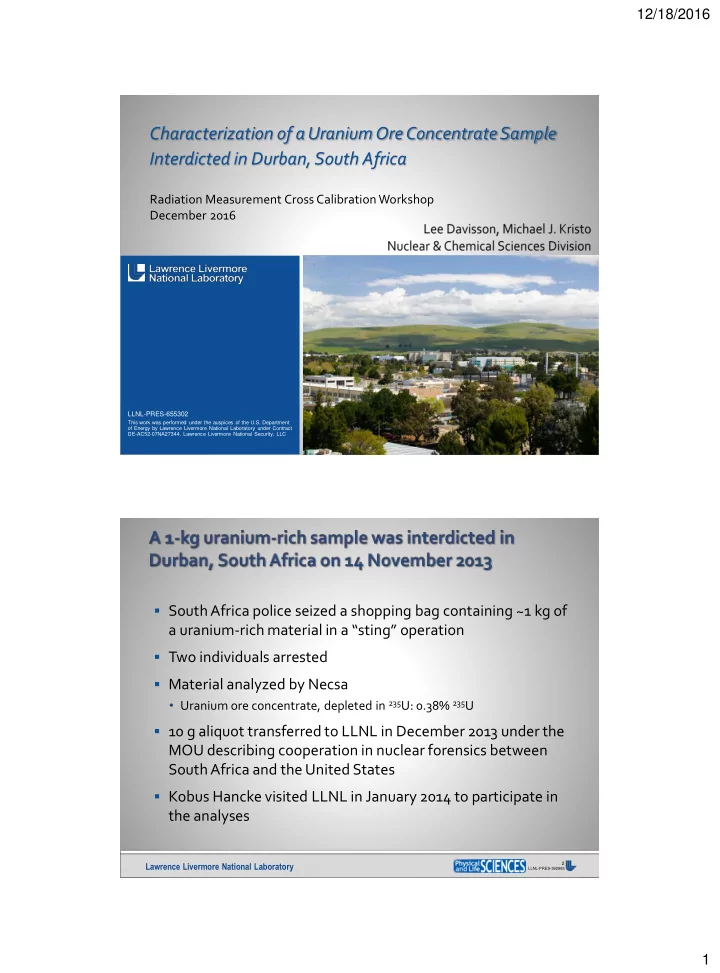
Characterization of a Uranium Ore Concentrate Sample Interdicted in - - PDF document

characterization of a uranium ore concentrate sample
SMART_READER_LITE
LIVE PREVIEW

Characterization of a Uranium Ore Concentrate Sample Interdicted in - - PDF document

12/18/2016 Characterization of a Uranium Ore Concentrate Sample Interdicted in Durban, South Africa Radiation Measurement Cross Calibration Workshop December 2016 LLNL-PRES-655302 This work was performed under the auspices of the U.S.


slide-1
SLIDE 1

12/18/2016 1

LLNL-PRES-655302

This work was performed under the auspices of the U.S. Department

  • f Energy by Lawrence Livermore National Laboratory under Contract

DE-AC52-07NA27344. Lawrence Livermore National Security, LLC

Characterization of a Uranium Ore Concentrate Sample Interdicted in Durban, South Africa

Radiation Measurement Cross Calibration Workshop December 2016

Lawrence Livermore National Laboratory

LLNL-PRES-592885 2

  • South Africa police seized a shopping bag containing ~1 kg of

a uranium-rich material in a “sting” operation

  • Two individuals arrested
  • Material analyzed by Necsa
  • Uranium ore concentrate, depleted in 235U: 0.38% 235U
  • 10 g aliquot transferred to LLNL in December 2013 under the

MOU describing cooperation in nuclear forensics between South Africa and the United States

  • Kobus Hancke visited LLNL in January 2014 to participate in

the analyses

slide-2
SLIDE 2

12/18/2016 2

Lawrence Livermore National Laboratory

LLNL-PRES-592885 3

  • Gamma ray spectroscopy
  • X-ray diffraction
  • X-ray fluorescence
  • Optical spectroscopy
  • Scanning electron microscopy
  • Davies-Gray titration
  • Inductively-coupled plasma mass spectrometry (ICP-MS)
  • Thermal ionization mass spectrometry (TIMS)

Lawrence Livermore National Laboratory

LLNL-PRES-592885 4

slide-3
SLIDE 3

12/18/2016 3

Lawrence Livermore National Laboratory

LLNL-PRES-592885 5

Lawrence Livermore National Laboratory

LLNL-PRES-592885 6

slide-4
SLIDE 4

12/18/2016 4

Lawrence Livermore National Laboratory

LLNL-PRES-592885 7

Lawrence Livermore National Laboratory

LLNL-PRES-592885 8

Radionuclide abundances in the Durban UOC Radionuclide Concentration (at. %)1 Concentration (atoms)

95Zr

<1.23 x 10⁷

106Ru

<1.85 x 10⁹

125Sb

<3.69 x 10⁸

137Cs

<1.85 x 10⁹

144Ce

<3.69 x 10⁸

155Eu

<3.69 x 10⁸

234U

(1.020 ± 0.20) x 10-3

235U

0.333 ± 0.001

238U

99.67 ± 0.20

  • 1. Uncertainties are 2 standard deviations
slide-5
SLIDE 5

12/18/2016 5

Lawrence Livermore National Laboratory

LLNL-PRES-592885 9

Ammonium Uranium Fluoride (NH4)2UF6 Uranium Oxide Ammonia Hydrate 2UO3·NH3·3H2O Ammonium Uranium Oxide Hydrate UO3·NH3·H2O Ammonia Uranium Oxide Hydrate UO3·yNH3·xH2O

Lawrence Livermore National Laboratory

LLNL-PRES-592885 10

  • Davies-Gray titration yields a U-content of 74.9 ± 0.5 wt.%
  • Compares to 67.5 wt.% measured by Necsa
  • Total impurity content of ~300 mg/g
  • Major impurities are Na, K, Ca, Fe, Mo and Cs
slide-6
SLIDE 6

12/18/2016 6

Lawrence Livermore National Laboratory

LLNL-PRES-592885 11

Isotope Abundance (pg/g) Abundance (at.%) Uncertainty

234U

0.002111 0.000007

235U

0.3196 0.0002

236U

0.01844 0.00007

238U

99.664 0.002

239Pu

9.7 ± 0.5 92.81

240Pu

0.0981 0.004

Lawrence Livermore National Laboratory

LLNL-PRES-592885 12

slide-7
SLIDE 7

12/18/2016 7

Lawrence Livermore National Laboratory

LLNL-PRES-592885 13

  • Modeled a graphite moderated, natural uranium (NU)

fueled reactor using the MAGNOX reactor model included in the Origen-ARP component of SCALE 6.1

  • NU fuel irradiated for ~100 days to a burnup of 1.6

GWD/MTU would have a

240Pu content of ~14% at

discharge

  • Using this fuel as feed for an enrichment cascade

producing

235U enriched to 2%, the ORNL MSTAR

program calculates 234U /235U = 9.1 x 10⁻³ and 236U /235U = 4.2 x 10⁻², both values consistent with measurements

Lawrence Livermore National Laboratory

LLNL-PRES-592885 14

  • The UOC is ammonium uranyl fluoride plus two hydrated

uranyl oxides

  • Total impurity content of ~300 mg/g
  • Major impurities are Na, K, Ca, Fe, Mo and Cs
  • The UOC is depleted in 235U with a 235U/238U ratio ~2x

lower than that of natural uranium (NU)

  • The elevated 236U content indicates the parent material

was irradiated in a nuclear reactor

  • The UOC likely originated as NU fuel irradiated in a

graphite-moderated reactor and used as feedstock for an enrichment cascade

slide-8
SLIDE 8

12/18/2016 8

Lawrence Livermore National Laboratory

LLNL-PRES-592885 15

Acknowledgements

The LLNL/NECSA nuclear forensics team:

Lars Borg Amy M. Gaffney Victoria G. Genetti Patrick M. Grant Kobus J. Hancke Ian D. Hutcheon Theresa M. Kayzar Gregory L. Klunder Kim B. Knight Michael J. Kristo Rachel E. Lindvall Naomi Marks Reuben P. Mogafe Aubrey N. Nelwamondo Christina E. Ramon Erick C. Ramon Martin Robel Michael A. Sharp Michael J. Singleton Ross W. Williams

Work supported by NNSA’s Office of Defense Nuclear Nonproliferation and the South African Nuclear Energy Corporation