Chapter Objectives Chapter 15 To calculate your life insurance - - PDF document

chapter objectives chapter 15
SMART_READER_LITE
LIVE PREVIEW

Chapter Objectives Chapter 15 To calculate your life insurance - - PDF document

Chapter Objectives Chapter 15 To calculate your life insurance protection needs Life Insurance and Estate To understand the important provisions in a Planning life insurance policy To describe the major kinds of life insurance To be able to


slide-1
SLIDE 1

Chapter 15 Life Insurance and Estate Planning Chapter Objectives

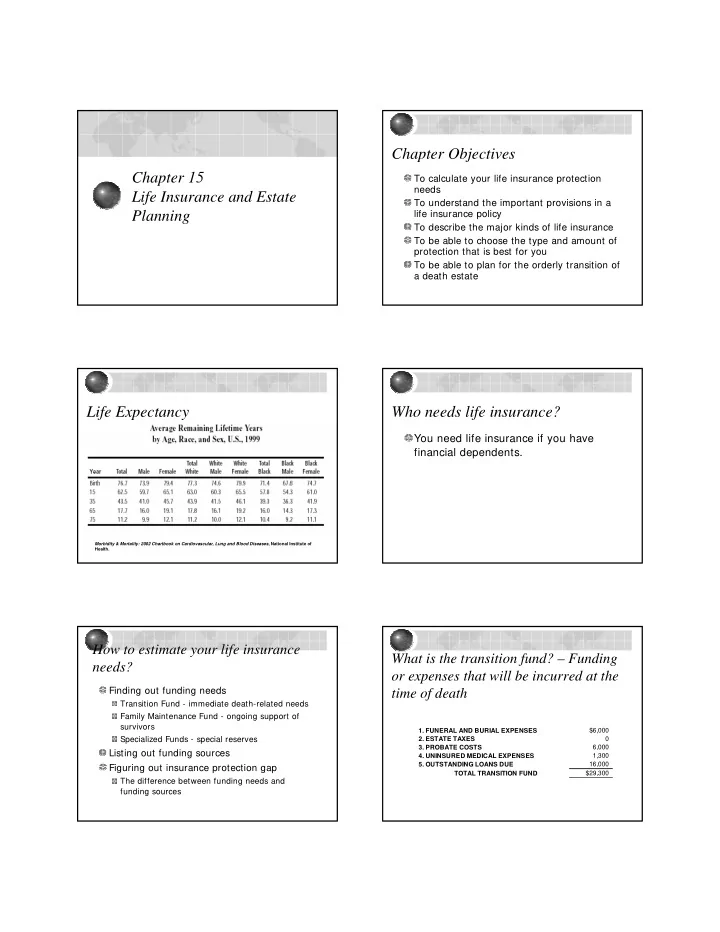
To calculate your life insurance protection needs To understand the important provisions in a life insurance policy To describe the major kinds of life insurance To be able to choose the type and amount of protection that is best for you To be able to plan for the orderly transition of a death estate

Life Expectancy

Morbidity & Mortality: 2002 Chartbook on Cardiovascular, Lung and Blood Diseases, National Institute of Health.

Who needs life insurance?

You need life insurance if you have financial dependents.

How to estimate your life insurance needs?

Finding out funding needs

Transition Fund - immediate death-related needs Family Maintenance Fund - ongoing support of survivors Specialized Funds - special reserves

Listing out funding sources Figuring out insurance protection gap

The difference between funding needs and funding sources

What is the transition fund? – Funding

  • r expenses that will be incurred at the

time of death

  • 1. FUNERAL AND BURIAL EXPENSES

$6,000

  • 2. ESTATE TAXES
  • 3. PROBATE COSTS

6,000

  • 4. UNINSURED MEDICAL EXPENSES

1,300

  • 5. OUTSTANDING LOANS DUE

16,000 TOTAL TRANSITION FUND $29,300

slide-2
SLIDE 2

What is the family maintenance fund? – Funding for the ongoing support of dependent family

MONTHLY SURVIVORS' EXPENSES $4,000 MONTHLY SURVIVORS' TAKE-HOME PAY $670 MONTHLY SURVIVORS' BENEFITS $1,980 TOTAL CONTRIBUTION BY SURVIVORS ($2,650) MONTLY MAINTENANCE REQUIREMENT $1,350 ANNUAL MAINTENANCE REQUIREMENT $16,200 Multiply by Annuity Factor Term of Fund (years) 10 Annual real return 2% Annuity Factor 9.1622 FAMILY MAINTENANCE FUND $148,428

What are the specialized funds? – For emergency, education of children, and retirement of spouse

  • 1. EMERGENCY FUND

$12,000

  • 2. EDUCATIONAL FUND

COST PER CHILD $44,000 NUMBER OF CHILDREN 3 $132,000

  • 3. RETIREMENT FUND

ANNUAL REQUIREMENT $5,000 RETIREMENT YEARS 20 $100,000

  • 4. OTHER FUNDS*

$0 TOTAL SPECIALIZED FUNDS $244,000

What are the total funding needs?

FUNDING NEEDS TRANSITION FUND $29,300 MAINTENANCE FUND $148,428 SPECIALIZED FUNDS $244,000 TOTAL NEEDS $421,728

What are the total funding sources?

FUNDING SOURCES FINANCIAL INVESTMENTS $56,000 TANGIBLE GOODS $10,000 LIFE INSURANCE GROUP $50,000 INDIVIDUAL SOCIAL SECURITY 255 TOTAL SOURCES (116,255)

TOTAL NEEDS $421,728 FUNDING SOURCES (116,255) UNFUNDED NEEDS $305,473 UNFUNDED ESTATE LIQUIDITY ***THE LIFE INSURANCE PROTECTION GAP*** $305,473

What is the insurance protection gap? – This is the amount of life insurance you need to buy Some useful Website for calculating life insurance needs

Forbes at http://www.forbes.com/tools/calculator/life_ins urance.jhtml Yahoo Insurance at http://insurance.yahoo.com/l1.html Life-line.org at http://www.life-line.org/ Insweb at http://www.insweb.com/ Smartmoney.com at http://www.smartmoney.com/insurance/life/in dex.cfm?story= intro

slide-3
SLIDE 3

The special language of life insurance policy - The basic policy

Face Amount

dollar amount of life insurance protection stated on the face of the policy

Premium

periodic payment on policy Nonparticipating insurance

typically stock insurance companies premiums not dependent upon the future earnings and mortality experience of the company

Participating insurance

typically mutual insurance companies may return part of the premium as a dividend if company has favorable earning

What are participating vs. nonparticipating insurance?

Cash value

equal to the savings accumulated during the existence of the policy insured can typically borrow against cash value

Surrender value

amount returned to the policy holder at termination cash value plus surrender dividends less

  • utstanding loans and surrender charges

What are cash value and surrender value?

Single life policy

taken out on the life of one person

Joint life policy

covers more than one person, pays out at the death of the first Survivorship joint life pays out at the death of the last individual

Family policy

coverage for several family members in one policy

What is “lives covered”?

Beneficiary

person or entity that receives proceeds

Co-beneficiaries

persons or entities that receive proceeds

Contingent beneficiary

also called secondary beneficiary receives proceeds if primary beneficiary dies before you do

Who is the “beneficiary”? What are “riders”?

Specialized provision meant to modify or extend

  • coverage. Examples (Textbook page 390):

accelerated death benefits accidental death benefits disability waiver premium nonforfeiture incontestability clause guaranteed insurability convertibility renewability cost of living adjustment settlement options grace period

slide-4
SLIDE 4

What are the different types of life insurance policies?

Term Insurance

no cash value buildup; provides only death protection

Cash Value Insurance

provides both death protection and cash value buildup functions as both death protection and a savings vehicle

What are the types of term insurance?

I ncreasing-Premium Term Level death benefit with increasing premiums in order to offset age- related risks Renewable term may be extended over some predefined period without proof of insurability Level-Premium Term Holds premium constant over a set number of years such as 5, 10, 15, or 20. may be renewed at a higher premium Decreasing Term premium remains constant increased risk of mortality offset by declining death protection Group Mortgage Life a type of decreasing term insurance meant to payoff the balance on a mortgage

What are the types of cash value insurance policies?

Whole life Limited payment life Modified whole life Adjustable life Universal life Variable life Variable-universal life

What is whole life (straight or

  • rdinary life)?

Premiums: level over time Face value = cash value + death protection Over time, cash value increases, death protection decreases, but face value stays the same.

What is limited payment life?

Premiums: level up to certain age, usually 65, then cease Higher premiums in early years than straight life before premiums cease Interest earned on cash value offsets premiums in later years

What is modified whole life?

Premiums: level, lower than whole life automatically reduces the death benefit as the insured ages as an attempt to meet the needs of the family throughout the life cycle

slide-5
SLIDE 5

What is adjustable life?

Both premium payments and face amount are adjustable within limits Typically contains a guaranteed insurability rider for increasing face amount

What is universal life?

Flexible premium payments that affect the size of the cash value build up Premium is a contribution that is voluntary within certain limits Contribution is split between charge for term insurance and an interest earning account Periodic reports on term protection, management expenses, and interest earned

  • n cash value

What is variable life?

Similar to universal life but with fixed annual premiums The insurer chooses an investment portfolio offered by the insurance company thus there is speculative risk

What is variable-universal life?

Combines the flexible premiums of universal life with the investment selection of variable life.

What are the tax advantage of cash value insurance?

Interest earned on cash value avoids immediate taxation Taxes must be paid when interest is paid out or policy is surrendered Pay out may be avoided by a policy loan Beneficiaries receive a tax-free payout at death of insured

How to select the right type of policy?

Term insurance provides the greatest face amount of death protection at the lowest premium Compare cash value insurance with other investments Consider a term plus savings plan Review the tax advantage of cash value insurance (see next slide) Comparison shop

slide-6
SLIDE 6

How to do comparison shopping?

Wide range of prices can make comparison shopping worthwhile Review the cost indexes (smaller numbers are better)

interest-adjusted net cost index (surrender cost index)

  • For an example, visit http://www.whole-life-

insurance.com/Actual-Results-Comparison.html

net payment cost index For more information about these indexes, visit http://www.insbuyer.com/findlowcostlifeinsurance.htm Be wary of using the indexes to compare dissimilar policies Indexes may depend upon faulty promises

How to check out the insurance company? – Important as you want the company to be there when you need it

Rating agencies

A.M. Best: http://www.ambest.com/ Duff & Phelps: http://www.duffllc.com/ Moody’s Investor Services: http://www.moodys.com/cust/default.asp Standard & Poor’s: http://www2.standardandpoors.com/NASApp/cs/C

  • ntentServer?pagename= sp/Page/HomePg

Weiss Group: http://www.weissratings.com/

Estate Planning – Some Terminologies

Death estate

property and wealth transferred at death

Will

a legal declaration of how your property is to be deposed of at death

What happens if you die with or without a will?

If you have a valid will, you die testate

The person who leaves a will is a testator(trix) The person named in the will who manages the death estate is the executor(trix)

If you die without a will, you die intestate

If you die intestate, the state decides how your property will be divided at death The state appoints an administrator(trix) to manage the death estate

What are the two ways to divide estate?

Per capita division

The inheritance is divided equally among all surviving family members.

Per stirpes division

The inheritance is divided equally among branches of the family

An example: A family has two children (A and B). One of them (A) died, leaving two grandchildren(Aa and Ab). The other (B) does not have children. The grandparent’s estate will be distributed as follows

Per capita: the three surviving members (Aa, Ab, and B) each receives 1/3 Per stirpes: B receives ½ , Aa receives ¼ , and Ab receives ¼ .

How to change or revoke a will?

Codicil

an amendment to an existing will, modifying or explaining specific terms

Revoking a Will

writing a new will change in family status

slide-7
SLIDE 7

What is the letter of last instructions?

Provides advice on the management of your death estate and the distribution of your assets Inventories your assets - life insurance, pension survivor benefits, and you financial holdings Names individuals who are familiar with your financial estate - stockbroker, accountant, lawyer

What is probate?

Court process in which assets are transferred according to the will Seven major steps of probate

1.Validation of will and appointment of executor(trix) or administrator(trix) 2.Informing heirs and claimants of death 3.Inventory and valuation of property and debts 4.Payments of claims against the estate 5.Determination and payment of taxes due 6.Determination of division and heirs 7.Division and distribution of estate

What are trusts?

A legal arrangement in which property is held by one party for the benefit of another Trustee

  • ne who controls the property in the trust

Grantor

  • ne who establishes and funds the trust

Some technical terms with respect to trusts

Fiduciary responsibility

legal responsibility to manage the trust in the best interests of the beneficiary

Testamentary trust

takes effect at death

Living trust

takes effect during the grantor’s lifetime

What are revocable vs. irrevocable trust?

Revocable trust

can be changed by the grantor

Irrevocable trust

cannot be changed by the grantor once it is established

What are the possible contractual relationships?

Joint tenancy

each owner has an undivided interest property passes to co-owner at death

Tenancy in common

each owner has an undivided interest property can be individually transferred

Community property

property acquired in marriage by the joint efforts

  • f both spouses
slide-8
SLIDE 8

Checklist for Estate Planning Documents

A valid will Letter of last instructions Durable power of attorney Living will Health care durable power of attorney