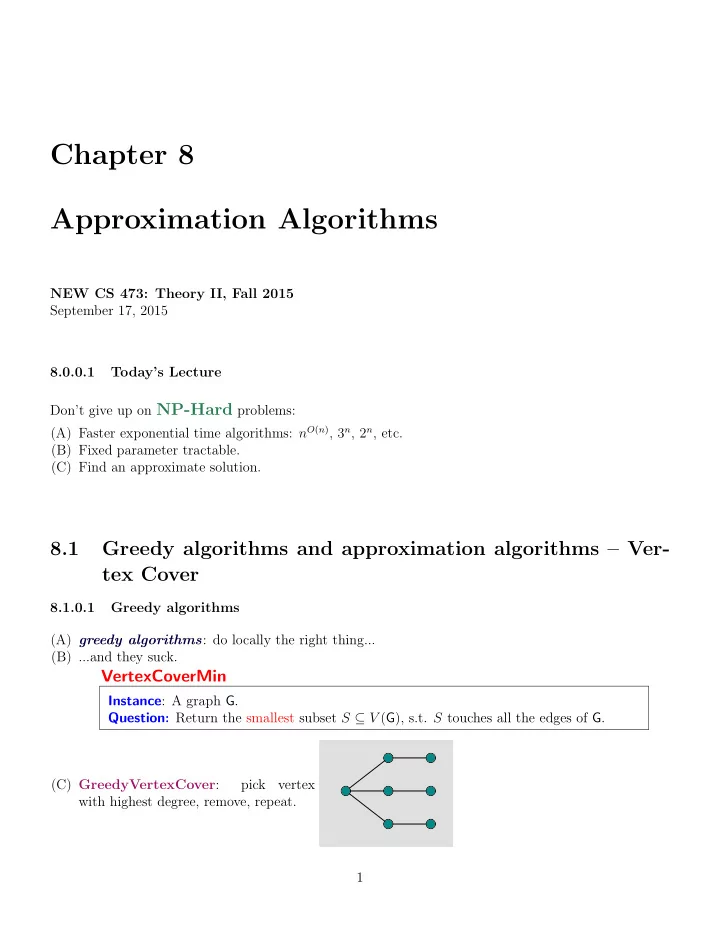
SLIDE 7 8.3.0.2 TSP Hardness Theorem 8.3.1. TSP-Min can not be approximated within any factor unless NP = P. Proof. (A) Reduction from Hamiltonian Cycle into TSP. (B) G = (V, E): instance of Hamiltonian cycle. (C) J: Complete graph over V. ∀u, v ∈ V wJ(uv) =
uv ∈ E 2
(D) ∃ tour of price n in J ⇐ ⇒ ∃ Hamiltonian cycle in G. (E) No Hamiltonian cycle = ⇒ TSP price at least n + 1. (F) But... replace 2 by cn, for c an arbitrary number 8.3.0.3 TSP Hardness - proof continued Proof: (A) Price of all tours are either: (i) n (only if ∃ Hamiltonian cycle in G), (ii) larger than cn + 1 (actually, ≥ cn + (n − 1)). (B) Suppose you had a poly time c-approximation to TSP-Min. (C) Run it on J: (i) If returned value ≥ cn + 1 = ⇒ no Ham Cycle since (cn + 1)/c > n (ii) If returned value ≤ cn = ⇒ Ham Cycle since OPT ≤ cn < cn + 1 (D) c-approximation algorithm to TSP = ⇒ poly-time algorithm for NP-Complete problem. Possible only if P = NP.
8.3.1 TSP with the triangle inequality
8.3.1.1 Because it is not that bad after all.
TSP△=-Min
Instance: G = (V, E) is a complete graph. There is also a cost function ω(·) defined over the edges of G, that complies with the triangle inequality. Question: The cheapest tour that visits all the vertices of G exactly once. triangle inequality: ω(·) if ∀u, v, w ∈ V(G), ω(u, v) ≤ ω(u, w) + ω(w, v). Shortcutting σ: a path from s to t in G = ⇒ ω(st) ≤ ω(σ).
8.3.2 TSP with the triangle inequality
8.3.2.1 Continued... Definition 8.3.2. Cycle in G is Eulerian if it visits every edge of G exactly once. Assume you already seen the following: Lemma 8.3.3. A graph G has a cycle that visits every edge of G exactly once (i.e., an Eulerian cycle) if and only if G is connected, and all the vertices have even degree. Such a cycle can be computed in O(n + m) time, where n and m are the number of vertices and edges of G, respectively. 7