Chapter 7 Programming Hardware Programming Barely Information - - PDF document

chapter 7
SMART_READER_LITE
LIVE PREVIEW

Chapter 7 Programming Hardware Programming Barely Information - - PDF document

2018/11/1 Communication Application Operating System Chapter 7 Programming Hardware Programming Barely Information (Low level programming languages) 2-2 Chapter Goals Connecting CPU and Memory Describe the


slide-1
SLIDE 1

2018/11/1 1

Chapter 7

Programming Barely

(Low level programming languages)

从这里开始

2-2

Communication Application Operating System

Programming

Hardware Information

7-3

Chapter Goals

  • Describe the fetch-decode-execute cycle of the von

Neumann machine

  • Low level programming languages(面向机器的语言)

– List the operations that a computer can perform – Distinguish between immediate mode addressing and direct addressing – Distinguish between machine language and assembly language – Describe the steps in creating and running an assembly- language program

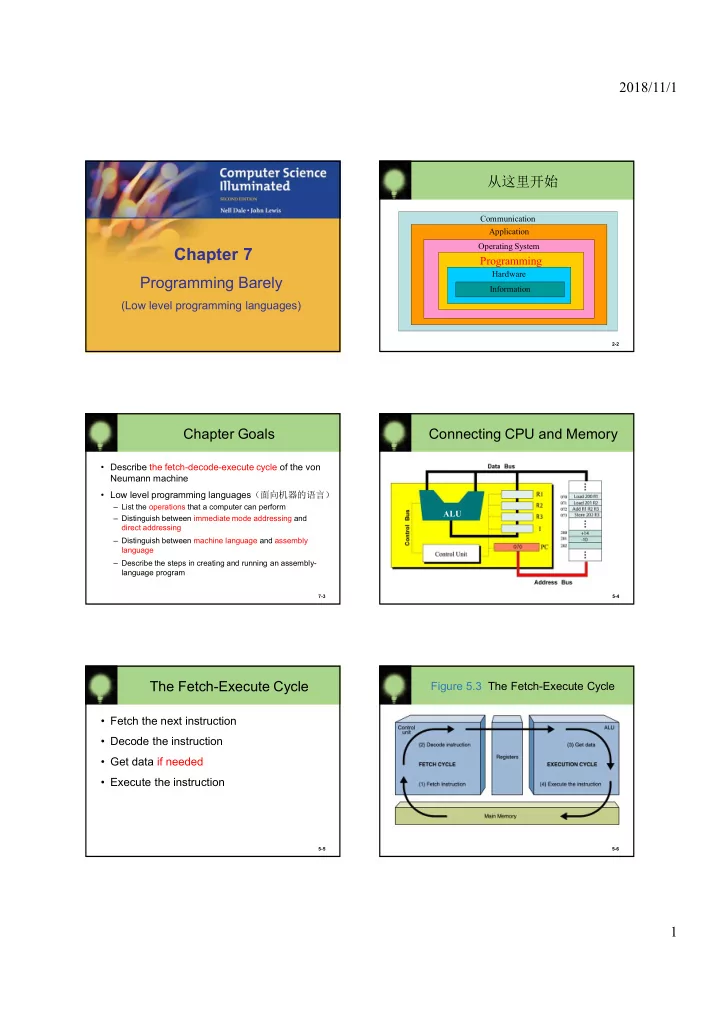
Connecting CPU and Memory

5-4

ALU

5-5

The Fetch-Execute Cycle

  • Fetch the next instruction
  • Decode the instruction
  • Get data if needed
  • Execute the instruction

5-6

Figure 5.3 The Fetch-Execute Cycle

slide-2
SLIDE 2

2018/11/1 2 How does CPU work?

  • Demo

5-7

http://www.science.smith.edu/~jcardell/Courses/CSC103/CPUsim/cpusim.html

7-8

Computer Operations

  • A computer is a programmable electronic device

that can store, retrieve, and process data

  • Data and instructions to manipulate the data are

logically the same and can be stored in the same place

  • Store, retrieve, and process are actions that the

computer can perform on data

7-9

Machine Language

  • Machine language (机器语言)The

instructions built into the hardware of a particular computer(计算机硬件可识别的 语言)

  • Initially, humans had no choice but to write

programs in machine language because

  • ther programming languages had not yet

been invented

– (用0,1编写程序?)

7-10

Machine Language

  • Every processor type has its own set
  • f specific machine instructions
  • The relationship between the processor

and the instructions it can carry out is completely integrated

  • Each machine-language instruction does
  • nly one very low-level task

7-11

PIPPIN Machine: A Virtual Computer

  • Virtual computer A hypothetical machine designed to

contain the important features of real computers that we want to illustrate

  • Features in PIPPIN

– The memory is made up of 256 bytes. A half store data and other store instruction – has 18 machine-language instructions – Has IR,PC,ACC(累加器) registers in CPU – A 8bit ALU(8位的CPU)

  • We are only going to examine a few of these instructions

7-12

Some Sample Instructions

http://cs.smith.edu/~jcardell/courses/CSC103/PIPPINGuide.html

slide-3
SLIDE 3

2018/11/1 3

7-13

Instruction Format

  • The instruction specifier is made up of

several sections

– The operation code – The register specifier – The addressing-mode specifier

7-14

Instruction Format

  • There are two parts to an instruction

– The 8-bit instruction specifier(命令指示) – And optionally, the 8-bit operand specifier(操作数)

X Z Z Z Z b b b b b b b b

  • perand specifier:

一个数值,或者 一个内存地址 instruction specifier: ZZZZ:操作码 X:寻址模式 1表示操作数是数值 0表示操作数是该地址的内容

A Program Example

7-15

Program Execution Demo

7-16 7-17

Assembly Language

  • Assembly languages (汇编语言) A

language that uses mnemonic codes(助 记忆符号) to represent machine- language instructions

– The programmer uses these alphanumeric codes in place of binary digits – A program called an assembler reads each

  • f the instructions in mnemonic form and

translates it into the machine-language equivalent(翻译成对应的机器语言)

7-18

Figure 7.5 Assembly Process

slide-4
SLIDE 4

2018/11/1 4 A New Program

让我们把这个算法,翻译成对应的程序?

//sum(1…n) set sum to 0 for count from 1 to n

set sum to sum + count

end for

  • utput sum

//W store n //set sum to 0 LOD #0 STO Y //for count from 1 to n LOD #1 // i=1 STO X JMP sum-end(16) sum-next: LOD X // i++ ADD #1 STO X sum-end: SUB W JMZ end(28)

//set sum to sum + count LOD Y ADD X STO Y JMP sum-next(10)

//end for end: HLT //output sum

High level programming language

  • High level programming language

– ?

  • Examples

– C, C++,Java, and Visual Basic – Ada, Lisp, C# – PHP, Python – more ……

7-20

http://images.china-pub.com/ebook195001-200000/199000/ch01.pdf

TIOBE Programming Index

7-21

http://www.tiobe.com/index.php/content/paperinfo/tpci/index.html ,2011.10

TIOBE Programming Index

7-22

TIOBE Programming Index

7-23 8-24

Compilers

  • Compiler (编译)A program that

translates a high-level language program into machine code

  • High-level languages provide a richer set
  • f instructions that makes the

programmer’s life even easier

slide-5
SLIDE 5

2018/11/1 5

8-25

Compilers

Figure 8.1 Compilation process 8-26

Interpreters

  • Interpreter (解释)A translating program

that translates and executes the statements in sequence

– Unlike an assembler or compiler which produce machine code as output, which is then executed in a separate step – An interpreter translates a statement and then immediately executes the statement – Interpreters can be viewed as simulators

8-27

Java

  • Introduced in 1996 and swept the

computing community by storm

  • Portability was of primary importance
  • Java is compiled into a standard machine

language called Bytecode

  • A software interpreter called the JVM

(Java Virtual Machine) takes the Bytecode program and executes it

8-28

Programming Language Paradigms

  • What is a paradigm?
  • A set of assumptions, concepts, values,

and practices that constitute a way of viewing reality

8-29

Programming Language Paradigms

Figure 8.2 Portability provided by standardized languages versus interpretation by Bytecode 8-30

Programming Language Paradigms

Figure 8.2 Portability provided by standardized languages versus interpretation by Bytecode

slide-6
SLIDE 6

2018/11/1 6

8-31

Programming Language Paradigms

  • Imperative or procedural model

– FORTRAN, COBOL, BASIC, C, Pascal, Ada, and C++

  • Functional model

– LISP, Scheme (a derivative of LISP), and ML

8-32

Programming Language Paradigms

  • Logic programming

– PROLOG

  • Object-oriented paradigm

– SIMULA and Smalltalk – C++ is as an imperative language with some

  • bject-oriented features

– Java is an object-oriented language with some imperative features

Programming in Python

7-33

>>> # Fibonacci series: ... # the sum of two elements defines the next ... a, b = 0, 1 >>> while b < 10: ... print b ... a, b = b, a+b ...

作业(1/1)

7-34

1、Program with machine language according to the following c. int_8 a = 1; int_8 c = a + 3; 1)Write your assembly code & machine code 2)Explain machine code execution with the fetch-decode-execute cycle 3)Explain functions about IR, PC, ACC registers in a CPU 4)Explain physical meaning about vars a & c in a machine 2、简答题 1)What are stored in memory? 2)Can a data or a instruction stored in the same place? 3) Explain Instruction Format with example instructions. 3、解释以下词汇 1)汇编语言(Assembly Language) 2)编译(Compiler) 3)命令式语言(Imperative programming) 4)函数编程语言(Functional programming) 5)过程式编程(Procedural programming)