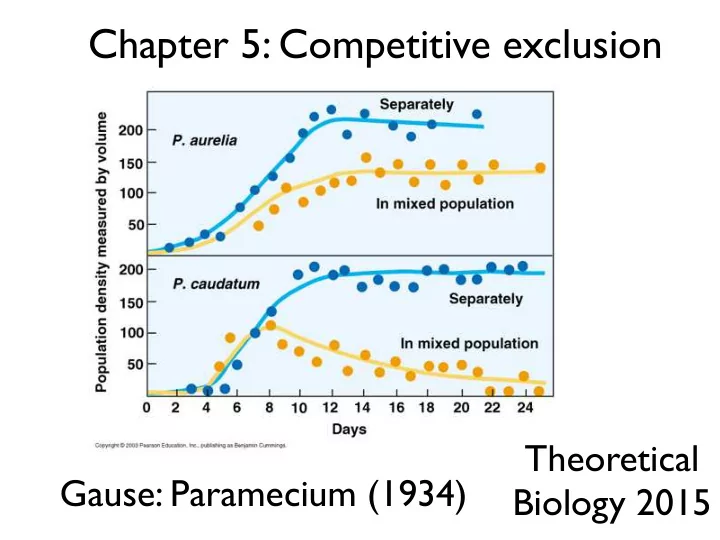
Chapter 5: Competitive exclusion Theoretical Gause: Paramecium - - PowerPoint PPT Presentation

chapter 5 competitive exclusion
SMART_READER_LITE
LIVE PREVIEW

Chapter 5: Competitive exclusion Theoretical Gause: Paramecium - - PowerPoint PPT Presentation

Chapter 5: Competitive exclusion Theoretical Gause: Paramecium (1934) Biology 2015 Competitive exclusion Tilman 1981 Two species of diatom feeding on silica: Af: Asterionella formosa Su: Synedra ulna , Si: silica From: Smith & Smith,


slide-1
SLIDE 1

Chapter 5: Competitive exclusion

Theoretical Biology 2015 Gause: Paramecium (1934)

slide-2
SLIDE 2

Competitive exclusion Tilman 1981

Two species of diatom feeding

  • n silica:

Af: Asterionella formosa Su: Synedra ulna, Si: silica

From: Smith & Smith, Elements of Ecology

slide-3
SLIDE 3

Question 6.5 on immune responses

dT dt = σ − δT T − βTI , dI dt = βTI − δII − k1IE1 − k2IE2 , dE1 dt = α1E1I − δEE1 and dE2 dt = α2E2I − δEE2 .

dE./dt gives: I=δE/α1 and I=δE/α2. E1 and E2 have to be solved from dI/dt=0. Substitute I=δE/α1 into dE2/dt:

dE2 dt = δEE2 (α2/α1 − 1) < 0

slide-4
SLIDE 4

Simplest mathematical model

Resource (e.g., amount of nitrogen available): Two consumers With a fitness of

R = 1 − N1 − N2 R01 = b1/d1 and R02 = b2/d2

dN1 dt = N1(b1R − d1) and dN2 dt = N2(b2R − d2)

slide-5
SLIDE 5

Nullclines

Substitution of R = 1 − N1 − N2 into dN1 dt = N1(b1R − d1) yields dN1 dt = N1 (b1(1 − N1 − N2) − d1) which has nullclines N1 = 0 and N2 = 1 − 1 R01 − N1

slide-6
SLIDE 6

Nullclines

Similarly the dN2/dt = 0 nullcline is found to be N2 = 1 − 1 R02 − N1 Thus, plotting N2 as a function of N1 the two nullclines run parallel with slope −1.

N1 N2 1 − 1

R0

1 − 1

R0

slide-7
SLIDE 7

Paradox of the plankton, bacteria in the gut, ...

How can so many species co-exist? co-existence not an equilibrium? Space is not homogeneous? Species are so similar that exclusion is slow? Species are largely controlled by parasites?