
SLIDE 1
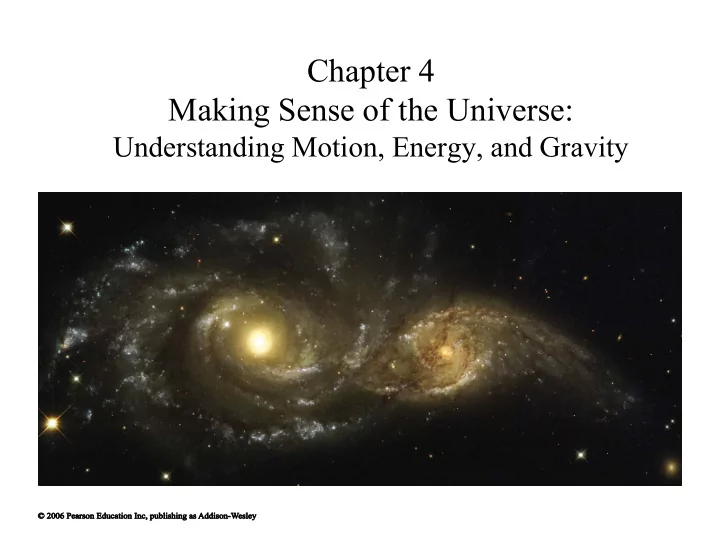
Chapter 4 Making Sense of the Universe: Understanding Motion, - - PowerPoint PPT Presentation
Chapter 4 Making Sense of the Universe: Understanding Motion, Energy, and Gravity 4.1 Describing Motion Our goals for learning: How do we describe motion? How is mass different from weight? How do we describe motion? Precise
Precise definitions to describe motion:
speed = distance time units of m s
⎛ ⎝ ⎜ ⎞ ⎠ ⎟
example: speed of 10 m/s
example: 10 m/s, due east
units of speed/time (m/s2)
accelerate at the same rate (not counting friction of air resistance).
m/s2: speed increases 10 m/s with each second of falling.
g is the same for all falling objects, regardless of their mass.
Apollo 15 demonstration
You are weightless in free-fall!
space
due to a constant state of free-fall
– Speed = distance / time – Speed & direction => velocity – Change in velocity => acceleration – Momentum = mass x velocity – Force causes change in momentum, producing acceleration
– Mass = quantity of matter – Weight = force acting on mass – Objects are weightless in free-fall
that operate on Earth also
⇒ one universe
gravity
light; first reflecting telescope, calculus… Sir Isaac Newton (1642-1727)
Newton’s first law of motion: An object moves at constant velocity unless a net force acts to change its speed
Force = mass × acceleration
For every force, there is always an equal and opposite reaction force.
– He discovered laws of motion & gravitation – He realized these same laws of physics were identical in the universe and on Earth
– 1. Object moves at constant velocity if no net force is acting. – 2. Force = mass × acceleration – 3. For every force there is an equal and opposite reaction force
unless an external twisting force (torque) is acting
Sun, so its rotation and orbit will continue indefinitely angular momentum = mass x velocity x radius
Angular momentum conservation also explains why objects rotate faster as they shrink in radius:
– Transfer from one object to another – Change in form
Energy can change type but cannot be destroyed.
the collective kinetic energy of many particles (for example, in a rock, in air, in water)
Thermal energy is related to temperature but it is NOT the same. Temperature is the average kinetic energy of the many particles in a substance.
Thermal energy is a measure of the total kinetic energy of all the particles in a substance. It therefore depends both on temperature AND density Example:
– object’s mass (m) – strength of gravity (g) – distance object could potentially fall
energy when it is spread out than when it contracts. ⇒A contracting cloud converts gravitational potential energy to thermal energy.
release a great deal of energy
spontaneously turn into particles (for example, in particle accelerators)
them? – Conservation of momentum
– Conservation of angular momentum
– Conservation of energy: energy cannot be created or destroyed but only transformed from one type to another. – Energy comes in three basic types: kinetic, potential, radiative.
The Universal Law of Gravitation: 1. Every mass attracts every other mass. 2. Attraction is directly proportional to the product of their masses. 3. Attraction is inversely proportional to the square of the distance between their centers.
be: – Bound (ellipses) – Unbound
His laws of gravity and motion showed that the relationship between the orbital period and average orbital distance of a system tells us the total mass of the system. Examples:
tell us the Sun’s mass.
Earth’s mass.
Jupiter’s mass.
p = orbital period a=average orbital distance (between centers) (M1 + M2) = sum of object masses p2= 4π2 G(M1+M2)a3 OR M1+M2=4π2 G a3 p2
– Directly proportional to the product of the masses (M x m) – Inversely proportional to the square of the separation
extend Kepler’s laws? – Applies to other objects, not just planets. – Includes unbound orbit shapes: parabola, hyperbola – Can be used to measure mass of orbiting systems.
(gravitational + kinetic) stays constant if there is no external force
change spontaneously.
More gravitational energy; Less kinetic energy Less gravitational energy; More kinetic energy Total orbital energy stays constant
⇒ So what can make an
energy?
drag
encounter.
escape (change from a bound to unbound orbit)
Earth ≈ 11 km/s from sea level (about 40,000 km/hr)
Escape and
don’t depend on the mass of the cannonball
than on far side
Earth
Size of tides depends on phase of Moon
makes Moon get farther from Earth).
caused it to “lock” in synchronous rotation.
arock = Fg Mrock Fg = G MEarthMrock REarth
2
arock = G MEarthMrock REarth
2
Mrock = G MEarth REarth
2
does not depend on its mass because Mrock in the equation for acceleration cancels Mrock in the equation for gravitational force
general theory of relativity.
understand orbits? – Change in total energy is needed to change orbit – Add enough energy (escape velocity) and object leaves
– Moon’s gravity stretches Earth and its oceans.
– Mass of object in Newton’s second law exactly cancels mass in law of gravitation.