Chapter 4.2: Origins of Greek Theatre Paleontology the biological - - PowerPoint PPT Presentation

chapter 4 2 origins of greek theatre paleontology
SMART_READER_LITE
LIVE PREVIEW

Chapter 4.2: Origins of Greek Theatre Paleontology the biological - - PowerPoint PPT Presentation

Chapter 4.2: Origins of Greek Theatre Paleontology the biological counterpart of history must build off a fragmentary record of the past and non- randomly selected data e.g. bias in favor of hard- bodied creatures like


slide-1
SLIDE 1

Chapter 4.2: Origins of Greek Theatre Paleontology

  • the biological counterpart of

history

  • must build off a fragmentary

record of the past and non- randomly selected data

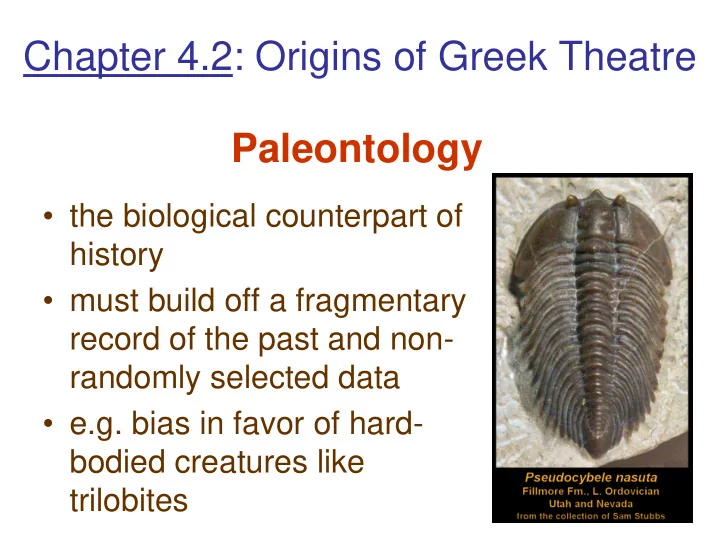
  • e.g. bias in favor of hard-

bodied creatures like trilobites

slide-2
SLIDE 2

Chapter 4.2: Origins of Greek Theatre Charles Darwin

  • British naturalist

(1809-1882)

  • “father of evolution”
  • posited a model of

evolution based on gradual change over time

slide-3
SLIDE 3

Chapter 4.2: Origins of Greek Theatre Transitional Forms

  • gradualism predicates the existence of

“transitional forms” bridging changes in evolution

  • but these are very few in number,

especially near critical junctures like the Permian/Triassic boundary

  • is it right to use a model of change based
  • n gradualism here or in theatre history?
slide-4
SLIDE 4

Chapter 4.2: Origins of Greek Theatre Punctuated Equilibrium

  • a different model of evolution championed

by the late Steven Jay Gould

  • “punk eek” seeks to address how evolution
  • ccurs at the great watershed moments in

evolutionary history

– equilibrium: long periods of relative stability – punctuation: quick and dramatic disruptions

slide-5
SLIDE 5

Chapter 4.2: Origins of Greek Theatre Punctuated Equilibrium

  • when crises like that at the Permian-

Triassic boundary occur, how do species survive at all?

  • even if individuals are not threatened, their

environment and food source/s (niches) are endangered

  • they must adapt quickly or starve

– cf. cats/dogs/squirrels model in Chapter 4

slide-6
SLIDE 6

Chapter 4.2: Origins of Greek Theatre Fitness

  • in such a case, what constitutes “fitness”

for survival

  • sometimes it is just a

fortuitous habit like the “deep sleep” of nautiloids

  • it can also be nothing more

than flexibility and luck

slide-7
SLIDE 7

Chapter 4.2: Origins of Greek Theatre Punk Eek and Theatre History

  • if Frazer can apply Darwinian gradualism

in reconstructing cultural history, can we not apply a punk-eek model?

  • we can if we see Greek tragedy as fitting

into an entertainment “niche”

– it was one of many genres which over time served the needs of the ancient Greeks for diversion and entertainment

slide-8
SLIDE 8

Chapter 4.2: Origins of Greek Theatre Punk Eek and Theatre History

  • the Greek entertainment “niche” seen

evolutionarily:

– early dominance

  • f epic, especially

Homer – but epic collapses

  • ca. 650 BCE

BCE

slide-9
SLIDE 9

Chapter 4.2: Origins of Greek Theatre Punk Eek and Theatre History

  • the Greek entertainment “niche” seen

evolutionarily:

– lyric poetry rises to fill the “niche” – but its limitations proved fatal in the long run – for instance, lyric poets could not tell long and complex stories the way Homer could

slide-10
SLIDE 10

Chapter 4.2: Origins of Greek Theatre Punk Eek and Theatre History

  • the Greek entertainment “niche” seen

evolutionarily:

– worse yet, without reinforcement the stories upon which epic had been built could lapse entirely from public conscience and memory – the “niche” was open for a form of entertainment which could be both “lyric” (fast, complex, intense) and “epic” (stately, built around traditional myth, full of gravity)

slide-11
SLIDE 11

Chapter 4.2: Origins of Greek Theatre Punk Eek and Theatre History

  • when applied to the rise of Greek tragedy,

a punk-eek model explains our failure to uncover transitional forms

  • there were very few transitional forms

since the change had to happen quickly

– they aren’t likely to leave traces because there weren’t very many to begin with

slide-12
SLIDE 12

Chapter 4.2: Origins of Greek Theatre Punk Eek and Theatre History

  • punk eek also allows us to avoid “cultural

Darwinism”

– the tendency to see modern art as the inevitable and predictable consequence of a civilization’s evolution over time

  • we can avoid the fallacy of “final forms”

– cf. Aristotle’s claim that “tragedy came to a stop, when it attained its own nature”

slide-13
SLIDE 13

Chapter 4.2: Origins of Greek Theatre Punk Eek and Theatre History

  • it also explains the presence of dithyramb
  • so Aristotle was correct to some extent

about the importance of dithyramb

  • but dithyramb is not the progenitor of

tragedy, rather an ultimately unsuccessful rival for the pre-Classical Greek entertainment niche

– choruses at heroes’ tombs is another example

slide-14
SLIDE 14

Chapter 4.2: Origins of Greek Theatre Conclusion

  • Greek tragedy was cobbled together from

elements already present in the pre- Classical Greek world

– complex singing (from lyric poetry) – impersonation and masks (from Dionysus worship) – traditional myth (from epic)

  • and it had to happen very quickly
slide-15
SLIDE 15

Chapter 4.2: Origins of Greek Theatre Conclusion

  • it was not a direct outgrowth of any of its

cultural forebears (Frazer, Murray, Bieber)

  • but at the same time it owed much to all of

them

  • it also depended on the “genius” of its

early founders (Else)

slide-16
SLIDE 16

Chapter 4.2: Origins of Greek Theatre Conclusion

  • but Pisistratus is the most important

founder of early tragedy because he gave it official sanction and financial backing

  • the City Dionysia was part of his

program to build the Athenian economy

  • free to rich foreign merchants visiting

Athens and buying Attic wares at the

  • utset of the annual trading season
slide-17
SLIDE 17

Chapter 4.2: Origins of Greek Theatre Conclusion

  • thus, Greek tragedy was the product of a

political compromise engineered by a savvy aging Athenian tyrant

– it allowed the worship of Dionysus but in an acceptable way – it gave the public a hot, new form of entertainment – it boosted the Athenian economy