Chapter 3 Selections false A logical value, or a truth value, is a - - PDF document

chapter 3 selections
SMART_READER_LITE
LIVE PREVIEW

Chapter 3 Selections false A logical value, or a truth value, is a - - PDF document

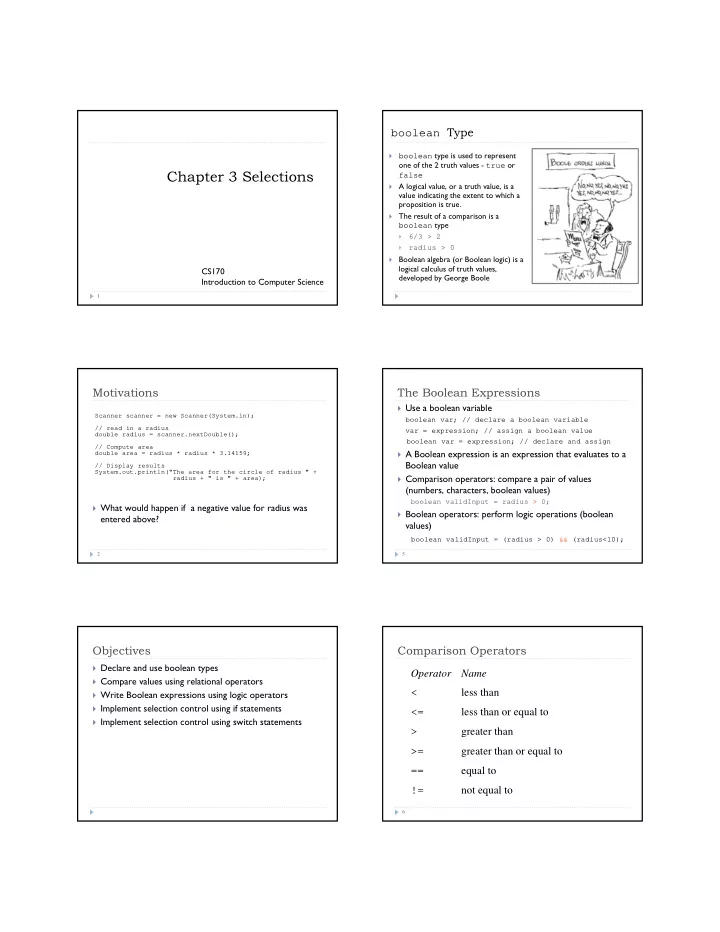
boolean Type boolean type is used to represent one of the 2 truth values - true or Chapter 3 Selections false A logical value, or a truth value, is a value indicating the extent to which a proposition is true. The result of a


slide-1
SLIDE 1

1

Chapter 3 Selections

CS170 Introduction to Computer Science

Motivations

2

 What would happen if a negative value for radius was

entered above?

Scanner scanner = new Scanner(System.in); // read in a radius double radius = scanner.nextDouble(); // Compute area double area = radius * radius * 3.14159; // Display results System.out.println("The area for the circle of radius " + radius + " is " + area);

Objectives

 Declare and use boolean types  Compare values using relational operators  Write Boolean expressions using logic operators  Implement selection control using if statements  Implement selection control using switch statements

boolean Type

boolean type is used to represent

  • ne of the 2 truth values - true or

false

A logical value, or a truth value, is a value indicating the extent to which a proposition is true.

The result of a comparison is a boolean type

6/3 > 2

radius > 0

Boolean algebra (or Boolean logic) is a logical calculus of truth values, developed by George Boole

The Boolean Expressions

5

 Use a boolean variable boolean var; // declare a boolean variable var = expression; // assign a boolean value boolean var = expression; // declare and assign  A Boolean expression is an expression that evaluates to a

Boolean value

 Comparison operators: compare a pair of values

(numbers, characters, boolean values)

boolean validInput = radius > 0;  Boolean operators: perform logic operations (boolean

values)

boolean validInput = (radius > 0) && (radius<10);

Comparison Operators

6

Operator Name < less than <= less than or equal to > greater than >= greater than or equal to == equal to != not equal to

slide-2
SLIDE 2

Boolean Operators

7

Operator Name ! not && and ||

  • r

^ exclusive or

Truth Table for Operator !

8

Truth Table for Operator &&

9

Truth Table for Operator ||

10

Truth Table for Operator ^

11

Example – TestBoolean

12

Scanner input = new Scanner(System.in); int number = input.nextInt(); System.out.println("Is " + number + " divisible by 2 and 3? " + ((number % 2 == 0) && (number % 3 == 0))); System.out.println("Is " + number + " divisible by 2 or 3? " + ((number % 2 == 0) || (number % 3 == 0))); System.out.println("Is " + number + " divisible by 2 or 3, but not both? " + ((number % 2 == 0) ^ (number % 3 == 0)));

TestBoolean.java

slide-3
SLIDE 3

Boolean Expressions Evaluation

 Java uses shortcut evaluation - evaluation of boolean

expression stops as soon as the result is known, which makes code execute faster than if all boolean operands were evaluated.

int x = 0; if ( x > 0 && x++ < 5) x = x - 1;

Problem: Determining Leap Year?

14

 Write a program that determines if given year is a leap

year

  • 1. Read input year
  • 2. Compute whether input year is a leap year - a year is a

leap year if it is divisible by 4 but not by 100 or if it is divisible by 400

  • 3. Display the result

LeapYear.java

Problem: A Simple Math Learning Tool

15

 Write a program to let a first grader practice

additions

 The program should randomly generate two single-

digit integers number1 and number2 and display a question such as “What is 7 + 9?” to the student

 After the student types the answer, the program

displays a message to indicate whether the answer is true or false.

Selection Statements

16

 if statement  switch statement  Conditional operators

Simple if Statements

17

Boolean Expression true Statement(s) false (radius >= 0) true Compupte area and print results false (A) (B)

if (radius >= 0) { area = radius * radius * PI; System.out.println("The area" + " for the circle of radius " + radius + " is " + area); } if (booleanExpression) { statement(s); }

Flow Chart

 A flowchart is a schematic representation of an algorithm

  • r a process.

 Start and end symbols, represented as rounded rectangles  usually containing the word "Start" or "End“  Arrows, showing "flow of control".  Processing steps, represented as rectangles.  Input/Output, represented as a parallelogram.  Conditional (or decision), represented as a diamond.  Typically contain a Yes/No question or True/False test.  Has two arrows coming out of it, usually from the bottom

point and right point, one corresponding to Yes or True, and one corresponding to No or False.

slide-4
SLIDE 4

Flow Chart Example

 Testing whether a number is even or odd

Example

if (number % 2 == 0) { System.out.println(number + “ is even”); } if (number % 2 != 0) { System.out.println(number + “ is odd”); }

Caution – if condition

21

if (i > 0) && (i < 10){ int a = 10; a = a / 3; System.out.println(“i is between 0 and 10”); } if ((i > 0) && (i < 10)){ int a = 10; a = a / 3; System.out.println(“i is between 0 and 10”); }

Note – Block statement

22

if ((i > 0) && (i < 10)) { System.out.println(“i is between 0 and 10”); } if ((i > 0) && (i < 10)) System.out.println(“i is between 0 and 10”);

Caution – Block statement

23

if ((i > 0) && (i < 10)){ int a = 10; a = a / 3; System.out.println(“i is between 0 and 10”); } if ((i > 0) && (i < 10)) int a = 10; a = a / 3; System.out.println(“i is between 0 and 10”); if ((i > 0) && (i < 10)) int a = 10; a = a / 3; System.out.println(“i is between 0 and 10”);

?

Caution – Extra semicolon

24

 Adding a semicolon at the end of an if clause is a mistake. if (radius >= 0); { area = radius*radius*PI; System.out.println("The area for the circle of radius " + radius + " is " + area); }

Wrong

if (radius >= 0){}; { area = radius*radius*PI; System.out.println("The area for the circle of radius " + radius + " is " + area); }

slide-5
SLIDE 5

The if...else Statement

25

if (booleanExpression) { statement(s)-for-the-true-case; } else { statement(s)-for-the-false-case; }

if...else Example

26

if (radius >= 0) { area = radius * radius * 3.14159; System.out.println("The area for the circle “ + “of radius ” + radius + " is " + area); } else { System.out.println("Negative input"); }

Multiple Alternative if Statements

27

if (score >= 90.0)

grade = 'A'; else if (score >= 80.0) grade = 'B'; else if (score >= 70.0) grade = 'C'; else if (score >= 60.0) grade = 'D'; else grade = 'F';

Equivalent

if (score >= 90.0) grade = 'A'; else if (score >= 80.0) grade = 'B'; else if (score >= 70.0) grade = 'C'; else if (score >= 60.0) grade = 'D'; else grade = 'F';

Trace if-else statement

28

if (score >= 90.0) grade = 'A'; else if (score >= 80.0) grade = 'B'; else if (score >= 70.0) grade = 'C'; else if (score >= 60.0) grade = 'D'; else grade = 'F';

Suppose score is 70.0 The condition is false

Trace if-else statement

29

if (score >= 90.0) grade = 'A'; else if (score >= 80.0) grade = 'B'; else if (score >= 70.0) grade = 'C'; else if (score >= 60.0) grade = 'D'; else grade = 'F';

Suppose score is 70.0 The condition is false

Trace if-else statement

30

if (score >= 90.0) grade = 'A'; else if (score >= 80.0) grade = 'B'; else if (score >= 70.0) grade = 'C'; else if (score >= 60.0) grade = 'D'; else grade = 'F';

Suppose score is 70.0 The condition is true

slide-6
SLIDE 6

Trace if-else statement

31

if (score >= 90.0) grade = 'A'; else if (score >= 80.0) grade = 'B'; else if (score >= 70.0) grade = 'C'; else if (score >= 60.0) grade = 'D'; else grade = 'F';

Suppose score is 70.0 grade is C

Trace if-else statement

32

if (score >= 90.0) grade = 'A'; else if (score >= 80.0) grade = 'B'; else if (score >= 70.0) grade = 'C'; else if (score >= 60.0) grade = 'D'; else grade = 'F';

Suppose score is 70.0 Exit the if statement

Note

33

 The else clause matches the most recent if clause in the

same block.

 What does it print?

int i = 1;

int j = 2; int k = 3; if (i > j) if (i > k) System.out.println("A"); else System.out.println("B");

(a) Equivalent (b)

int i = 1; int j = 2; int k = 3; if (i > j) if (i > k) System.out.println("A"); else System.out.println("B");

Note, cont.

34

 To force the else clause to match the first if clause, you

must add a pair of braces

int i = 1; int j = 2; int k = 3; if (i > j) { if (i > k) System.out.println("A"); } else System.out.println("B");

 This statement prints B.

TIP – Assigning value to a boolean variable

35

boolean even; if (number % 2 == 0) even = true; else even = false; boolean even = number % 2 == 0;

TIP – testing a boolean variable

36

if (even == true)

System.out.println( "It is even.");

(a) Equivalent

if (even) System.out.println( "It is even.");

(b)

slide-7
SLIDE 7

Conditional Operator

37

if (x > 0) y = 1 else y = -1; y = (x > 0) ? 1 : -1;

if (booleanExp) var = exp1; else var = exp2; var = (booleanExp) ? exp1 : exp2

Conditional Operator

38

if (num % 2 == 0) System.out.println(num + “is even”); else System.out.println(num + “is odd”); System.out.println( (num % 2 == 0)? (num + “ is even”) : (num + “ is odd”)); if (amount/100 <= available100 ) n100 = amount/100; else n100 = available100; n100 = (amount/100 <= available100) ? amount/100 : available100

switch Statement

39

switch (switch-expression) { case value1: statement(s)1; break; case value2: statement(s)2; break; … case valueN: statement(s)N; break; default: statement(s)-for-default; }

switch Statement

40

switch (dayOfWeek) { case 0: System.out.println(“Sunday”); break; case 1: System.out.println(“Monday”); break; case 2: System.out.println(“Tuesday”); break; case 3: System.out.println(“Wednesday”); break; . . . default: System.out.println("Errors: invalid day"); }

switch Statement Flow Chart

41

switch (ch) { case 'a': System.out.println(ch); case 'b': System.out.println(ch); case 'c': System.out.println(ch); }

Caution: switch statement

42

Suppose ch is 'a':

Don’t forget the break statement! Once a case is matched, the statements are executed until a break statement or the end of switch statement is reached

slide-8
SLIDE 8

Formatting Output

 Problem: display floating point number with two digits

after decimal point

 Previous solution:

43

 Good solution: user printf and specify a format

double x = 12.2223345322; System.out.println(“Number is ” + (int) (x * 100) / 100.0);

double x = 12.2223345322; System.out.printf(“Number is %.2f”, x);

Formatting Output

44

System.out.printf(format, item1, item2, … , itemk);

Examples:

int n = 100; int i = 0; . . . Change value of i . . . System.out.printf(“You completed %d out of %d tasks”, i, n); String name = “Steve”; double balance; . . . Change value of balance . . . System.out.printf(“Hello %s, your balance is %.2f”, name, balance);

Syntax: Usage: Format consists of substrings and format specifiers which specifies how the items should be displayed respectively

Frequently-Used Format Specifiers

45

Specifier Output Example %b a boolean value true or false %c a character 'a' %d a decimal integer 200 %f a floating-point number 45.460000 %e

a number in standard scientific notation

4.556000e+01 %s a string "Java is cool"

A format specifier consists of a percent sign and a conversion code

Operator Precedence (operators order)

46

 What is the value of the expression:  The expression in parenthesis is evaluated first  When expression does not have parenthesis, certain

rules are applied during evaluation

3 + 4 * 4 > 5 * (4 + 3) - 1 (2 % 13 + 4) > 3 + 2 2 % 13 + 4

Evaluate subexpressions in parenthesis

Operator Precedence

47

var++, var-- +, - (Unary plus and minus), ++var,--var (type) Casting ! (Not) *, /, % (Multiplication, division, and remainder) +, - (Binary addition and subtraction) <, <=, >, >= (Comparison) ==, !=; (Equality) ^ (Exclusive OR) && (Conditional AND) Short-circuit AND || (Conditional OR) Short-circuit OR =, +=, -=, *=, /=, %= (Assignment operator)

Operator Associativity

 When two operators with the same precedence are

evaluated, the associativity of the operators determines the order of evaluation

 All binary operators except assignment operators are

left-associative

 Assignment operators are right-associative

48

a – b + c – d a = (b += (c = 5)) ((a – b) + c) – d a = b += c = 5

slide-9
SLIDE 9

Example

49

3 + 4 * 4 > 5 * (4 + 3) - 1 3 + 4 * 4 > 5 * 7 – 1 3 + 16 > 5 * 7 – 1 3 + 16 > 35 – 1 19 > 35 – 1 19 > 34 false (1) inside parentheses first (2) multiplication (3) multiplication (4) addition (5) subtraction (6) greater than

HINT

 If not sure what gets evaluated first, ALWAYS use

parenthesis to make the expression to be evaluated as you want

50

double value = (i ++) + (x * 4) % n; double value = i++ + x * 4 % n;

VS

Problem: A Subtraction Quiz Tool

51

Write a program to teach a first grade child to learn subtractions

 Randomly generates two single-digit integers number1

and number2

 If number 1 is smaller than number 2, swap number1 with

number2

 Displays a question for number1 – number 2 and reads

the student’s answer

 Checks the answer and displays a message to indicate

whether the answer is correct.

SubtractionQuiz.java

Problem: Lottery

Write a program that implements a lottery

 Generate a random number between 0-99  Prompt the user to enter a guess between 0-99  Check the guess and give out prize using the following

rule:

 If user’s number has the same digits as the generated

number, the prize is $3,000

 If user’s number has one digit that appears in the

generated number, the prize is $1,000

 Otherwise there is no prize

Lottery.java

Problem: Guessing Birth Day

 Write a program that can guess your birth day using the

following algorithm:

53

GuessBirthDate.java

(GUI) Confirmation Dialogs

int option = JOptionPane.showConfirmDialog(null, "Continue?");

54

GuessBirthDateUsingConfirmationDialog.java