SLIDE 1
Chapter 2: Force systems
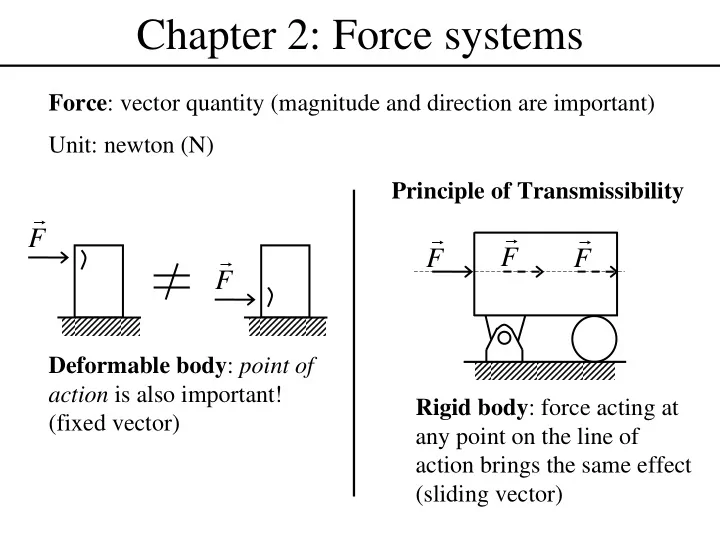
Force: vector quantity (magnitude and direction are important) Unit: newton (N) Deformable body: point of action is also important! (fixed vector) Principle of Transmissibility
F r F r F r F r F r
Rigid body: force acting at any point on the line of action brings the same effect (sliding vector)
SLIDE 2
External and internal effects
Depend on body in consideration External Internal
F r F r
Fixed
F r
SLIDE 3 Concurrent forces
A
1
F r
2
F r R r A
2
F r
1
F r R r A
1
F r
2
F r R r
Forces that their line of action intersect at a point (point A)
- Their sum is called resultant R
- Line of action of resultant R must pass point A
SLIDE 4 Vector components and projections
a b
R r
1
F r
2
F r
a b
b
F r R r
a
F r
= orthogonal projection
b a F
F r r , R r
2 1, F
F r r R r = vector components
2 1
F F R r r r + =
b a
F F R r r r + ≠
SLIDE 5 A special case of vector addition
2
F
1
F
1
R r
2
R r
2
F
1
F F F
R r
1
R r
2
R r
1
R r
2
R r
2
F
1
F F F
F1 and F2 are parallel Add F and –F to produce R1 and R2 Magnitude, direction and line of action of R can be known
r r r r r r r
SLIDE 6
Sample problem (1)
Combine the two forces P and T, which act on the fixed structure at B, into a single equivalent force R.
SLIDE 7 Sample problem (2)
Determine the components of the 800- N force F along the oblique axes a and
- b. Also, determine the projections of F
- nto the a- and b- axes
SLIDE 8
Sample problem (3)
The tension in cable AC is 8 kN. Determine the required tension T in cable AB such that the net effect of the two cable tension is a downward force at point A. Determine the magnitude R of this downward force.
SLIDE 9 Rectangular components
x y j ˆ i ˆ
θ
F r
x
F r
y
F r
y x
F F F r r r + = j F i F F
y x
ˆ ˆ + =
2 2 y x
F F F + = ) cos(θ F Fx = ) sin(θ F Fy =
1
tan ( / )
y x
F F θ
−
=
F F F
y x
r r r
components vector , = F F F
y x
r
components scalar , =
SLIDE 10 Reference axis
x y
F r
θ
Fx= Fcosθ Fy= −Fsinθ x y
F r
θ
Fx= −Fcosθ Fy= −Fsinθ y
F r
θ
x
β
Fx= Fsin(β−θ) Fy= −Fcos(β−θ)
Reference axis: assignment based on convenience
SLIDE 11 Vector summation
1
F r
2
F r
y x F2y Ry F1y F1x F2x Rx
r
) ˆ ˆ ( ) ˆ ˆ (
2 2 1 1 2 1
j F i F j F i F F F R
y x y x
+ + + = + = r r r
j F F i F F j R i R
y y x x y x
ˆ ) ( ˆ ) ( ˆ ˆ
2 1 2 1
+ + + = +
∑
= + =
x x x x
F F F R
2 1
∑
= + =
y y y y
F F F R
2 1
SLIDE 12 Sample problem (4)
If the equal tensions T in the pulley cable are 400 N, express in vector notation the force R exerted on the pulley by the two
- tensions. Determine the magnitude of R.
SLIDE 13
Sample problem (5)
If the cable tension is 750 N, determine the n- and t-components of this force acting on point A of the bar.
SLIDE 14
Sample problem (6)
(1) Write F in terms of the unit vector i and j and identify both its vector and scalar components. (2) Determine the scalar components of the force vector F along the x'- and y'- axes. (3) Determine the scalar components of F along the x- and y'- axes. The 500-N force F is applied to the vertical pole as shown.