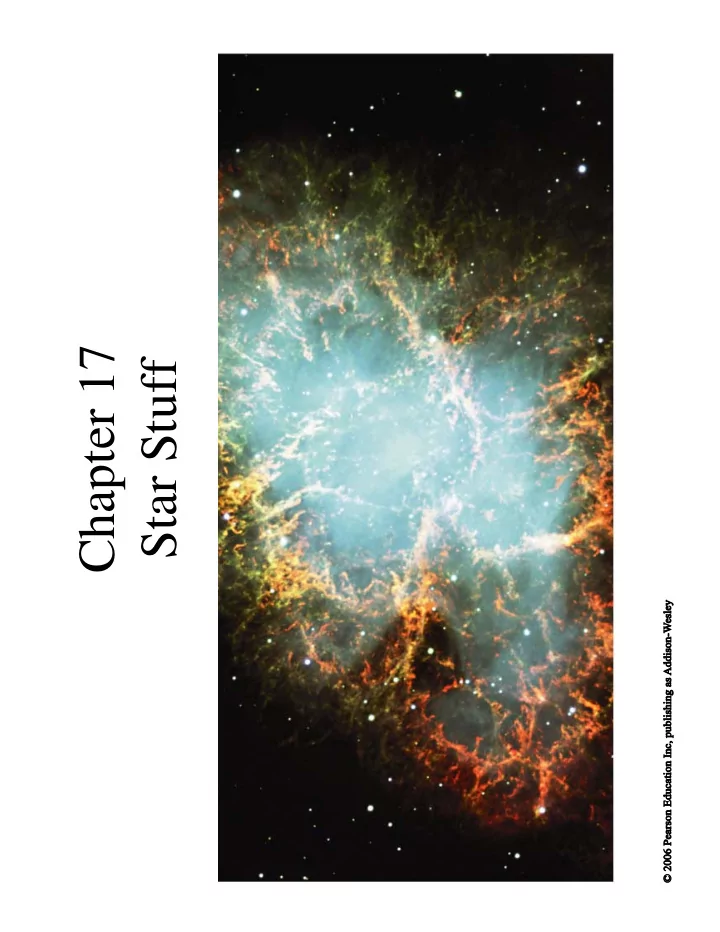
SLIDE 1
Chapter 17 Star Stuff
SLIDE 2 17.1 Lives in the Balance
- Our goals for learning
- How does a star’s mass affect nuclear
fusion?
SLIDE 3
How does a star’s mass affect nuclear fusion?
SLIDE 4 Stellar Mass and Fusion
- The mass of a main sequence star determines its core
pressure and temperature
- Stars of higher mass have higher core temperature and
more rapid fusion, making those stars both more luminous and shorter-lived
- Stars of lower mass have cooler cores and slower
fusion rates, giving them smaller luminosities and longer lifetimes
SLIDE 5
High-Mass Stars > 8 MSun Low-Mass Stars < 2 MSun Intermediate- Mass Stars Brown Dwarfs
SLIDE 6 Star Clusters and Stellar Lives
life stories of stars comes from comparing mathematical models of stars with observations
particularly useful because they contain stars of different mass that were born about the same time
SLIDE 7 What have we learned?
- How does a star’s mass affect nuclear
fusion?
– A star’s mass determines its core pressure and temperature and therefore determines its fusion rate – Higher mass stars have hotter cores, faster fusion rates, greater luminosities, and shorter lifetimes
SLIDE 8 17.2 Life as a Low-Mass Star
- Our goals for learning
- What are the life stages of a low-mass star?
- How does a low-mass star die?
SLIDE 9
What are the life stages of a low- mass star?
SLIDE 10
A star remains on the main sequence as long as it can fuse hydrogen into helium in its core
SLIDE 11 Life Track after Main Sequence
clusters show that a star becomes larger, redder, and more luminous after its time on the main sequence is over
SLIDE 12 Broken Thermostat
H begins fusing to He in a shell around the core
because the core thermostat is broken— the increasing fusion rate in the shell does not stop the core from contracting
SLIDE 13
Helium fusion does not begin right away because it requires higher temperatures than hydrogen fusion—larger charge leads to greater repulsion Fusion of two helium nuclei doesn’t work, so helium fusion must combine three He nuclei to make carbon
SLIDE 14 Helium Flash
- Thermostat is broken in low-mass red giant
because degeneracy pressure supports core
- Core temperature rises rapidly when helium fusion
begins
- Helium fusion rate skyrockets until thermal
pressure takes over and expands core again
SLIDE 15
Helium burning stars neither shrink nor grow because core thermostat is temporarily fixed.
SLIDE 16 Life Track after Helium Flash
red giant should shrink and become less luminous after helium fusion begins in the core
SLIDE 17 Life Track after Helium Flash
clusters agree with those models
stars are found in a horizontal branch
SLIDE 18
Combining models of stars of similar age but different mass helps us to age- date star clusters
SLIDE 19
How does a low-mass star die?
SLIDE 20 Double Shell Burning
- After core helium fusion stops, He fuses into
carbon in a shell around the carbon core, and H fuses to He in a shell around the helium layer
- This double-shell burning stage never reaches
equilibrium—fusion rate periodically spikes upward in a series of thermal pulses
- With each spike, convection dredges carbon up
from core and transports it to surface
SLIDE 21 Planetary Nebulae
burning ends with a pulse that ejects the H and He into space as a planetary nebula
becomes a white dwarf
SLIDE 22 End of Fusion
- Fusion progresses no further in a low-mass star
because the core temperature never grows hot enough for fusion of heavier elements (some He fuses to C to make oxygen)
- Degeneracy pressure supports the white dwarf
against gravity
SLIDE 23 Life stages
mass star like the Sun
SLIDE 24
Life Track of a Sun-Like Star
SLIDE 25 Earth’s Fate
- Sun’s luminosity will rise to 1,000 times
its current level—too hot for life on Earth
SLIDE 26 Earth’s Fate
- Sun’s radius will grow to near current
radius of Earth’s orbit
SLIDE 27 What have we learned?
- What are the life stages of a low-mass
star?
– H fusion in core (main sequence) – H fusion in shell around contracting core (red giant) – He fusion in core (horizontal branch) – Double-shell burning (red giant)
- How does a low-mass star die?
– Ejection of H and He in a planetary nebula leaves behind an inert white dwarf
SLIDE 28 17.3 Life as a High-Mass Star
- Our goals for learning
- What are the life stages of a high-mass star?
- How do high-mass stars make the elements
necessary for life?
- How does a high-mass star die?
SLIDE 29
What are the life stages of a high- mass star?
SLIDE 30 CNO Cycle
sequence stars fuse H to He at a higher rate using carbon, nitrogen, and
- xygen as catalysts
- Greater core
temperature enables H nuclei to
repulsion
SLIDE 31 Life Stages of High-Mass Stars
- Late life stages of high-mass stars are similar to
those of low-mass stars: – Hydrogen core fusion (main sequence) – Hydrogen shell burning (supergiant) – Helium core fusion (supergiant)
SLIDE 32
How do high-mass stars make the elements necessary for life?
SLIDE 33
Big Bang made 75% H, 25% He – stars make everything else
SLIDE 34
Helium fusion can make carbon in low-mass stars
SLIDE 35
CNO cycle can change C into N and O
SLIDE 36 Helium Capture
- High core temperatures allow helium to
fuse with heavier elements
SLIDE 37
Helium capture builds C into O, Ne, Mg, …
SLIDE 38 Advanced Nuclear Burning
- Core temperatures in stars with >8MSun
allow fusion of elements as heavy as iron
SLIDE 39
Advanced reactions in stars make elements like Si, S, Ca, Fe
SLIDE 40 Multiple Shell Burning
burning proceeds in a series of nested shells
SLIDE 41
Iron is dead end for fusion because nuclear reactions involving iron do not release energy (Fe has lowest mass per nuclear particle)
SLIDE 42 Evidence for helium capture: Higher abundances of elements with even numbers
SLIDE 43
How does a high-mass star die?
SLIDE 44
Iron builds up in core until degeneracy pressure can no longer resist gravity Core then suddenly collapses, creating supernova explosion
SLIDE 45 Supernova Explosion
pressure goes away because electrons combine with protons, making neutrons and neutrinos
the center, forming a neutron star
SLIDE 46
Energy and neutrons released in supernova explosion enable elements heavier than iron to form, including Au and U
SLIDE 47 Supernova Remnant
collapse of core drives outer layers into space
the remnant of the supernova seen in A.D. 1054
SLIDE 48 Supernova 1987A
- The closest supernova in the last four
centuries was seen in 1987
SLIDE 49 Rings around Supernova 1987A
- The supernova’s flash of light caused rings
- f gas around the supernova to glow
SLIDE 50 Impact of Debris with Rings
- More recent observations are showing the
inner ring light up as debris crashes into it
SLIDE 51 What have we learned?
- What are the life stages of a high-mass
star?
– They are similar to the life stages of a low- mass star
- How do high-mass stars make the
elements necessary for life?
– Higher masses produce higher core temperatures that enable fusion of heavier elements
- How does a high-mass star die?
– Iron core collapses, leading to a supernova
SLIDE 52 17.4 The Roles of Mass and Mass Exchange
- Our goals for learning
- How does a star’s mass determine its life
story?
- How are the lives of stars with close
companions different?
SLIDE 53
How does a star’s mass determine its life story?
SLIDE 54 Role of Mass
- A star’s mass determines its entire life story
because it determines its core temperature
- High-mass stars with >8MSun have short lives,
eventually becoming hot enough to make iron, and end in supernova explosions
- Low-mass stars with <2MSun have long lives,
never become hot enough to fuse carbon nuclei, and end as white dwarfs
- Intermediate mass stars can make elements
heavier than carbon but end as white dwarfs
SLIDE 55 Low-Mass Star Summary
- 1. Main Sequence: H fuses to He
in core
- 2. Red Giant: H fuses to He in
shell around He core
He fuses to C in core while H fuses to He in shell
H and He both fuse in shells
- 5. Planetary Nebula leaves white
dwarf behind
Not to scale!
SLIDE 56 Reasons for Life Stages
- Core shrinks and heats until it’s
hot enough for fusion
- Nuclei with larger charge
require higher temperature for fusion
- Core thermostat is broken
while core is not hot enough for fusion (shell burning)
- Core fusion can’t happen if
degeneracy pressure keeps core from shrinking
Not to scale!
SLIDE 57 Life Stages of High-Mass Star
- 1. Main Sequence: H fuses to He
in core
- 2. Red Supergiant: H fuses to He
in shell around He core
He fuses to C in core while H fuses to He in shell
- 4. Multiple Shell Burning:
Many elements fuse in shells
- 5. Supernova leaves neutron star
behind
Not to scale!
SLIDE 58
How are the lives of stars with close companions different?
SLIDE 59
Thought Question
The binary star Algol consists of a 3.7 MSun main sequence star and a 0.8 MSun subgiant star. What’s strange about this pairing? How did it come about?
SLIDE 60 Stars in Algol are close enough that matter can flow from subgiant
star
SLIDE 61 Star that is now a subgiant was originally more massive As it reached the end
- f its life and started to
grow, it began to transfer mass to its companion (mass exchange) Now the companion star is more massive
SLIDE 62 What have we learned?
- How does a star’s mass determine its life
story?
– Mass determines how high a star’s core temperature can rise and therefore determines how quickly a star uses its fuel and what kinds of elements it can make
- How are the lives of stars with close
companions different?
– Stars with close companions can exchange mass, altering the usual life stories of stars