Chapter 15: Information Extraction and Knowledge Harvesting The - - PowerPoint PPT Presentation

chapter 15 information extraction and knowledge harvesting
SMART_READER_LITE
LIVE PREVIEW

Chapter 15: Information Extraction and Knowledge Harvesting The - - PowerPoint PPT Presentation

Chapter 15: Information Extraction and Knowledge Harvesting The Semantic Web is not a separate Web but an extension of the current one, in which information is given well-defined meaning. -- Sir Tim Berners-Lee The only source of knowledge is


slide-1
SLIDE 1

Chapter 15: Information Extraction and Knowledge Harvesting

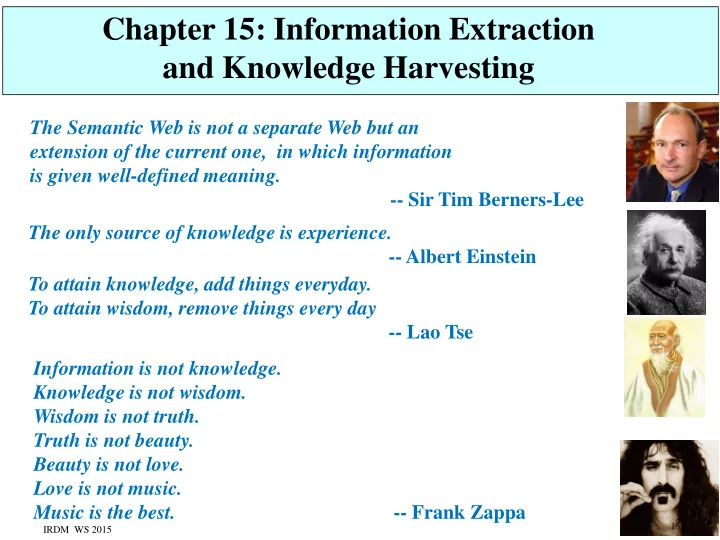
Information is not knowledge. Knowledge is not wisdom. Wisdom is not truth. Truth is not beauty. Beauty is not love. Love is not music. Music is the best.

  • - Frank Zappa

The only source of knowledge is experience.

  • - Albert Einstein

To attain knowledge, add things everyday. To attain wisdom, remove things every day

  • - Lao Tse

The Semantic Web is not a separate Web but an extension of the current one, in which information is given well-defined meaning.

  • - Sir Tim Berners-Lee

IRDM WS 2015 15-1

slide-2
SLIDE 2

Outline

15.1 Motivation and Overview 15.2 Information Extraction Methods 15.3 Knowledge Harvesting at Large Scale

IRDM WS 2015 15-2

slide-3
SLIDE 3

8.1 Motivation and Overview

What?

  • extract entities and attributes from (Deep) Web sites
  • mark-up entities and attributes in text & Web pages
  • harvest relational facts from the Web to populate knowledge base

Overall: lift Web and text to level of “crisp“ structured data Why?

  • compare values (e.g. prices) across sites
  • extract essential info fields (e.g. job skills & experience from CV)
  • more precise queries:
  • semantic search with/for “things, not strings“
  • question answering and fact checking
  • constructing comprehensive knowledge bases
  • sentiment mining (e.g. about products or political debates)
  • context-aware recommendations
  • business analytics

IRDM WS 2015 15-3

slide-4
SLIDE 4

Use-Case Example: News Search

http:/stics.mpi-inf.mpg.de

IRDM WS 2015 15-4

slide-5
SLIDE 5

Use-Case Example: News Search

http:/stics.mpi-inf.mpg.de

IRDM WS 2015 15-5

slide-6
SLIDE 6

Use-Case Example: Biomedical Search

http://www.nactem.ac.uk/medie/search.cgi

IRDM WS 2015 15-6

slide-7
SLIDE 7

K.Goh,M.Kusick,D.Valle,B.Childs,M.Vidal,A.Barabasi: The Human Disease Network, PNAS, May 2007

But not so easy with:

diabetes mellitus, diabetis type 1, diabetes type 2, diabetes insipidus, insulin-dependent diabetes mellitus with ophthalmic complications, ICD-10 E23.2, OMIM 304800, MeSH C18.452.394.750, MeSH D003924, …

Use-Case Text Analytics: Disease Networks

IRDM WS 2015 15-7

slide-8
SLIDE 8

Methodologies for IE

  • Rules & patterns, especially regular expressions
  • Pattern matching & pattern learning
  • Distant supervision by dictionaries, taxonomies, ontologies etc.
  • Statistical machine learning: classifiers, HMMs, CRFs etc.
  • Natural Language Processing (NLP): POS tagging, parsing, etc.
  • Text mining algorithms in general

IRDM WS 2015 15-8

slide-9
SLIDE 9

IE Example: Web Pages to Entity Attributes

IRDM WS 2015 15-9

slide-10
SLIDE 10

IE Example: Web Pages to Entity Attributes

IRDM WS 2015 15-10

slide-11
SLIDE 11

IE Example: Text to Opinions on Entities

IRDM WS 2015 15-11

slide-12
SLIDE 12

IE Example: Web Pages to Facts & Opinions

IRDM WS 2015 15-12

slide-13
SLIDE 13

IE Example: Web Pages to Facts on Entities

IRDM WS 2015 15-13

slide-14
SLIDE 14

IE Example: Text to Relations

Max Karl Ernst Ludwig Planck was born in Kiel, Germany, on April 23, 1858, the son of Julius Wilhelm and Emma (née Patzig) Planck. Planck studied at the Universities of Munich and Berlin, where his teachers included Kirchhoff and Helmholtz, and received his doctorate of philosophy at Munich in 1879. He was Privatdozent in Munich from 1880 to 1885, then Associate Professor of Theoretical Physics at Kiel until 1889, in which year he succeeded Kirchhoff as Professor at Berlin University, where he remained until his retirement in 1926. Afterwards he became President of the Kaiser Wilhelm Society for the Promotion of Science, a post he held until 1937. He was also a gifted pianist and is said to have at one time considered music as a career. Planck was twice married. Upon his appointment, in 1885, to Associate Professor in his native town Kiel he married a friend of his childhood, Marie Merck, who died in 1909. He remarried her cousin Marga von Hösslin. Three of his children died young, leaving him with two sons.

Max Planck 4/23, 1858 Kiel Albert Einstein 3/14, 1879 Ulm Mahatma Gandhi 10/2, 1869 Porbandar Person BirthDate BirthPlace ... Max Planck Nobel Prize in Physics Marie Curie Nobel Prize in Physics Marie Curie Nobel Prize in Chemistry Person Award type (Max Planck, physicist) bornOn (Max Planck, 23 April 1858) bornIn (Max Planck, Kiel) plays (Max Planck, piano) spouse (Max Planck, Marie Merck) spouse (Max Planck, Marga Hösslin) advisor (Max Planck, Kirchhoff) advisor (Max Planck, Helmholtz) AlmaMater (Max Planck, TU Munich)

IRDM WS 2015 15-14
slide-15
SLIDE 15

IE Example: Text to Annotations

http://services.gate.ac.uk/annie/

IRDM WS 2015 15-15

slide-16
SLIDE 16

IE Example: Text to Annotations

http://www.opencalais.com/opencalais-demo/

IRDM WS 2015 15-16

slide-17
SLIDE 17

Info Extraction vs. Knowledge Harvesting

many sources

  • ne source

Surajit

  • btained his

PhD in CS from Stanford University under the supervision

  • f Prof. Jeff Ullman.

He later joined HP and worked closely with Umesh Dayal …

source- centric IE

instanceOf (Surajit, scientist) inField (Surajit, computer science) hasAdvisor (Surajit, Jeff Ullman) almaMater (Surajit, Stanford U) workedFor (Surajit, HP) friendOf (Surajit, Umesh Dayal) …

yield-centric harvesting

Student Advisor

hasAdvisor

Student University Surajit Chaudhuri Stanford U Alon Halevy Stanford U Jim Gray UC Berkeley … …

almaMater

  • targeted: hasAdvisor, almaMater
  • open: worked for, affiliation, employed by,

romance with, affair with, …

Student Advisor Surajit Chaudhuri Jeffrey Ullman Alon Halevy Jeffrey Ullman Jim Gray Mike Harrison … …

1) recall !

2) precision

1) precision !

2) recall

IRDM WS 2015 15-17

slide-18
SLIDE 18

15-18

Title Year The Shawshank Redemption 1994 The Godfather 1972 The Godfather - Part II 1974 Pulp Fiction 1994 The Good, the Bad, and the Ugly 1966

15.2.1 IE with Rules on Patterns (aka. Web Page Wrappers)

Goal: Identify and extract entities and attributes in regularly structured HTML page, to generate database records Rule-driven regular expression matching

  • regex over alphabet  of tokens:

, , (expr1|expr2), (expr)*

  • Interpret pages from same source

(e.g. Web site to be wrapped) as regular language (FSA, Chomsky-3 grammar)

  • Specify rules by regex‘s

for detecting and extracting attribute values and relational tuples

IRDM WS 2015

slide-19
SLIDE 19

15-19

LR Rules: Left and Right Tokens

L token (left neighbor) fact token R token (right neighbor) pre-filler pattern filler pattern post-filler pattern Example:

L = <B>, R = </B> → MovieTitle L = <I>, R = </I> →Year

produces relation with tuples: <Godfather 1, 1972>, <Interstellar, 2014>, <Titanic, 1997> Rules can be combined and generalized  RAPIER [Califf and Mooney ’03]

<HTML> <TITLE>Top-250 Movies</TITLE> <BODY> <B>Godfather 1</B><I>1972</I><BR> <B>Interstellar</B><I>2014</I><BR> <B>Titanic</B><I>1997</I><BR> </BODY> </HTML>

IRDM WS 2015

slide-20
SLIDE 20

15-20

Advanced Rules: HLRT, OCLR, NHLRT, etc.

Idea: Limit application of LR rules to proper context (e.g., to skip over HTML table header)

  • HLRT rules (head left token right tail)

apply LR rule only if inside HT (e.g., H = <TD> T = </TD>)

  • OCLR rules (open (left token right)* close):

O and C identify tuple, LR repeated for individual elements

  • NHLRT (nested HLRT):

apply rule at current nesting level,

  • pen additional levels, or return to higher level

<TABLE> <TR><TH><B>Country</B></TH><TH><I>Code</I></TH></TR> <TR><TD><B>Godfather 1</B></TD><TD><I>1972</I></TD></TR> <TR><TD><B>Interstellar</B></TD><TD><I>2014</I></TD></TR> <TR><TD><B>Titanic</B></TD><TD><I>1997</I></TD></TR> </TABLE>

IRDM WS 2015

slide-21
SLIDE 21

15-21

Rules for HTML DOM Trees

  • Use HTML tag paths from root to target element
  • Use more powerful operators for matching, splitting, extracting

Example: extract the volume table.tr[1].td[*].txt, match /Volume/ extract the % change table.tr[1].td[1].txt, match /[(](.*?)[)]/ extract the day’s range for the stock: table.tr[2].td[0].txt, match/Day’s Range (.*)/, split /-/ match /.../, split /…/ return lists of strings

Source: A. Sahuguet, F. Azavant: Looking at the Web through <XML> glasses, http://db.cis.upenn.edu/research/w4f.html

IRDM WS 2015

slide-22
SLIDE 22

15-22

Learning Regular Expressions (aka. Wrapper Induction)

Input: Hand-tagged examples of a regular language Output: (Restricted) regular expression for the language of a finite- state transducer that reads sentences of the language and outputs token of interest Example: This apartment has 3 bedrooms. <BR> The monthly rent is $ 995. This apartment has 4 bedrooms. <BR> The monthly rent is $ 980. The number of bedrooms is 2. <BR> The rent is $ 650 per month. yields * <digit> * “<BR>” * “$” <digit>+ * as learned pattern Problem: Grammar inference for general regular languages is hard.  restricted class of regular languages

(e.g. WHISK [Soderland 1999], LIXTO [Baumgartner 2001])

IRDM WS 2015

slide-23
SLIDE 23

15-23

Source: R. Baumgartner, Datalog-related Aspects in Lixto Visual Developer, 2010, http://datalog20.org/slides/baumgartner.pdf

Example of Markup Tool for Supervised Wrapper Induction

IRDM WS 2015

slide-24
SLIDE 24

15-24

Source: R. Baumgartner, Datalog-related Aspects in Lixto Visual Developer, 2010, http://datalog20.org/slides/baumgartner.pdf

Example of Markup Tool for Supervised Wrapper Induction

IRDM WS 2015

slide-25
SLIDE 25

15-25

Limitations and Extensions of Rule-Based IE

  • Powerful for wrapping regularly structured web pages

(e.g., template-based from same Deep Web site / CMS)

  • Many complications with real-life HTML

(e.g., misuse of tables for layout)

  • Extend flat view of input to trees:

– hierarchical document structure (DOM tree, XHTML) – extraction patterns for restricted regular languages on trees (e.g. fragements and variations of XPath)

  • Regularities with exceptions are difficult to capture

– Identify positive and negative cases and use statistical models

IRDM WS 2015

slide-26
SLIDE 26

15-26

For heterogeneous Web sources and for natural-language text

  • NLP techniques (PoS tagging, parsing) for tokenization
  • Identify patterns (regular expressions) as features
  • Train statistical learners for segmentation and labeling

(e.g., HMM, CRF, SVM, etc.) augmented with lexicons

  • Use learned model to automatically tag new input sequences
  • Example for labeled training data:

The WWW conference in 2007 takes place in Banff in Canada. Today‘s keynote speaker is Dr. Berners-Lee from W3C.

with tags of the following kinds:

event, person, location, organization, date

15.2.2 IE with Statistical Learning

IRDM WS 2015

slide-27
SLIDE 27

15-27

IE as Boundary Classification

Idea: Learn classifiers to recognize start token and end token for the facts under consideration. Combine multiple classifiers (ensemble learning) for more robust output. Example:

There will be a talk by Alan Turing at the University at 4 PM.

  • Prof. Dr. James Watson will speak on DNA at MPI at 6 PM.

The lecture by Francis Crick will be in the IIF at 3:15 today.

Trained classifiers test each token (with PoS tag, LR neighbor tokens, etc. as features) for two classes: begin-fact, end-fact

person place time

IRDM WS 2015

slide-28
SLIDE 28

15-28

IE as Text Segmentation and Labeling

Idea: Observed text is concatenation of structured record with limited reordering and some missing fields Examples: Addresses and bibliographic records

Source: S. Sarawagi: Information Extraction, 2008

 Hidden Markov Model (HMM) !

IRDM WS 2015

slide-29
SLIDE 29

15-29

HMM Example: Postal Address

Goal: Label the tokens in sequences Max-Planck-Institute, Stuhlsatzenhausweg 85 with the labels Name, Street, Number Σ = {“MPI”, “St.”, “85”} // output alphabet S = {Name, Street, Number} // (hidden) states

IRDM WS 2015

slide-30
SLIDE 30

HMM Example: Postal Addresses

Source: Eugene Agichtein and Sunita Sarawagi, Tutorial at KDD 2006

IRDM WS 2015 15-30

slide-31
SLIDE 31

Basics from NLP for IE (in a Nutshell)

Surajit Chaudhuri obtained his PhD from Stanford University under the supervision of Prof. Jeff Ullman

Part-of-Speech (POS) Tagging: Dependency Parsing:

Surajit Chaudhuri obtained his PhD from Stanford University under the supervision of Prof. Jeff Ullman Surajit Chaudhuri obtained his PhD from Stanford University under the supervision of Prof. Jeff Ullman

NNP NNP VBD PRP NN IN NNP NNP IN DT NN IN NNP NNP NNP

pobj nn nn psubj pobj prep poss nn nn pobj prep pobj det prep

IRDM WS 2015 15-31

slide-32
SLIDE 32

NLP: Part-of-Speech (POS) Tagging

POS Tags (Penn Treebank):

CC coordinating conjunction PRP$ possessive pronoun CD cardinal number RB adverb DT determiner RBR adverb, comparative EX existential there RBS adverb, superlative FW foreign word RP particle IN preposition or subordinating conjunction SYM symbol JJ adjective TO to JJR adjective, comparative UH interjection JJS adjective, superlative VB verb, base form LS list item marker VBD verb, past tense MD modal VBG verb, gerund or present participle NN noun VBN verb, past participle NNS noun, plural VBP verb, non-3rd person singular present NNP proper noun VBZ verb, 3rd person singular present NNPS proper noun, plural WDT wh-determiner (which …) PDT predeterminer WP wh-pronoun (what, who, whom, …) POS possessive ending WP$ possessive wh-pronoun PRP personal pronoun WRB wh-adverb

Tag each word with its grammatical role (noun, verb, etc.) Use HMM or CRF trained over large corpora

http://www.lsi.upc.edu/~nlp/SVMTool/PennTreebank.html

IRDM WS 2015 15-32

slide-33
SLIDE 33

buy

How to find the best sequence of POS tags for sentence “We can buy a can”?

HMM for Part-of-Speech Tagging

PRP MD VB

We can

DT NN a 0.4 0.1 0.2 0.2 0. 3 0.4 0.1 0.5 0.4 0.2 0.5 0.6 0.1 0.2 0.1 0.1 0.6

buy PRP MD VB We can DT NN a can

IRDM WS 2015 15-33

slide-34
SLIDE 34

x1 x2 x3 xk yk y3 y2 y1

(Linear-Chain) Conditional Random Fields (CRFs) Extend HMMs in several ways:

  • exploit complete input sequence for predicting state transition,

not just last token

  • use features of input tokens

(e.g. hasCap, isAllCap, hasDigit, isDDDD, firstDigit, isGeoname, hasType, afterDDDD, directlyPrecedesGeoname, etc.) For token sequence x=x1…xk and state sequence y=y1..yk HMM models joint distr. P[x,y] = i=1..k P[yi|yi-1] * P[xi|yi] CRF models conditional distr. P[y|x] with conditional independence of non-adjacent yi‘s given x

… … x1 x2 x3 xk yk y3 y2 y1 …

HMM

CRF

IRDM WS 2015 15-34

slide-35
SLIDE 35

CRF Training and Inference

graph structure of conditional-independence assumptions leads to:

      

 

   m 1 j T 1 t t 1 t j j

) x , y , y ( f exp ) x ( Z 1 ] x | y [ P 

where j ranges over feature functions and Z(x) is a normalization constant parameter estimation with n training sequences: MLE with regularization

    

     

  

n 1 i T 1 t m 1 j n 1 i m 1 j 2 2 j ) i ( ) i ( t ) i ( t ) i ( 1 t j j

2 ) x ( Z log ) x , y , y ( f ) ( L log    

inference of most likely (x,y) for given x: dynamic programming (similar to Viterbi) CRFs can be further generalized to undirected graphs

  • f coupled random variables (aka. MRF: Markov random field)

IRDM WS 2015 15-35

slide-36
SLIDE 36

NLP: Deep Parsing for Constituent Trees

  • Construct syntax-based tree of sentence constituents
  • Use non-deterministic context-free grammars natural ambiguity
  • Use probabilistic grammar (PCFG): likely vs. unlikely parse trees

(trained on corpora) Extensions and variations:

  • Lexical parser: enhanced with lexical dependencies

(e.g., only specific verbs can be followed by two noun phrases)

  • Chunk parser: simplified to detect only phrase boundaries

S NP NP The bright student who works hard will pass all exams. VP SBAR WHNP S VP ADVP VP NP NP

IRDM WS 2015 15-36

slide-37
SLIDE 37

NLP: Link-Grammar-Based Dependency Parsing

Dependency parser based on grammatical rules for left & right connector

rules have form: w1  left: { A1 | A2 | …} right: { B1 | B2 | …} w2  left: { C1 | B1 | …} right: {D1 | D2 | …} w3  left: { E1 | E2 | …} right: {F1 | C1 | …}

  • Parser finds all matchings that connect all words into planar graph

(using dynamic programming for search-space traversal)

  • Extended to probabilistic parsing and error-tolerant parsing

O(n3) algorithm with many implementation tricks, and grammar size n is huge [Sleator/ Temperley 1991]

IRDM WS 2015 15-37

slide-38
SLIDE 38

Dependency Parsing Examples (1)

Selected tags (CMU Link Parser), out of ca. 100 tags (plus variants):

MV connects verbs to modifying phrases like adverbs, time expressions, etc. O connects transitive verbs to direct or indirect objects J connects prepositions to objects B connects nouns with relative clauses http://www.link.cs.cmu.edu/link/

IRDM WS 2015 15-38

slide-39
SLIDE 39

Dependency Parsing Examples (2)

Selected tags (Stanford Parser), out of ca. 50 tags:

nsubj: nominal subject amod; adjectival modifier rel: relative rcmod: relative clause modifier dobj: direct object acomp: adjectival complement det: determiner poss: possession modifier … http://nlp.stanford.edu/software/lex-parser.shtml

IRDM WS 2015 15-39

slide-40
SLIDE 40

Additional Literature for 15.2

  • S. Sarawagi: Information Extraction, Foundations & Trends in Databases 1(3), 2008
  • H. Cunningham: Information Extraction, Automatic.

in: Encyclopedia of Language and Linguistics, 2005, http://www.gate.ac.uk/ie/

  • M.E. Califf, R.J. Mooney: Bottom-Up Relational Learning of Pattern Matching Rules for

Information Extraction, JMLR 2003

  • S. Soderland: Learning Information Extraction Rules for Semi-Structured and Free Text,

Machine Learning Journal 1999

  • N. Kushmerick: Wrapper induction: Efficiency and expressiveness, Art. Intelligence 2000
  • A. Sahuguet, F. Azavant: Building light-weight wrappers for legacy web data-sources

using W4F, VLDB 1999

  • R Baumgartner et al.: Visual Web Information Extraction with Lixto, VLDB 2001
  • G. Gottlob et al.: The Lixto data extraction project, PODS 2004
  • B. Liu: Web Data Mining, Chapter 9, Springer 2007
  • C. Manning, H. Schütze: Foundations of Statistical Natural Language Processing,

MIT Press 1999

IRDM WS 2015 15-40