
SLIDE 1
14-1
Chapter 14: NMR Spectroscopy
- A. Introduction
- MS and IR can provide MW and a few other details, but we
generally need way more info to fully determine a structure.
- Nuclear magnetic resonance (NMR) spectroscopy is a very
powerful technique for structure determination.
- 1H NMR (“proton NMR”) provides details about the number,
types, and relationships of H atoms in a molecule.
- 13C NMR provides details about the number and types of C
atoms in a molecule.
- NMR involves an effect on nuclei that occurs when molecules
are exposed to radiofrequency energy while in a magnetic field...
14-2
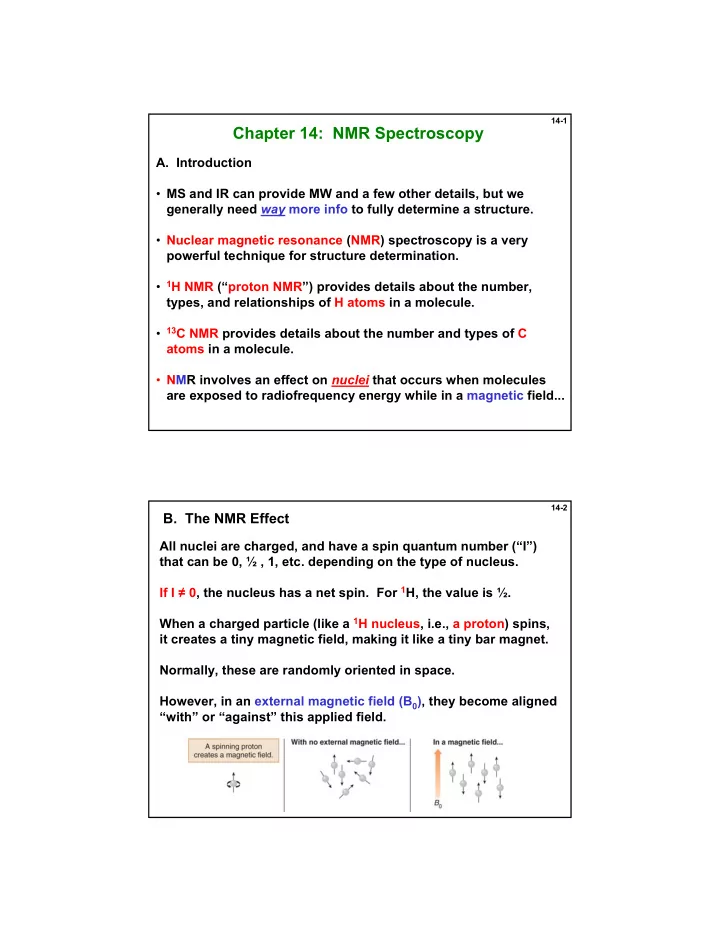
All nuclei are charged, and have a spin quantum number (“I”) that can be 0, ½ , 1, etc. depending on the type of nucleus. If I ≠ 0, the nucleus has a net spin. For 1H, the value is ½. When a charged particle (like a 1H nucleus, i.e., a proton) spins, it creates a tiny magnetic field, making it like a tiny bar magnet. Normally, these are randomly oriented in space. However, in an external magnetic field (B0), they become aligned “with” or “against” this applied field.
- B. The NMR Effect