The NMR research group Prof. Marc Baldus Prof. Rolf Boelens Dr. - - PowerPoint PPT Presentation

the nmr research group
SMART_READER_LITE
LIVE PREVIEW

The NMR research group Prof. Marc Baldus Prof. Rolf Boelens Dr. - - PowerPoint PPT Presentation

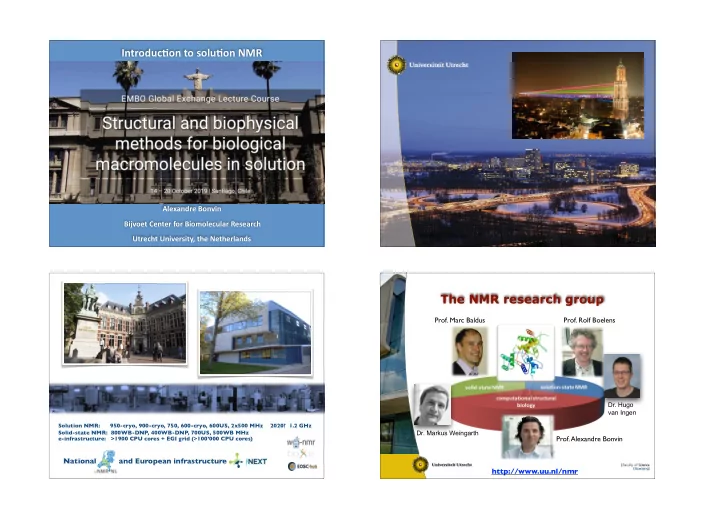
1 Introduc=on to solu=on NMR Alexandre Bonvin Bijvoet Center for Biomolecular Research Utrecht University, the Netherlands The NMR research group Prof. Marc Baldus Prof. Rolf Boelens Dr. Hugo van Ingen Solution NMR: 950-cryo,


slide-1
SLIDE 1

1

Alexandre Bonvin Bijvoet Center for Biomolecular Research Utrecht University, the Netherlands

Introduc=on to solu=on NMR

Solution NMR: 950-cryo, 900-cryo, 750, 600-cryo, 600US, 2x500 MHz Solid-state NMR: 800WB-DNP, 400WB-DNP, 700US, 500WB MHz e-infrastructure: >1900 CPU cores + EGI grid (>100’000 CPU cores) 2020? 1.2 GHz

National and European infrastructure

The NMR research group

  • Prof. Marc Baldus
  • Prof. Rolf Boelens
  • Prof. Alexandre Bonvin

http://www.uu.nl/nmr

  • Dr. Markus Weingarth
  • Dr. Hugo

van Ingen

slide-2
SLIDE 2

5

NMR ‘journey’

  • Why use NMR for structural biology...?
  • The very basics
  • Multidimensional NMR (intro)
  • Resonance assignment (lecture Banci)
  • Structure parameters & calculations (lecture

Banci)

  • NMR relaxation & dynamics

6

Topics Why use NMR.... ? NMR & Structural biology

Dynamic activation of an allosteric regulatory protein Tzeng S-R & Kalodimos CG Nature (2009)

a apo-CAP CAP-cAMP2 CBD DBD F helices F helices

D Y N A M I C S

slide-3
SLIDE 3

NMR & Structural biology

Dynamic activation of an allosteric regulatory protein Tzeng S-R & Kalodimos CG Nature (2009)

  • Allosteric regulation
  • Dynamic interaction between ligand-binding & DNA

binding site

D Y N A M I C S

NMR & Structural biology

B i o m o l e c u l a r i n t e r a c t i o n s

  • Even weak and transient complexes can be studied

NMR & Structural biology

11

E X C I T E D S T AT E S

Shekhar & Kay PNAS 2013

NMR & Structural biology

12

M E M B R A N E P R O T E I N S

  • Native like

environment

  • Structural changes due to

lipid environment

van der Cruijsen, ..... & Baldus PNAS 2013

slide-4
SLIDE 4

NMR & Structural biology

13

A M Y L O I D F I B R I L S

Amyloid Fibrils of the HET-s(218–289) Prion Form a β Solenoid with a Triangular Hydrophobic Core Wasmer

  • C. et al Science (2008)

14

NMR & Structural biology

I N - C E L L N M R

  • Study proteins in their native cellular

environment

  • Outermembrane protein in bacterial cell envelop

Renault M, ..... & Baldus PNAS 2012

The very basics of NMR The NMR sample

  • Isotope labeling

– 15N,13C, 2H – selective labeling (e.g. only methyl groups) – recombinant expression in E.coli

  • Sample

– pure, stable and high concentration

  • 500 uL of 0.5 mM solution -> ~ 5 mg per sample

– preferably low salt, low pH – no additives

16

slide-5
SLIDE 5

precession E = µ B0

17

Nuclear spin

18

Nuclear spin

(rad . T-1 . s-1)

19

Nuclear spin

  • Nuclear magnetic resonance
  • Only nuclei with non-zero spin quantum number are “magnets”
  • Commonly used spins are spin ½ nuclei: 1H, 13C, 15N, 31P etc.

B0

α β

quantum number I = ½

Larmor frequency

ν = (γB0)/2π

α β

ΔE = γħB0

magnetic field strength gyromagnetic ratio (different for each type of nucleus) ½

  • ½

20

Nuclear spin & radiowaves

  • NMR a non invasive technique
  • Low energy radiowaves
slide-6
SLIDE 6

21

Boltzman distribution

m = -½ m = ½ 1H

Example

  • 20.001 spins
  • Only 1 more spin in lower energy state

22

Net magnetization Pulse

  • Radio frequency pulses
  • Turn on an amplifier for a certain amount of time &

certain amount of power (B1 field)

B0 B1

(

π γ ν = 1 2 B π γ ν 2

1

B =

1

rotating frame: observe with frequency ν0

  • nly rotation

around B1 is

  • bserved

24

Chemical shielding

Local magnetic field is influenced by electronic environment ==> frequencies of nuclei will differ

slide-7
SLIDE 7

25

Chemical shift

( )

σ π γ ν − = 1 2 B

!= 1 06"# "ref "ref

shielding constant More conveniently expressed as part per million by comparison to a reference frequency:

26

The spectrometer

27

Free induction decay (FID) FID: analogue vs digital

28

Free Induction Decay (FID)

slide-8
SLIDE 8

time (ms)

Signal

25 50 75 100 125 175 150 200

  • freq. (s-1)

Signal

5 10 15 20 25 30 35 40

FT FT

29

Fourier Transform

30

Relaxation

  • NMR Relaxation

– Restores Boltzmann equilibrium

  • T2-relaxation (transverse relaxation)spin-spin)

– disappearance of transverse (x,y) magnetization – contributions from spin-spin and T1 relaxation – 1/T2 ~ signal line-width

  • T1-relaxation (longitudinal relaxation / spin-

lattice)

– build-up of longitudinal (z) magnetization – determines how long you should wait for the next experiment

31

Relaxation

  • Restoring Boltzmann equilibrium
  • T2 relaxation: disappearance of transverse (x,y)

magnetization

!! 1/T2 ~ signal line-width !!

  • Restoring Boltzmann equilibrium
  • T1 relaxation: build-up of longitudinal (z) magnetization

32

Relaxation

!! T1 determines when to start the next experiment !!

slide-9
SLIDE 9

33

NMR spectral quality

  • Sensitivity

– Signal to noise ratio (S/N)

  • Sample concentration
  • Field strength
  • ..
  • Resolution

– Peak separation

  • Line-width (T2)
  • Field strength
  • ..

34

Scalar coupling / J-coupling

H3C - CH2 - Br

3JHH

35

  • Nuclear magnetic resonance
  • In a magnetic field magnetic nuclei will resonate with

a specific frequency

  • FT-NMR
  • Pulse, rotating frame, FID
  • Chemical shift
  • Electronic environment influences local magnetic

field -> frequency

  • NMR relaxation
  • T1 & T2
  • J-coupling

Key concepts NMR Multidimensional NMR

slide-10
SLIDE 10

Why multidimensional NMR?

  • Resolve overlapping signals
  • observe signals from different nuclei separately
  • Correlate chemical shifts of different nuclei
  • needed for assignment of the chemical shifts
  • Encoding structural and/or dynamical

information

  • enables structure determination
  • enables study of dynamics

38

2D NMR

39

3D NMR

40

nD experiment

direct dimension indirect dimensions

1D

1 FID of N points

acquisition

t1

preparation

2D

N FIDs of N points

t2 t1

mixing preparation evolution acquisition

3D

NxN FIDs of N points

t2 t1 t3

mixing preparation evolution mixing evolution acquisition

slide-11
SLIDE 11
  • mixing/magnetization transfer

spin-spin interactions

E = E =

???? proton A proton B

Encoding information

41

  • Magnetic dipole interaction (NOE)

– Nuclear Overhauser Effect – through space – distance dependent (1/r6) – NOESY -> distance restraints

  • J-coupling interaction

– through 3-4 bonds max. – chemical connectivities – assignment – also conformation dependent

42

Magnetization transfer

dipole-dipole interaction

t2

FID

t1

NOESY

tm

magnetic dipole interaction crosspeak intensity ~1/r6 up to 5 Å

COSY

t2

FID

t1

J-coupling interaction transfer over one J-coupling, i.e.

  • max. 3-4 bonds

TOCSY

t2

FID

t1

J-coupling interaction transfer over several J- couplings, i.e. multiple steps

  • ver max. 3-4 bonds

mlev

43

homonuclear NMR

44

2D NOESY

diagonal

HN HN

cross-peak

  • Uses dipolar interaction (NOE) to transfer

magnetization between protons

– cross-peak intensity ~ 1/r6 – distances (r) < 5Å

slide-12
SLIDE 12

Homonuclear scalar coupling

45

3JHNHα ~ 2-10 Hz 3JHαHβ ~ 3-12 Hz

2D TOCSY

2D COSY & TOCSY

46

HN Hα Hβ

2D COSY

HN Hα Hβ

t2

FID

t1

NOESY

tm A A (ωA) A B A (ωA) B (ωB) F1 F2 ωA ωA ωB

E = E =

proton A proton B ~Å

47

homonuclear NMR

(F1,F2) = ωA, ωA (F1,F2) = ωA, ωB Diagonal Cross-peak – measure frequencies of different nuclei; e.g. 1H, 15N, 13C – no diagonal peaks – mixing not possible using NOE, only via J

48

E = E =

1H 15N

heteronuclear NMR

slide-13
SLIDE 13

49

J coupling constants

1JCaCb = 35 Hz 1JCaC’ =

55 Hz

2JCaN = 7 Hz 1JNC’ =

  • 15 Hz

1JCaN =

  • 11 Hz

1JHN = -92 Hz 1JCaHa = 140 Hz 2JNC’ < 1 Hz 1JCbCg = 35 Hz 1JCbHb = 130 Hz

15N HSQC

50

– Backbone HN – Side-chain NH and NH2 1H-15N HSQC: ‘protein fingerprint’

51

1H-15N HSQC: ‘protein fingerprint’

52

slide-14
SLIDE 14

Key concepts multidimensional NMR

53

  • Resolve overlapping signals
  • Mixing/magnetization transfer
  • NOESY, TOCSY, COSY
  • HSQC
  • 3D NOESY-HSQC, 3D TOCSY-HSQC
  • Triple resonance


Relaxation & dynamics

  • Return to equilibrium

– Spin-lattice relaxation – Longitudinal relaxation → T1 relaxation

  • Return to z-axis

– Spin-spin relaxation – Transversal relaxation → T2 relaxation

  • Dephasing of magnetization in the x/y

plane + return to z-axis

NMR relaxation

55

B0 B0

B1 B1

  • Fluctuating magnetic fields

– Overall tumbling and local motions cause the local magnetic fields to fluctuate in time

Relaxation is caused by dynamics

56

Bloc B0

slide-15
SLIDE 15
  • Fluctuating magnetic fields

– Overall tumbling and local motions cause the local magnetic fields to fluctuate in time – Bloc(t) is thus time dependent – If Bloc(t) is fluctuating with frequency components near ω0 then transitions may be induced that bring the spins back to equilibrium – The efficiency of relaxation also depends on the amplitude

  • f Bloc(t)

Relaxation is caused by dynamics

57

Stationary random function, Bloc(t)

<Bloc(t)> = 0 <Bloc(t)> 0

2

What are the frequency components of B (t)?

t

Bloc(t)•ex

Local fluctuating magnetic fields

  • Bloc(t) = Bloc[iso] + Bloc(t)[aniso]

– Isotropic part is not time dependent

  • chemical shift
  • J-coupling

– Only the anisotropic part is time dependent

  • chemical shift anisotropy (CSA)
  • dipolar interaction (DD)

58

r

B0

anisotropic interactions

13C

CSA dipole-dipole

Local fluctuating magnetic fields

  • Bloc(t) = Bloc[iso] + Bloc(t)[aniso]

– Isotropic part is not time dependent

  • chemical shift
  • J-coupling

– Only the anisotropic part is time dependent

  • chemical shift anisotropy (CSA)
  • dipolar interaction (DD)
  • Only Bloc(t)[aniso] can cause relaxation

– Transverse fluctuating fields: Bloc(t)•ex + Bloc(t)•ey – Longitudinal fluctuating fields: Bloc(t)•ez

59

Components of the local field

  • Bloc(t)•exy

– Transverse fluctuating fields – Non-adiabatic: exchange of energy between the spin-system and the lattice [environment]

60

α β

non-adiabatic transitions

T1 relaxation

transitions between states restore Boltzman equilibrium

α β

slide-16
SLIDE 16

Components of the local field

  • Bloc(t)•exy

– Transverse fluctuating fields – Non-adiabatic: exchange of energy between the spin-system and the lattice [environment]

– Heisenberg’s uncertainty relationship:

  • shorter lifetimes ⇔ broadening of energy

levels

61

α β

non-adiabatic transitions variations of ω0

Components of the local field

  • Bloc(t)•ez

– Longitudinal fluctuating fields – Adiabatic: NO exchange of energy between the spin-system and the lattice – Effective field along z-axis varies

  • frequency ω0 varies

62

adiabatic variations of ω0

B0

Bloc(t)•ez

Bloc(t)•ez: frequency ω0 varies due to local changes in B0 Bloc(t)•exy: transitions between states reduce phase coherence

T2 relaxation

Correlation function

  • Describes the

fluctuating magnetic fields

– correlation function C(τ) decays exponentially with a characteristic time τc

63

Stationary random function, Bloc(t)

<Bloc(t)> = 0 <Bloc(t)> 0

2

t

Bloc(t)•ex ^

Time correlation function, C(τ)

C(τ) = <Bloc(t)Bloc(t+τ)> = <Bloc(0)Bloc(τ)> C(0) = <Bloc(t)>

2

C( ) = <Bloc(t)> = 0

2

0.2 0.4 0.6 0.8 1

τ τc C(τ) C(τ) = exp(–τ/τc) ∞

Spectral density function

  • Frequencies of the random fluctuating fields

– Spectral density function J(ω) is the Fourier transform of the correlation function C(τ) – J(ω) describes if a certain frequency can induce relaxation and whether it is efficient

64

J(ω) ω 5 ns 10 ns 20 ns

τc

J(ω) = τc/(1+ω2τc2)

slide-17
SLIDE 17

Link to rotational motions in liquids

  • Molecules in solution

“tumble” (rotational diffusion combining rotations and collisions with other molecules)

  • Can be characterized by a rotational

correlation time τc

  • τc is the time needed for the rms deflection
  • f the molecules to be ~ 1 radian (60°)

65

Link to rotational motions in liquids

  • Small molecules (or high temperature):

–smaller (shorter) correlation times (fast tumbling), –J(w) extends to higher frequencies - spectrum is flatter

  • Large molecules (or low temperature):

–larger (longer) correlation times (slow tumbling) –J(w) larger close to 0

66

J(ω) ω 5 ns 10 ns 20 ns

τc

J(ω) = τc/(1+ω2τc2)

67

Relaxation

  • relaxation time is related to rate of motion

R1 = 1/T1 R2 = 1/T2

  • ps

ns

s

ms s

RDC H/D exchange relaxation dispersion R1,R2,NOE

fs

bond vibrations

  • verall tumbling enzyme catalysis; allosterics

loop motions domain motions side chain motions protein folding real time NMR J-couplings protein dynamics NMR

  • 68

NMR time scales

slide-18
SLIDE 18

Protein backbone dynamics

  • 15N relaxation to describe ps-ns dynamics

– R1: longitudinal relaxation rate – R2: transversal relaxation rate – hetero-nuclear NOE: {1H}-15N

69

dipole interaction chemical shift anisotropy

Protein backbone dynamics

  • 15N relaxation to describe ps-ns dynamics

– R1: longitudinal relaxation rate – R2: transversal relaxation rate – hetero-nuclear NOE: {1H}-15N

  • Measured as a 2D 1H-15N spectrum

– R1,R2: Repeat experiment several times with increasing relaxation- delay – Fit the signal intensity as a function of the relaxation delay

  • I0. exp(-Rt)

– {1H}-15N NOE: Intensity ratio between saturated and non-saturated experiment

70

Relaxation rates

71

  • ps

ns

s

ms s

RDC H/D exchange relaxation dispersion R1,R2,NOE

fs

bond vibrations

  • verall tumbling enzyme catalysis; allosterics

loop motions domain motions side chain motions protein folding real time NMR J-couplings protein dynamics NMR

  • 72

NMR time scales

slide-19
SLIDE 19

73

Conformational exchange

74

Conformational exchange

  • Causes line-broadening of the signals

–R2,eff = R2 + Rex

75

H/D exchange

protected only in the DNA-bound state protected in the free state

Lac headpiece Kalodimos et al. Science

  • time scales

  • fluctuating magnetic fields
  • correlation function, spectral density

function

  • molecular motions
  • rotational correlation time (ns)
  • fast time scale flexibility (ps-ns)
  • slow time scale (μs-ms): conformational

exchange

76

Key concepts relaxation