Chapter 13: Unsaturated Hydrocarbons Unsaturated Hydrocarbons - - PDF document

chapter 13 unsaturated hydrocarbons unsaturated
SMART_READER_LITE
LIVE PREVIEW

Chapter 13: Unsaturated Hydrocarbons Unsaturated Hydrocarbons - - PDF document

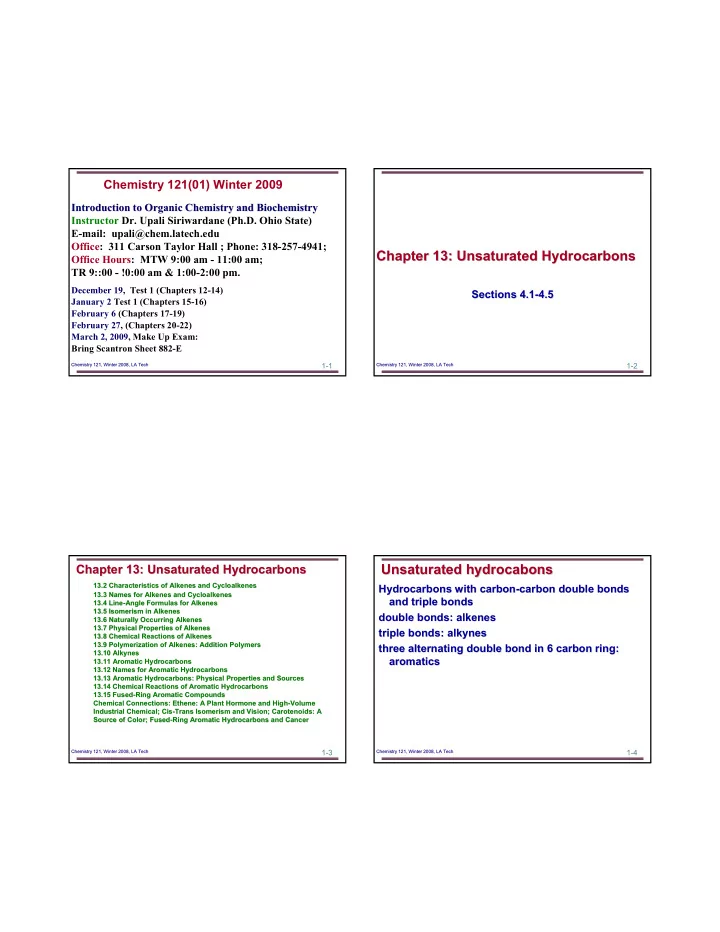
Chemistry 121(01) Winter 2009 Introduction to Organic Chemistry and Biochemistry Introduction to Organic Chemistry and Biochemistry Instructor Dr. Upali Siriwardane (Ph.D. Ohio State) E-mail: upali@chem.latech.edu Office: 311 Carson Taylor


slide-1
SLIDE 1

1-1

Chemistry 121, Winter 2008, LA Tech Chemistry 121, Winter 2008, LA Tech

Introduction to Organic Chemistry and Biochemistry Introduction to Organic Chemistry and Biochemistry Instructor Dr. Upali Siriwardane (Ph.D. Ohio State) E-mail: upali@chem.latech.edu Office: 311 Carson Taylor Hall ; Phone: 318-257-4941; Office Hours: MTW 9:00 am - 11:00 am; TR 9::00 - !0:00 am & 1:00-2:00 pm.

December 19, Test 1 (Chapters 12-14) January 2 Test 1 (Chapters 15-16) February 6 (Chapters 17-19) February 27, (Chapters 20-22) March 2, 2009, Make Up Exam: Bring Scantron Sheet 882-E

Chemistry 121(01) Winter 2009

1-2

Chemistry 121, Winter 2008, LA Tech Chemistry 121, Winter 2008, LA Tech

Chapter 13: Chapter 13: Unsaturated Hydrocarbons Unsaturated Hydrocarbons

Sections 4.1 Sections 4.1-

  • 4.5

4.5

1-3

Chemistry 121, Winter 2008, LA Tech Chemistry 121, Winter 2008, LA Tech

Chapter 13: Chapter 13: Unsaturated Hydrocarbons Unsaturated Hydrocarbons

13.2 Characteristics of Alkenes and 13.2 Characteristics of Alkenes and Cycloalkenes Cycloalkenes 13.3 Names for Alkenes and 13.3 Names for Alkenes and Cycloalkenes Cycloalkenes 13.4 Line 13.4 Line-

  • Angle Formulas for Alkenes

Angle Formulas for Alkenes 13.5 Isomerism in Alkenes 13.5 Isomerism in Alkenes 13.6 Naturally Occurring Alkenes 13.6 Naturally Occurring Alkenes 13.7 Physical Properties of Alkenes 13.7 Physical Properties of Alkenes 13.8 Chemical Reactions of Alkenes 13.8 Chemical Reactions of Alkenes 13.9 Polymerization of Alkenes: Addition Polymers 13.9 Polymerization of Alkenes: Addition Polymers 13.10 Alkynes 13.10 Alkynes 13.11 Aromatic Hydrocarbons 13.11 Aromatic Hydrocarbons 13.12 Names for Aromatic Hydrocarbons 13.12 Names for Aromatic Hydrocarbons 13.13 Aromatic Hydrocarbons: Physical Properties and Sources 13.13 Aromatic Hydrocarbons: Physical Properties and Sources 13.14 Chemical Reactions of Aromatic Hydrocarbons 13.14 Chemical Reactions of Aromatic Hydrocarbons 13.15 Fused 13.15 Fused-

  • Ring Aromatic Compounds

Ring Aromatic Compounds Chemical Connections: Chemical Connections: Ethene Ethene: A Plant Hormone and High : A Plant Hormone and High-

  • Volume

Volume Industrial Chemical; Industrial Chemical; Cis Cis-

  • Trans Isomerism and Vision;

Trans Isomerism and Vision; Carotenoids Carotenoids: A : A Source of Color; Fused Source of Color; Fused-

  • Ring Aromatic Hydrocarbons and Cancer

Ring Aromatic Hydrocarbons and Cancer

1-4

Chemistry 121, Winter 2008, LA Tech Chemistry 121, Winter 2008, LA Tech

Unsaturated Unsaturated hydrocabons hydrocabons

Hydrocarbons with carbon Hydrocarbons with carbon-

  • carbon double bonds

carbon double bonds and triple bonds and triple bonds double bonds: alkenes double bonds: alkenes triple bonds: alkynes triple bonds: alkynes three alternating double bond in 6 carbon ring: three alternating double bond in 6 carbon ring: aromatics aromatics

slide-2
SLIDE 2

1-5

Chemistry 121, Winter 2008, LA Tech Chemistry 121, Winter 2008, LA Tech

ethene ethyne benzene C2H4 C2H2 C6H6 CnH2n CnH2n−2 CnHn unsaturated unsaturated Aromatic alkene alkyne Arene Chapters 13 Chapters 13 Chapter 13

C C C C C C H H H H H H

Unsaturated Hydrocarbons: Unsaturated Hydrocarbons:

Alkenes Alkynes Arenes

1-6

Chemistry 121, Winter 2008, LA Tech Chemistry 121, Winter 2008, LA Tech

Units of Units of Unsaturation Unsaturation Cycloalkane Cycloalkane ring ring CnH2n (one unit of unsat.) Unsaturated hydrocarbons: Unsaturated hydrocarbons: bond CnH2n (one unit of unsat.) bond CnH2n−2 (two units of unsat.)

Compounds that have have fewer hydrogens than saturated hydrocarbons (CnH2n+2). Two hydrogen are considered as unit of unstauration

1-7

Chemistry 121, Winter 2008, LA Tech Chemistry 121, Winter 2008, LA Tech

  • Alkene

Alkene: contains a carbon-carbon double bond and has the general formula CnH2n

  • The two carbon atoms of a double bond and the four

atoms bonded to them lie in a plane, with bond angles

  • f approximately 120°

H C C H H H 121.7° Ethylene H C C CH3 H H 124.7° Propene

Structure of Alkenes Structure of Alkenes

1-8

Chemistry 121, Winter 2008, LA Tech Chemistry 121, Winter 2008, LA Tech

Planar Structure of Alkenes Planar Structure of Alkenes

According to the orbital overlap model, a double bond According to the orbital overlap model, a double bond consists of consists of

  • a

a σ σ bond formed by overlap of bond formed by overlap of sp sp2

2 hybrid

hybrid orbitals

  • rbitals
  • a

a π π bond formed by overlap of parallel bond formed by overlap of parallel 2 2p p orbital

  • rbital

Rotating by 90 Rotating by 90° °breaks the breaks the pi pi bond bond

slide-3
SLIDE 3

1-9

Chemistry 121, Winter 2008, LA Tech Chemistry 121, Winter 2008, LA Tech

Structure of Alkynes Structure of Alkynes

The functional group of an The functional group of an alkyne alkyne is a carbon is a carbon-

  • carbon triple

carbon triple bond bond A triple bond consists of A triple bond consists of

  • one σ bond formed by the overlap of sp hybrid orbitals
  • two π bonds formed by the overlap of sets of parallel 2p
  • rbitals

1-10

Chemistry 121, Winter 2008, LA Tech Chemistry 121, Winter 2008, LA Tech

Alkenes Alkenes

Second members of the hydrocarbon family. Second members of the hydrocarbon family.

  • contain only hydrogen and carbon
  • have single bonds and at least one C=C double

bond

All members have the general formula of All members have the general formula of

C Cn

nH

H2n

2n

Twice as Twice as ma many ny hy hydr drogen

  • gen

as as carbo carbon Twice as Twice as ma many ny hy hydr drogen

  • gen

as as carbo carbon 1-11

Chemistry 121, Winter 2008, LA Tech Chemistry 121, Winter 2008, LA Tech

Alkenes: Naming and Structures Alkenes: Naming and Structures

One simple class of compound is the One simple class of compound is the alkene alkene which has only C, H and single bonds. which has only C, H and single bonds.

  • ethene

propene 2- butene

  • C2H4

C3H6 C4H8

  • CH2CH2

CH3CH2CH2 CH3CH2CHCH3

1-12

Chemistry 121, Winter 2008, LA Tech Chemistry 121, Winter 2008, LA Tech

IUPAC Nomenclature of Alkenes and Alkynes IUPAC Nomenclature of Alkenes and Alkynes

  • name the longest continuous carbon chain containing the

name the longest continuous carbon chain containing the multiple multiple bond(s bond(s) (parent chain). If cyclic, ring is the parent. ) (parent chain). If cyclic, ring is the parent.

  • use the infix

use the infix -

  • en

en-

  • to show the presence of a carbon

to show the presence of a carbon-

  • carbon

carbon double bond double bond

  • use the infix

use the infix -

  • yn

yn-

  • to show the presence of a carbon

to show the presence of a carbon-

  • carbon

carbon triple bond triple bond

  • number the parent chain to give the 1st carbon of the

number the parent chain to give the 1st carbon of the double/triple bond the lower number double/triple bond the lower number

  • If both double and triple are present and cannot have the

If both double and triple are present and cannot have the same #, then double bonds take priority. same #, then double bonds take priority.

  • follow

follow IUPAC IUPAC general rules for numbering and naming general rules for numbering and naming substituents substituents

  • for a

for a cycloalkene cycloalkene, the double bond must be numbered 1,2 , the double bond must be numbered 1,2

slide-4
SLIDE 4

1-13

Chemistry 121, Winter 2008, LA Tech Chemistry 121, Winter 2008, LA Tech

IUPAC Nomenclature of Alkynes IUPAC Nomenclature of Alkynes

  • use the infix -yn

yn- to show the presence of a carbon- carbon triple bond

  • number the parent chain to give the 1st carbon of the

triple bond the lower number

  • follow IUPAC rules for numbering and naming

substituents

3-Methyl-1-butyne 6,6-Dimethyl-3-heptyne

1 1 2 2 3 3 4 4 5 6 7

1-14

Chemistry 121, Winter 2008, LA Tech Chemistry 121, Winter 2008, LA Tech

Example of IUPAC Nomenclature of Alkenes Example of IUPAC Nomenclature of Alkenes Cycloalkanes Cycloalkanes

1-Hexene 4-Methyl-1-hexene 2-Ethyl-3-methyl- 1-pentene

1 1 1 2 2 2 3 3 3 4 4 4 5 5 5 6 6 1 2 3 4 5

3-Methylcyclo- pentene CH3 1,6-Dimethylcyclo- hexene CH3 CH3

1 6 5 4 3

2

1-15

Chemistry 121, Winter 2008, LA Tech Chemistry 121, Winter 2008, LA Tech

Nomenclature of Alkenes: Common Names Nomenclature of Alkenes: Common Names

Some alkenes, particularly low Some alkenes, particularly low-

  • molecular

molecular-

  • weight ones, are

weight ones, are known almost exclusively by their known almost exclusively by their common names common names

CH2=CH2 CH3CH=CH2 CH3C=CH2 CH3 IUPAC: Isobutylene Propylene Ethylene Common: 2-Methylpropene Propene Ethene 1-16

Chemistry 121, Winter 2008, LA Tech Chemistry 121, Winter 2008, LA Tech

Alkenes Alkenes

First four members of the First four members of the alkanes alkanes Name Name # of C # of C Condensed formula Condensed formula Ethene Ethene 2 2 CH CH2

2=

=CH

CH2

2

Propene Propene 3 3 CH CH3

3CH

CH=

=CH

CH2

2

2 2-

  • Butene

Butene 4 4 CH CH3

3CH=CHCH

CH=CHCH3

3

Called a Called a homologous series homologous series

  • “Members differ by number of CH2 groups”
slide-5
SLIDE 5

1-17

Chemistry 121, Winter 2008, LA Tech Chemistry 121, Winter 2008, LA Tech

Naming alkenes and alkynes Naming alkenes and alkynes

Find the longest carbon chain. Use as base Find the longest carbon chain. Use as base name with an name with an ene ene or

  • r yne

yne ending. ending. Number the chain to give lowest number for the Number the chain to give lowest number for the carbons of the double or triple bond. carbons of the double or triple bond. Locate any branches on chain. Locate any branches on chain. Use base names with a Use base names with a yl yl ending. ending. For multiple branch of the same type, modify name with For multiple branch of the same type, modify name with di di, tri, ... , tri, ... Show the location of each branch with numbers. Show the location of each branch with numbers. List multiple branches alphabetically List multiple branches alphabetically

  • the

the di di, tri, ... don , tri, ... don’ ’t count.. t count..

1-18

Chemistry 121, Winter 2008, LA Tech Chemistry 121, Winter 2008, LA Tech

Cis Cis and trans Geometrical isomers of alkenes and trans Geometrical isomers of alkenes

two groups are said to be located two groups are said to be located cis cis to each other if they to each other if they lie on the same side of a plane with respect to the double lie on the same side of a plane with respect to the double bond. bond. If they are on opposite sides, their relative position is If they are on opposite sides, their relative position is described as trans. described as trans.

1-19

Chemistry 121, Winter 2008, LA Tech Chemistry 121, Winter 2008, LA Tech

Geometrical Stereoisomerism Geometrical Stereoisomerism

Because of restricted rotation about a C Because of restricted rotation about a C-

  • C double bond,

C double bond, groups on adjacent carbons are either groups on adjacent carbons are either cis cis or trans to

  • r trans to

each other each other

cis-2-Butene mp -139°C, bp 4°C trans-2-Butene mp -106°C, bp 1°C C H3C C H CH3 C H H C CH3 H H3C 1-20

Chemistry 121, Winter 2008, LA Tech Chemistry 121, Winter 2008, LA Tech

Physical Properties Physical Properties

Alkenes and alkynes are Alkenes and alkynes are nonpolar nonpolar compounds compounds

  • the only attractive forces between their molecules are

dispersion forces

Their physical properties are similar to those of Their physical properties are similar to those of alkanes alkanes of similar carbon skeletons

  • f similar carbon skeletons
  • those that are liquid at room temperature are less dense

than water (1.0 g/m L)

  • they dissolve in each other and in nonpolar organic

solvents

  • they are insoluble in water
slide-6
SLIDE 6

1-21

Chemistry 121, Winter 2008, LA Tech Chemistry 121, Winter 2008, LA Tech

Cis Cis-

  • Trans Isomerism

Trans Isomerism

  • trans alkenes are more stable than cis alkenes because
  • f nonbonded interaction strain between alkyl

substituents of the same side of the double bond

1-22

Chemistry 121, Winter 2008, LA Tech Chemistry 121, Winter 2008, LA Tech

Geometric isomers

There There are tw are two pos

  • possible arr

ble arrangements ngements. Example 2 Example 2 Example 2 Example 2-

  • but

butene ne but butene ne

C=C C=C H CH CH3 H3C H C=C C=C CH CH3 H H H3C

cis cis cis cis Larges Largest groups t groups are are

  • n the s
  • n the same s

me side de. trans trans trans trans Larges Largest groups t groups are are

  • n oppos
  • n opposite s

te sides des. 1-23

Chemistry 121, Winter 2008, LA Tech Chemistry 121, Winter 2008, LA Tech

Cis Cis-

  • Trans Isomerism in

Trans Isomerism in Cycloalkenes Cycloalkenes

  • the configuration of the double bond in cyclopropene through

cycloheptene must be cis; these rings are not large enough to accommodate a trans double bond

  • cyclooctene is the smallest cycloalkene that can accommodate a

trans double bond H H CH3 C H3

trans-Cyclooctene cis-Cyclooctene

1-24

Chemistry 121, Winter 2008, LA Tech Chemistry 121, Winter 2008, LA Tech

Cis Cis-

  • Trans Isomerism

Trans Isomerism

Dienes Dienes, , trienes trienes, and , and polyenes polyenes

  • for an alkene with n

n carbon-carbon double bonds, each

  • f which can show cis-trans isomerism, 2

2n

n cis-trans

isomers are possible

  • consider 2,4-heptadiene; it has four cis-trans isomers,

two of which are drawn here

C2-C3 C4-C5 Double bond trans trans trans cis cis trans cis cis trans,trans-2,4- heptadiene trans,cis-2,4- heptadiene

2 2 4 4

slide-7
SLIDE 7

1-25

Chemistry 121, Winter 2008, LA Tech Chemistry 121, Winter 2008, LA Tech

Naturally Occurring Naturally Occurring

AlkenesCis AlkenesCis-

  • Trans Isomerism

Trans Isomerism

  • vitamin A has five double bonds
  • four of the five can show cis-trans isomerism
  • vitamin A is the all-trans isomer

Vitamin A aldehyde (retinal) enzyme- catalyzed

  • xidation

H O Vitamin A (retinol) OH 1-26

Chemistry 121, Winter 2008, LA Tech Chemistry 121, Winter 2008, LA Tech

Naturally Occurring Alkenes: The Naturally Occurring Alkenes: The Terpenes Terpenes

Terpene Terpene: : a compound whose carbon skeleton can be a compound whose carbon skeleton can be divided into two or more units identical with the carbon divided into two or more units identical with the carbon skeleton of skeleton of isoprene isoprene 2-Methyl-1,3-butadiene (Isoprene)

1 2 3 4

head tail

1-27

Chemistry 121, Winter 2008, LA Tech Chemistry 121, Winter 2008, LA Tech

Terpenes Terpenes: Polymers of Isoprene : Polymers of Isoprene

  • myrcene, C10H16, a

component of bayberry wax and oils of bay and verbena

  • menthol, from

peppermint OH 1-28

Chemistry 121, Winter 2008, LA Tech Chemistry 121, Winter 2008, LA Tech

Terpenes Terpenes

Vitamin A Vitamin A (retinol) (retinol)

  • the four isoprene units in vitamin A are shown in red
  • they are linked head to tail, and cross linked at one

point (the blue bond) to give the six-membered ring OH

slide-8
SLIDE 8

1-29

Chemistry 121, Winter 2008, LA Tech Chemistry 121, Winter 2008, LA Tech

Reactions of alkenes Reactions of alkenes

Combustion Combustion C C2

2H

H4

4 + 4 O

+ 4 O2

2

2 CO 2 CO2

2 + 2 H

+ 2 H2

2O + heat

O + heat Alkynes also under go combustion reactions Alkynes also under go combustion reactions similarly similarly

1-30

Chemistry 121, Winter 2008, LA Tech Chemistry 121, Winter 2008, LA Tech

Addition Reactions Addition Reactions

The exposed electrons of double bonds make The exposed electrons of double bonds make alkenes more reactive than alkenes more reactive than alkanes alkanes and and show addition reactions. show addition reactions.

1-31

Chemistry 121, Winter 2008, LA Tech Chemistry 121, Winter 2008, LA Tech

1-32

Chemistry 121, Winter 2008, LA Tech Chemistry 121, Winter 2008, LA Tech

Halogenation Halogenation

Halogenation Halogenation -

  • Addition of halogen to the

Addition of halogen to the double bond. Textbook page xx. double bond. Textbook page xx.

slide-9
SLIDE 9

1-33

Chemistry 121, Winter 2008, LA Tech Chemistry 121, Winter 2008, LA Tech

1-34

Chemistry 121, Winter 2008, LA Tech Chemistry 121, Winter 2008, LA Tech

Hydrogenation Hydrogenation

Addition of hydrogen to the double bond. Textbook page 84 1-35

Chemistry 121, Winter 2008, LA Tech Chemistry 121, Winter 2008, LA Tech

1-36

Chemistry 121, Winter 2008, LA Tech Chemistry 121, Winter 2008, LA Tech

Hydration Hydration

Addition of water to the double bond. Addition of water to the double bond. Textbook page86. Textbook page86.

slide-10
SLIDE 10

1-37

Chemistry 121, Winter 2008, LA Tech Chemistry 121, Winter 2008, LA Tech

1-38

Chemistry 121, Winter 2008, LA Tech Chemistry 121, Winter 2008, LA Tech

Markovnikov Markovnikov Rule Rule

Non symmetric Non symmetric alkene alkene In In hydrohalogenation hydrohalogenation and hydration and hydration reations reations hydrogen adds to the double hydrogen adds to the double-

  • bonded carbon with

bonded carbon with the most the most hydrogens hydrogens

1-39

Chemistry 121, Winter 2008, LA Tech Chemistry 121, Winter 2008, LA Tech

Polymerization Polymerization

Formula Name Monomer Polymer Polypropylene CH3CH=CH2 CH-CH2 Polystyrene

  • CH=CH2

CH-CH2 Polychloroprene H2C=CHC=CH2 CH2CH=CCH2

|

Cl ( )

|

CH3 ( )

|

Cl ( )

1-40

Chemistry 121, Winter 2008, LA Tech Chemistry 121, Winter 2008, LA Tech

slide-11
SLIDE 11

1-41

Chemistry 121, Winter 2008, LA Tech Chemistry 121, Winter 2008, LA Tech

1-42

Chemistry 121, Winter 2008, LA Tech Chemistry 121, Winter 2008, LA Tech

Reactions of alkynes Reactions of alkynes

Alkynes undergo hydration, Alkynes undergo hydration, halogenation halogenation, and , and hydrohalogenation hydrohalogenation just like alkenes. just like alkenes. A special application is the carbide lamp (oxidation of A special application is the carbide lamp (oxidation of alkyne alkyne). ). 2 C (coke) + 2 C (coke) + CaO CaO (lime) + heat (lime) + heat

  • --> CaC

> CaC2

2 (calcium carbide) + CO

(calcium carbide) + CO CaC CaC2

2 + H

+ H2

2O

O

  • --> H

> H-

  • C

C≡ ≡C C-

  • H (acetylene) + Ca(OH)

H (acetylene) + Ca(OH)2

2

Acetylene serves as combustion fuel for the carbide Acetylene serves as combustion fuel for the carbide lamp. lamp.

1-43

Chemistry 121, Winter 2008, LA Tech Chemistry 121, Winter 2008, LA Tech

Aromatic hydrocarbons Aromatic hydrocarbons

Aromatic hydrocarbons Aromatic hydrocarbons -

  • organic compounds that had
  • rganic compounds that had

aromas and had different chemical properties from aromas and had different chemical properties from alkane alkane Benzene is the parent compound for the aromatic Benzene is the parent compound for the aromatic

  • hydrocarbons. Textbook, page90.
  • hydrocarbons. Textbook, page90.

Consider benzene. C Consider benzene. C6

6H

H6

6

1-44

Chemistry 121, Winter 2008, LA Tech Chemistry 121, Winter 2008, LA Tech

Resonance Structures of Benzene Resonance Structures of Benzene

Resonance structures or contributing Resonance structures or contributing structures = when two or more structure can structures = when two or more structure can be drawn for a compound. be drawn for a compound. In In thiscase thiscase, the real structure is something , the real structure is something between the proposed structures. Textbook, between the proposed structures. Textbook, page 90 page 90-

  • 91.

91.

slide-12
SLIDE 12

1-45

Chemistry 121, Winter 2008, LA Tech Chemistry 121, Winter 2008, LA Tech

Naming Aromatic Naming Aromatic Hydroarbons Hydroarbons. .

Monosubstituted Monosubstituted benzenes: benzenes: Ar Ar-

  • CH

CH2

2CH

CH3

3 ethylbenzene

ethylbenzene Ar Ar-

  • CH

CH2

2-

  • CH

CH2

2-

  • CH

CH2

2-

  • CH

CH3

3

butylbenzene butylbenzene Ar Ar-

  • CH

CH3

3

(methylbenzene) toluene (methylbenzene) toluene Ar Ar-

  • X (

X (halobenzene halobenzene) ) bromobenzene bromobenzene, , Ar Ar-

  • NO

NO2

2

nitrobenzene nitrobenzene Ar Ar-

  • SO

SO3

3H

H benzenesulfonic benzenesulfonic acid acid Ar Ar-

  • NH

NH2

2

a a nitrile nitrile substituent substituent

X

1-46

Chemistry 121, Winter 2008, LA Tech Chemistry 121, Winter 2008, LA Tech

Nomenclature Nomenclature

Disubstituted Disubstituted benzenes benzenes

  • locate substituents by numbering or
  • use the locators ortho (1,2-), meta (1,3-), and para (1,4-)

Where one group imparts a special name, name the Where one group imparts a special name, name the compound as a derivative of that molecule compound as a derivative of that molecule

CH3 Br COOH NO2 Cl NH2 3-Chloroaniline (m-Chloroaniline) 4-Bromotoluene (p-Bromotoluene) 2-Nitrobenzoic acid (o-Nitrobenzoic acid)

1-47

Chemistry 121, Winter 2008, LA Tech Chemistry 121, Winter 2008, LA Tech

Nomenclature Nomenclature

Polysubstituted Polysubstituted benzenes benzenes

  • with three or more substituents, number the atoms of

the ring

  • if one group imparts a special name, it becomes the

parent name

  • if no group imparts a special name, number to give the

smallest set of numbers, and then list alphabetically

CH3 Cl NO2 OH Br Br Br NO2 CH2CH3 Br

6 4 3 6 4 3 2 1 5 5 2 1 5 6 4 3 1 2

4-Chloro-2-nitro- toluene 2,4,6-Tribromo- phenol 2-Bromo-1-ethyl-4- nitrobenzene 1-48

Chemistry 121, Winter 2008, LA Tech Chemistry 121, Winter 2008, LA Tech

slide-13
SLIDE 13

1-49

Chemistry 121, Winter 2008, LA Tech Chemistry 121, Winter 2008, LA Tech

Disubstituted Disubstituted benzenes: benzenes:

Textbook, page 352. Textbook, page 352. 2,6 2,6-

  • dibromotoluene

dibromotoluene p p-

  • diethylbenzene

diethylbenzene 3,5 3,5-

  • dinitrotoluene

dinitrotoluene p p-

  • cholonitrobenzene

cholonitrobenzene

  • nitrobenzenesulfonic

nitrobenzenesulfonic acid acid 4 4-

  • benzyl

benzyl-

  • 1

1-

  • octene
  • ctene

m m-

  • cyanotoluene

cyanotoluene

1-50

Chemistry 121, Winter 2008, LA Tech Chemistry 121, Winter 2008, LA Tech

1-51

Chemistry 121, Winter 2008, LA Tech Chemistry 121, Winter 2008, LA Tech

1-52

Chemistry 121, Winter 2008, LA Tech Chemistry 121, Winter 2008, LA Tech

slide-14
SLIDE 14

1-53

Chemistry 121, Winter 2008, LA Tech Chemistry 121, Winter 2008, LA Tech

Benzylic Benzylic Oxidation Oxidation

Benzene is unaffected by strong oxidizing agents Benzene is unaffected by strong oxidizing agents such as H such as H2

2CrO

CrO4

4 and KMnO

and KMnO4

4

  • halogen and nitro substituents are unaffected by these

reagents

  • an alkyl group with at least one hydrogen on the

benzylic carbon is oxidized to a carboxyl group

CH3 Cl O

2N

H2CrO4 COOH Cl O2N 2-Chloro-4-nitrotoluene 2-Chloro-4-nitrobenzoic acid

1-54

Chemistry 121, Winter 2008, LA Tech Chemistry 121, Winter 2008, LA Tech

Benzylic Benzylic Oxidation Oxidation

  • if there is more than one alkyl group, each is oxidized

to a -COOH group

  • terephthalic acid is one of the two monomers required

for the synthesis of poly(ethylene terephthalate), a polymer that can be fabricated into Dacron polyester fibers and into Mylar films

CH3 H3C H2CrO4 COH HOC O O 1,4-Dimethylbenzene (p-xylene) 1,4-Benzenedicarboxylic acid (terephthalic acid) 1-55

Chemistry 121, Winter 2008, LA Tech Chemistry 121, Winter 2008, LA Tech

Reactions of Benzene Reactions of Benzene

The most characteristic reaction of aromatic The most characteristic reaction of aromatic compounds is substitution at a ring carbon compounds is substitution at a ring carbon

H Cl2 FeCl3 Cl HCl + + Chlorobenzene Halogenation: H HNO3 H2SO4 NO2 H2O + + Nitrobenzene Nitration: 1-56

Chemistry 121, Winter 2008, LA Tech Chemistry 121, Winter 2008, LA Tech

Reactions of Benzene Reactions of Benzene

H H2SO4 SO3H H2O + Benzenesulfonic acid Sulfonation: + H RX AlCl3 R HX + + An alkylbenzene Alkylation: H R-C-X O AlCl3 CR O HX + + Acylation: An acylbenzene An acyl halide

slide-15
SLIDE 15

1-57

Chemistry 121, Winter 2008, LA Tech Chemistry 121, Winter 2008, LA Tech

Nitration Nitration

The The electrophile electrophile is NO is NO2

2+ +, generated in this way

, generated in this way

H O NO2 O SO3H H O NO2 H H HSO4 + + + Nitric acid Conjugate acid

  • f nitric acid

O H H NO2 H O H NO2

+

+ + The nitronium ion

1-58

Chemistry 121, Winter 2008, LA Tech Chemistry 121, Winter 2008, LA Tech

Friedel Friedel-

  • Crafts Alkylation

Crafts Alkylation

Friedel Friedel-

  • Crafts alkylation forms a new C

Crafts alkylation forms a new C-

  • C bond

C bond between an aromatic ring and an alkyl group between an aromatic ring and an alkyl group

Cl AlCl3 HCl + Benzene 2-Chloropropane (Isopropyl chloride) Isopropylbenzene (Cumene) +

1-59

Chemistry 121, Winter 2008, LA Tech Chemistry 121, Winter 2008, LA Tech

Friedel Friedel-

  • Crafts

Crafts Acylations Acylations

Treating an aromatic ring with an acid chloride in Treating an aromatic ring with an acid chloride in the presence of AlCl the presence of AlCl3

3

  • acid (

acid (acyl acyl) chloride: ) chloride: a derivative of a carboxylic acid in which the -OH is replaced by a chlorine

O CH3CCl AlCl3 CCH3 O HCl + Benzene Acetophenone (a ketone) Acetyl chloride (an acyl halide) +