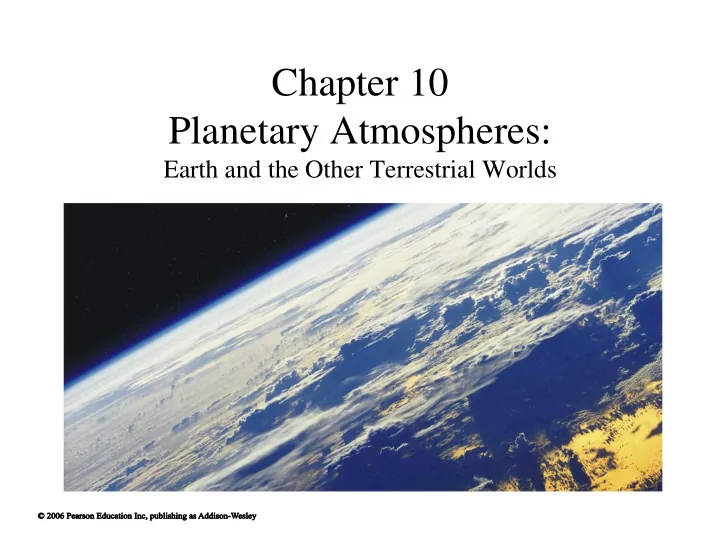
SLIDE 1
Chapter 10 Planetary Atmospheres:
Earth and the Other Terrestrial Worlds
SLIDE 2 10.1 Atmospheric Basics
- Our goals for learning
- What is an atmosphere?
- How does the greenhouse effect warm a
planet?
- Why do atmospheric properties vary with
altitude?
SLIDE 3
What is an atmosphere?
An atmosphere is a layer of gas that surrounds a world An atmosphere is a layer of gas that surrounds a world
SLIDE 4 Earth’s Atmosphere
thick
molecular nitrogen (N2) and
SLIDE 5
Atmospheric Pressure
Gas pressure Gas pressure depends on both depends on both density and density and temperature. temperature. Adding air Adding air molecules molecules increases the increases the pressure in a pressure in a balloon. balloon. Heating the air Heating the air also increases also increases the pressure. the pressure.
SLIDE 6 Atmospheric Pressure
decrease with altitude because the weight of overlying layers is less
sea level is
– 1.03 kg per sq. meter – 14.7 lbs per sq. inch – 1 bar
SLIDE 7 Where does an atmosphere end?
upper boundary
is < 10 km from surface, but a small fraction extends to >100 km
considered “space”
SLIDE 8 Where does an atmosphere end?
- Small amounts of gas are present even at > 300 km
SLIDE 9 Effects of Atmospheres
- Create pressure that determines whether
liquid water can exist on surface
- Absorb and scatter light
- Create wind, weather, and climate
- Interact with solar wind to create a
magnetosphere
- Can make planetary surfaces warmer through
greenhouse effect
SLIDE 10
How does the greenhouse effect warm a planet?
SLIDE 11 Greenhouse Effect
through atmosphere and warms planet’s surface
infrared light from surface, trapping heat
SLIDE 12 Planetary Temperature
temperature is determined by balance between the energy of sunlight it absorbs and the energy of outgoing thermal radiation
SLIDE 13 Temperature and Distance
from the Sun determines the total amount of incoming sunlight
SLIDE 14 Temperature and Rotation
rate affects the temperature differences between day and night
SLIDE 15 Temperature and Reflectivity
reflectivity (or albedo) is the fraction of incoming sunlight it reflects
albedo absorb more sunlight, leading to hotter temperatures
SLIDE 16 “No Greenhouse” Temperatures
- Venus would be 510°C colder without greenhouse
effect
- Earth would be 31°C colder (below freezing on
average)
SLIDE 17
What do atmospheric properties vary with altitude?
SLIDE 18 Light’s Effects on Atmosphere
- Ionization: Removal
- f an electron
- Dissociation:
Destruction of a molecule
photon’s direction
energy is absorbed
SLIDE 19 Light’s Effects on Atmosphere
ionize and dissociate molecules
- Molecules tend to scatter
blue light more than red
infrared light
SLIDE 20 Earth’s Atmospheric Structure
layer of Earth’s atmosphere
altitude
light from surface and convection
SLIDE 21 Earth’s Atmospheric Structure
above the troposphere
altitude in lower part, drops with altitude in upper part
- Warmed by absorption
- f ultraviolet sunlight
SLIDE 22 Earth’s Atmospheric Structure
at about 100 km altitude
altitude
light from the Sun heat and ionize gases
SLIDE 23 Earth’s Atmospheric Structure
layer in which atmosphere gradually fades into space
altitude; atoms can escape into space
UV light
SLIDE 24 Why the sky is blue
blue light from Sun, making it appear to come from different directions
red light scatters less
SLIDE 25 Atmospheres of Other Planets
with a stratosphere because of UV- absorbing ozone molecules (O3).
molecules protect us from Sun’s UV light.
No No-
greenhouse temperatures
SLIDE 26 Earth’s Magnetosphere
- Magnetic field of Earth’s atmosphere protects us from
charged particles streaming from Sun (solar wind)
SLIDE 27 Aurora
- Charged particles can enter atmosphere at magnetic
poles, causing an aurora
SLIDE 28 What have we learned?
– A layer of gas that surrounds a world
- How does the greenhouse effect warm a planet?
– Atmospheric molecules allow visible sunlight to warm a planet’s surface but absorb infrared photons, trapping the heat.
- Why do atmospheric properties vary with
altitude?
– They depend on how atmospheric gases interact with sunlight at different altitudes.
SLIDE 29 10.2 Weather and Climate
- Our goals for learning
- What creates wind and weather?
- What factors can cause long-term climate
change?
- How does a planet gain or lose atmospheric
gases?
SLIDE 30
What creates wind and weather?
SLIDE 31 Weather and Climate
- Weather is the ever-varying combination of
wind, clouds, temperature, and pressure
– Local complexity of weather makes it difficult to predict
- Climate is the long-term average of weather
– Long-term stability of climate depends on global conditions and is more predictable
SLIDE 32 Global Wind Patterns
distinctive patterns – Equatorial: E to W – Mid-latitudes: W to E – High-latitudes: E to W
SLIDE 33 Circulation Cells: No Rotation
equator
at poles
these motions would produce two large circulation cells
SLIDE 34 Coriolis Effect
- Conservation of angular momentum causes a ball’s
apparent path on a spinning platform to change direction
SLIDE 35 Coriolis Effect on Earth
pole to equator is going farther from axis and begins to lag Earth’s rotation
equator to pole goes closer to axis and moves ahead of Earth’s rotation
SLIDE 36 Coriolis Effect on Earth
angular momentum causes large storms to swirl
depends on hemisphere – N: counterclockwise – S: clockwise
SLIDE 37 Circulation Cells with Rotation
deflects north-south winds into east-west winds
each of the two large “no-rotation” cells breaks into three smaller cells
SLIDE 38 Prevailing Winds
- Prevailing surface winds at mid-latitudes blow from
W to E because Coriolis effect deflects S to N surface flow of mid-latitude circulation cell
SLIDE 39
Clouds and Precipitation
SLIDE 40
What factors can cause long-term climate change?
SLIDE 41 Solar Brightening
- Sun very gradually grows brighter with time,
increasing the amount of sunlight warming planets
SLIDE 42 Changes in Axis Tilt
- Greater tilt makes more extreme seasons, while
smaller tilt keeps polar regions colder
SLIDE 43 Changes in Axis Tilt
tugs from other bodies in solar system cause Earth’s axis tilt to vary between 22° and 25°
SLIDE 44 Changes in Reflectivity
- Higher reflectivity tends to cool a planet, while
lower reflectivity leads to warming
SLIDE 45 Changes in Greenhouse Gases
- Increase in greenhouse gases leads to warming,
while a decrease leads to cooling
SLIDE 46
How does a planet gain or lose atmospheric gases?
SLIDE 47
Sources of Gas
Outgassing Outgassing from volcanoes from volcanoes Evaporation of Evaporation of surface liquid; surface liquid; sublimation of sublimation of surface ice surface ice Impacts of Impacts of particles and particles and photons eject photons eject small amounts small amounts
SLIDE 48 Losses of Gas
Condensation Condensation
Chemical Chemical reactions with reactions with surface surface Large impacts Large impacts blast gas into blast gas into space space Thermal escape Thermal escape
Sweeping by Sweeping by solar wind solar wind
SLIDE 49
Thermal Escape
SLIDE 50 What have we learned?
- What creates wind and weather?
– Atmospheric heating and Coriolis effect
- What factors can cause long-term climate
change?
– Brightening of Sun – Changes in axis tilt – Changes in reflectivity – Changes in greenhouse gases
SLIDE 51 What have we learned?
- How does a planet gain or lose
atmospheric gases?
– Gains: Outgassing, evaporation/sublimation, and impacts by particles and photons – Losses: Condensation, chemical reactions, blasting by large impacts, sweeping by solar winds, and thermal escape
SLIDE 52 10.3 Atmospheres of Moon and Mercury
- Our goals for learning
- Do the Moon and Mercury have any
atmosphere at all?
SLIDE 53
Do the Moon and Mercury have any atmosphere at all?
SLIDE 54 Exospheres of Moon and Mercury
- Sensitive measurements show Moon and Mercury
have extremely thin atmospheres
- Gas comes from impacts that eject surface atoms
Moon Moon Mercury Mercury
SLIDE 55 What have we learned?
- Do the Moon and Mercury have any
atmosphere at all?
– Moon and Mercury have very thin atmospheres made up of particles ejected from surface
SLIDE 56 10.4 The Atmospheric History of Mars
- Our goals for learning
- What is Mars like today?
- Why did Mars change?
SLIDE 57
What is Mars like today?
SLIDE 58 Seasons on Mars
- The ellipticity of Mars’s orbit makes seasons more
extreme in the southern hemisphere
SLIDE 59 Polar Ice Caps of Mars
- Carbon dioxide ice of polar cap sublimates as
summer approaches and condenses at opposite pole
Late winter Late winter Midspring Midspring Early summer Early summer
SLIDE 60 Polar Ice Caps of Mars
cap during summer is primarily water ice
SLIDE 61 Dust Storms on Mars
- Seasonal winds can drive dust storms on Mars
- Dust in the atmosphere absorbs blue light,
sometimes making the sky look brownish-pink
SLIDE 62 Changing Axis Tilt
Mars’s axis tilt ranges from 0° to 60° over long time periods
variations cause dramatic climate changes
changes can produce alternating layers of ice and dust
SLIDE 63
Why did Mars change?
SLIDE 64 Climate Change on Mars
widespread surface water for 3 billion years
probably kept surface warmer before that
most of its atmosphere
SLIDE 65 Climate Change on Mars
- Magnetic field may have preserved early Martian
atmosphere
- Solar wind may have stripped atmosphere after field
decreased because of interior cooling
SLIDE 66 What have we learned?
– Mars is cold, dry, and frozen – Strong seasonal changes cause CO2 to move from pole to pole, leading to dust storms
– Its atmosphere must have once been much thicker for its greenhouse effect to allow liquid water on the surface – Somehow Mars lost most of its atmosphere, perhaps because of declining magnetic field
SLIDE 67 10.5 The Atmospheric History of Venus
- Our goals for learning
- What is Venus like today?
- How did Venus get so hot?
SLIDE 68
What is Venus like today?
SLIDE 69 Atmosphere of Venus
thick carbon dioxide atmosphere with a surface pressure 90 times Earth’s
produces very weak Coriolis effect and little weather
SLIDE 70 Greenhouse Effect on Venus
dioxide atmosphere produces an extremely strong greenhouse effect
fate because most of its carbon and water is in rocks and
SLIDE 71
How did Venus get so hot?
SLIDE 72 Atmosphere of Venus
contain droplets of sulphuric acid
has fast winds that remain unexplained
SLIDE 73 Runaway Greenhouse Effect
- Runaway greenhouse effect would account for why
Venus has so little water
SLIDE 74 What have we learned?
- What is Venus like today?
– Venus has an extremely thick CO2 atmosphere – Slow rotation means little weather
- How did Venus get so hot?
– Runaway greenhouse effect made Venus too hot for liquid oceans – All carbon dioxide remains in atmosphere, leading to a huge greenhouse effect
SLIDE 75 10.6 Earth’s Unique Atmosphere
- Our goals for learning
- How did Earth’s atmosphere end up so
different?
- Why does Earth’s climate stay relatively
stable?
- How might human activity change our
planet?
SLIDE 76
How did Earth’s atmosphere end up so different?
SLIDE 77 Four Important Questions
- Why did Earth retain most of its outgassed
water?
- Why does Earth have so little atmospheric
carbon dioxide, unlike Venus?
- Why does Earth’s atmosphere consist mostly
- f nitrogen and oxygen?
- Why does Earth have a UV-absorbing
stratosphere?
SLIDE 78 Earth’s Water and CO2
remained cool enough for liquid
- ceans to form
- Oceans dissolve
atmospheric CO2, enabling carbon to be trapped in rocks
SLIDE 79 Nitrogen and Oxygen
carbon and oxygen is in rocks, leaving a mostly nitrogen atmosphere
- Plants release some
- xygen from CO2
into atmosphere
SLIDE 80 Ozone and the Stratosphere
break up O2 molecules, allowing
- zone (O3) to form
- Without plants to
release O2, there would be no ozone in stratosphere to absorb UV light
SLIDE 81
Why does Earth’s climate stay relatively stable?
SLIDE 82 Carbon Dioxide Cycle
1. Atmospheric CO2 dissolves in rainwater 2. Rain erodes minerals which flow into
3. Minerals combine with carbon to make rocks on ocean floor
SLIDE 83
Carbon Dioxide Cycle
4. Subduction carries carbonate rocks down into mantle 5. Rock melt in mantle and outgas CO2 back into atmosphere through volcanoes
SLIDE 84 Earth’s Thermostat
- Cooling allows CO2 to build up in atmosphere
- Heating causes rain to reduce CO2 in atmosphere
SLIDE 85 Long-Term Climate Change
- Changes in Earth’s axis tilt might lead to ice ages
- Widespread ice tends to lower global temperatures
by increasing Earth’s reflectivity
- CO2 from outgassing will build up if oceans are
frozen, ultimately raising global temperatures again
SLIDE 86
How might human activity change our planet?
SLIDE 87 Dangers of Human Activity
- Human-made CFCs in atmosphere destroy
- zone, reducing protection from UV radiation
- Human activity is driving many other species
to extinction
- Human use of fossil fuels produces
greenhouse gases that can cause global warming
SLIDE 88 Global Warming
- Earth’s average temperature has increased by
0.5°C in past 50 years
- Concentration of CO2 is rising rapidly
- An unchecked rise in greenhouse gases will
eventually lead to global warming
SLIDE 89 CO2 Concentration
have tracked CO2 concentration for last 500,000 years
indicate current CO2 concentration is highest in at least 500,000 years
SLIDE 90 CO2 Concentration
- Most of CO2 increase has happened in last 50 years!
SLIDE 91 Modeling of Climate Change
global warming suggest that recent temperature increase is indeed consistent with human production of greenhouse gases
SLIDE 92 Consequences of Global Warming
- Storms more numerous and intense
- Rising ocean levels; melting glaciers
- Uncertain effects on food production,
availability of fresh water
- Potential for social unrest
SLIDE 93 What have we learned?
- How did Earth’s atmosphere end up so
different?
– Temperatures just right for oceans of water – Oceans keep most CO2 out of atmosphere – Nitrogen remains in atmosphere – Life releases some oxygen into atmosphere
- Why does Earth’s climate stay relatively
stable?
– Carbon dioxide cycle acts as a thermostat
SLIDE 94 What have we learned?
- How might human activity change our
planet?
– Destruction of ozone – High rate of extinction – Global warming from production of greenhouse gases