Chapter 10: Facilitating Students to Proudly Showcase their - - PDF document

chapter 10 facilitating students to proudly showcase
SMART_READER_LITE
LIVE PREVIEW

Chapter 10: Facilitating Students to Proudly Showcase their - - PDF document

124 Chapter 10: Facilitating Students to Proudly Showcase their Research: Embedding the Presentation of Student Research into a Part- time Business Degree Valerie Kendlin Programme Manager & Learning Support Officer valerie.kendlin@ucd.ie


slide-1
SLIDE 1

124

Chapter 10: Facilitating Students to Proudly Showcase their Research: Embedding the Presentation of Student Research into a Part- time Business Degree

Valerie Kendlin Programme Manager & Learning Support Officer valerie.kendlin@ucd.ie Dr Orna O’Brien Programme Office Director & School Manager

  • rna.obrien@ucd.ie

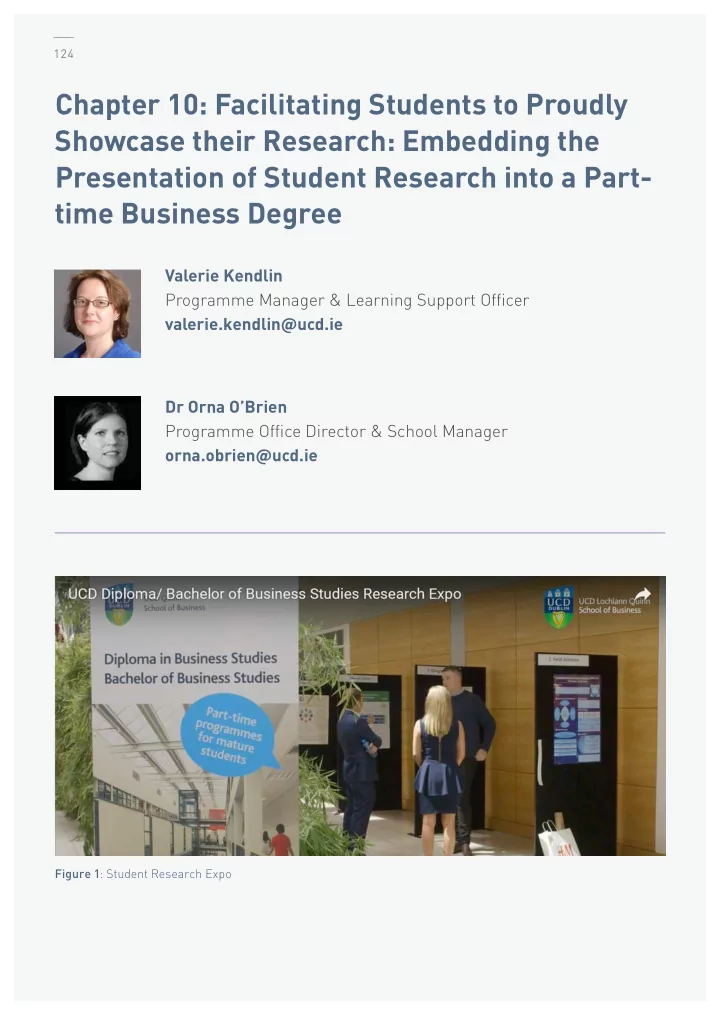
Figure 1: Student Research Expo

slide-2
SLIDE 2

125

Introduction

Making academic research enjoyable, fulfilling, developmental and achievable seemed crucial to this cohort of students. Adopting the concepts of Universal Design within this module appeared to give us the

  • pportunity to do this.

This assessment was selected to deliberatively showcase the marriage of experiential learning with academic learning which part-time students demonstrate so

  • well. The Bachelor of Business Studies

begins with a Level 7 60 ECTS diploma qualification covering the bedrock of business functional areas. Students can then progress to two further 60 credit stages comprising the Degree stages which provides them with a Level 8 degree award. The students on the programme are aged 21 and above, with an average age of 34. Many students have moved into middle management positions or are starting to move up the career ladder and are motivated, focused and engaged. Students are expected to take a more analytical and research-focused overview

  • f their topics as they move into the

Degree stages and topics include strategic management, entrepreneurship and project management. The programmes provides an introduction to research through the module ‘Undergraduate Dissertation’ which allows the students to research a practical problem from an academic perspective, as these students have strong practitioner insights which allows them to explore theory from a practical perspective. The opportunities for the students to not only explore the academic theory of this topic but to share their findings with their peers and the academic community seems to be a natural progression for the introduction of the poster presentations.

slide-3
SLIDE 3

126

Module Name

BMGT3002D Undergraduate Dissertation

Universal Design Principles

  • Flexibility in use
  • Tolerance for error
  • A community of learners
  • Instructional climate

Discipline

Management

Level

UCD level 3

College

Business

Learning Outcomes

  • Evaluate different research methodology approaches and

identify the most suitable approaches in different situations.

  • Conduct interviews and/or administer surveys for the purposes
  • f research.
  • Explore the key themes arising in the literature and to

demonstrate how these themes are applicable in the chosen research site.

  • Understand the various ethical considerations when

undertaking research.

  • Evaluate research findings and be able to identify the most

relevant findings.

  • Present a clear discussion of the main research findings and

be able to put forward appropriate conclusions based on the findings.

slide-4
SLIDE 4

127

Design and implementation

The students’ experiential learning complements the classroom experience and provides them with a platform to explore the academic material from a range of aspects. For many students it is their first experience of Higher Education and the programme team is very cognisant

  • f the challenges inherent in returning to
  • education. This incremental and embedded

approach to academic skill development allows Tolerance for error and culminates in the ability to present a poster on their own research at the end of the degree. Academic skills modules are introduced in Year 1 and then are progressively scaffolded into curriculum design across the degree programme and can be itemised as follows (Irving, 2011):

  • During Year 1 Stage 1, students undertake

two 5ECTS modules intended to introduce and advance critical thinking. The Semester 1 module ‘Introducing Academic Competencies’ introduces the key academic tools needed at university e.g. essay writing, information literacy, exam technique. The concept of critical thinking is introduced too. In Semester 2, students undertake ‘Developing Academic Competencies’ which explores critical thinking in more depth and introduces reflective writing.

Why Universal Design with this module?

Profjle of our students The prior involvement in education by students on the programme is varied. Many students on this programme have already attained certificates and diplomas in specialist areas of business and are looking to copper fasten their experience and knowledge with a degree. However others may not have enjoyed formal education or learning in an academic

  • environment. The flexible entry route to the

programme allows students to commence the programme once aged 23 years or

  • ver and having demonstrated a suitable

consideration of the programme at interview. The work experience and personal stories of each of the students provides them with a unique insight into the programme material and how it can help their professional development.

slide-5
SLIDE 5

128

  • For Year 2, students have an opportunity

to undertake a module called Business

  • Project. In this Business Project module,

students develop their critical thinking skills by conducting a review of a particular business environment of their choice and a short, peer-assessed poster presentation in class.

  • For Year 3, students undertake 20

ECTS on critical thinking skills with the Management Practice modules. In semester 1, students have an opportunity to enhance their critical thinking skills with Management Practice 1 which is the identification of a topic and a literature review on this topic. In Semester 2, students continue with the topic and research the topic in their organisation by completing two interviews, analysing the interview findings and drawing conclusions.

  • For Year 4, students then undertake a 20

ECTS module entitled ‘Undergraduate Dissertation’. This is outlined below.

UG dissertation module final year

As part of the final year of study, students have an opportunity to conduct a small piece

  • f research on a topic of their choice, thus

helping them to develop research skills in their chosen field allowing for Flexibility in use. This is a core module of 20 credits and is part of Stage 3 of the Bachelor of Business Studies. The dissertation provides students with an opportunity to demonstrate their ability to identify, collect, organise and analyse data and to systematically develop a cohesive argument to address a particular research topic with some minor primary data collection. The project culminates with a Research Expo day which is worth 10%

  • f the project. The Research Expo provides

students with an opportunity to use a poster to showcase their work to classmates, faculty, programme staff, family, friends and employers in a positive Instructional

  • climate. A panel of judges circulates to

evaluate the posters. In addition to the academic requirements, the use of the poster presentation in the atrium of the UCD Lochlann Quinn School of Business provides a sense of occasion for the students as they present their work and share with their peers in a Community of learners. This afternoon is also the students’ last day on campus for the programme.

slide-6
SLIDE 6

129

their selection. A reception is available just prior to the start of the Expo and academics, students and staff mix together before formal judging commences as this too also builds a sense of community. The inclusion of family, employers and

  • ther supporters might be perceived as a

witness to a rite of passage in many respects where the students’ supporters can come and observe the student as they engage with the academic community on a topic of

Figure 2: Sample of student advice regarding poster presentation

Topic 14: Preparing a poster presentation

Recommended readings: North Carolina State University. 2013. Creating effective poster presentations. [Online] . [Accessed 13 April 2017]. Available from: https://projects.ncsu.edu/project/posters/ExamplePosters.html On completion of studying this topic, you should be able to: The class will take part in four distinct debates and will be split accordingly into different groups. The groups will rotate through the debates and take on different roles during each debate. In any of the three debates the class groups will take on one of these categories:

  • Understand what a poster presentation is.
  • Understand the key features of a poster presentation.
  • Understand the nature of poster presentation session for the BBS

Undergraduate Dissertation.

slide-7
SLIDE 7

130

Benefits to the student

By using a poster presentation as part of the assessment for the ‘Undergraduate Dissertation’, students have the opportunity acquire specialist knowledge and also develop transferable skills including project management, time management, data analysis, report writing, poster production and poster presentation. In student feedback*, 75% of respondents either agreed or strongly agreed with the statement: “My research will help me with my career”. Over the academic year the academic support officers and Programme Director discussed the transformative nature of education and research and the Centre for Distance Learning captured this on video. The students discuss how their research and engagement with the programme gave them confidence in discussing workplace related topics. The module appears to have helped to demystify the research process for students (Healey and Jenkins, 2009) and it is likely that it has encouraged them to pursue further studies. 95% of the survey respondents either agreed or strongly agreed with the statement: “I plan to undertake postgraduate study in the future”. Furthermore:

  • The Research Expo demonstrates that

being a part-time student and completing a research project can be socialised learning experiences. The use of a poster for assessment purpose enabled this.

  • It is a particularly effective means for

students to distil their key research findings and display them visually.

  • The event has been a very successful way

to assess the students’ understanding of the research process.

  • Students have enjoyed the opportunity

to discuss their research and engage with their peers on their research topics, representing a very positive culmination to the students’ research endeavours.

  • Academics can see the breadth of work

and research undertaken by students

Figure 3: Students discussing their research at their posters Figure 4: Posters at the Research Expo 2016

slide-8
SLIDE 8

131

Comments from the students include *The survey was completed by approximately 50% of the 43 students to whom it was issued.

“the Research Expo… shows you this is what you have done, this is what you have been working for” with one lecturer identifying this event as a “bearing witness” by students’ family and friends to their journey through their undergraduate programme. Students commented that being pushed out of their comfort zone and actively engaging in the research process was challenging and extremely enjoyable with one student noting that they can “talk about work related topics with more credibility” as a result of this programme.

slide-9
SLIDE 9

132

Advice to others for implementation

This case study provides an example of the design of assessment which is aligned with the student profile and the purpose

  • f the module overall. The completion of

research can be an isolating and frustrating experience for students. The use of a poster presentation demonstrates how the process of research dissemination can be socialised across and within a wider community of University academics and students themselves (Boyer, 1998). There are three key elements of consideration should another practitioner wish to approach this method:

1) Student engagement

  • 1. Ensure you survey the student cohort

in advance of the process to ascertain feelings around the research process/ doing research which can then be compared to the post research survey to measure impact.

  • 2. Identify through the survey any common

inhibitions regarding the process. For example, students are often wary of preparing a poster. A short workshop, information sheet or provision of a sample poster can help to manage expectations.

  • 3. Emphasise the social aspect and

culmination of 4 years of study and remind students this is an opportunity to show their peers what they have learnt!

  • 4. The sharing of experience at an event

can be very motivating. It can help students to reconsider postgraduate studies which may have been thought inaccessible due to the preconception that graduate studies are linked with

  • research. Have brochures for graduate

study available.

Figure 5: Academic judge and students discussing research findings

slide-10
SLIDE 10

133

2) Posters

  • 1. Ensure that the poster element is

given proportionate attention during the year and differing levels of design suggestions are given.

  • 2. Ensure guidance is given to students
  • n suggested visual impact techniques,

poster layout guidelines and how you want to “showcase” your findings.

  • 3. Ensure judges are a mix from different

disciplines as the student must be able to transmit the content of the research and the import of the findings concisely to the judge regardless of background.

3) Logistics

  • 1. Publicise widely across university and

within department/College/University.

  • 2. Ensure “event organisation” protocol is
  • bserved and everything is planned and

co-ordinated preferably by a dedicated member of staff to ensure a relaxed atmosphere and full enjoyment by students and visitors.

  • 3. Ensure lots of professional imagery

and reusable resources are taken to capture the event as these might be used to promote the benefit of this event/ approach in the future.

Figure 6: Sample poster layout from Study Guide

slide-11
SLIDE 11

134

References and resources

Boyer Commission on Educating Undergraduates in the Research University. (1998). Reinventing undergraduate education: A blueprint for America’s research universities, CA: Carnegie Foundation for the Advancement of Teaching. Brannick, T., Coughlan, A., Hannon, E., Dowling- Hetherington, L. and O’ Brien, O. (2016) ‘Topic 14: Preparing a Poster Presentation’ [Study Guide], BMGT3002D: Undergraduate Dissertation. University College Dublin. 20 April. Healey, M. and Jenkins, A. (2009): Developing Undergraduate research and inquiry, York Higher Education Academy. Irving, J.H. (2011): ‘Integrating Research into an Undergraduate Accounting Course’, Issues in Accounting Education, 26 (2): 287-303. UCD Bachelor of Business Studies Research Expo 2016 - Dublin 2016, video, UCD, July 15 2016, viewed 13 April 2017 2011, <https://youtu.be/FAZ2ioAvdB0>. Waite-Connor, C. (2004) US Geological Survey The poster session: a guide for preparation. Available at: http://associations.sou.edu/aaaspd/PosterPrep. html (Accessed 20th April 2017).