Chapter 1: Introduction What is an Operating System? Mainframe - - PDF document

chapter 1 introduction
SMART_READER_LITE
LIVE PREVIEW

Chapter 1: Introduction What is an Operating System? Mainframe - - PDF document

Chapter 1: Introduction What is an Operating System? Mainframe Systems Desktop Systems Multiprocessor Systems Distributed Systems Clustered System Real -Time Systems Handheld Systems Computing Environments


slide-1
SLIDE 1

Silberschatz, Galvin and Gagne 2002 1.1 Operating System Concepts

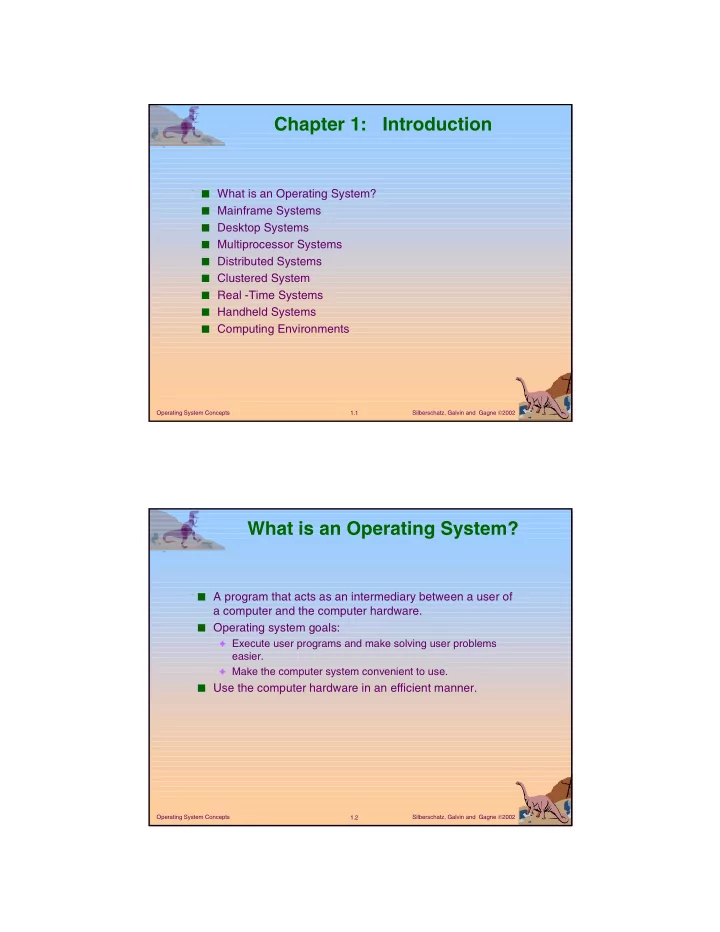
Chapter 1: Introduction

■ What is an Operating System? ■ Mainframe Systems ■ Desktop Systems ■ Multiprocessor Systems ■ Distributed Systems ■ Clustered System ■ Real -Time Systems ■ Handheld Systems ■ Computing Environments

Silberschatz, Galvin and Gagne 2002 1.2 Operating System Concepts

What is an Operating System?

■ A program that acts as an intermediary between a user of

a computer and the computer hardware.

■ Operating system goals:

✦ Execute user programs and make solving user problems

easier.

✦ Make the computer system convenient to use.

■ Use the computer hardware in an efficient manner.

slide-2
SLIDE 2

Silberschatz, Galvin and Gagne 2002 1.3 Operating System Concepts

Computer System Components

  • 1. Hardware – provides basic computing resources (CPU,

memory, I/O devices).

  • 2. Operating system – controls and coordinates the use of

the hardware among the various application programs for the various users.

  • 3. Applications programs – define the ways in which the

system resources are used to solve the computing problems of the users (compilers, database systems, video games, business programs).

  • 4. Users (people, machines, other computers).

Silberschatz, Galvin and Gagne 2002 1.4 Operating System Concepts

Abstract View of System Components

slide-3
SLIDE 3

Silberschatz, Galvin and Gagne 2002 1.5 Operating System Concepts

Operating System Definitions

■ Resource allocator – manages and allocates resources. ■ Control program – controls the execution of user

programs and operations of I/O devices .

■ Kernel – the one program running at all times (all else

being application programs).

Silberschatz, Galvin and Gagne 2002 1.6 Operating System Concepts

Mainframe Systems

■ Reduce setup time by batching similar jobs ■ Automatic job sequencing – automatically transfers

control from one job to another. First rudimentary

  • perating system.

■ Resident monitor

✦ initial control in monitor ✦ control transfers to job ✦ when job completes control transfers pack to monitor

slide-4
SLIDE 4

Silberschatz, Galvin and Gagne 2002 1.7 Operating System Concepts

Memory Layout for a Simple Batch System

Silberschatz, Galvin and Gagne 2002 1.8 Operating System Concepts

Multiprogrammed Batch Systems

Several jobs are kept in main memory at the same time, and the CPU is multiplexed among them.

slide-5
SLIDE 5

Silberschatz, Galvin and Gagne 2002 1.9 Operating System Concepts

OS Features Needed for Multiprogramming

■ I/O routine supplied by the system. ■ Memory management – the system must allocate the

memory to several jobs.

■ CPU scheduling – the system must choose among

several jobs ready to run.

■ Allocation of devices.

Silberschatz, Galvin and Gagne 2002 1.10 Operating System Concepts

Time-Sharing Systems–Interactive Computing

■ The CPU is multiplexed among several jobs that are kept

in memory and on disk (the CPU is allocated to a job only if the job is in memory).

■ A job swapped in and out of memory to the disk. ■ On-line communication between the user and the system

is provided; when the operating system finishes the execution of one command, it seeks the next “control statement” from the user’s keyboard.

■ On-line system must be available for users to access data

and code.

slide-6
SLIDE 6

Silberschatz, Galvin and Gagne 2002 1.11 Operating System Concepts

Desktop Systems

■ Personal computers – computer system dedicated to a

single user.

■ I/O devices – keyboards, mice, display screens, small

printers.

■ User convenience and responsiveness. ■ Can adopt technology developed for larger operating

system’ often individuals have sole use of computer and do not need advanced CPU utilization of protection features.

■ May run several different types of operating systems

(Windows, MacOS, UNIX, Linux)

Silberschatz, Galvin and Gagne 2002 1.12 Operating System Concepts

Parallel Systems

■ Multiprocessor systems with more than on CPU in close

communication.

■ Tightly coupled system – processors share memory and a

clock; communication usually takes place through the shared memory.

■ Advantages of parallel system:

✦ Increased throughput ✦ Economical ✦ Increased reliability ✔ graceful degradation ✔ fail-soft systems

slide-7
SLIDE 7

Silberschatz, Galvin and Gagne 2002 1.13 Operating System Concepts

Parallel Systems (Cont.)

■ Symmetric multiprocessing (SMP)

✦ Each processor runs and identical copy of the operating

system.

✦ Many processes can run at once without performance

deterioration.

✦ Most modern operating systems support SMP

■ Asymmetric multiprocessing

✦ Each processor is assigned a specific task; master

processor schedules and allocated work to slave processors.

✦ More common in extremely large systems

Silberschatz, Galvin and Gagne 2002 1.14 Operating System Concepts

Symmetric Multiprocessing Architecture

slide-8
SLIDE 8

Silberschatz, Galvin and Gagne 2002 1.15 Operating System Concepts

Distributed Systems

■ Distribute the computation among several physical

processors.

■ Loosely coupled system – each processor has its own

local memory; processors communicate with one another through various communications lines, such as high- speed buses or telephone lines.

■ Advantages of distributed systems.

✦ Resources Sharing ✦ Computation speed up – load sharing ✦ Reliability ✦ Communications

Silberschatz, Galvin and Gagne 2002 1.16 Operating System Concepts

Distributed Systems (cont)

■ Requires networking infrastructure. ■ Local area networks (LAN) or Wide area networks (WAN) ■ May be either client-server or peer-to-peer systems.

slide-9
SLIDE 9

Silberschatz, Galvin and Gagne 2002 1.17 Operating System Concepts

General Structure of Client-Server

Silberschatz, Galvin and Gagne 2002 1.18 Operating System Concepts

Clustered Systems

■ Clustering allows two or more systems to share storage. ■ Provides high reliability. ■ Asymmetric clustering: one server runs the application

while other servers standby.

■ Symmetric clustering: all N hosts are running the

application.

slide-10
SLIDE 10

Silberschatz, Galvin and Gagne 2002 1.19 Operating System Concepts

Real-Time Systems

■ Often used as a control device in a dedicated application

such as controlling scientific experiments, medical imaging systems, industrial control systems, and some display systems.

■ Well-defined fixed-time constraints. ■ Real-Time systems may be either hard or soft real-time.

Silberschatz, Galvin and Gagne 2002 1.20 Operating System Concepts

Real-Time Systems (Cont.)

■ Hard real-time:

✦ Secondary storage limited or absent, data stored in short

term memory, or read-only memory (ROM)

✦ Conflicts with time-sharing systems, not supported by

general-purpose operating systems. ■ Soft real-time

✦ Limited utility in industrial control of robotics ✦ Useful in applications (multimedia, virtual reality) requiring

advanced operating-system features.

slide-11
SLIDE 11

Silberschatz, Galvin and Gagne 2002 1.21 Operating System Concepts

Handheld Systems

■ Personal Digital Assistants (PDAs) ■ Cellular telephones ■ Issues:

✦ Limited memory ✦ Slow processors ✦ Small display screens.

Silberschatz, Galvin and Gagne 2002 1.22 Operating System Concepts

Migration of Operating-System Concepts and Features

slide-12
SLIDE 12

Silberschatz, Galvin and Gagne 2002 1.23 Operating System Concepts

Computing Environments

■ Traditional computing ■ Web-Based Computing ■ Embedded Computing