Changing needs in a changing world Research supported by TLRI Why - - PDF document

changing needs in a changing world
SMART_READER_LITE
LIVE PREVIEW

Changing needs in a changing world Research supported by TLRI Why - - PDF document

Statistics Road Tour 2012 Changing Needs in a Changing World: Part II: Maxine Pfannkuch Department of Statistics University of Auckland, New Zealand THE UNIVERSITY OF AUCKLAND DEPARTMENT OF STATISTICS Hans Rosling s TED talks, Documentary


slide-1
SLIDE 1

Part II: Maxine Pfannkuch

THE UNIVERSITY OF AUCKLAND DEPARTMENT OF STATISTICS

Changing Needs in a Changing World:

Department of Statistics

University of Auckland, New Zealand Statistics Road Tour 2012

Research supported by TLRI

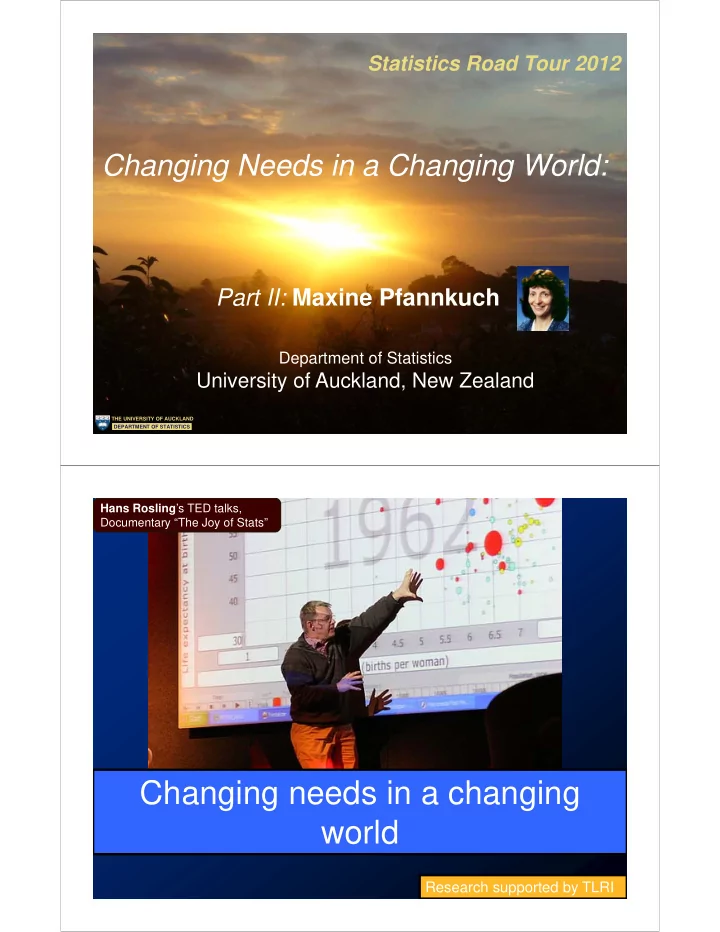
Hans Rosling’s TED talks, Documentary “The Joy of Stats”

Changing needs in a changing world

slide-2
SLIDE 2

FROM STATISTICAL PRACTICE PERSPECTIVE

Why change?

Why change?

slide-3
SLIDE 3

Why change?

Brad Efron – Bootstrapping 1979 R A Fisher – Randomisation1935

Why change? (Cobb, 2007)

6

slide-4
SLIDE 4

Why change? (Cobb, 2007)

[can teach] more fundamental ideas that now, thanks to computers, we could and should be teaching. Before computers, there was no alternative. Now, there is no excuse.

7 Why change to bootstrapping/randomisation methods?

  • “Rapidly becoming the preferred

way to do statistical inference” (Hesterberg et al., 2009)

  • Efron (2000): “it has taken me a long time to

get over the feeling that there is something magically powerful about formulas ... and to start trusting in the efficacy of computer- based methods ...”

8

slide-5
SLIDE 5

THE NEXT BIG THING IN TEACHING STATISTICS WILL BE

Removing the letters z and t from introductory courses

Rossman & Chance, USCOTS 2011

9

FROM STATISTICS EDUCATION RESEARCH PERSPECTIVE

Why Change?

slide-6
SLIDE 6

Why change? Inference research

11

Inference research

  • Study on students’ grasp of statistical

inference concepts

  • the results from our study agree with the

findings of the considerable research that has been done in the last thirty years … that people tend to think deterministically and lack awareness or understanding of variation and its relation to sample size.

(Meletiou-Mavrotheris, Lee, & Fouladi, 2007)

12

slide-7
SLIDE 7

Inference research

One course insufficient for developing inferential concepts Research suggests students should be introduced to inferential concepts much earlier Students need a deeper understanding of sampling variability (Konold & Kazak, 2008)

13

Inference research

  • Multitude of misconceptions associated with

significance testing (Nickerson, 2004)

  • And with confidence intervals (Fidler, 2006)
  • From a learning perspective randomisation

and bootstrapping methods should be more conceptually accessible to ALL students than normal-based methods

14

slide-8
SLIDE 8

Our World has Changed in Statistics

  • Currently, too big a gap between statistical practice

and statistics education

– Stuck in the 1950s (Efron, 2000) and what was computable in 20th Century (Cobb, 2007)

15

George Cobb Brad Efron

Our World has Changed in Statistics

  • Currently, too big a gap between statistical literacy

and statistics education

  • The final national NBC/Wall Street Journal Poll, released on

Sunday, showed Obama with the support of 48 percent of likely voters, with Romney receiving 47 percent. The poll had a margin of error of 2.55 percentage points.

16

slide-9
SLIDE 9

Example: Political Poll March 2008 Example: Political Poll March 2008

slide-10
SLIDE 10

Example: Political Poll March 2008

  • National

MOE?

  • ACT

MOE? 19

Example: Political Poll March 2008

  • MOE for males?
  • MOE for RONZ?
  • MOE for AGE?
slide-11
SLIDE 11

Example: Political Poll March 2008

  • Claim: More females

vote for National than Labour

  • MOE for this

difference?

  • Claim: More people in

Auckland vote for National than the RONZ

  • MOE for this

difference?

Research supported by TLRI

Hans Rosling’s TED talks, Documentary “The Joy of Stats”

Changing needs in a changing world: Rethinking what we teach