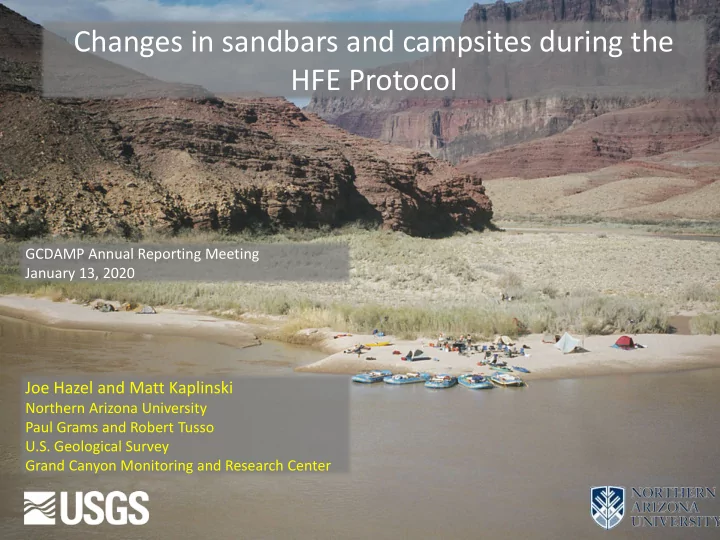
Changes in sandbars and campsites during the HFE Protocol GCDAMP - - PowerPoint PPT Presentation

changes in sandbars and campsites during the hfe protocol
SMART_READER_LITE
LIVE PREVIEW

Changes in sandbars and campsites during the HFE Protocol GCDAMP - - PowerPoint PPT Presentation

Changes in sandbars and campsites during the HFE Protocol GCDAMP Annual Reporting Meeting January 13, 2020 Joe Hazel and Matt Kaplinski Northern Arizona University Paul Grams and Robert Tusso U.S. Geological Survey Grand Canyon Monitoring


slide-1
SLIDE 1

Changes in sandbars and campsites during the HFE Protocol

GCDAMP Annual Reporting Meeting January 13, 2020

Joe Hazel and Matt Kaplinski

Northern Arizona University Paul Grams and Robert Tusso U.S. Geological Survey Grand Canyon Monitoring and Research Center

slide-2
SLIDE 2

Overview

  • Background on the HFE Protocol
  • Background on study sites, methods, and database
  • Observations of sandbar response from HFE protocol
  • Observations of sandbar response to 1990-2019
  • Campsite area response during the HFE protocol
  • Summary
slide-3
SLIDE 3

HFE-related Science and Management Questions: HFE-related Science and Management Questions:

  • With frequent HFEs, will

sandbars increase in size and abundance?

  • Will frequent HFEs cause

sand supply in channel to decrease and exacerbate sediment deficit?

Pre-dam:

  • Annual floods
  • Abundant sand

supply

  • Large sandbars

Post-dam I:

  • Daily small floods
  • Limited sand supply
  • Eroding sandbars
  • Unplanned floods (spills)

Post-dam II:

  • Restricted hydropower
  • perations
  • High Flow Experiments

(HFEs)

  • triggered by sand

supply from Paria River

Pre-dam Post-dam I Pre-HFE Post-HFE

https://waterdata.usgs.gov

slide-4
SLIDE 4

The HFE Protocol:

  • Track sand inputs from Paria River

and model sand budget during designated accounting periods

  • July 1 – Dec. 1
  • Dec. 1 – Jun. 30
  • Find the magnitude and duration
  • f HFE that “fits” the amount of

sand available

  • Schedule HFE

Wright and Kennedy (2011)

slide-5
SLIDE 5

Post-dam Floods and High-flows: Summary of findings up to start of 2012 HFE Protocol

  • Sediment depleted floods scour the bed.
  • Sediment-depleted floods can build high-

elevation sandbars at expense of erosion from the channel and low-elevation parts of eddies.

  • Floods during sediment-enriched conditions

build bars without “mining” background sand storage.

  • High flows should be timed to best take

advantage of recent tributary sand inputs.  These findings are basis of the key components of HFE Protocol:

  • Tracking sand inputs from Paria River over the summer-fall

storm season.

  • Scheduling HFEs to follow the series of inputs when sand

storage in Upper Marble Canyon is greatest.

  • Scaling the size (magnitude and duration) of HFE to

“match” the amount of sand accumulation. Schmidt and Grams (2011); Wright and Kennedy (2011)

slide-6
SLIDE 6

Long-term monitoring (LTM) sites between Lees Ferry and Diamond Creek

  • 32 sites established in 1990 by

Beus and others (1992)

  • Additional sites added in 1993,

1996, 2002, and 2008 for a total of 44 sites

  • The percentage of eddies with

monitored sandbars is 9% and 7% in Marble and Grand Canyons, respectively

  • 37 sites are monitored for

campsite area

slide-7
SLIDE 7

Sandbar and campsite survey methods

*Campsite Area = a smooth substrate (preferably sand) with no more than eight degrees of slope with little or no vegetation

Total Station Surveys of Sandbar Topography, Campsite Area* (vegetation survey plots), and Daily Imagery

slide-8
SLIDE 8

Flow regimes, high-flow experiments, and sandbar surveys

Hazel and others, in prep

  • 11 HFEs between 1996 and November 2018, including lower magnitude HMFs in

1997 and 2000

  • ~1,750 surveys collected between 1990 and 2019
  • The original LTM sites have as many as 50 repeat surveys
  • Sandbar surveys during the HFE protocol are made ~11 months following each HFE

1990 1995 2000 2005 2010 2015 2020 1,000 2,000 Discharge, in cubic meters per second

1990-91 experimental flows 1996 HFE 1997 Test Flow 2000 LSSF HMF Flows 2004 HFE 2008 HFE 2012 HFE Modified Low Fluctuating Flow (MLFF) Alternative Interim Operating Critera 2013 HFE 2014 HFE 2011 Equalization Flows 2011-2020 Multi-Year HFE Protocol 2016 HFE 2018 HFE

slide-9
SLIDE 9

Sandbar database and web application

  • In development since 2014

– Started as a javascript app supported by oracle database – Now mainly in python and supported by a sql database (free and open source)

  • Includes a desktop “workbench” for

loading, processing and viewing data

  • Web application for public access to data
  • Series of python scripts for generating

summary plots

  • Next step is to incorporate those in workbench

and web application

Desktop sandbar workbench Sandbar web application www.gcmrc.gov/sandbar OR www.usgs.gov/apps/sandbar

slide-10
SLIDE 10

What are the high-flow experiments (HFEs) doing?

Debris Fan

HFEs transfer sand from channel and low- elevation parts of eddies to sandbars along channel margins

Eroded sandbar before HFE HFE inundates sandbar Sandbar following HFE

https://waterdata.usgs.gov

slide-11
SLIDE 11

November 2018 High-flow Experiment Deposition-1 09/28/2018 12/04/2018

HFE Deposition  HFE Deposition 

River Mile (RM) 122R

11/01/2018 11/11/2018

River Mile (RM) 029R

slide-12
SLIDE 12

November 2016 High-flow Experiment Sandbar Deposition-2

River Mile (RM) 23L

HFE Deposition filling gullies

11/06/2016 11/13/2016

slide-13
SLIDE 13

Rebuilding of sandbars and campsites affected by tributary floods

  • Flash flood and debris flow at 220-

mile in 2018 eroded and wiped out middle camp (a long-term monitoring site)

  • Also eroded gully through upper

camp

  • Both partially rebuilt by 2018 HFE

Middle camp upper camp

11/3/2018 11/13/2018

RM 220 R

slide-14
SLIDE 14

Cumulative increases in sand volume at some sites

Post-HFE 2018 pre-HFE 2012

2012 HFE Fall 2012 to Fall 2018 increase

Preliminary results, subject to review, do not cite

RM 9 L

slide-15
SLIDE 15

Two analysis periods between 1990 and 2019

  • Sand depleted period (1990-

2003)

– Median discharge ~351 m3/s – Sand conveyance threshold exceeded 78% of the time – Paria sand supply was average or above average in only 5 years during the 14-year period

  • Sand enriched period (2004-

present)

– Median discharge ~332 m3/s – Sand conveyance threshold exceeded 80% of the time – Paria sand supply was average or above average in 9 years during the 15-year period – 7 HFEs were timed to occur before inputs were conveyed through the system – The difference? Large inputs and only

  • ne year with high releases

1990 1995 2000 2005 2010 2015 250 500 750

Annual mean discharge, in cubic meters per second

A

1990 1995 2000 2005 2010 2015 Calendar year 1,000 2,000 3,000

Sand supply, in thousand metric tons

Sand Depleted Period Sand Enriched Period Sand Depleted Period Sand Enriched Period Long-term annual average sand input (1924-2016)

B

Sand conveyance

  • r erosion threshold

Hazel and others, in prep

slide-16
SLIDE 16

Photographic analyses of the HFE protocol

Results of 2018 HFE on par with previous HFEs 11/1/2018 11/10/2018

Preliminary results, subject to review, do not cite

www.gcmrc.gov/sandbar 10/11/2019

slide-17
SLIDE 17

Sandbar size during the HFE protocol period

  • Positive trends in most bar types and in both Marble and Grand

Canyon

  • Increases in sandbar volume off-set sandbar erosion that
  • ccurred between HFEs

Wide, vegetated bars Narrow to medium reattachment bars Undifferentiated and separation bars

Preliminary results, subject to review, do not cite

slide-18
SLIDE 18

Long-term sandbar response size during the HFE protocol period

  • Increased HFE frequency is

maintaining sandbars at a majority of the sites

  • HFE protocol is off-setting erosion

characteristic of the 1990-2003 sand depleted period for most bar types

  • Trends for separation and

undifferentiated eddy bars show a slight decline in Grand Canyon

  • Trends are markedly similar for

both Marble and Grand Canyons

Preliminary results, subject to review, do not cite

slide-19
SLIDE 19

Campsite area in Marble and Grand Canyons

  • HFEs increase and maintain

campsite area

  • Decreases are primarily due to

vegetation expansion

  • Campsite area declines in years

without HFEs

  • Trends are similar for both

Marble and Grand Canyons

RM 194 L

4/20/1996 11/20/2016

slide-20
SLIDE 20

Summary

  • Each HFE since 2012 has resulted in

sandbar deposition

  • Increases in sandbar size occur at 50% or

more of monitoring sites

  • There is no difference in site response in

different parts of the canyon

– Marble and Grand Canyon show similar trends

  • Although bars erode, they are larger than

they would be without HFEs

  • HFEs do not scour or remove vegetation

– Erosion and vegetation encroachment decrease campsite area during the intervening periods between HFEs

  • There is evidence for cumulative increases

in bar size at some sites whereas others continue to decrease

  • The majority of sandbars are those that

reliably aggrade during HFEs

RM 9 L

Post-HFE 2018 pre-HFE 2012

slide-21
SLIDE 21

Acknowledgements

Erich Mueller, Daniel Buscombe, Thomas Gushue, Daniel Hamill, James Hensleigh, Robert Ross, Keith Kohl, Jack Schmidt, Laura Kennedy, David Topping, Rod Parnell, Bryan Cooperrider, Karen Koestner, Emily Thompson, Daniel Hadley, Katie Chapman … In Memoriam: Greg Sponenburgh and Frank Protiva