Changes in Consumer Knowledge, Behavior, and Confidence Since the - - PDF document

changes in consumer knowledge behavior and confidence
SMART_READER_LITE
LIVE PREVIEW

Changes in Consumer Knowledge, Behavior, and Confidence Since the - - PDF document

Changes in Consumer Knowledge, Behavior, and Confidence Since the 1996 PR/HACCP Final Rule Presented at Thinking Globally Working Locally: A Conference on Food Safety Education Presented by Sheryl Cates Orlando, FL September 18, 2002


slide-1
SLIDE 1

1

Changes in Consumer Knowledge, Behavior, and Confidence Since the 1996 PR/HACCP Final Rule

Presented at Thinking Globally — Working Locally: A Conference on Food Safety Education Presented by Sheryl Cates Orlando, FL September 18, 2002

P.O. Box 12194 · 3040 Cornwallis Road · Research Triangle Park, NC 27709 Phone: 919-541-6810 · Fax: 919-541-6683 · scc@rti.org · www.rti.org

2

Purpose

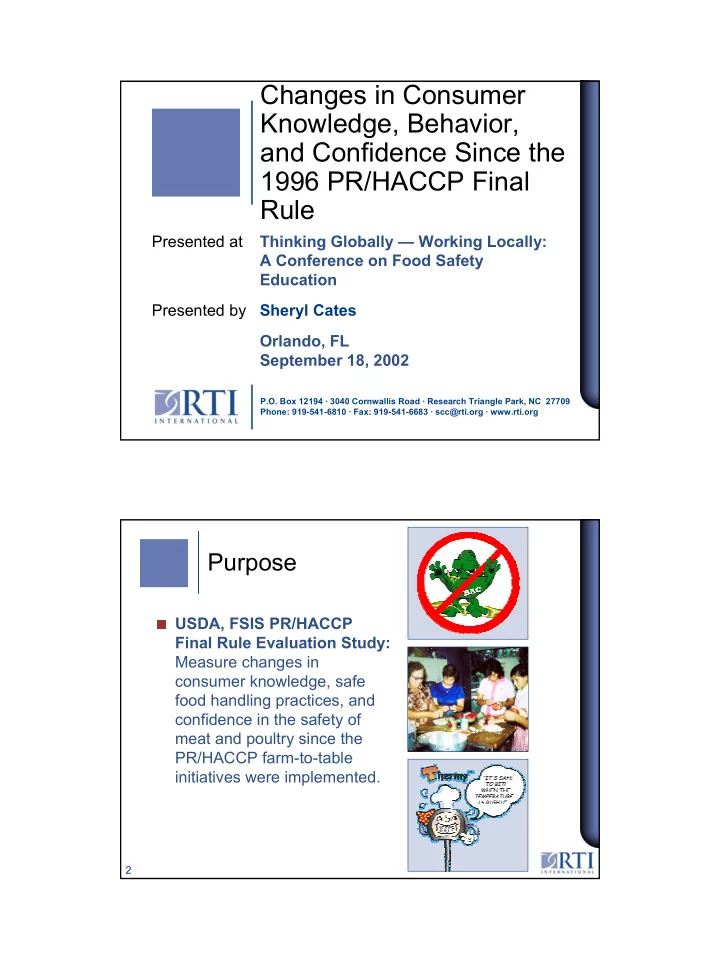
USDA, FSIS PR/HACCP

Final Rule Evaluation Study: Measure changes in consumer knowledge, safe food handling practices, and confidence in the safety of meat and poultry since the PR/HACCP farm-to-table initiatives were implemented.

slide-2
SLIDE 2

2

3

Existing Data Sources

2001 Home Food Safety Refrigeration Survey ADA & ConAgra 1998, 1999, 2001 Food Safety Survey Penn State University 1999 Utah State University Study FDA 1993, 1998, 2001 Food Safety Survey FDA & FSIS 1996/97, 1998/99, 2000/01 Population Survey CDC, FoodNet 1997, 1999, 2000 Home Food Safety Study Audits International Year(s) of Data Collection Study Sponsor

4

FSIS-Sponsored Consumer Focus Groups

General & High Risk Parents of Young Children Pregnant Women General & High Risk Population 2002 Changes in Consumer Knowledge, Behavior, and Confidence 2002 Thermometer Usage Messages and Delivery Mechanisms

http://www.fsis.usda.gov/OA/research/rti_thermy.pdf

2001 Listeriosis Food Safety Messages and Delivery Mechanisms

http://www.fsis.usda.gov/OA/research/lmfocus.pdf

2000 Food Safety Messages and Delivery Mechanisms

http://www.fsis.usda.gov/OA/research/fsmessages.pdf

Year Study
slide-3
SLIDE 3

3

5

Reported vs. Actual Behavior

In surveys and focus groups, consumers report that

they are more knowledgeable about food safety and have improved certain safe handling practices

However, observation studies show that actual

practices often differ from reported practices

Wash hands all or most of the time before food preparation Utah State University Study (1999) Reported 87% Actual 45%

6

Reported Safe Handling Practices: Clean and Separate (FDA/FSIS Food Safety Survey)

68% 66% 79% 76% 68% 85% 82% 72% 0% 20% 40% 60% 80% 100% Always wash hands with soap before preparing food Usually wash hands with soap after handling raw meat/poultry Properly clean cutting boards or other surfaces to prevent cross-contamination Percentage of Consumers (%) 1993 1998 2001 NA

slide-4
SLIDE 4

4

7

Reported Safe Handling Practices: Cook (FDA/FSIS Food Safety Survey)

22% 6% 3% 60% 32% 12% 6% 46% 0% 20% 40% 60% 80% 100% Own a food thermometer Always/often use thermometer- roasts* Always/often use thermometer- chicken parts* Always/often use thermometer- hamburgers* Percentage of Consumers (%) 1998 2001

*Includes non-thermometer owners.

8

Safe Handling Practices: Chill (FDA/FSIS Food Safety Survey & ADA/ConAgra Home Refrigeration Survey)

46% 26% 33% 40% 0% 20% 40% 60% 80% 100% Safely store large amounts

  • f leftovers (<2

hrs + shallow containers) Safely defrost meat/poultry Own a refrigerator thermometer Aware of proper refrigerator temperature Percentage of Consumers (%) 1993 2001 NA NA NA NA

slide-5
SLIDE 5

5

9

Knowledge of “High-Risk” Foods, High-Risk Populations, and Pathogens

Perception of meat and poultry

as “high-risk” foods has increased

Limited knowledge of high-risk

populations

Awareness of pathogens has

increased; however, consumers do not always follow practices to minimize pathogens

10

Awareness of Foodborne Pathogens (FDA/FSIS Food Safety Survey)

5% 7% 8% 9% 79% 14% 85% 93% 31% 88% 93% 0% 20% 40% 60% 80% 100% Salmonella

  • E. coli

Listeria Campylobacter Percentage of Consumers (%) 1993 1998 2001

Have you ever heard of [pathogen] as a problem in food?

NA

slide-6
SLIDE 6

6

11

Focus Group Findings on Changes in Consumer Knowledge and Behavior

Reported changes Switch from wood to plastic cutting boards Defrost foods in refrigerator More conscientious about hand washing Overcook meat and poultry Use food thermometer Participants attribute behavioral changes to media

coverage of food safety

Many participants rely on food labels for food safety

information

12

Audits International Home Food Safety Study

25% 25% 4% 0% 10% 20% 30% 40% 50% 1997 1999 2000 Acceptable Performance Percentage of Households (%)

Acceptable Performance = no critical violations and no more than four major violations

slide-7
SLIDE 7

7

13

Focus Group Findings on Changes in Consumer Confidence

Participants’ confidence in the safety of meat and

poultry has increased or remained about the same

Participants attribute their increased confidence to

media coverage of food safety

Participants think the government is doing an

adequate job keeping meat and poultry safe

Most participants think the government has not

improved its performance in the past 5 years

14

Consumer Confidence in the Safety of Meat and Poultry

Most consumers willingly accept responsibility for

ensuring that the food they eat is safe

Most consumers are confident that the meat and

poultry they prepare at home is safe to eat

Consumers worry more about how meat and poultry

are handled prior to purchase than about how they handle it at home

Believe foodborne illness originates in food

processing plants and restaurants, not their homes

Concerns about antibiotic residues Concerns about food transportation

slide-8
SLIDE 8

8

15

Conclusions (I)

Consumers’ reported knowledge and use of safe

handling practices have increased; however, when

  • bserved consumers do not always follow safe

practices

Although the self-reported use of some practices has

increased, additional improvements are warranted

Food thermometer use Safely storing leftovers Safely thawing meat/poultry

16

Conclusions (II)

Consumers have some knowledge about foodborne

pathogens, “high-risk” foods, and high-risk populations, but their knowledge is sometimes wrong

  • r incomplete

Consumer confidence in the safety of meat and

poultry has increased or remained about the same

Consumers are satisfied with the government’s

performance at ensuring the safety of meat and poultry

slide-9
SLIDE 9

9

17

A Conference on Food Safety Education

Thinking Globally -- Working Locally