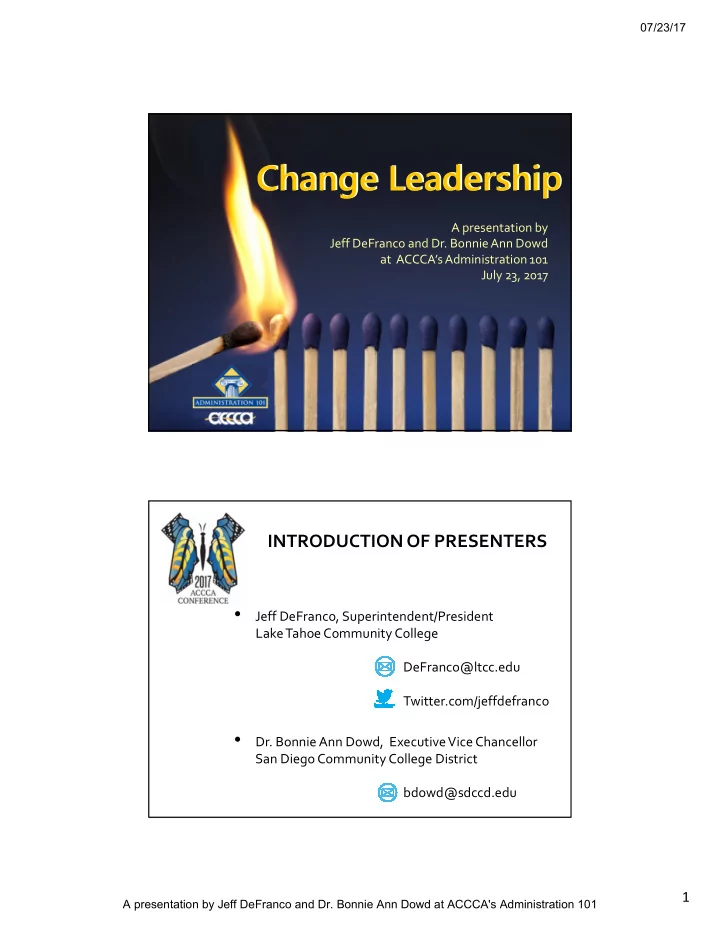
Change Leadership Change Leadership A presentation by Jeff - - PDF document

change leadership change leadership
SMART_READER_LITE
LIVE PREVIEW

Change Leadership Change Leadership A presentation by Jeff - - PDF document

07/23/17 Change Leadership Change Leadership A presentation by Jeff DeFranco and Dr. Bonnie Ann Dowd at ACCCAs Administration 101 July 23, 2017 INTRODUCTION OF PRESENTERS Jeff DeFranco, Superintendent/President Lake Tahoe Community


slide-1
SLIDE 1

1

Change Leadership Change Leadership

A presentation by Jeff DeFranco and Dr. Bonnie Ann Dowd at ACCCA’s Administration 101 July 23, 2017

INTRODUCTION OF PRESENTERS

  • Jeff DeFranco, Superintendent/President

Lake Tahoe Community College DeFranco@ltcc.edu Twitter.com/jeffdefranco

  • Dr. Bonnie Ann Dowd, Executive Vice Chancellor

San Diego Community College District bdowd@sdccd.edu

07/23/17 A presentation by Jeff DeFranco and Dr. Bonnie Ann Dowd at ACCCA's Administration 101

slide-2
SLIDE 2

2

WHY “CHANGE LEADERSHIP?”

Roadmap Roadmap

07/23/17 A presentation by Jeff DeFranco and Dr. Bonnie Ann Dowd at ACCCA's Administration 101

slide-3
SLIDE 3

3

PROGRAM LEARNING OUTCOMES

  • Understand typical impacts of change on individuals and
  • rganizations
  • Learn how to facilitate change
  • Understand the leaders role during the change process
  • Understand concepts to drive organizational transformation;

specifically, moving from incremental change to adaptive change

  • How to influence beliefs to lead to actions.

(Start with Why)

  • Apply these lessons to your work for your

college or district

CHANGE AHEAD

07/23/17 A presentation by Jeff DeFranco and Dr. Bonnie Ann Dowd at ACCCA's Administration 101

slide-4
SLIDE 4

4

Definition

Change: [chãnj] verb. 1) to make or become different 2) to transform

WHY DOESN’T CHANGE OFTEN SUCCEED?

07/23/17 A presentation by Jeff DeFranco and Dr. Bonnie Ann Dowd at ACCCA's Administration 101

slide-5
SLIDE 5

5

SHARE YOUR EXPERIENCE WITH CHANGE

CHANGE IS UNCOMFORTABLE

07/23/17 A presentation by Jeff DeFranco and Dr. Bonnie Ann Dowd at ACCCA's Administration 101

slide-6
SLIDE 6

6

Future Thinking…

Now lets be future thinkers…

07/23/17 A presentation by Jeff DeFranco and Dr. Bonnie Ann Dowd at ACCCA's Administration 101

slide-7
SLIDE 7

7

SUCCESS OR FAILURE IN CHANGE

  • Many authors have documented that

up to 70% of change initiatives fail.

  • -Higgs and Rowland, 2005

THE IMPLEMENTATION DIP

07/23/17 A presentation by Jeff DeFranco and Dr. Bonnie Ann Dowd at ACCCA's Administration 101

slide-8
SLIDE 8

8

THE IMPLEMENTATION DIP

How can leaders help replicate the 30% of change initiatives that are successful?

07/23/17 A presentation by Jeff DeFranco and Dr. Bonnie Ann Dowd at ACCCA's Administration 101

slide-9
SLIDE 9

9

REPLICATING SUCCESSFUL CHANGE

  • Create milestones along the way and

celebrate achievements when those goals are met (Kotter, 1995) to motivate and help reinvigorate the movement

  • Break up progress in bite size elements for

ease in communication

COMPONENTS OF SUCCESSFUL CHANGE MANAGEMENT

  • Change Initiation; making a compelling case for

change and getting key, respected stakeholders

  • n board with the movement
  • Change Leadership; fostering a shared vision and

influencing and persuading others;

  • Change Presence; the leader is visibly and

courageously committed to the change goals.

Higgs, M., & Rowland, D. (2000). Building change leadership capability: ‘The quest for change competence’. Journal of Change Management, 1(2), 116-130. http://doi:10.1080/714042459

07/23/17 A presentation by Jeff DeFranco and Dr. Bonnie Ann Dowd at ACCCA's Administration 101

slide-10
SLIDE 10

10

FACILITATIVE LEADERSHIP – SHARED VISION

How does small change develop into large change?

07/23/17 A presentation by Jeff DeFranco and Dr. Bonnie Ann Dowd at ACCCA's Administration 101

slide-11
SLIDE 11

11

DIFFUSION OF INNOVATION

Rogers, E., (1962). Diffusion of Innovations. New York, NY: Free Press of Glencoe.

DIFFUSION OF INNOVATION

June 2008-Dec 2008 2015 Fall 2009 According to a 2015 survey 68% of the U.S. mobile consumers own smartphones. 2010-11 2012 Rogers, E., (1962). Diffusion of Innovations. New York, NY: Free Press of Glencoe.

07/23/17 A presentation by Jeff DeFranco and Dr. Bonnie Ann Dowd at ACCCA's Administration 101

slide-12
SLIDE 12

12

THE TIPPING POINT

  • Malcolm Gladwell emphasized the significant

impact that a small, yet critical, group of people can play in sparking change. “The tipping point is that magic moment when an idea, trend, or social behavior crosses a threshold, tips, and spreads like wildfire.”

  • -Gladwell, 2000, p.55

07/23/17 A presentation by Jeff DeFranco and Dr. Bonnie Ann Dowd at ACCCA's Administration 101

slide-13
SLIDE 13

13

DIFFUSION OF INNOVATION

Rogers, E., (1962). Diffusion of Innovations. New York, NY: Free Press of Glencoe.

SURFING THE EDGE OF CHAOS

(Pascale, Millemann, & Gioja, 2000)

07/23/17 A presentation by Jeff DeFranco and Dr. Bonnie Ann Dowd at ACCCA's Administration 101

slide-14
SLIDE 14

14

SURFING THE EDGE OF CHAOS

Paradigm Shift

SURFING THE EDGE OF CHAOS

  • Followers want leaders to cushion them

from the shock of risk. However, great leaders use risk to force

  • rganizations to adapt.
  • Organizations are complex adaptive

systems, but equilibrium makes them complacent and vulnerable, so adaptive leaders deliberately upset their organizations' equilibrium.

07/23/17 A presentation by Jeff DeFranco and Dr. Bonnie Ann Dowd at ACCCA's Administration 101

slide-15
SLIDE 15

15

SURFING THE EDGE OF CHAOS

  • The chairman of Sears shocked

the old stores and tried to inspire part-time clerks and salespeople to seek solutions to daunting problems.

  • He was met with partial

success, but old ways reasserted themselves.

PARADIGM SHIFT: FOSBURY FLOP

07/23/17 A presentation by Jeff DeFranco and Dr. Bonnie Ann Dowd at ACCCA's Administration 101

slide-16
SLIDE 16

16

QUOTES FROM THOMAS KUHN

“All the significant breakthroughs were break-withs old ways

  • f thinking”
  • -Thomas Kuhn

Thomas Samuel Kuhn (7/18/22– 6/17/96) was an American physicist, historian and philosopher of science.

07/23/17 A presentation by Jeff DeFranco and Dr. Bonnie Ann Dowd at ACCCA's Administration 101

slide-17
SLIDE 17

17

QUOTES FROM ALBERT EINSTEIN “The significant problem we face cannot be solved at the same level of thinking we were at when we created them.”

  • -Albert Einstein

START WITH WHY

07/23/17 A presentation by Jeff DeFranco and Dr. Bonnie Ann Dowd at ACCCA's Administration 101

slide-18
SLIDE 18

18

START WITH WHY

07/23/17 A presentation by Jeff DeFranco and Dr. Bonnie Ann Dowd at ACCCA's Administration 101

slide-19
SLIDE 19

19

START WITH WHY

QUOTES BY SIMON SINEK

  • "I try to find, celebrate and

teach leaders how to build platforms that will inspire

  • thers.”
  • “If you hire people just because

they can do a job, they’ll work for your money. But if you hire people who believe what you believe, they’ll work for you with blood and sweat and tears. ”

Simon O. Sinek is a British/American author, motivational speaker and marketing consultant

07/23/17 A presentation by Jeff DeFranco and Dr. Bonnie Ann Dowd at ACCCA's Administration 101

slide-20
SLIDE 20

20

QUOTES BY SIMON SINEK

  • “People don’t buy what you

do; people buy why you do it.”

  • "[Martin Luther King, Jr.]

gave the I have a dream speech, not the I have a plan speech.”

In any change effort there are major questions to be asked first before change occurs:

07/23/17 A presentation by Jeff DeFranco and Dr. Bonnie Ann Dowd at ACCCA's Administration 101

slide-21
SLIDE 21

21

What is your path to make change?

Schmieder-Ramirez, 2016

Is it “doable” in your mind?

Schmieder-Ramirez, 2016

07/23/17 A presentation by Jeff DeFranco and Dr. Bonnie Ann Dowd at ACCCA's Administration 101

slide-22
SLIDE 22

22

Does it fit with the mission?

Schmieder-Ramirez, 2016

WILL IT FIT ON A

T-SHIRT?

Schmieder-Ramirez, 2016

07/23/17 A presentation by Jeff DeFranco and Dr. Bonnie Ann Dowd at ACCCA's Administration 101

slide-23
SLIDE 23

23

TWO-WAY COMMUNICATION IS THE CURRENCY OF CHANGE A USEFUL RULE ABOUT VISION “Whenever you cannot describe the vision driving a change initiative in five minutes or less and get a reaction that signifies both understanding and interest, you are in for trouble."

  • - John Kotter

“Leading Change”

07/23/17 A presentation by Jeff DeFranco and Dr. Bonnie Ann Dowd at ACCCA's Administration 101

slide-24
SLIDE 24

24

CHANGE MANAGEMENT LESSONS VIDEO

07/23/17 A presentation by Jeff DeFranco and Dr. Bonnie Ann Dowd at ACCCA's Administration 101

slide-25
SLIDE 25

25

This work is licensed under the Creative Commons Attribution-NoDerivs 3.0 Unported License. It may be freely shared for commercial or non-commercial purposes providing it is not resold, altered, edited or displayed in part. It must remain attributed to Better Business Learning Pty Ltd.

Everything you need to build change capability

Learn more at www.changeactivation.com

07/23/17 A presentation by Jeff DeFranco and Dr. Bonnie Ann Dowd at ACCCA's Administration 101

slide-26
SLIDE 26

26

LEADING CHANGE Eight Steps to Transforming Your Organization

  • - John Kotter “Leading Change”

Kotter, J. P. (1995). Leading change: Why transformation efforts fail. Harvard Business Review, 73(2), 69-67

07/23/17 A presentation by Jeff DeFranco and Dr. Bonnie Ann Dowd at ACCCA's Administration 101

slide-27
SLIDE 27

27

  • 1. Establishing a Sense of Urgency
  • Examining market and

competitive realities

  • Identifying and discussing

crises, potential crises or major

  • pportunities

Eight Steps to Transforming Your Organization

Kotter, J. P. (1995). Leading change: Why transformation efforts fail. Harvard Business Review, 73(2), 69-67

  • 2. Forming a Powerful Guiding Coalition
  • Assembling a group with enough power

to lead the change effort

  • Encouraging the group to work

together as a team

Eight Steps to Transforming Your Organization

Kotter, J. P. (1995). Leading change: Why transformation efforts fail. Harvard Business Review, 73(2), 69-67

07/23/17 A presentation by Jeff DeFranco and Dr. Bonnie Ann Dowd at ACCCA's Administration 101

slide-28
SLIDE 28

28

  • 3. Creating a Vision
  • Creating a vision to help direct the

change effort

  • Developing strategies for achieving

that vision

Eight Steps to Transforming Your Organization

Kotter, J. P. (1995). Leading change: Why transformation efforts fail. Harvard Business Review, 73(2), 69-67

  • 4. Communicating the Vision
  • Using every vehicle possible to

communicate the new vision and strategies

  • Teaching new behaviors by the

example of the guiding coalition

Eight Steps to Transforming Your Organization

Kotter, J. P. (1995). Leading change: Why transformation efforts fail. Harvard Business Review, 73(2), 69-67

07/23/17 A presentation by Jeff DeFranco and Dr. Bonnie Ann Dowd at ACCCA's Administration 101

slide-29
SLIDE 29

29

  • 5. Empowering Others to Act on the Vision
  • Getting rid of obstacles to change
  • Changing systems or structures that

seriously undermine the vision

  • Encouraging risk taking and

nontraditional ideas, activities, and actions

Eight Steps to Transforming Your Organization

Kotter, J. P. (1995). Leading change: Why transformation efforts fail. Harvard Business Review, 73(2), 69-67

  • 6. Planning for and Creating Short-Term Wins
  • Planning for visible performance

improvements.

  • Creating those improvements
  • Recognizing and rewarding

employees involved in the improvements

Eight Steps to Transforming Your Organization

Kotter, J. P. (1995). Leading change: Why transformation efforts fail. Harvard Business Review, 73(2), 69-67

07/23/17 A presentation by Jeff DeFranco and Dr. Bonnie Ann Dowd at ACCCA's Administration 101

slide-30
SLIDE 30

30

  • 7. Consolidating Improvements and

Producing Still More Changes

  • Using increased credibility to change

systems, structures, and policies that don’t fit the vision

  • Hiring, promoting, and developing

employees who can implement the vision

  • Reinvigorating the process with new

projects, themes, and change agents

Eight Steps to Transforming Your Organization

Kotter, J. P. (1995). Leading change: Why transformation efforts fail. Harvard Business Review, 73(2), 69-67

  • 8. Institutionalizing New Approaches
  • Articulating the connections

between the new behaviors and corporate success

  • Developing the means to ensure

leadership development and succession

Eight Steps to Transforming Your Organization

Kotter, J. P. (1995). Leading change: Why transformation efforts fail. Harvard Business Review, 73(2), 69-67

07/23/17 A presentation by Jeff DeFranco and Dr. Bonnie Ann Dowd at ACCCA's Administration 101

slide-31
SLIDE 31

31

CHANGE THE CULTURE, CHANGE THE GAME

  • Don’t demand actions. Leaders must form

the beliefs that lead to the actions.

  • Leaders also shape the experiences that lead to beliefs.
  • When you create an experience, present an

interpretation as well; connect the experience to the beliefs you want others to hold.

  • Telling people what to do is different from influencing

them to act in new ways. Since influence stems from understanding, it is important to engage in dialogue and transparent sharing of information.

Connors, R., Smith, T. (2011). Changing the culture, change the game: The breakthrough strategy for energizing your

  • rganization and creating accountability for results. New York, NY: Penguin Random House.

CHANGE THE CULTURE

  • “Culture forms the superglue that bonds an
  • rganization, unites people, and helps an

enterprise accomplish desired ends.” (p. 253)

  • -Bolman & Deal, 2008
  • The culture of an organization is dependent
  • n its “function, time, product, customers

place and process.”

  • -Bolman & Deal, 2013

07/23/17 A presentation by Jeff DeFranco and Dr. Bonnie Ann Dowd at ACCCA's Administration 101

slide-32
SLIDE 32

32

EXAMPLES OF CHANGING CULTURE

IBM’s culture is formal and rigid. Google’s culture is more laidback and Informal. Due to the pioneering and competitive market, Apple’s culture is one of secrecy, teamwork and high attention to detail. Toyota maintains a traditional culture, focused on quality, affordability and high productivity.

Bolman, L.G., & Deal, T.E. (2008. Reframing organizations: Artistry, choice, and leadership (4th ed.). San Francisco: Jossey-Bass

FIVE PRACTICES OF EXEMPLARY LEADERSHIP

When leaders are at their best, they:

  • 1. Model the Way
  • 2. Inspire a Shared Vision
  • 3. Challenge the Process
  • 4. Enable Other to Act
  • 5. Encourage the Heart

(Kouzes & Posner, 2010)

07/23/17 A presentation by Jeff DeFranco and Dr. Bonnie Ann Dowd at ACCCA's Administration 101

slide-33
SLIDE 33

33

MODEL THE WAY:

for colleagues, employees, customers and others.

Clarify values by finding your voice and affirming shared values. Set the example by aligning actions with shared values.

Leadership Practices:

Kouzes and Posner, 2012

INSPIRE A SHARED VISION:

Enlist others to create an ideal image of what the

  • rganization can be.

E Envision the future by imagining exciting and ennobling possibilities. Enlist others in a common vision by appealing to shared aspirations.

Leadership Practices:

Kouzes and Posner, 2012

07/23/17 A presentation by Jeff DeFranco and Dr. Bonnie Ann Dowd at ACCCA's Administration 101

slide-34
SLIDE 34

34

CHALLENGE THE PROCESS:

abandon the status quo to seek innovative ways to improve.

Search for opportunities by seizing the initiative and by looking outward for innovative ways to improve. Experiment and take risks by constantly generating small wins and learning from experience.

Leadership Practices:

Kouzes and Posner, 2012

ENABLE OTHERS TO ACT:

Foster collaboration by actively involving others and demonstrating mutual respect and trust.

Foster collaboration by building trust and facilitating relationships. Strengthen others by increasing self- determination and developing competence.

Leadership Practices:

Kouzes and Posner, 2012

07/23/17 A presentation by Jeff DeFranco and Dr. Bonnie Ann Dowd at ACCCA's Administration 101

slide-35
SLIDE 35

35

ENCOURAGE THE HEART:

Recognize the contributions of

  • thers and celebrate

accomplishments.

Recognize contributions by showing appreciation for individual excellence. Celebrate the values and victories by creating a supportive community.

Leadership Practices:

Kouzes and Posner, 2012

THE LEADERS ROLE DURING CHANGE

  • Make a business case for change
  • Communicate the risks of not changing
  • Educate employees on how their work will change
  • Be visible, accessible, & transparent
  • Be an ambassador for the change
  • Stay optimistic
  • Be the keeper of the vision

07/23/17 A presentation by Jeff DeFranco and Dr. Bonnie Ann Dowd at ACCCA's Administration 101

slide-36
SLIDE 36

36

ROLE OF AMBASSADORS

  • “PR team” for project
  • Making the business case for change
  • Two-way communication
  • Sharing the vision
  • Greener pastures ahead
  • What this project will do for you?
  • Why this project is compelling?

(emotional ties)

EMPLOYEES ROLE DURING CHANGE

  • Recognize that change does happen
  • Seek information and answers
  • Communicate with others
  • Assess what stage you are at
  • Know there will be a dip…
  • Engage in the change – help drive
  • Try and see the big picture
  • Be a navigator!!!

07/23/17 A presentation by Jeff DeFranco and Dr. Bonnie Ann Dowd at ACCCA's Administration 101

slide-37
SLIDE 37

37

FACILITATING DISCUSSIONS ABOUT CHANGE

  • Acknowledge underlying concerns and feelings
  • Share honest concerns & feelings
  • Encourage the open expression of concerns and

feelings

  • Accept, empathize and

legitimize

  • Share what you know

and don’t know

Understanding the Individual Process of Change Understanding the Individual Process of Change Denial Commitment Resistance Exploration

(Adapted from Scott &Jaffe, 1989)

07/23/17 A presentation by Jeff DeFranco and Dr. Bonnie Ann Dowd at ACCCA's Administration 101

slide-38
SLIDE 38

38

Facilitative Strategies

  • Provide frequent consistent messages and

information

  • Demonstrate visible signs of change
  • Clarify what is changing and what is not
  • Place change in broader context
  • Address rumors and misinformation

Facilitative Strategies

  • Provide guidance, support and recognition
  • Provide frequent feedback on progress
  • Provide opportunities for leadership
  • Establish “performance levers” to sustain

new behavior

  • Careful not to overload or burnout

Facilitative Strategies

  • Probe for underlying feelings/concerns
  • Acknowledge and legitimize feelings
  • Clarify case for change, vision and plan
  • Listen reflectively and actively
  • Establish firm expectations
  • Provide exposure and opportunity to influence

through participation Facilitative Strategies

  • Acknowledge efforts and struggle
  • Celebrate successes and endings
  • Provide opportunities for visible advocacy
  • Provide varied opportunities for

participation and contribution

Denial Commitment Resistance Exploration

(Adapted from Scott & Jaffe, 1989)

Understanding the Individual Process of Change

HOW TO LEAD CHANGE AT A COLLEGE & DISTRICT LEVEL

07/23/17 A presentation by Jeff DeFranco and Dr. Bonnie Ann Dowd at ACCCA's Administration 101

slide-39
SLIDE 39

39

IF I COULD CHANGE ONE THING IN MY ORGANIZATION WHAT WOULD IT BE?... WHICH OF THESE CHANGE STRATEGIES COULD ACHIEVE THE DESIRED CHANGE?

07/23/17 A presentation by Jeff DeFranco and Dr. Bonnie Ann Dowd at ACCCA's Administration 101

slide-40
SLIDE 40

40

QUESTIONS

07/23/17 A presentation by Jeff DeFranco and Dr. Bonnie Ann Dowd at ACCCA's Administration 101