Challenging a Business Property Assessment Strategies for Reducing - - PowerPoint PPT Presentation

challenging a business property assessment
SMART_READER_LITE
LIVE PREVIEW

Challenging a Business Property Assessment Strategies for Reducing - - PowerPoint PPT Presentation

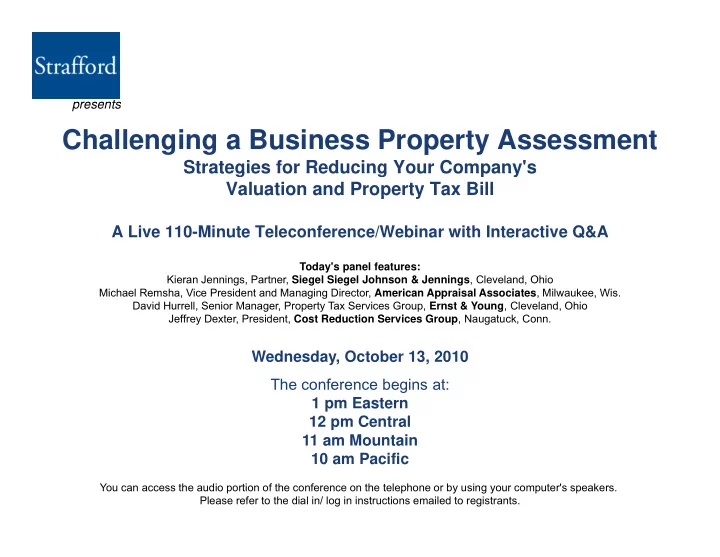
presents presents Challenging a Business Property Assessment Strategies for Reducing Your Company's Strategies for Reducing Your Company s Valuation and Property Tax Bill A Live 110-Minute Teleconference/Webinar with Interactive Q&A


slide-1
SLIDE 1

presents

Challenging a Business Property Assessment

Strategies for Reducing Your Company's

presents

Strategies for Reducing Your Company s Valuation and Property Tax Bill

A Live 110-Minute Teleconference/Webinar with Interactive Q&A

Today's panel features: Kieran Jennings, Partner, Siegel Siegel Johnson & Jennings, Cleveland, Ohio Michael Remsha, Vice President and Managing Director, American Appraisal Associates, Milwaukee, Wis. David Hurrell, Senior Manager, Property Tax Services Group, Ernst & Young, Cleveland, Ohio Jeffrey Dexter, President, Cost Reduction Services Group, Naugatuck, Conn.

Wednesday, October 13, 2010 The conference begins at: The conference begins at: 1 pm Eastern 12 pm Central 11 am Mountain 10 P ifi 10 am Pacific

You can access the audio portion of the conference on the telephone or by using your computer's speakers. Please refer to the dial in/ log in instructions emailed to registrants.

slide-2
SLIDE 2

For Continuing Education purposes, g please let us know how many people are listening at your location by g y y

  • closing the notification box
  • and typing in the chat box your
  • and typing in the chat box your

company name and the number of attendees attendees.

  • Then click the blue icon beside the box

to send to send.

For live event only

slide-3
SLIDE 3
  • If you are listening via your computer

If you are listening via your computer speakers, please note that the quality of your sound will vary depending on the speed and lit f i t t ti quality of your internet connection.

  • If the sound quality is not satisfactory and you

li t i i t k are listening via your computer speakers, please dial 1-866-869-6667 and enter your PIN when prompted. Otherwise, please send e p o p ed O e se, p ease se d us a chat or e-mail sound@straffordpub.com immediately so we can address the problem.

  • If you dialed in and have any difficulties

during the call, press *0 for assistance.

slide-4
SLIDE 4

Challenging A Business Challenging A Business Property Assessment Webinar

  • Oct. 13, 2010

David Hurrell, Ernst & Young david.hurrell@ey.com Jeffrey Dexter, Cost Reduction Services Group Michael Remsha, American cut.costs@att.net Kieran Jennings, Siegel Siegel Johnson & Appraisal Associates mremsha@american- appraisal.com Jennings kjennings@siegeltax.com

slide-5
SLIDE 5

Today’s Program Today s Program

Developing, Leveraging An Assessor Relationship Slides 6-14 (David Hurrell) Creating Your Presentation Slides 15-20 (Jeffrey Dexter) Lessons From Assessment Scenarios Slides 21-31 (Michael Remsha) Negotiating From A Position Of Strength Slides 32-40 (Kieran Jennings)

5

( g )

slide-6
SLIDE 6

Developing, Leveraging An Assessor Relationship Relationship David Hurrell, Ernst & Young

6

slide-7
SLIDE 7

Agenda For This Section

► Understanding the landscape ► What to expect: Know your assessor ► Establishing working relationships with assessors ► Accomplishing your goals: Making the relationship work for you

Page 7

slide-8
SLIDE 8

Understanding The Landscape

Total state and local business taxes, FY2008-FY2009, ($Billions) Total tal One One- ear ear % % T t T tal One One-Year ear Busin Business Tax ss Tax 200 008 200 009 Taxe axes Cha hange Property taxes on business property $209.60 $215.30 36.50% 2.70% General sales taxes on business inputs $133.2 $126.90 21.50%

  • 4.70%

Corporate income lax $58.10 $50.60 8.60

  • 13.00

rp rate i c me lax $ 8. $ .

  • 8. %
  • 3. %

Unemployment insurance 532.5 $30.70 5.20%

  • 5.50%

Business and corporate license $37.50 $38.30 6.50% 2.30% Individual income tax on business income $37.60 $32.30 5.50%

  • 14.10%

Public utility taxes $28.00 $28.80 4.90 2.90 ► Property taxes on real personal and utility property by business account for the largest share of total state and local Public utility taxes $2 . $2 . 4.9 % 2.9 % Excise taxes $29.20 $26.30 4.50% 9.90% Insurance premiums taxes $16.40 $15.60 2.60%

  • 5.20%

Other business taxes 529.1 $25.20 4.30%

  • 3.30%

Total Busin Total Business Taxes ss Taxes $611.10 $590.00 100.00%

  • 3.50%

► Property taxes on real, personal and utility property by business account for the largest share of total state and local business taxes, 36.5% or $215.3 billion. Property taxes increased 2.7% in FY2009, after growing 4.8% in FY2008 and 6.4% in FY2007. Property taxes as a share of total state and local businesses taxes increased by 2.2 percentage points in FY2009. Property taxes are the largest local business tax (74.1% of total local business taxes).

Page 8

slide-9
SLIDE 9

Understanding The Landscape (Cont.)

► Trend: Mounting state and local budget deficits, reflecting fallout

  • f economic recession
  • f economic recession

► State/local taxing jurisdiction responses: ► Use of more hired external auditors for personal property audits ► Use of more hired external auditors for personal property audits

  • n a contingency fee basis.

► Dismissal of distressed sales as evidence of “market value” ► Revaluations reflecting minimal decreases, unless challenged by

taxpayers taxpayers

► Pressure for increased tax levies ► Consideration of split/rolls adverse to business property ► Reconsideration of changes in ownership limits on caps (i e

CA

► Reconsideration of changes in ownership limits on caps (i.e., CA

– proposed change – Prop XIII)

Page 9

slide-10
SLIDE 10

What To Expect: Know Your Assessor

Assessment community – general characteristics

► Mass appraisal techniques ► Comfort level with the cost approach ► Typically slow to react to market changes ► Pushing back with greater force and frequently on appeals, value

reductions and waivers for fees, penalties, etc. , p ,

► Greater flexibility in an informal setting vs. appeals

Page 10

slide-11
SLIDE 11

What To Expect: Know Your Assessor (Cont.)

Local assessor meetings – Tips for preparation

Understand the LOCAL landscape N t L l b i d liti l li t

News reports: Local economy, business and political climate

Research recent and historical property tax cases and hearings

Connect with colleagues, business contacts and consultants who operate in the local jurisdiction the local jurisdiction

Gain a working understanding of the assessor’s methodologies, comfort levels and acceptable risk parameters

Local statutes

Local statutes

Standard of value

Where to get comparables

Understand local customs – “When in Rome ”

Understand local customs – When in Rome …

“Step into the shoes” of the assessor by considering:

Jurisdiction responsibilities

Reporting requirements

Page 11

Reporting requirements

Documentation needed

slide-12
SLIDE 12

Establishing Working Relationships With Assessors

Basics

► Respect is a must ► Always be truthful; don’t omit or hide facts ► Identify potential common bonds by observing the assessor’s

surroundings

► Be as transparent as possible. Develop credibility and trust by acting

p p p y y g ethically.

Page 12

slide-13
SLIDE 13

Establishing Working Relationships With Assessors (Cont.) ( )

Practical considerations Practical considerations

► Gain credibility ► Know the subject property ► Site visit ► Spend time with operations people ► Develop a meaningful argument with market-based support ► Thorough preparation is key ► Third-party documentation ► Be comfortable with the information you provide ► Be comfortable with the information you provide ► Special considerations for proprietary information

Page 13

slide-14
SLIDE 14

Accomplishing Your Goals: Making The Relationship Work For You p

The art of negotiation

► Balancing what the assessor will accept with your company’s needs ► Balancing what the assessor will accept with your company s needs ► How aggressive do you have to be to achieve the desired result? ► Political considerations/standing in the community ► Internal buy-in ► Establish acceptable settlement parameters ► Leverage your knowledge of how the assessor operates ► Outline key objectives ► Document settlement options ► Be prepared for pushback ► Be prepared for pushback ► Make it a win-win situation ► Marathon, not a sprint

Page 14

slide-15
SLIDE 15

Creating Your Presentation Jeffrey Dexter, Cost Reduction Services Group

15

slide-16
SLIDE 16

Determining If There’s A Case

  • Gathering property info (see info sheet for this section)
  • Benchmarking resources to check
  • Benchmarking resources to check
  • Review any recent appraisal
  • Tour the property

16

slide-17
SLIDE 17

“Know Your Audience”

  • Revaluation company and staffers

B d f A A l

  • Board of Assessment Appeals
  • Assessor
  • Town/county attorney
  • Your property manager/contact

17

slide-18
SLIDE 18

“D l i Y P t ti ” “Developing Your Presentation”

  • Start with the basics (see presentation handout for this section)
  • Discuss the problems (note what detracts from value)
  • Discuss the problems (note what detracts from value)
  • Know if something adds to value
  • Income/expense info

» Data source, time frame, format

  • Show all rent information
  • Use comparable assessments, if warranted
  • Photos: A picture is worth a thousand words

18

slide-19
SLIDE 19

“Show Time!”

Wh d i h

  • Where to go … and getting there.
  • Listening in (a/k/a “eavesdropping”)
  • The “ice breaker”
  • Asking questions (e.g., of the revaluation company)

A i ti

  • Answering questions
  • Beg for questions

19

slide-20
SLIDE 20

Post-Presentation

  • Any “after the meeting” questions needing an answer?
  • Any amendments to be made?
  • Any amendments to be made?
  • Critique your performance
  • On to the next show

20

slide-21
SLIDE 21

Lessons From Assessment Scenarios

Michael Remsha, American Appraisal Associates

21

slide-22
SLIDE 22

Levels Of Value Levels Of Value

Definitions vary by state M k l

  • Market value
  • Fair market value
  • Full value
  • Fair and cash value
  • Fair and cash value
  • True value
  • Among others

Generally the assessment should reflect what you can Generally, the assessment should reflect what you can sell the property for in the market

  • With or without installation?

22

slide-23
SLIDE 23

Approaches To Value Approaches To Value

Income approach

  • Can be too complex
  • Data may not be available

Data may not be available Sales comparison approach

  • Can be very useful for marketable assets

y Cost approach

  • Can be applied to most assets

23

slide-24
SLIDE 24

Real Life Story No.1 Real Life Story No.1

V l f i l i h i d Very large manufacturing plant in the auto industry

  • Supplied parts to the auto assembly plants
  • Supplied replacement parts to the public
  • Global market
  • Global market
  • 20 years old (effective age of PP = 10 years)
  • Updated many times over the years

Updated many times over the years

  • Major issues with functional obsolescence (FO)
  • FO was not economically curable
  • Technology continually changing

gy y g g

  • County assessor relied on state tables!

24

slide-25
SLIDE 25

Real Life Story No. 1 (Cont.) Real Life Story No. 1 (Cont.)

Replacement plant design

  • Same capacity and utility of actual plant
  • Utilized new, modern machinery and equipment
  • Design, cost and operating characteristics different
  • Smaller workforce
  • Lower energy expense
  • Less scrap

25

slide-26
SLIDE 26

Real Life Story No. 1 (Cont.) y ( )

Economic obsolescence (EO)

  • Compared the returns on invested capital
  • Current returns vs. “the good old days”
  • Value line investment survey data
  • Value line investment survey data
  • Returns as of appraisal date = 15%
  • Returns as of “the good old days” = 19%
  • EO = 21%

EO 21%

  • Compared equity-to-book ratio
  • Subject industry vs. U.S. industry
  • S&P industry surveys data

y y

  • Subject industry = 2.36
  • U.S. industry = 3.90
  • EO = 39%

26

slide-27
SLIDE 27

Real Life Story No. 1 (Cont.) y ( )

Functional obsolescence (FO)

  • Labor: 1,800 people vs. 1,254 people

E 8 35 MMB lb 6 23 MMB lb

  • Energy: 8.35 MMBtu per lb vs. 6.23 MMBtu per lb
  • Scrape: 1.25% of production vs. 0.50% of production

Annual penalty Annual penalty

  • Labor: $35,333,000
  • Energy: 2,045,000
  • Scrap: 3 458 000

Scrap: 3,458,000

  • Total: $40,836,000

Present value of the annual penalty = $158,000,000 p y , , Over the remaining life of the property

27

slide-28
SLIDE 28

Real Life Story No. 1 (Cont.) Real Life Story No. 1 (Cont.)

R d i $420 000 000 Reproduction cost new $420,000,000

  • Less FO due to excess capital costs

(60,000,000) Cost of replacement 480,000,000

  • Less physical depreciation

220 000 000

  • Less physical depreciation

220,000,000

  • Less economic obsolescence

52,000,000

  • Less functional obsolescence

158,000,000 Equals cost indicator of value $ 49 000 000 Equals cost indicator of value $ 49,000,000 Assessment was more than $100 million

28

slide-29
SLIDE 29

Real Life Story No 2 Real Life Story No. 2

Very large manufacturing plant in the telecommunications industry

  • Manufactured high-tech equipment
  • Technology advanced every six months

f i i l h i

  • Manufacturing equipment was constantly changing
  • Global market
  • Major issue with “ghost assets” or “unrecorded retirements”
  • Major issue with “ghost assets” or “unrecorded retirements”
  • Continually being updated
  • Cannibalism was an issue
  • Major issues with functional (technological) obsolescence

Major issues with functional (technological) obsolescence

  • Technology was continually changing
  • County assessor relied on state M&E tables!

29

slide-30
SLIDE 30

Real Life Story No. 2 (Cont.) Real Life Story No. 2 (Cont.)

Cleaned up the property record (asset ledger) Cleaned up the property record (asset ledger) Went to the market to survey selling prices of M&E

  • Obtained actual market data from used equipment dealers

Obtained actual market data from used equipment dealers

  • Age vs. actual selling price
  • Developed a market-based depreciation schedule

p p

  • Age vs. % of historical cost
  • Applied it to the cleaned-up property record
  • Result: Market value of the actual assets on-site
  • Won case
  • State developed a special depreciation schedule for the future!

30

slide-31
SLIDE 31

In Conclusion In Conclusion

Income approach

  • Can be too complex
  • Can be too complex
  • Working capital vs. intangible assets vs. tangible assets

Sales comparison approach

  • Can be very useful for marketable assets

Can be very useful for marketable assets

  • Develop market-based depreciation curves

Cost approach

  • Must be able to quantify all forms of depreciation and obsolescence

q y p Any approach supported by factual evidence will get the point across and can be used in negotiations/court

31

slide-32
SLIDE 32

Negotiating From A Position Of Strength

Kieran Jennings, Siegel Siegel e Je gs, S ege S ege Johnson & Jennings

“If you know your enemies and know yourself, you can win a hundred battles.” – Sun Tzu

32

slide-33
SLIDE 33

Discovery

  • What is discovery?
  • What evidence must we turn over?
  • What evidence must we turn over?
  • Discoverable vs. admissible
  • What can we learn from our opposition?

33

slide-34
SLIDE 34

Knowledge That Is Necessary At Knowledge That Is Necessary At Beginning Of Case

  • Case law
  • Reassessment rules
  • Reassessment rules
  • Opposition
  • Local custom (unwritten rules)
  • Available valuation arguments

34

slide-35
SLIDE 35

When To Start Negotiation

  • Informal reviews
  • Filing the case
  • Filing the case
  • County level
  • Appeal level

Note: Each case is different, but the decision of when to start negotiation must be made after considering your opposition.

35

slide-36
SLIDE 36

Factors With The Case Judge

  • Has this judge decided similar cases?
  • Has this judge heard appeals for the subject?
  • Is the judge strict with rules of evidence and timelines?
  • What other factors may effect the pace of litigation?

36

slide-37
SLIDE 37

Your Evidence/Witness

  • Are you required to provide all evidence in your possession?
  • When do you need an appraisal?
  • What witnesses are needed to preserve evidence and testimony to be

used at trial?

  • How can you effectively start to negotiate?

37

slide-38
SLIDE 38

Opposing Witnesses

  • What cases did the witness testify in previously?
  • What is the style of testimony?
  • Are there potential contradictory statements in other court records?
  • What is the witness’ reputation?

38

slide-39
SLIDE 39

Opposing Attorney

  • What is their style of negotiation/litigation?
  • What is their background?

– Will they pull from other areas of law? – Is your case a test case for them?

39

slide-40
SLIDE 40

Getting Everyone To Agree

  • “One hundred victories in one hundred battles is not the most desired.

Capitulating the enemy without fighting is the most desired.” – Sun Capitulating the enemy without fighting is the most desired. Sun Tzu

  • Mediation
  • Mediation
  • Negotiation face-to-face vs. phone vs. e-mail

40