
SLIDE 1
Page 1 September 9, 2008 Group Risk Control
ERSTE GROUP
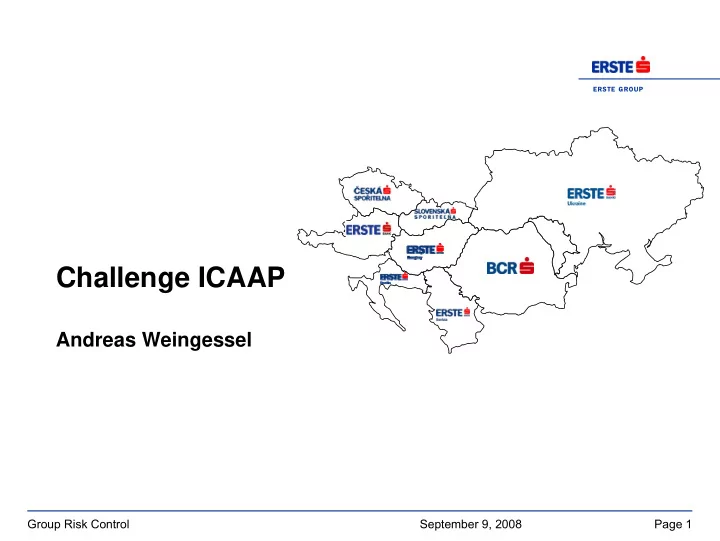
Challenge ICAAP Andreas Weingessel Group Risk Control September 9, - - PowerPoint PPT Presentation
ERSTE GROUP Challenge ICAAP Andreas Weingessel Group Risk Control September 9, 2008 Page 1 Agenda ERSTE GROUP Introduction Basel II From Pillar 1 to Pillar 2 Basel II Pillar 2 Risks to be considered Challenges in
Page 1 September 9, 2008 Group Risk Control
ERSTE GROUP
Page 2 September 9, 2008 Andreas Weingessel / Group Risk Control
ERSTE GROUP
Page 3 September 9, 2008 Andreas Weingessel / Group Risk Control
ERSTE GROUP
Slide taken from the presentation in the AGM
Page 4 September 9, 2008 Andreas Weingessel / Group Risk Control
ERSTE GROUP
Chief Risk Officer (CRO) Group Risk Management Group Credit Risk Reporting Group Risk Control Group Market & Liquidity RM Enterprise-wide RM Group Operational Risk Control Group Credit Risk Methods Group Rating Methods
Page 5 September 9, 2008 Andreas Weingessel / Group Risk Control
ERSTE GROUP
Page 6 September 9, 2008 Andreas Weingessel / Group Risk Control
ERSTE GROUP
Risk adequate capital All specific bank risks and other risks capital Market risk in the trading book Credit risk Operational risk
Minimum Capital Requirements
Continuous risk management process Evaluation of bank's internal capital adequacy assessment process (ICAAP) Definition of bank's individual solvability- coefficients
Supervisory Review Process
Enhanced disclosure Better assessment for market participants of capital adequacy of banks Increase of market discipline
Market Discipline
Page 7 September 9, 2008 Andreas Weingessel / Group Risk Control
ERSTE GROUP
0% 50% 100% 150% 200% 250% 300% 0% 20% 40% 60% 80% 100%
Page 8 September 9, 2008 Andreas Weingessel / Group Risk Control
ERSTE GROUP
Page 9 September 9, 2008 Andreas Weingessel / Group Risk Control
ERSTE GROUP
Page 10 September 9, 2008 Andreas Weingessel / Group Risk Control
ERSTE GROUP
Risk Basel I Basel II Best Practice Erste Bank AG
Counterparty Risk
Yes, but not risk sensitive significant improvements
Concentration Risk
Yes, but not risk sensitive significant improvements
Transfer Risk
No No
Settlement Risk
Yes, but not risk sensitive significant improvements
Trading book
Internal model (VaR) Internal model (VaR)
Interest risk in the Banking book
No Monitoring (Pillar II)
Equity risk
Yes, but not risk sensitive significant improvements Internal model (VaR) No
Real estate risk
No No Internal model (VaR) No
Operational Risk
No yes, different approaches Internal model (VaR) Internal model (VaR)
Business Risk
No No Internal model (VaR) Internal model (VaR)
Liquidity Risk
No Monitoring (Pillar II) Internal monitoring Internal monitoring
Riskaggregation
Total Risk = MR+CR Total Risk = MR+CR+OR Correlations / Copulas Correlations / Copulas Portfoliomodel based
(CreditManager) Internal model (VaR)
Creditrisk Market- risk
Internal model (VaR) Internal model (VaR)
Page 11 September 9, 2008 Andreas Weingessel / Group Risk Control
ERSTE GROUP
Page 12 September 9, 2008 Andreas Weingessel / Group Risk Control
ERSTE GROUP
(Internal Capital Adequacy Assessment Process)
(Internal Capital Adequacy Assessment Process)
(Supervisory Review and Evaluation Process)
(Supervisory Review and Evaluation Process)
(Risk Assessment System)
(Risk Assessment System)
(Supervisory Review Process)
(Supervisory Review Process)
Page 13 September 9, 2008 Andreas Weingessel / Group Risk Control
ERSTE GROUP
Page 14 September 9, 2008 Andreas Weingessel / Group Risk Control
ERSTE GROUP
A- (0,09%) AA- (0,04%) A+ (0,05%) A (0,07%) AA (0,03%) Confidence Level Rating 99,93% 99,97% ∅ 99,95% Capital Requirement = f (Target Confidence Level) Current Rating Target Rating
Page 15 September 9, 2008 Andreas Weingessel / Group Risk Control
ERSTE GROUP
Page 16 September 9, 2008 Andreas Weingessel / Group Risk Control
ERSTE GROUP
(1) Every institution must have a process for assessing its capital adequacy in relation to its risk profile (an ICAAP). (2) The ICAAP is the responsibility of the institution. (3) The ICAAP should be formal, the capital policy fully documented and the management body’s responsibility. (4) The ICAAP should form an integral part of the management process and decision- making culture of the institution. (5) The ICAAP should be reviewed regularly. (6) The ICAAP should be risk-based. (7) The ICAAP should be comprehensive. (8) The ICAAP should be forward-looking. (9) The ICAAP should be based on adequate measurement and assessment processes. (10) The ICAAP should produce a reasonable outcome.
Page 17 September 9, 2008 Andreas Weingessel / Group Risk Control
ERSTE GROUP
Diversi- fication Diversi- fication Business Risk Business Risk Central Capital Reserve Central Capital Reserve Market- risk Market- risk Credit- risk Credit- risk Op. Risk Op. Risk Capital Economic Capital Limit Capital + Shareholder Capital + Reserves + Hidden Reserves + Overendowment in provisions, general bad debt charge
fixed assets (i.e. securities) econom. Minimum- capital (EC Limit) econom. Minimum- capital (EC Limit)
Page 18 September 9, 2008 Andreas Weingessel / Group Risk Control
ERSTE GROUP
Page 19 September 9, 2008 Andreas Weingessel / Group Risk Control
ERSTE GROUP
Credit Risk traditional
Credit Risk
Treasury
Credit Risk
Market Risk Trading Book Market Risk Banking Book Market Liquidity Risk
Market Risk Quantifiable Risks
(effect on return < 1 year)
Strategic Risks
(effect on return > 1 year)
Operational Risk
Page 20 September 9, 2008 Andreas Weingessel / Group Risk Control
ERSTE GROUP
part of credit risk
IT - System External Process Employees
Event Risk
Operational Risk
Own Assets Business risk Reputational Risk Equity Risk Liquidity Risk
Page 21 September 9, 2008 Andreas Weingessel / Group Risk Control
ERSTE GROUP
Credit institutions must have in place administrative, accounting and control mechanisms for the capture, assessment, management and monitoring of risks arising from banking transactions and banking
transactions conducted. Wherever possible, the administrative, accounting and control procedures must also capture risks arising from banking transactions and banking operations which might possibly arise. …
In particular, the procedures pursuant to para. 2 must include the following:
are not covered by no. 3,
Page 22 September 9, 2008 Andreas Weingessel / Group Risk Control
ERSTE GROUP
Page 23 September 9, 2008 Andreas Weingessel / Group Risk Control
ERSTE GROUP
Page 24 September 9, 2008 Andreas Weingessel / Group Risk Control
ERSTE GROUP
Page 25 September 9, 2008 Andreas Weingessel / Group Risk Control
ERSTE GROUP
Page 26 September 9, 2008 Andreas Weingessel / Group Risk Control
ERSTE GROUP
Page 27 September 9, 2008 Andreas Weingessel / Group Risk Control
ERSTE GROUP
External Data Scenario Analysis Business Environment & Internal Control Factors Internal Data
Data Entry by Nominated Persons ORCA Audit Reports Risk Assessment / Risk Mapping Captive G/L Accounts Risk Map Knowledge of independent Line Managers and Business Experts Knowledge
Team Scenario Analysis Workshop Scenarios ORX Database Loss experience
banks Group Model Statistical Tests Validation Data Flow Information Used Internal Watchlist Allocation to Subsidiaries Gross Income Exposure Indicators KRIs (Op)Risk Committee External Insurance Cover Relevance Relevance External Watchlist ORCA Supervisor
Page 28 September 9, 2008 Andreas Weingessel / Group Risk Control
ERSTE GROUP
Page 29 September 9, 2008 Andreas Weingessel / Group Risk Control
ERSTE GROUP
Page 30 September 9, 2008 Andreas Weingessel / Group Risk Control
ERSTE GROUP
*Cited from: Basel Committee: Range of practices and issues in economic capital modelling. Forthcoming
Page 31 September 9, 2008 Andreas Weingessel / Group Risk Control
ERSTE GROUP
Page 32 September 9, 2008 Andreas Weingessel / Group Risk Control
ERSTE GROUP
Page 33 September 9, 2008 Andreas Weingessel / Group Risk Control
ERSTE GROUP
Page 34 September 9, 2008 Andreas Weingessel / Group Risk Control
ERSTE GROUP
Local Supervisor Creditor Rating agency Risk vs. Capital Shareholder Analysts Risk vs. Return Retail Private Banking Asset Management Large Corporates Treasury ALM
Page 35 September 9, 2008 Andreas Weingessel / Group Risk Control
ERSTE GROUP
Good credit qualities priced at expensive market conditions Migration of good customers to banks with risk-adjusted pricing Poor credit qualities are priced too cheap Immigration of these customers from banks with risk- adjusted pricing increasing risk in portfolio
Rating Margin in % 1 2 3 4 5 6 7 8 flat market price too expensive too cheap
Page 36 September 9, 2008 Andreas Weingessel / Group Risk Control
ERSTE GROUP
Personnel Cost Net Interest Income Other Income
Other Costs Total Income Expenses Credit Risk Market Risk Business Risk Operational Risk Economic Capital Hurdle Rate Expected Loss Risk adjusted Return Cost of Economic Capital Economic Profit ROEC/ RAROC Shareholder value added
Revenue / Gross margin Drivers Cost Drivers Risk Based Capital Drivers
Page 37 September 9, 2008 Andreas Weingessel / Group Risk Control
ERSTE GROUP