CHAINING routine sequential action, dynamic decision making, motor - - PowerPoint PPT Presentation

chaining
SMART_READER_LITE
LIVE PREVIEW

CHAINING routine sequential action, dynamic decision making, motor - - PowerPoint PPT Presentation

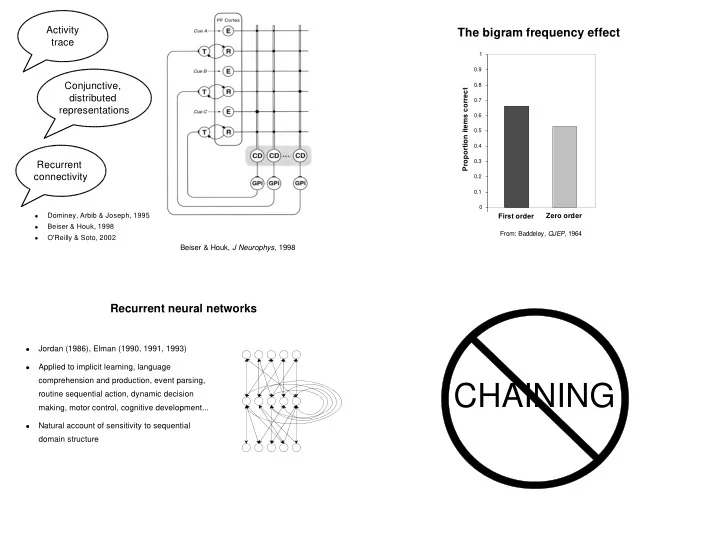
Activity The bigram frequency effect trace 1 0.9 Conjunctive, 0.8 Proportion items correct distributed 0.7 representations 0.6 0.5 0.4 0.3 Recurrent connectivity 0.2 0.1 0 Dominey, Arbib & Joseph, 1995 Zero order First


slide-1
SLIDE 1

Beiser & Houk, J Neurophys, 1998

Activity trace Conjunctive, distributed representations Recurrent connectivity

  • Dominey, Arbib & Joseph, 1995
  • Beiser & Houk, 1998
  • O'Reilly & Soto, 2002

Recurrent neural networks

  • Jordan (1986), Elman (1990, 1991, 1993)
  • Applied to implicit learning, language

comprehension and production, event parsing, routine sequential action, dynamic decision making, motor control, cognitive development...

  • Natural account of sensitivity to sequential

domain structure

From: Baddeley, QJEP, 1964

0.1 0.2 0.3 0.4 0.5 0.6 0.7 0.8 0.9 1

Proportion items correct First order Zero order

The bigram frequency effect

CHAINING

slide-2
SLIDE 2
  • Initial interest
  • Ebbinghaus
  • Wickelgren (associative intrusions)
  • Murdock (TODAM)
  • Eventual rejection
  • Lashley
  • Baddeley, 1968, sawtooth pattern
  • Henson, Norris, Page & Baddeley,

1996: “Memory unchained”

The trouble with chaining

0.1 0.2 0.3 0.4 0.5 0.6 0.7 0.8 0.9 1

1 2 3 4 5 6 Position Errors PC PN AC AN

Baddeley, QJEP, 1968

Example AC list: B R D Q P L

Context-association models of serial recall

B T C V G

Hebbian links Context signal

  • Burgess & Hitch, 1992
  • Henson, 1996
  • Houghton, 1990
  • Brown, Preece & Hulme, 2000

"Interactions between short- and long-term memory pose problems for most models of serial recall" (Henson, Cog. Psych., 1998)

CHAINING

???

Model architecture

List items (input) List items (output)

a b c d … a b c d …

slide-3
SLIDE 3

Training and testing

  • Same trial structure (encoding, recall) during training and testing
  • Actual relevant “training” experience is from language
  • List lengths 1-9
  • Trained on small proportion of possible sequences (< 1 / 1,000)
  • Training: backpropagation learning procedure
  • Testing: weights frozen (during both encoding and recall)
  • Three simulations
  • 1. Localist letter units
  • 2. Two-dimensional items (confusable / non-confusable)
  • 3. Bigram frequencies of English

Empirical data: Crannell & Parrish, J Psychol, 1957

0.1 0.2 0.3 0.4 0.5 0.6 0.7 0.8 0.9 1 4 5 6 7 8 9 10 11

List length Accuracy Empirical data: Henson, Norris, Page & Baddeley, QJEP, 1996

Simulation

0.1 0.2 0.3 0.4 0.5 0.6 0.7 0.8 0.9 1

1 2 3 4 5 6

Output position Proportion

Data

0.1 0.2 0.3 0.4 0.5 0.6 0.7 0.8 0.9 1

1 2 3 4 5 6

Output position Proportion

Transposition errors

slide-4
SLIDE 4

Empirical data: Baddeley, QJEP, 1968

0.1 0.2 0.3 0.4 0.5 0.6 0.7 0.8 0.9 1

1 2 3 4 5 6 Position Errors (proportion)

Data

PC PN AC AN

0.1 0.2 0.3 0.4 0.5 0.6 0.7 0.8 0.9 1

1 2 3 4 5 6

Simulation

Position Empirical data: Baddeley, QJEP, 1964

0.1 0.2 0.3 0.4 0.5 0.6 0.7 0.8 0.9 1

Data Simulation

Proportion items correct

First order Zero order

Data

0.1 0.2 0.3 0.4 0.5 0.6 0.7 0.8 0.9 1

1 2 3 4 5 6 7 8 9 Position

Accuracy

Simulation

0.1 0.2 0.3 0.4 0.5 0.6 0.7 0.8 0.9 1

1 2 3 4 5 6 7 8 9 Position Accuracy High BF Low BF

Empirical data: Kantowitz, Ornstein & Schwartz, JEP, 1972

Grouping effects

Empirical data Model

slide-5
SLIDE 5

Representational similarity

T R B L . . . T R B L

T1 R2 B3 L4 B2 D3 S3 D2 S2

Similarity chart for isr

0.0 0.2 0.4 0.6 0.8 1.0 1 2 3 Distance Correlation

Same item Confusable Non-confusable

Distance between positions of contributing items Similarity between items’ contributions ( r 2 )

B3

B2 D2 S2 D3 S3

slide-6
SLIDE 6

Item Position

B3 B4 F2 S3 D2 F1 S1 D3 LRTFJ ZDGBT ZDBGT LRFTJ JFTRL

Cumulative transposition distance

18 16 14 12 10 8 6 4 2

Euclidian distance

6 5 4 3 2 1

Non-confusable Confusable 5 4 3 2

Non-confusable Euclidean distance from reference (Median) Confusable Degree of re-ordering (Cumulative transposition distance)

5 4 3 2

Beiser & Houk, J Neurophys, 1998

slide-7
SLIDE 7

Weight magnitudes Accuracy depends on:

  • 1. Frequency (goodness) of target
  • 2. Neighborhood relations of target
  • a. Similar (near) neighbors: lower accuracy
  • b. High-frequency neighbors: lower accuracy

(analogous to frequency and regularity/consistency effects in single word reading; Andrews, 1982; Taraban & McClelland, 1987)

The good neighbor effect:

Assuming equal target goodness, recall accuracy will be lower for targets with high-goodness near neighbors

(cf. consistency effects among “regular” words; Glushko, 1979; e.g., GAVE is slower than GATE due to interference from HAVE)

A A B

0.75 0.25

A1, A2, A3, B1, B2, B3 A B

0.75 0.25

B

slide-8
SLIDE 8

ABABAB BABABA .00402 ABABBA BABAAB .00209 ABAABA BABBAB .00209 AABBAB BBAABA .00106 ABBAAB BAABBA .00106 AABABB BBABAA .00106 ABAABB BABBAA .00106 ABBBAA BAAABB .00052 AABBBA BBAAAB .00052 AAABBB BBBAAA .00026 List structure Probability

AABABB AABBAB ABAABB ABBAAB ABABAB

The good neighbor effect: An experimental test

(Botvinick, submitted)

  • Six undergraduate participants
  • Immediate serial recall
  • Items: Six pseudo-words (dah, fie, poe, noo, tee, kay)
  • ABABAB grammar
  • Auditory presentation (100 words / min)
  • Verbal and keyboard responding (repeats prevented)
  • Eight training, seven testing sessions (250 lists / session)

0.1 0.2 0.3 0.4 0.5 0.6 0.7 0.302 0.15 0.076 0.037 0.019 Stimulus probability Proportion correct 0.1 0.2 0.3 0.4 0.5 0.6 0.7 0.302 0.15 0.076 0.037 0.019 Stimulus probability Proportion correct

AABABB 0.54* Others 0.44 AABABB 0.51* Others 0.46 Simulation Empirical data

Stimulus class probability Stimulus class probability

slide-9
SLIDE 9

Conclusions

  • Theory
  • Activation-based coding, recurrent connectivity
  • Conjunctive representation of item, position
  • Sequence representation occupies continuous, multidimensional space
  • Graded similarity structure
  • Evidence
  • Fits with neuroanatomic, neurophysiologic data
  • Fits with behavioral data (this isn't chaining)
  • Exhibits appropriate sensitivity to domain structure